 Vista

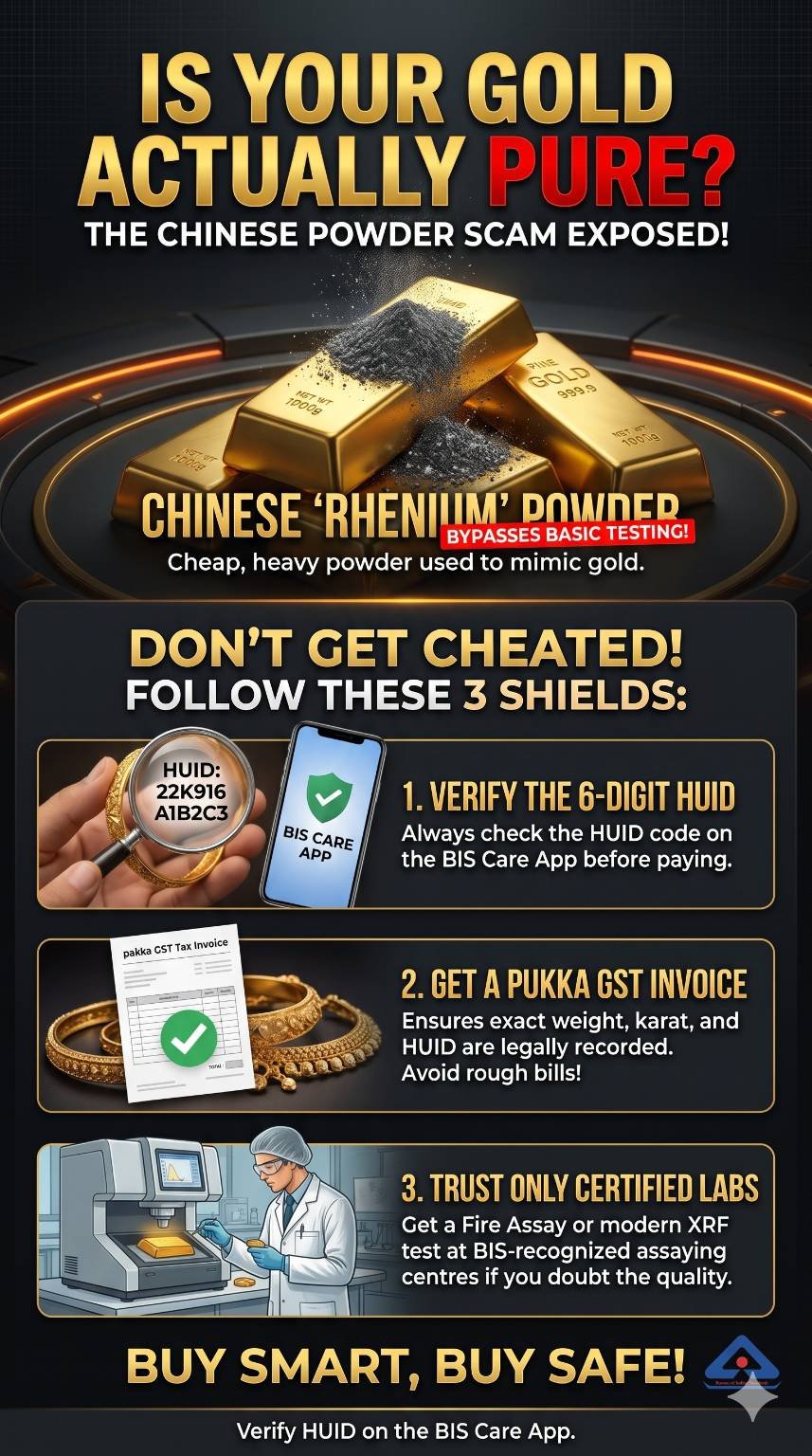
Gold adulteration in India has returned to the headlines after a November 2026 investigation reported that jewellery containing rhenium powder was still assessed as high-purity gold by some routine tests. The story is often described as the Chinese rhenium powder in gold scam, the “Mr India powder” claim or a new fake-gold hallmarking problem. Here is the essential distinction: a reported investigation has raised legitimate questions about gold purity testing, but it does not establish that every BIS-hallmarked ornament is fake, or that all XRF scanners are incapable of detecting rhenium.
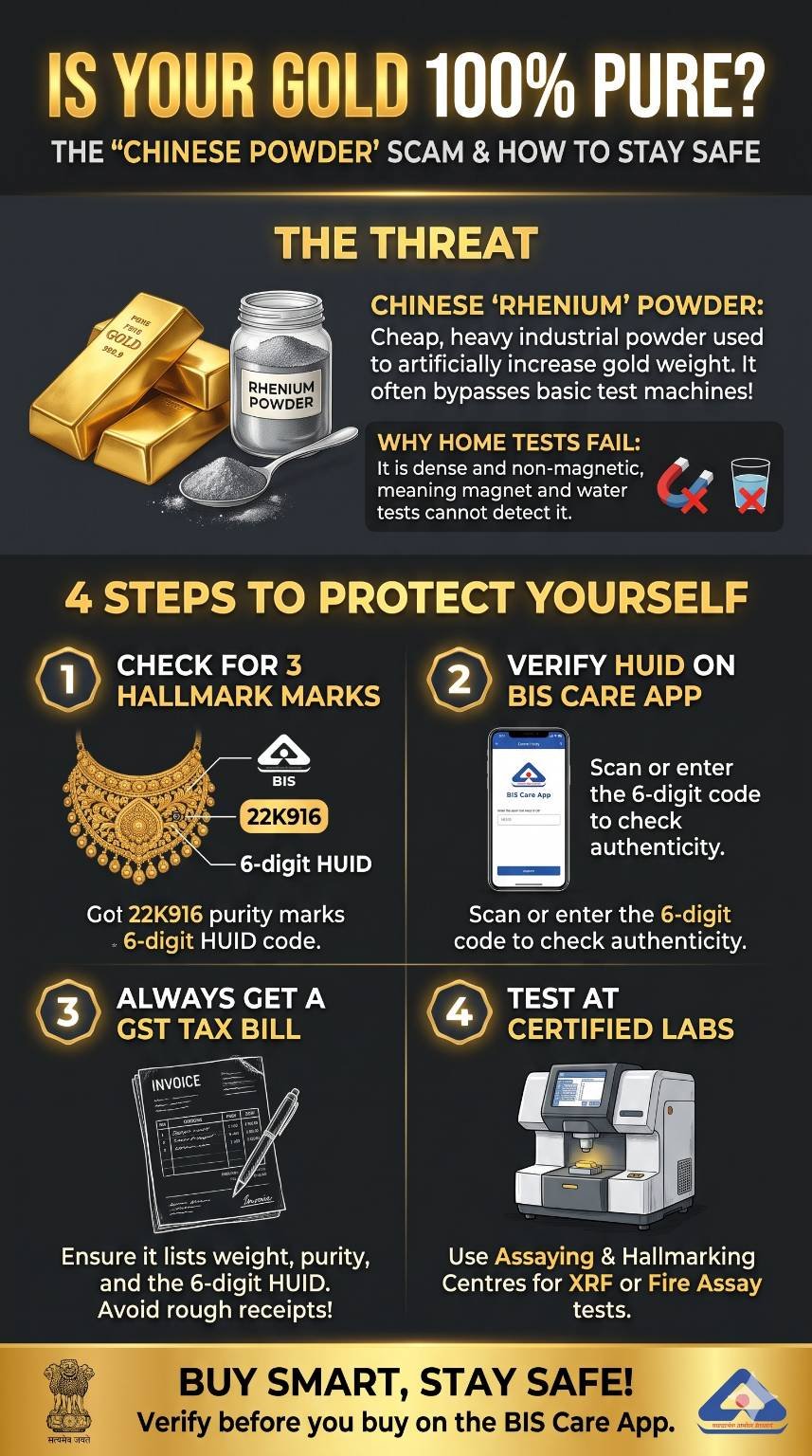
Consumers do not need to abandon jewellery shopping. A better response is to verify the three BIS hallmark symbols, check the six-character HUID on the official BIS Care app, preserve the itemised purchase invoice and use a BIS-recognised Assaying and Hallmarking Centre when independent testing is warranted. This guide separates established science and regulation from reported allegations, and explains the safest practical choices for an Indian gold buyer.
Updated: 21 November 2026. This explainer follows the reported chronology and official BIS guidance available by the update date.
What is the alleged Chinese rhenium powder gold scam?
A Dainik Bhaskar investigation in Jodhpur, Rajasthan, described the alleged use of a dense metal powder to increase the weight of gold jewellery without a corresponding rise in its precious-metal content. Coverage by Business Standard, Mint and other outlets described a claimed supply connection to Shenzhen, China. The reported supplier claims should not be confused with a regulator’s nationwide finding or proof of where every suspected sample originated.
The reported experiment began with 7.83 g of 24-carat gold. Investigators added 1 g of rhenium powder, bringing the weight to 8.83 g, then added approximately 0.75 g of other alloying metal to create a finished ornament weighing 9.58 g. On those figures, the gold content was approximately 81.73% of the finished item’s total weight, equivalent to around 19.6K–20K rather than 22K. A properly described 22K916 article should contain about 91.6% gold.
The news reports stated that the ornament passed checks at some locations, and that one hallmarking centre reportedly marked it as 22K916. A showroom machine was said to have shown more than 93% gold while failing to flag rhenium. These observations call for investigation of testing and sampling procedures. They do not prove that all hallmarking centres share the same flaw. An estimated loss of about ₹14,700 per tola at a hypothetical gold price of ₹1.5 lakh was presented in the reporting; that is an illustrative scenario, not a fixed loss for every purchase.
What is gold adulteration, and how is it different from normal alloying?
Pure gold is comparatively soft, so jewellery often contains other metals to improve strength, colour or workability. This legitimate process is called alloying. For example, 22K916 denotes 916 parts of gold per 1,000 parts of the jewellery’s precious-metal alloy, while 18K750 means 750 parts per 1,000. Copper, silver and other permitted alloying materials do not automatically make a correctly labelled 22K ornament fraudulent.
Adulteration begins when the seller misrepresents actual purity, hides foreign material or charges for gold that is not there. Several different risks are sometimes lumped together online: a lower-carat alloy sold as 22K, excessive solder or unaccounted non-gold filling, a counterfeited hallmark, or an unusual dense metallic component. Allegations about rhenium, iridium and ruthenium should be investigated on their own facts; the metals are not interchangeable and behave differently in manufacturing and analysis.
For instance, a jewellery piece with stones, resin or an enclosed filler needs clear weight and price disclosure rather than an assumption that all gross weight is gold. Likewise, a bar and a finely worked necklace require different ways of assessing possible internal voids or inclusions. The headline “China gold scam” describes a reported supply claim and should not be used to label all Chinese jewellery as counterfeit.
What is rhenium powder? Rhenium vs radium vs gold
Rhenium is chemical element Re, atomic number 75, a rare, high-density transition metal used in aerospace superalloys and other industrial settings. The Royal Society of Chemistry lists a melting point of around 3,185°C and density of about 20.8 g/cm³. For comparison, gold has a density of about 19.3 g/cm³ and melts at approximately 1,064°C.
| Property | Gold (Au) | Rhenium (Re) |
|---|---|---|
| Approximate density | 19.3 g/cm³ | 20.8 g/cm³ |
| Approximate melting point | 1,064°C | 3,185°C |
| Typical uses | Jewellery, investment, electronics | High-temperature alloys and industrial technology |
| Ordinary household magnet | Not a reliable purity test | Not a reliable purity test |
Its high density helps explain interest in the reported gold adulteration claims. But rhenium is not a magic, permanently invisible ingredient: its detectability depends on the physical form, distribution, location and laboratory method. Nor is its price a universal fixed number; industrial-grade specifications, supply and purity matter. A claim that it “always bypasses scanners” is not scientifically defensible.
There is also a naming mix-up. Rhenium is not radium. Radium (Ra) is a radioactive element with very different properties and risks. Some social-media descriptions use “radium powder” or the Hindi phrase “Mr India powder” inaccurately. The substance identified in the reported investigation was rhenium, not verified radioactive radium.
Can rhenium adulteration evade an XRF machine or BIS hallmark test?
A touchstone test and associated acid testing are mainly surface-based checks. They can be useful as an initial screening method, but they cannot reliably characterise every hidden component inside jewellery. X-ray fluorescence (XRF) estimates elemental composition from X-rays emitted by the tested material. It has an important advantage: the test can be performed without destroying the ornament. Yet the reading is commonly dominated by the region sampled near the surface, so an outer gold-rich layer may not represent the whole piece.
The specific instrument configuration also matters. The presence or absence of rhenium detection depends on the machine’s analytical range, element library, calibration, selected test mode, sample geometry and test procedure. Some properly equipped XRF systems can identify unusual metallic elements; others may be set up primarily for standard jewellery alloys. Consequently, “XRF always catches rhenium” and “no XRF can ever detect rhenium” are both misleading statements.
A fire assay, or cupellation-based gold determination performed using an appropriate sample and standard method, is a recognised and often more dependable way to assess actual gold content. It involves consuming or altering a sample, and no laboratory result should be described as absolutely 100% error-free. If the problem is identifying separate particles of a foreign element, targeted elemental analysis and methods such as electron microscopy with spectroscopy may be useful. The laboratory should choose a method suitable for that particular suspect item.
Industrial metallurgy introduces another limitation to viral claims: rhenium’s melting point is vastly above the melting point of gold, so the substances cannot simply be assumed to melt together homogeneously in a conventional jewellery furnace. The precise behaviour depends on preparation and microstructure. This technical issue is one reason scientific conclusions require independent testing rather than a dramatic video alone.
What did GJC, IBJA and BIS say in November 2026?
On 20 November 2026, PTI reported that the All India Gem and Jewellery Domestic Council (GJC) had alerted the Bureau of Indian Standards about allegations involving rhenium and iridium-based materials. GJC chairman Rajesh Rokde urged jewellers to strengthen checks on their supply chain, and asked buyers to verify HUID details, obtain proper invoices and avoid panic. Reports of isolated suspected cases do not establish widespread fraudulent trade.
The Economic Times reported that the India Bullion and Jewellers Association (IBJA) raised concerns about possible malpractice, purity records and unregistered refiners, urging tougher inspection and standards oversight. Those are representations and allegations; they should not be presented as court findings against specific jewellers.
The BIS system has real safeguards. A Government of India briefing issued in November 2026 explains its digital HUID system, automated weighing, machine-record integration and inspections. It states that more than 65 crore gold articles had received HUID codes as of 15 October 2026. This context matters: an investigation into a possible loophole is not the same thing as evidence that India’s entire hallmark infrastructure has failed.
How to check gold purity in India: BIS hallmark and HUID verification
Step 1 — Find all three required hallmark marks
On eligible hallmarked gold jewellery, look for the BIS Standard Mark, a purity or fineness mark such as 22K916, and a unique six-character alphanumeric HUID. The difference between 22K916 and 18K750 is material when comparing prices. Use a jeweller’s magnifier or ask staff to show the marks clearly. For a picture-led explanation, see our published BIS Gold Hallmark Symbols Chart.
Step 2 — Verify HUID with the official BIS Care App
Open the official BIS Care application and use its Verify HUID option. Enter the exact code on your specific ornament. Compare the reported fineness, product category, jeweller and Assaying and Hallmarking Centre details. According to the November 2026 government briefing, an upgrade introduced on 8 June 2026 also enabled access to photographs of the hallmarked article and its markings, as well as recorded weight, where those records are available. Compare the official record with the jewellery you are being sold.
HUID verification confirms a registered identification record and helps detect mismatches, but it is not a substitute for direct laboratory analysis in a genuinely suspect case. Ask questions if the code fails, the article type is different, or the seller refuses to let you verify the details. Be alert to lookalike applications and use the official BIS service.
Step 3 — Keep an itemised GST or tax invoice
Make sure the bill describes each ornament and gives its net precious-metal weight, declared purity, rate and price, making charges, hallmarking charges where applicable, stones or other components, and tax. Keep both the paper and digital versions. Asking the jeweller to write the HUID on the invoice is practical record-keeping, but BIS’s general bill requirements do not make printing the HUID on every invoice universally mandatory. What matters is verifying the HUID that is actually on the article and holding an invoice proving the seller’s representations.
Step 4 — Use independent recognised testing when needed
If a new purchase, inherited item, exchange or buyback valuation raises a genuine concern, consult a BIS-recognised Assaying and Hallmarking Centre (AHC). Ask what the proposed test measures and whether cutting or melting a sample is necessary. A quick shop-floor karatmeter reading is useful but not equivalent to an independent comprehensive laboratory examination. Get the method, reported purity and relevant conditions in writing.
Do magnet, water, vinegar or phone-app gold tests actually work?
Home tests are popular because they seem cheap and immediate. Unfortunately, they are particularly unreliable for answering the question “How to detect adulteration in 22K gold?” A magnet may flag certain ferromagnetic materials, but a non-magnetic response does not verify 22-carat purity. A water-drop or sinking test does not distinguish gold from all other dense metals. Vinegar and poorly controlled acid experiments can damage jewellery, create safety risks and give false reassurance about internal composition.
Even professional-looking mobile videos can conceal important limitations: a coated sample, the selected testing point, or the absence of a documented chain of custody. The appropriate conclusion is not that every gold item is suspect; it is that no single casual home test certifies precious-metal fineness. Combine traceability, honest documentation and expert testing proportionate to the value at risk.
Seven checks to protect yourself when buying 22K or 24K gold
- Choose a traceable seller. A BIS-registered jewellery retailer with clear contact details and reliable after-sales support is easier to hold accountable.
- Check the exact item. Ask to inspect the three BIS marks on the jewellery being purchased, not just a display poster.
- Verify HUID before paying. The fineness, type, seller record and available photograph/weight data should make sense for the article in front of you.
- Separate all weights and costs. Gross weight may include stones, fittings or other components; ask how the net gold weight was established.
- Retain the full purchase trail. Preserve the itemised bill, payment proof, clear hallmark photos and written buyback or exchange policy.
- Be cautious of implausible bargains. A dramatic discount or anonymous social-media seller is a reason to investigate, not a reason to assume immediate profit.
- Know how to escalate. Where evidence suggests a purity mismatch, seek a suitable independent test before making formal allegations.
Buying investment coins and bars requires similar care with the refiner, authenticity documentation, packaging and seller terms; verify the precise product’s certification rather than assuming every claim about “24K gold” is a BIS hallmark.
What if BIS-hallmarked gold fails a purity test? Complaint and compensation
Start by documenting the discrepancy. Preserve the purchase bill, HUID and a reliable testing report; contact the jeweller for a written resolution. The BIS consumer protection guidance provides a complaint route and describes compensation for qualifying hallmarked precious-metal articles found below the marked fineness. The formula refers to twice the value difference attributable to the purity shortage, plus testing charges under the applicable rules—not automatically twice the entire purchase price.
Consumers can use the BIS Care App, the BIS complaint mechanisms or the government’s National Consumer Helpline on 1915 for guidance. Criminal or civil action depends on the facts and evidence; this article is not individual legal advice. Reporting a possible defect responsibly supports genuine quality control without spreading unverified allegations about an entire trade.
Frequently asked questions about gold adulteration in India
Is Chinese rhenium powder really being mixed into gold?
A November 2026 investigative report described an experiment and alleged supply links. Industry associations asked for more scrutiny. That is grounds for careful investigation, not proof that every shop or hallmark contains this material.
Can fake gold carry a real-looking BIS hallmark and HUID?
Counterfeiting, record mismatch or other malpractice are potential risks in any authentication system. Verify the specific hallmark and HUID through BIS Care, check the physical details and use independent testing if necessary.
What is the difference between 22K916 and 20K833 gold?
22K916 indicates about 91.6% gold; 20K833 indicates approximately 83.3% gold. The reported sample’s 81.73% gold content was below even the 20K833 nominal fineness, which is why describing it as properly certified 22K would be problematic.
Is rhenium the same as radioactive radium powder?
No. Rhenium (Re) is an industrial transition metal; radium (Ra) is a different radioactive element. The recent gold-adulteration allegations concerned rhenium.
Which is more reliable: XRF test vs Fire Assay test?
XRF is valuable for rapid, non-destructive elemental estimates at sampled surfaces. Fire assay using proper procedures is a recognised method of determining actual gold content and can require destroying part of a sample. A qualified lab chooses based on the question and material.
How do I complain about suspected gold adulteration?
Keep your invoice and hallmark details, obtain a suitable independent test report and approach the seller and BIS complaint channels. The National Consumer Helpline at 1915 provides additional consumer-grievance guidance.
Bottom line: verify the jewellery, not the viral headline
The new gold scam reports are a strong reminder that a purity percentage is meaningful only if the test represents the material being purchased. They are not a reason to panic about every family ornament. Match the BIS hallmark with its digital HUID record, buy from a reputable source, insist on a complete invoice and seek independent testing when facts justify it. That approach protects both consumers and honest jewellers much better than a blanket claim that “Chinese powder defeats every machine.”
Editorial note and sources: Updated 21 November 2026. This article is general consumer information, not investment or legal advice. Illustrations are conceptual rather than photographs of verified incidents. Primary and additional references: PIB/BIS official hallmarking overview, BIS consumer compensation guidance, Royal Society of Chemistry rhenium data, Business Standard investigation summary, PTI/GJC, Economic Times/IBJA.









Share Your Opinion
Comments are closed on this post.