 Vista

Direct answer: Kuchipudi hand gestures or hastas are named mudras used with dance postures, gaze and expression to communicate rhythm and dramatic storytelling. Common examples include Pataka, Tripataka, Ardhachandra and Anjali, but a gesture’s meaning depends on its context. These four charts cover hand positions, stance and movement, and the difference between beginner practice and advanced items such as Tarangam.
Updated 21 November 2026. Educational illustrations; learn physical technique through qualified instruction.
Kuchipudi hand gestures and dance postures: four charts


What is Kuchipudi dance and how do hand gestures work?
Kuchipudi is a classical Indian dance and dance-drama tradition associated with Andhra Pradesh, named after the village of Kuchipudi in the Krishna region. Performers combine movement, rhythmic footwork, storytelling, facial expression and hasta mudras, or named hand gestures. A hand shape may communicate an object, character, action or quality when supported by the dancer’s gaze, body direction and narrative. It is therefore misleading to present each gesture in a cartoon chart as a permanent one-word sign with no reference to the performance.
The Government of India’s CCRT Kuchipudi booklet describes the dance’s dramatic heritage and the importance of hastas, bodily positions and items such as Tarangam. Our four illustrated charts compare basic mudras, posture positions, selected gesture names and stance/movement relationships. They are educational reference diagrams, not photographs of one named guru’s choreography. Real training involves rhythm, flexibility, expression and correction over time, and the examples here should be read as a beginner’s guide to recognising concepts rather than an authoritative list of every form.
Basic Kuchipudi hand mudras and names
Kuchipudi hand gestures draw upon a broader classical Indian hasta vocabulary. Commonly encountered names include Pataka, Tripataka, Ardhapataka, Ardhachandra, Shikhara, Katakamukha, Suchi, Chandrakala, Padmakosha and Anjali. Some are shaped with a single hand, while others combine two hands; different schools and texts present their lists and transliterations in somewhat different ways. Students should learn the version provided by their instructor or examination syllabus instead of assuming that all printed English spellings are equally standard.
The first illustration is a recognition chart. It helps readers compare familiar forms but cannot show every finger from every angle. For example, the thumb’s position and the flexion of a specific finger can distinguish related shapes. If a low-resolution image seems to show the wrong finger, verify the movement through a trustworthy demonstration. Avoid forcing finger joints into uncomfortable extremes. Accurate identification includes the whole hand, wrist and how it moves into the next gesture, not just a frozen outline.
Asamyuta and Samyuta: one hand and two hands
As in several Indian classical forms, Asamyuta Hasta denotes gestures made with one hand, while Samyuta Hasta denotes combined-hand gestures. The categories help students organise a large number of forms, but the classification is not a shortcut for complete dramatic expression. A two-hand Anjali can signal reverence in a fitting context, and other combined hands may form shapes associated with specific actions or objects. The manner of presenting the gesture can be different in Kuchipudi’s dance-drama setting.
Some textbooks list particular counts of hastas following Abhinaya Darpana traditions. Those numbers should be attached to the named source and syllabus rather than repeated as universal for all schools. Learning is more effective when students make two notebook columns—single-hand and double-hand—and then add a few documented applications for each name. The third chart identifies selected gesture names and their broad uses, without pretending that one symbol carries the same meaning in every Kuchipudi performance.
Posture positions: stance, knees, feet and torso
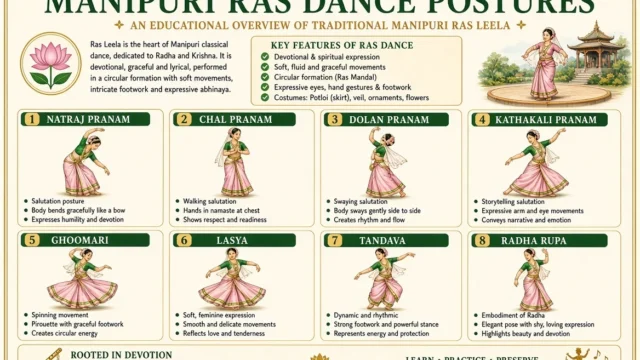
Kuchipudi basic postures involve the whole body, including a stable base, bent-knee positions in relevant passages, coordinated arms and a torso capable of expressive movement. Pictures often highlight a classical half-seated or turned-out stance, but the precise position depends on the exercise, the choreography and the individual student. A still figure is an insufficient technical guide for how the dancer shifts weight, changes direction or times movement to the music.
The second and fourth diagrams show common visual relationships between arms, legs and movement, but no single drawing should be used to enforce a fixed degree of knee flexion. If a beginner attempts to copy an exaggerated shape without warm-up or supervision, the ankles, knees or back may be uncomfortable. Study with a qualified teacher, start with comfortable movement and learn transitions slowly. The aim is expressive control and rhythmic precision, not creating an extreme posture for a social-media photograph.
Abhinaya, character and the meaning of a mudra
Abhinaya is expressive communication through the dancer’s face, body, hands and other elements of performance. In Kuchipudi’s dramatic background, a hand gesture often helps establish an action or role within a spoken or sung narrative. A Pataka-like shape, for instance, can support different uses depending on the line of poetry, the dancer’s orientation and the movement sequence. Without knowing the story, viewers should avoid translating it as one fixed word in every frame.
The gesture-names chart offers selected examples, but viniyoga or applications belong to specific teaching and textual contexts. A narrative performance may also use changing facial expression and movement style to make a character recognisable. Good educational practice separates the technical name of the hand from the meaning achieved by a full combination of signs. This distinction is especially important for machine-generated infographics that sometimes invent meanings or combine several different dance traditions under the label “Kuchipudi Mudra Dictionary.”
What is Tarangam and why is the brass plate famous?
Tarangam is a recognised Kuchipudi performance item often associated with songs or episodes from the Krishna Leela Tarangini tradition. Some performances feature dancers balancing or moving on the rim of a brass plate while maintaining rhythm and expression, an impressive skill that many viewers associate with Kuchipudi. The CCRT’s illustrated Kuchipudi booklet documents such performances as part of the repertoire. However, not every Kuchipudi item uses a plate, and a plate performance should not be treated as the only definition of the entire dance form.
For learners, the important distinction is between understanding what they are watching and attempting it themselves. Standing or dancing on a metal plate can be hazardous without specialised training and controlled conditions. Never attempt the stunt from an image guide or viral clip. Enjoy the technique as part of an artist’s skilled repertoire and consult a trained instructor for appropriate developmental exercises. The hand gestures visible during a Tarangam must also be interpreted in the musical and dramatic context.
Kuchipudi, Bharatanatyam and Odissi: how they differ
These Indian classical dance traditions share elements of performance theory and some gesture names, but their histories, choreographic structures and movement qualities are not interchangeable. Bharatanatyam is particularly associated with Tamil Nadu and uses codified adavus, hastas and expressive items. Odissi from Odisha is well known for Chowka and Tribhangi. Kuchipudi developed through Andhra’s dance-drama culture and includes distinctive repertoire and expressive practices. The same hand shape does not establish which form a performer is dancing.
Compare costume, music, movement through space, dramatic storytelling and the complete choreography. A generic picture of Anjali cannot be reliably titled “authentic Kuchipudi dance photo” unless the dancer and performance are identified. When publishing charts, describe their instructional scope and distinguish an illustration from a genuine stage photograph. Such accuracy makes cultural comparisons useful and avoids confusing students preparing for different syllabi or classroom assignments.
Practice checklist: learn gestures and positions safely
Start with a few basic hand names and confirm their finger shapes with your instructor. Practise one hand at a time where appropriate, then combine hands only when the exercise requires it. Work on the transition from one gesture to the next while keeping wrists comfortable. Introduce the correct standing and bent-knee positions under supervision, paying attention to balance and breathable movement rather than striving for a rigid picture-perfect outline.
Later, connect the hand gestures to the lyrics and characters in a short supervised expressive exercise. Reciting the names can help memory, but meaning becomes clear through context. On a stable, suitable surface, rehearse footwork slowly before faster combinations. Rest if there is pain, dizziness or unusual fatigue. Advanced items such as dancing on a brass plate should be reserved for properly trained performers. The charts are designed for recognition and revision, not to replace the physical and dramatic instruction that makes Kuchipudi a complete art form.
Kuchipudi gestures and postures FAQs
What are Kuchipudi hand gestures called?
They are generally called hastas or mudras and support both rhythm and expressive storytelling.
What is the difference between Asamyuta and Samyuta Hasta?
Asamyuta uses one hand, while Samyuta combines both hands.
Does the same mudra have one meaning in every Kuchipudi dance?
No. Meaning depends on narrative, gaze, body movement and dramatic context.
What is Kuchipudi Tarangam?
A recognised repertoire item; some performances famously involve skilled movement on a brass plate.
Can I learn postures or a brass-plate dance from a chart?
Charts introduce concepts, but supervised training is essential; never attempt advanced plate work from an illustration.
Conclusion: gesture shape is just the beginning
Kuchipudi gestures work within a complete dance-drama language. Use diagrams to identify selected hastas and postures, and rely on qualified teachers for expressive movement and advanced training.
Official and instructional references
Government of India CCRT: Kuchipudi Dance booklet; CCRT: Indian classical dance cultural packages; Pustakalaya: Classical hand gestures and applications; SVYASA: Related Abhinaya Darpana gesture syllabus.














Share Your Opinion
Comments are closed on this post.