 Vista

Direct answer: The Raag Samay Chakra arranges Hindustani ragas by traditional performance periods, often shown as eight three-hour prahars. Bhairav is linked with dawn, Bhimpalasi with afternoon, Yaman with evening and Malkauns with late night. These four charts teach the associations without suggesting that any raga is forbidden outside its customary time.
Updated 21 November 2026. Times are approximate traditions and can vary by school.
Raag Samay Chakra: four visual time charts

What is Raag Samay Chakra in Hindustani music?
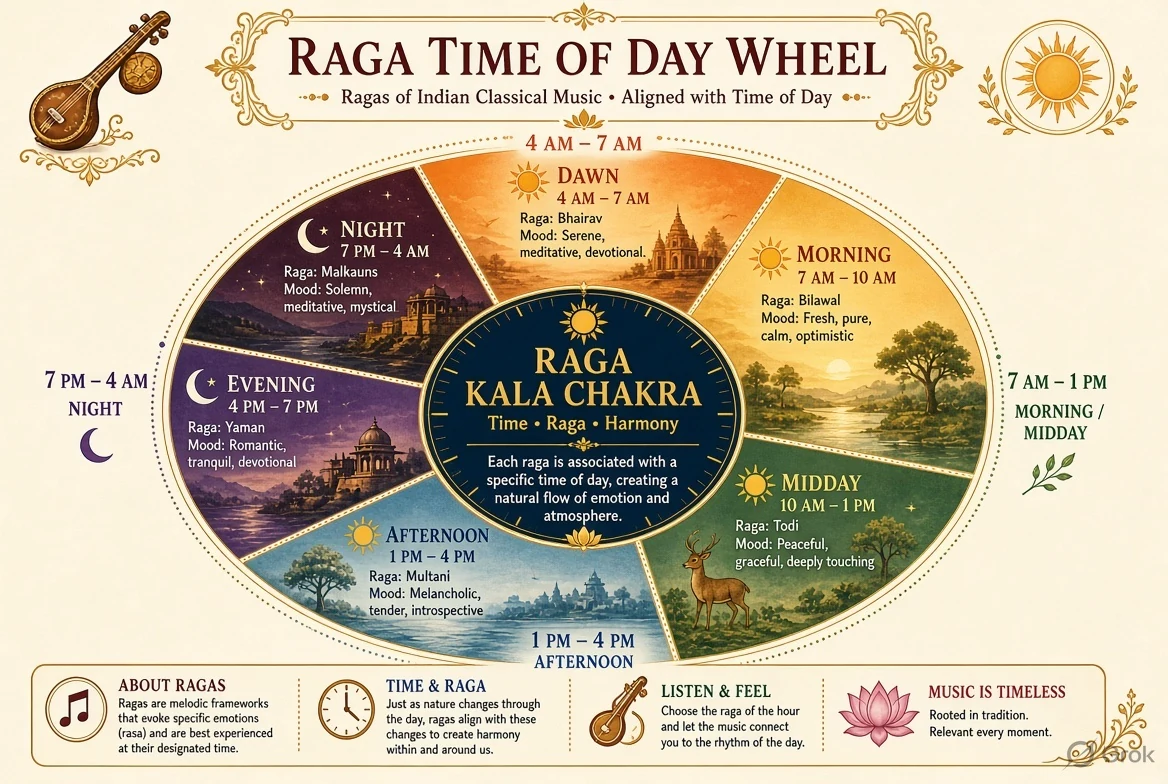
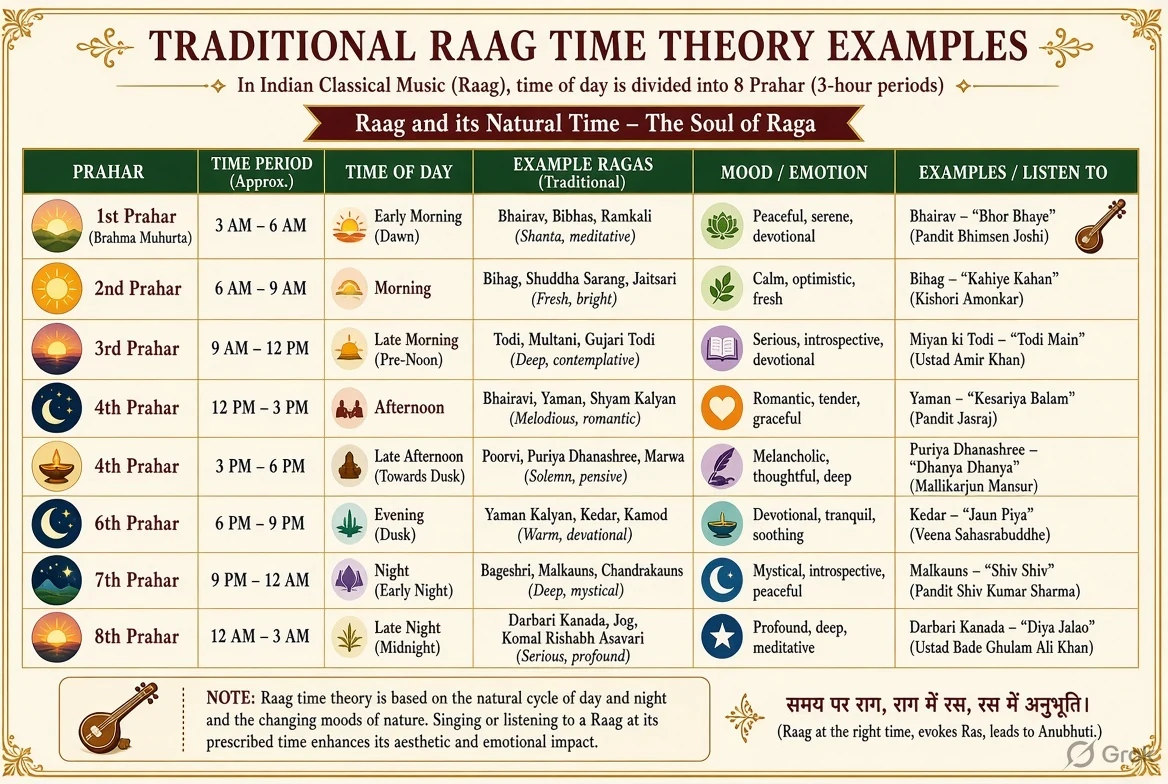
Raag Samay Chakra is a visual way of studying the traditional association between particular Hindustani ragas and times of day. Musical pedagogy often divides a day and night into eight prahars, each treated approximately as a three-hour watch. Some ragas are commonly taught as morning choices, others for afternoon, sunset or night. The purpose of a time wheel is to help students organise that repertoire and recognise the aesthetic relationship between an hour, melodic material and musical expectation.
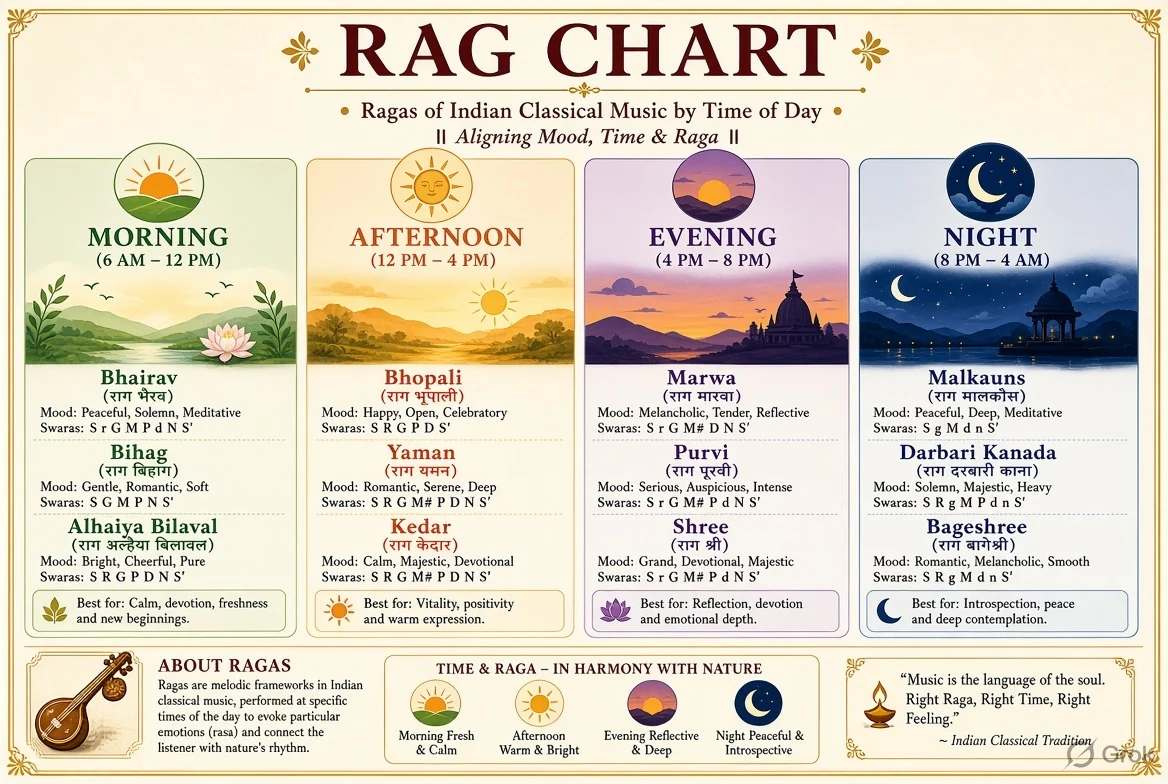
This is not a scientifically proven law that a melody becomes ineffective or unsafe if heard outside a printed clock interval. Academic introductions to Hindustani raga, including Pustakalaya’s music studies, describe the time associations as historically developed conventions that differ between musicians and periods. The system has been influentially organised in modern teaching through work associated with Vishnu Narayan Bhatkhande and others. Our four visual charts illustrate the time wheel, familiar examples, prahar divisions and selected theories without pretending every gharana follows one fixed list.
Eight prahars: how a twenty-four-hour cycle is divided
Many raga time charts show eight prahar periods across 24 hours. A simplified diagram may start the day around 6 a.m. and divide it into three-hour blocks, with four watches by day and four by night. This is a convenient study model rather than a universal astronomical schedule. Sunrise and sunset shift with season and location, so a scholar or musician may use transitional windows anchored to actual light conditions instead of precise numbers printed on an infographic.
When studying our Prahar Division Chart, look at the sequence instead of memorising every number as a global absolute. A listener in Delhi in winter and another in London in summer will not have identical dawn conditions at 6 a.m. The main idea is the recurring progression from pre-dawn and morning into midday, afternoon, dusk, late evening and deep night. In examination notes, follow the timing convention explicitly used by your course. For public-facing explainers, identify examples as approximate and note variations in interpretation.
Morning ragas: Bhairav, Ahir Bhairav and Todi
Raag Bhairav is strongly associated with dawn or the early morning, while Ahir Bhairav is also widely described as a morning raga. Miyan ki Todi is typically placed later in the morning in many contemporary teaching systems. These examples are familiar enough to help students recognise the general shape of the Samay Chakra. They are not interchangeable modes, however: each has its own characteristic pitches, phrases, ornamentation and musical identity.
A performer may choose a raga at a different hour for a festival programme, teaching demonstration or recording. Such decisions do not mean the artist has played the “wrong notes.” Time theory is one strand of the raga’s cultural setting, not its full definition. To compare Bhairav and Todi meaningfully, listen for their melodic movement and the characteristic way notes are treated, not only the clock. Our Morning Rag Chart is a starting point; a proper raga study also includes aroha, avaroha, pakad and examples from recognised musicians.
Afternoon and evening: Bhimpalasi, Yaman and Bhupali
Raag Bhimpalasi is often associated with the afternoon, while Yaman is a prominent evening raga, commonly linked with the first part of the night after sunset. Bhupali or Bhoopali is also often taught among the evening ragas. An afternoon-to-evening chart helps the student visualise a progression through the daylight hours and into the lighting of lamps, a traditional image for the early evening. But the exact boundaries differ across music schools.
Yaman’s place in the evening is one of the best-known examples in beginner Hindustani pedagogy. It does not mean that performing Yaman at a daytime lecture is prohibited; demonstrations and concert programming can be flexible. The time association also should not be confused with a guaranteed psychological result. Descriptions such as “Yaman feels expansive” refer to learnt musical and cultural perceptions, not a medical intervention. When interpreting a performance, combine the time association with an understanding of swara treatment, melodic phrases and stylistic lineage.
Deep night ragas: Darbari Kanada and Malkauns
Darbari Kanada and Malkauns are commonly placed in late-night or deep-night groups. They are frequently cited in guides to the Raag Samay system because their conventional performance windows contrast strongly with early-morning Bhairav. Their musical characteristics are distinct: Darbari Kanada’s phrases and note treatment do not become Malkauns merely because both may be taught at night.
A classroom wall clock may place them in one narrow block after midnight, but the exact start and end times vary between sources. It is better to explain “late night in many Hindustani traditions” than confidently announce that a raga must begin at precisely 1:00 a.m. and end at 3:00 a.m. Evening concerts often extend well into the night, and modern recordings are available at any hour. The traditional association remains meaningful as a listening and teaching reference without being treated as a legal restriction on performance.
Sandhiprakash ragas and musical twilight
Sandhiprakash is a term associated with the transition between day and night, often discussed around dawn and dusk. Certain groups of ragas have been classified by their swara patterns and time associations, and some pedagogical explanations connect them to the changing light around these transitional hours. Pustakalaya’s raga discussion explains musical characteristics such as altered Re or Dha in relation to commonly taught groupings. Such classifications offer a way to organise knowledge rather than a complete algorithm for assigning every possible raga.
Not every raga fits an over-simple list. Two ragas may use similar notes yet have different identities and different customary time placements because their key phrases and treatment differ. Likewise, schools can disagree about whether a specific raga should be regarded as dawn, late morning or evening. Students should record the author or teacher whose classification they use. Our traditional theory image helps visualise the relation between periods and example names but is not intended to resolve all historical disagreements.
Seasonal ragas: Malhar and Basant are a related idea
Alongside daily time theory, Hindustani traditions also recognise associations between particular ragas and seasons. The Malhar family is often connected with the monsoon, while Basant and Bahar are commonly associated with spring. These are useful contextual facts when explaining the larger aesthetic organisation of Indian music. They should not be confused with the eight-prahar cycle, which divides a single day rather than a whole year.
A modern musician may perform a Malhar raga during another season for a recording or concert. The effect depends on musical interpretation, audience familiarity and context; claims that a raga literally causes rain or reliably changes weather are not supported by scientific evidence. When building an informational poster, separate “daily Samay Chakra” from “seasonal association” and avoid merging them into one mandatory timetable. The names of different Malhar variants should also be preserved rather than treated as one identical scale.
Why musicians still discuss time theory today
Time theory continues to inform teaching, festivals and listening culture, but Indian classical concerts also operate in modern schedules and global settings. Students often learn an ideal performance period along with a raga’s scale, important notes and characteristic phrases. A musician choosing a concert programme may consider audience, event length, tradition and artistic intention. There are respected performances of ragas outside their familiar time slots, and some ragas have flexible or debated associations.
The strongest reason to study the chart is that it connects melodic learning with cultural history. It helps beginners ask why a particular raga is traditionally associated with dawn or sunset and then compare recorded performances from different musicians. The raga’s identity does not disappear when a recording is played on a phone at noon. For an SEO article, that caveat prevents a helpful guide becoming a fabricated rulebook. Use the source’s classification and identify uncertainty where the textbooks disagree.
Raag Samay Chakra FAQs
How many prahars are in a day?
A common Hindustani teaching scheme divides 24 hours into eight watches of roughly three hours each.
When is Raag Bhairav traditionally sung?
It is strongly associated with dawn or early morning.
Is Raag Yaman a morning raga?
Yaman is conventionally associated with early evening or the first part of the night.
Which ragas are commonly taught for late night?
Darbari Kanada and Malkauns are widely cited examples.
Is singing a raga outside its traditional time wrong?
Not necessarily. Time theory is a respected convention with practical and historical variation.
Conclusion: a guide, not a prohibition
Study raag time theory as musical culture and repertoire knowledge, not as an absolute schedule that forbids modern performance choices.
Scholarly and learning references
Pustakalaya: Svara and Raga, traditional time theory; Open Book Publishers: Rags Around the Clock (scholarly handbook); Sitarpedia: Raga and Time, Samay; Meend: Hindustani ragas by time of day.














Share Your Opinion
Comments are closed on this post.