 Vista
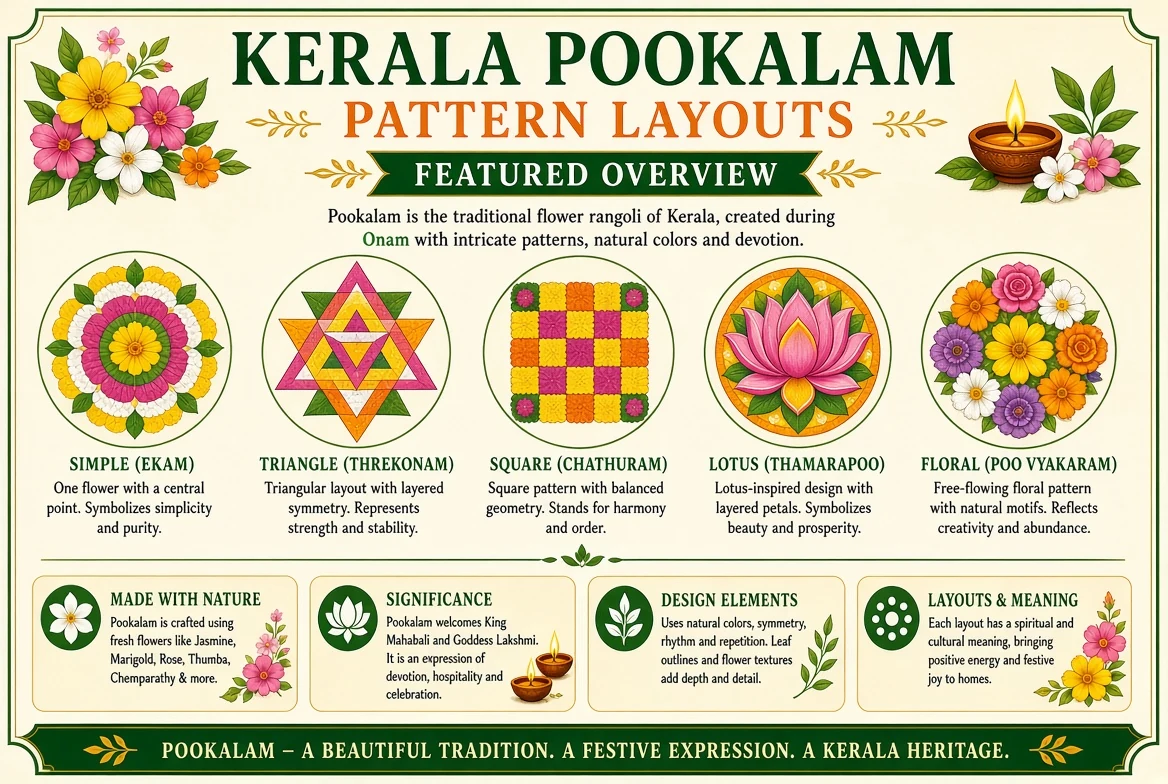
Direct answer: Onam Pookalam is Kerala’s floral floor-art tradition, usually made by arranging fresh flower petals. Designs can use circular rings, eight-petal flowers, contrasting colour layers and radial symmetry. Athapookalam begins around Atham during the Onam season, but there is no one compulsory pattern for every day or household. Four visual charts explain the layouts.
Updated 21 November 2026. The images are educational layouts, not documentary photographs.
Kerala Pookalam pattern layouts: four illustrated charts


What is a Pookalam in Kerala’s Onam celebration?
A Pookalam or Pookkalam is a flower carpet arranged on the floor, strongly associated with Onam in Kerala. The name is often explained through the Malayalam words for flower and artistic arrangement. People make the designs with fresh petals, leaves and carefully placed coloured blooms. Circular rings are common, but flower carpets can also include a star, lotus, eight-petal structure or more individual geometry. They form part of the visible seasonal welcome linked with the story of King Mahabali and the wider Onam celebrations.
Kerala Tourism documents Pookalam as a major Onam practice, beginning around Atham and developing through the days leading up to Thiruvonam. This is a festival-based living practice, not simply an “ancient rangoli download” category. Our four diagrams illustrate a circular floral carpet, an eight-petal design, petal-colour layers and symmetry. They are reusable educational charts, not photographs of a particular household’s finished Onam arrangement. For a real event image, record the creators, flowers, location and date rather than presenting a generic illustration as a documentary photograph.
Athapookalam: from Atham to Thiruvonam
The term Athapookalam is often used for the flower carpet created in the Onam season beginning on Atham. Kerala Tourism describes a practice in which a modest early arrangement is expanded across festival days with new petals and additional rings or motifs. The exact sequence, materials and number of rings can vary by location and household. It is not historically sound to impose one rigid internet infographic as the compulsory ten-day layout for every family.
Some accounts mention early use of small pale flowers such as thumba, with brighter flowers added as the festival progresses. Modern supplies depend on seasonal availability, local markets and ecological considerations. A careful guide should distinguish what Kerala Tourism documents from an optional classroom design. If readers search “Onam Pookalam day-wise designs,” explain that day-wise progression is a widespread tradition, but an eight-petal drawing alone does not tell viewers which festival day a real photo depicts. The cultural context comes from its maker and occasion.
Circular Pookalam design: centre and petal rings
A simple circular Pookalam design can be organised around a central point with concentric rings of petals. The centre might hold a small flower, colour cluster or recognizable motif; the next rings build visual rhythm and help keep the carpet balanced. A circle is practical because the maker can extend an existing design as more flowers are added. Yet Pookalam is not limited to circles: creative arrangements often include stars, petals, abstract shapes or lettering in public competitions.
For a beginner project, prepare a clean level surface, identify the centre and draw light guide circles that can be covered by petals. Keep ring widths proportional to the available flowers and plan the outer border first if space is limited. Use whole flowers in selected areas if they fit the composition, but avoid claiming every authentic Pookalam must use exactly one number of rings. Our circular layout image demonstrates a planning principle rather than prescribing a mandatory ritual geometry. The quality of a design depends on careful placement and teamwork more than diameter alone.
Eight-petal Pookalam layout: how the geometry works
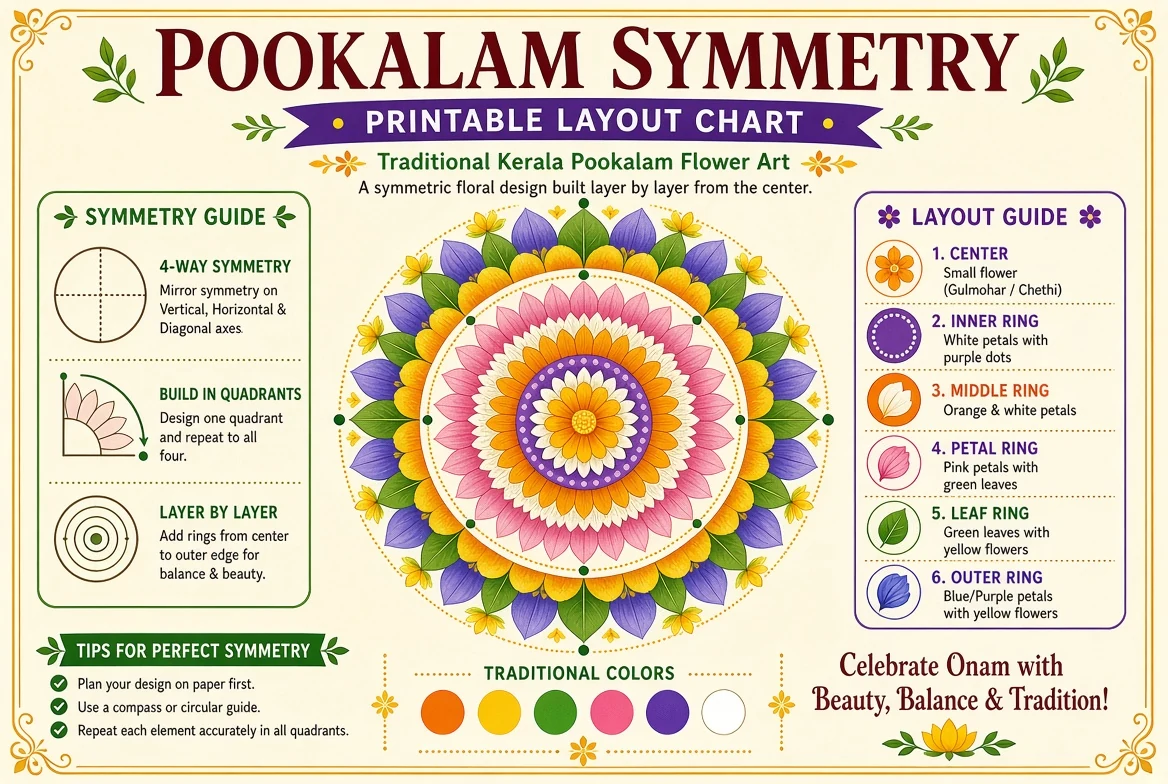
The eight-petal Pookalam design is a useful school and competition subject because the centre can be divided into eight equal angular sectors. Dividing a circle into eight sections yields 45-degree intervals, giving a symmetrical arrangement when each petal follows the same outline. This is one possible geometrical layout, not a claim that all eight-petal floral carpets traditionally carry a fixed religious translation. Petal shapes can vary from rounded lobes to pointed leaves or star-like forms.
To sketch it, mark the centre, then draw vertical, horizontal and diagonal directions before outlining the petals between those guides. Fill each mirrored segment with petals of the chosen colour, and use a narrow contrasting border to separate shapes. Working from opposite sectors helps keep the design balanced. For handmade layouts, slight differences are normal and need not be edited into artificial perfection. The second diagram supports measurement and drawing skill while leaving room for creative and regional variations.
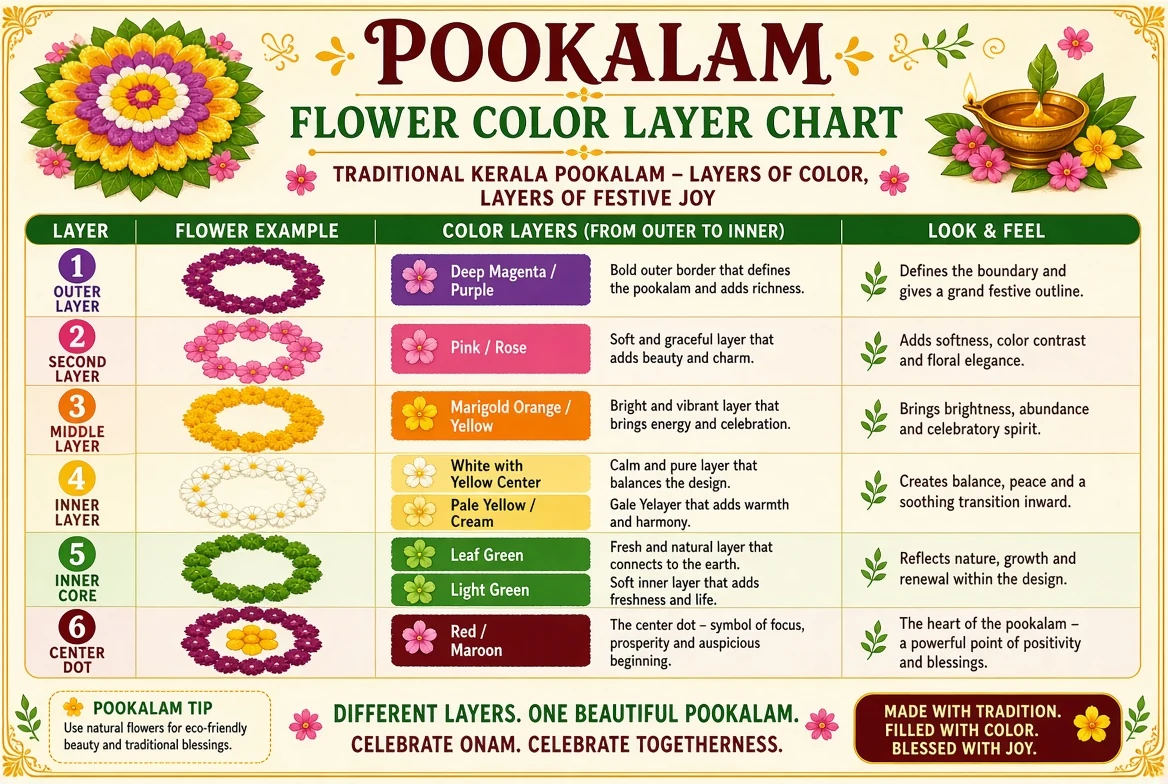
Pookalam flower colour layers: choosing suitable petals
Pookalam flower colour combinations frequently use yellow, orange, white, red and purple accents. Kerala Tourism mentions flowers including thumba, chethi, chemparathy, shankhupushpam and marigold-type blooms in discussions of Onam. Flower names and availability can differ by region; even a traditional name may refer to a botanical plant that is difficult to source locally today. Choose fresh petals that hold colour and shape long enough for the expected display time.
Contrast is especially helpful in geometric arrangements: a pale ring can separate two warm-coloured areas, while a darker outline can make an eight-petal lotus clearer from a distance. Avoid relying on synthetic chemical dyes or potentially irritating powders merely to force an exact chart palette. If the event is outdoors, wind, rain and sunlight can affect petals. Check for allergic sensitivities and keep floor designs away from slippery high-traffic paths. A beautiful chart is useful, but a real Pookalam needs safe, locally available flowers and an appropriate surface.
Symmetry and radial repetition in a Pookalam
Many Onam Pookalam patterns can be analysed through symmetry. A reflection axis divides the image into two comparable halves; rotational symmetry repeats a petal or colour segment around the centre. An eightfold design, for example, can be built from a repeated 45-degree sector. These mathematical ideas help students plan layouts before sorting and placing hundreds of petals, but geometry should support the cultural art rather than replace the value of hands-on practice.
Our printable symmetry reference introduces a centre point, sector lines and concentric guides. It can be used to test whether a design looks balanced at a small scale before a larger floral arrangement is made. If a flower carpet includes a realistic bird, boat or Mahabali figure, however, strict rotation may not apply. Do not force every creative Pookalam into a symmetric lotus. Competitions and households can legitimately prefer storytelling, local motifs or asymmetry. Describe what the actual design does, not what a generic mathematical chart expects.
Flower carpet making: practical steps for families and schools
Choose a flat, dry, stable area and measure the available space. Sketch a small layout, select your flowers and sort petals by colour into separate trays. Mark the centre and the primary divisions gently. Fill small central areas first if they are hard to reach later, then work outward without walking across the design. Several people can prepare petal colours while others place them. Maintain a visible outline so neighbouring segments do not merge unintentionally.
After completion, take a photograph with the entire floral arrangement visible. Record the flowers used and the people who helped. Keep walkways and exits open, especially in shared schools or halls. Avoid excessive waste: use a manageable design, source seasonal flowers where practical, and dispose of spent organic material responsibly. Instructions such as “use exactly four kilograms of petals for an eight-petal Pookalam” cannot be universal because size and petal density vary. Plan quantities from the actual dimensions and the available material.
Pookalam vs Kolam, Rangoli and Bengali Alpana
Several Indian traditions create patterns at a doorway or on the ground, but Pookalam is characteristically a flower-petal carpet associated with Kerala’s Onam festival. Kolam in Tamil Nadu commonly involves flour or powder lines and dot-based designs, including Pulli and Sikku. Bengali Alpana has a rice-paste floor-painting tradition with lotus, footprints and other motifs. Aipan from Kumaon often uses white rice paste on a red geru background. Rangoli is a widely used umbrella term for diverse floor decorations.
These terms can overlap in everyday speech, but their regional settings and materials deserve separate explanations. A coloured rice-powder mandala should not be tagged “authentic Onam flower Pookalam photo” if it contains no flowers. Conversely a genuine floral carpet may use a simple geometric layout without being mistaken for Tamil Sikku Kolam. Accurate image ALT text—“Kerala Onam Pookalam eight-petal flower carpet”—helps readers find relevant visual ideas and preserves regional identity.
Onam Pookalam FAQs
What is Pookalam made of?
Traditionally it is an arranged floral carpet made with flowers and petals, often with leaves.
What is Athapookalam?
A flower carpet associated with the Onam festival beginning at Atham and continuing toward Thiruvonam.
Are all Pookalams circular?
No. Many are circular, but stars, flowers and modern narrative layouts are also used.
Which colours work for simple Pookalam designs?
Yellow, orange, white, red and purple petals are common useful choices, depending on available flowers.
Is an eight-petal design mandatory for Onam?
No. It is one optional geometry among many traditional and contemporary arrangements.
Conclusion: use flowers and context, not a fixed template
A good Pookalam layout balances available petals, clear geometry and the community experience of Onam. Use these charts for planning, while respecting individual makers, seasonal flowers and regional variations.
Sources and official references
Kerala Tourism: Ona Pookkalam practices; Kerala Tourism: Pookkalam in the Onam festival; Kerala Tourism: Onam flower markets; Asia InCH: Onam Pookalam threshold art.
















Share Your Opinion
Comments are closed on this post.