 Vista

Direct answer: An antique pottery maker mark or backstamp may identify a factory, artist, decorator, country of origin or pattern number. To identify a stamp on a plate or vase, compare its shape, whether it is painted or impressed, and the ceramic object’s glaze and style. This visual antique pottery maker marks chart covers common mark types without claiming that every crown, crossed sword or number has a universal meaning.
Updated 21 November 2026. Reference charts are illustrative, not authenticated reproductions of specific factory stamps.
Antique pottery maker marks chart: four image references
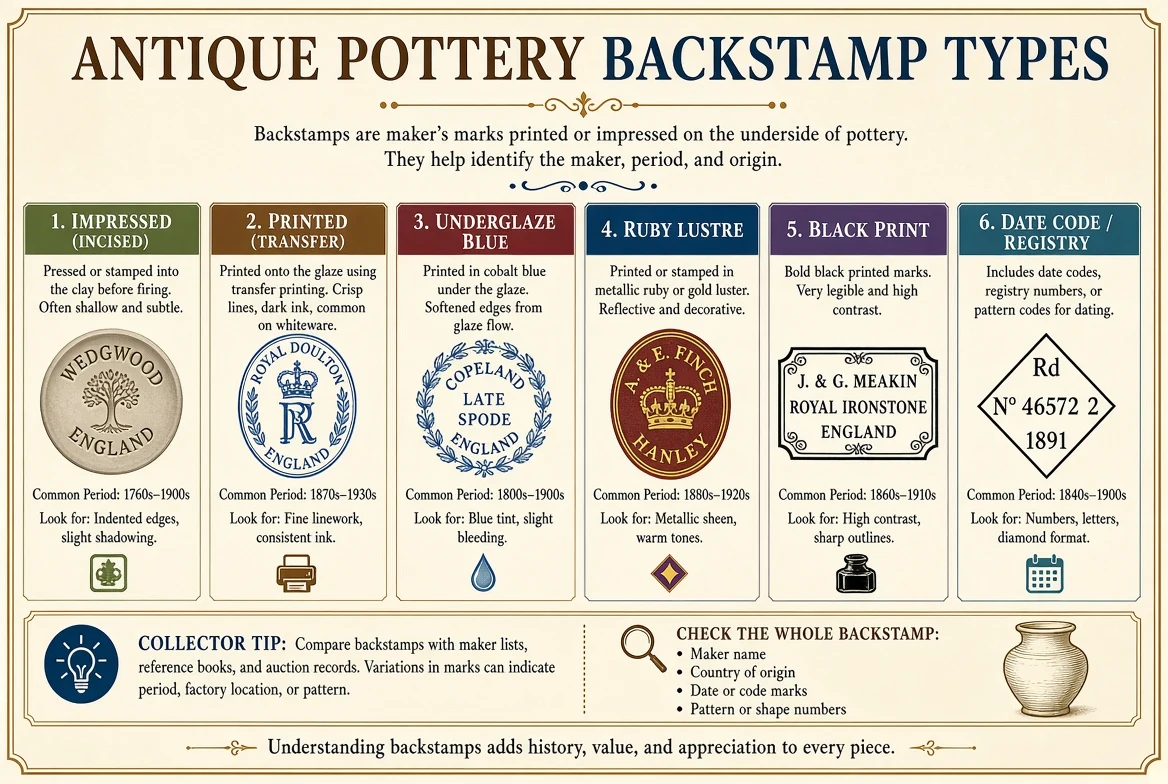


How to identify an antique pottery maker’s mark
A pottery maker’s mark, sometimes called a backstamp, is a signature, symbol, letter combination or printed design found on a ceramic object. It may appear on the underside of a plate, the base of a vase, the foot of a teacup or a less visible surface. The crucial point is that not every mark denotes the factory. Some identify a painter or decorator; others indicate a model, production batch, retailer or country of origin. One stamp should therefore be read together with the ceramic body, glaze, technique and design.
Start with clear photographs of the whole item and its underside. Turn the mark upright before transcribing it, and record whether it is impressed into wet clay, under the glaze, applied over a fired surface or printed as a transfer. Similar symbols were reused by unrelated makers, and a famous design can be copied. The illustrations in this article introduce common mark categories rather than asserting that a particular drawn crown or crossed sword belongs to one authenticated antique.
Pottery backstamp types: impressed, incised, painted and printed
Impressed marks are pressed into the clay and leave a depression; incised marks are cut into the clay, often by hand. A painted mark may be brushed on, while a transfer-printed backstamp can have crisp repeated lettering or decorative elements. Their relative position to the glaze gives another clue. A mark under a transparent glaze was present before the final glaze firing; an overglaze decorator’s mark may have been applied later during finishing.
This distinction matters in authentication. An alleged early factory mark painted on top of an otherwise inconsistent glaze can deserve further scrutiny, though genuine examples vary by tradition. Some studio potters sign works individually, while large factories use standardised stamps. A paper label can be useful but may have been detached, replaced or moved from another piece. An accurate chart identifies the technique without promising a precise manufacture date simply because a mark is blue, green or impressed.
Factory marks and the Meissen crossed swords example
A classic example is the Meissen crossed-swords mark, which the Metropolitan Museum of Art describes in its discussion of the manufactory’s early eighteenth-century history. The Met notes that the factory moved to a crossed-swords mark painted under the glaze in 1722. Such documented examples show how a recognisable factory symbol can be researched, but they also show why a modern chart of crossed swords is not enough to authenticate a vase. Later versions, imitations, alterations and individual factory practices must be considered.
Some objects were sold undecorated and later painted by independent decorators, so the object’s production and decoration can have different histories. A false attribution can result when someone reads a decorator’s initials as though they were the maker’s complete identity. Compare glaze, ceramic paste, foot-ring finishing, shape and historic factory catalogues in addition to marks. Major museum collection entries provide safer comparisons than anonymous “royal pottery symbols and meanings” charts that assign an exact century to every crown icon.
Maker’s mark vs decorator’s mark vs pattern number
A maker’s or factory mark usually points to the manufacturer or workshop that produced the ceramic blank or finished object. A decorator’s mark can name a painter who worked on it, sometimes independently of the manufacturer. A pattern number, shape number or model code may be there for inventory control rather than indicating a company or date. Some pieces contain two or more of these marks, which should not be collapsed into one imaginary signature.
For example, an old teapot may have an impressed number on the base and a painted letter beside a printed factory device. The number could refer to its mould; the painted letter could represent a decorator or a workshop code. Without documentary evidence, neither can be translated automatically into an exact year. When making a record, transcribe every visible component separately and note its colour and placement. This gives a specialist much better evidence than a cropped photo with only one circled character.
Country-of-origin marks: England, Germany, Japan and other labels
Country names such as “England,” “Germany,” “Japan,” or “Made in…” can help locate a market or legal labeling context, but they do not provide an exact universal age formula. Export rules developed differently by country, and some goods carry the retailer’s destination or brand alongside the country. A label might date packaging or decoration rather than the original formation of an older ceramic blank. Modern reproductions can also use historic-sounding names and conventional-looking country wording.
Search phrases like “antique pottery mark England date” are most useful when paired with a particular maker name and consistent shape or pattern. If a base says “Made in England,” compare documented logo periods for that exact manufacturer rather than claiming all objects with those words were made in one decade. Country wording may narrow possibilities, but material, glaze, production technique and provenance remain necessary. Charts showing origin labels here are visual comparison aids, not a legal timeline applying equally across all markets.
How to research an unknown pottery symbol without an exact name
If a mark is only a crown, shield, animal, initials or crossed lines, begin with shape-based description: “crown over W impressed pottery mark,” for example. Include whether the mark is surrounded by a circle, accompanied by a place name or numbered beneath. Use documented museum catalogues, maker references and reputable antique ceramic publications for comparison. Reverse-image search can locate similar marks, but it cannot tell whether the proposed identification is correct or a copied internet caption.
Photograph the mark in direct and raking light to reveal impressed edges. Avoid enhancing the image so aggressively that strokes are invented. Measure the object’s dimensions and note the texture, weight, glaze and decoration. Some factories changed marks across decades, while different firms reused similar motifs. If a reference identifies a symbol, check whether it also matches the object’s actual style and stated period. Seek expert authentication before assigning a costly attribution to a famous eighteenth-century factory.
Are all old pottery pieces stamped on the bottom?
No. Some antique pottery and studio ceramics are unmarked, and not all marks survive normal use. A missing stamp does not make the object fake or worthless. Early, regional and handmade wares can be identified through clay type, method of manufacture, glaze, decorative style and archaeological context. Conversely, having a crisp printed backstamp does not guarantee antiquity, since modern factories also use stamped maker logos and can imitate earlier styles.
The distinction between pottery, earthenware, stoneware and porcelain also matters for identification. They use different bodies and firing practices, which can help narrow provenance. An old-looking crackle glaze or artificially stained base may be a deliberate aesthetic finish rather than evidence of age. A thorough investigation combines multiple observations. The mark is one piece of evidence, sometimes a very helpful one, but not a shortcut around careful material examination.
Antique pottery mark mistakes and resale myths
Be wary of listings that declare a piece “rare royal porcelain worth thousands” because a blurry stamp resembles a crown. Common factory pottery can carry impressive-looking marks; collectors may pay more for documented scarce patterns, high-quality painting, unusual production variants or identifiable artists. Market value also depends on condition, chips, restoration, provenance and recent completed transactions. Asking prices on online marketplaces are not evidence of completed sales.
Do not scrape a stubborn backstamp with abrasive cleaners to reveal it. That can remove glaze, dirt patterns or useful provenance details. If identification matters financially, request an appraisal from a specialist who can examine the actual object. A photo comparison article cannot certify authenticity or assign an individual antique’s sale price. Learn the difference between factory mark, decorator initials and inventory number before approaching a dealer.
FAQs about antique pottery backstamps
What is a pottery backstamp?
A mark on a ceramic piece, often on its underside, which may identify a manufacturer, decorator, pattern or origin.
Do crossed swords always mean Meissen?
No. Documented Meissen examples exist, but shapes were copied or imitated, so a mark alone is insufficient.
Is a country name enough to date a vase?
No. Country marks must be considered with the exact maker, design, production method and labeling context.
Can an antique vase have no maker’s mark?
Yes. Many genuine old ceramics are unmarked and require other evidence.
Does an impressed number show the year?
Not necessarily. It may identify a mould, pattern, shape or workshop code.
Conclusion: the backstamp is one clue, not the whole provenance
To identify antique pottery, record the complete mark and compare factory, decorator, pattern and origin information against actual documented objects. Glaze, form, decoration and provenance matter as much as the symbol under the base. Be cautious with expensive attributions based on one internet image.
Sources and museum references
The Metropolitan Museum of Art: Meissen factory marks and decoration; The Met: Sèvres Porcelain Makers and Marks; The Met: European Porcelain glossary and factory marks; The Met: Independent china decorators.













Share Your Opinion
Comments are closed on this post.