 Vista
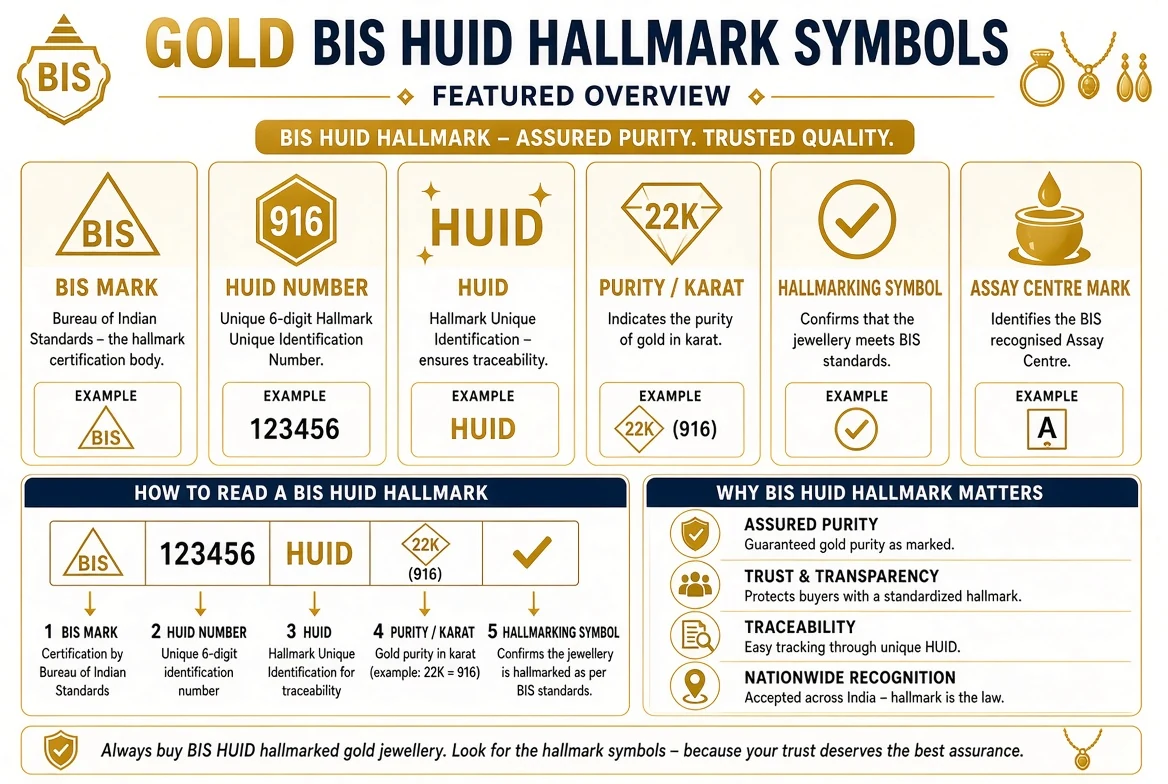
Direct answer: The current BIS Gold HUID hallmark symbols are a three-part marking: the BIS logo, purity/fineness grade such as 22K916, and a unique six-character HUID code. Look for all three and verify the code through the official BIS Care app. This chart explains 22K916, 18K750, 14K585, 2026 hallmark grades and how to distinguish a genuine official record from a generic seller stamp.
Updated 21 November 2026 with Government of India November 2026 hallmarking guidance. This is consumer education, not a substitute for a laboratory purity test.
BIS Gold HUID hallmark symbols: four image charts


BIS gold hallmark symbols: what every buyer should recognise
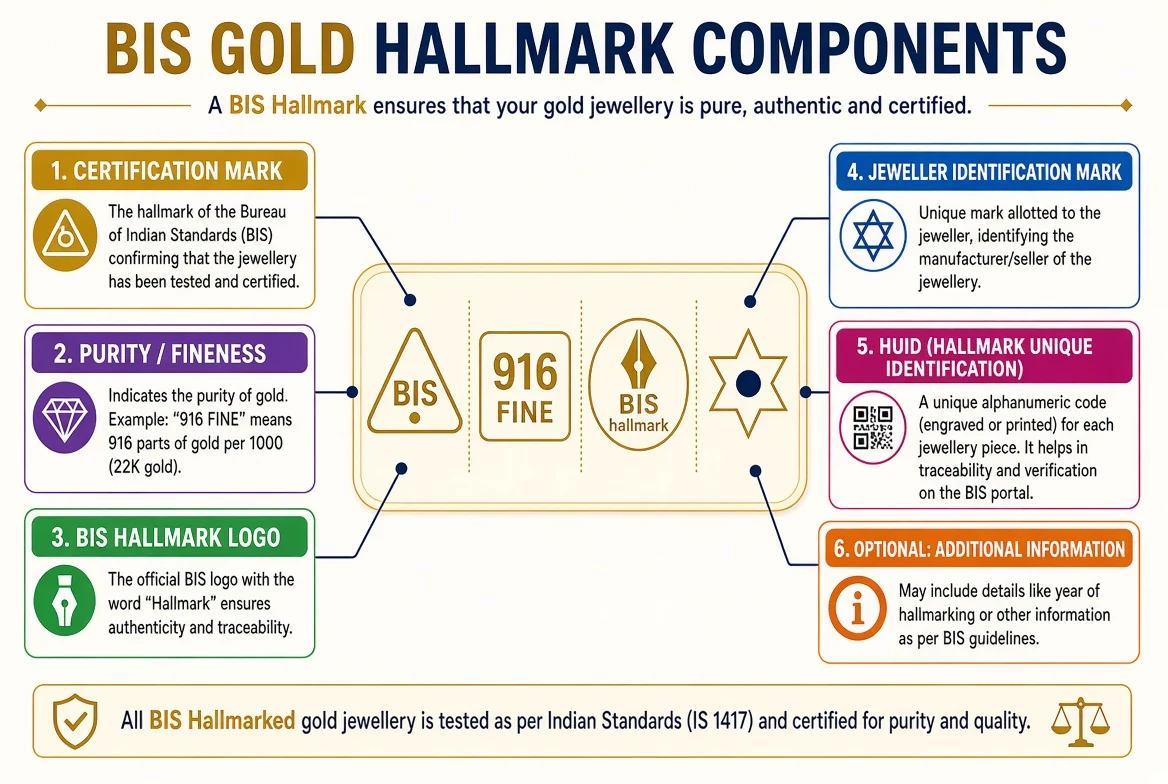
BIS hallmark symbols on gold jewellery are not one mysterious logo; they consist of three important details in the current HUID-based scheme. The first is the Bureau of Indian Standards standard mark, often called the BIS logo. The second is a purity-and-fineness mark such as 22K916. The third is a unique HUID (Hallmark Unique Identification) code. These three components help consumers distinguish an officially hallmarked article from a piece that merely carries a generic seller’s “22KT” stamp.
The November 2026 Ministry of Consumer Affairs/PIB briefing explicitly lists these three markings and explains how the system supports traceability. The mark can be small, so an in-store magnifying lens is useful. Begin with the label and then compare the article’s details through the BIS Care application. The chart is an identification aid, not a replacement for official verification or a laboratory assay. Buyers should also preserve a proper invoice and any written purity descriptions supplied by the jeweller.
22K916, 18K750 and 14K585: what the numbers mean
The number following the karat value indicates fineness in parts per thousand. Thus 22K916 signifies approximately 916 parts of gold in a thousand, or 91.6% fineness. Likewise 18K750 indicates 75% fineness, and 14K585 indicates 58.5%. This relationship is more informative than the casual claim that 22K and 24K are both “pure gold.” Alloys are used in jewellery to change strength, workability and other practical properties.
BIS’s 2026 framework also recognises 20K833, 23K958, 24KS995 and 9K375 grades. A number stamped on a chain does not independently establish that the article meets the claimed level; it must be considered alongside the rest of the hallmark and the official HUID record. Buyers frequently search “916 gold mark real or fake” and “750 hallmark meaning”. The direct answer is that those are fineness descriptions, not unique serial numbers, investment values or automatic certificates of authenticity.
2026 hallmark grades: six mandatory and 9K voluntary
A March 2026 Government of India communication distinguished six caratage categories covered by mandatory gold hallmarking—14K, 18K, 20K, 22K, 23K and 24KS—from the 9K grade available on a voluntary basis under the relevant standard. A November 2026 briefing described the broader seven-grade hallmarking framework, including 9K375. These statements are not contradictory: a grade can exist within the standard without being included in the same mandatory coverage requirement.
Mandatory hallmarking itself has expanded geographically in phases. It is therefore inaccurate to say that every jewellery category, shop or district has always been subject to exactly one unchanged nationwide rule. Buyers should consult current BIS district lists and applicable exemptions when asking whether an article must carry mandatory hallmarking. This symbols guide focuses on how to recognise an HUID-marked gold article wherever one is sold. It deliberately avoids giving an outdated all-India compliance list or saying that a 9K375 stamp is automatically prohibited.
What is a six-character HUID and where can you find it?
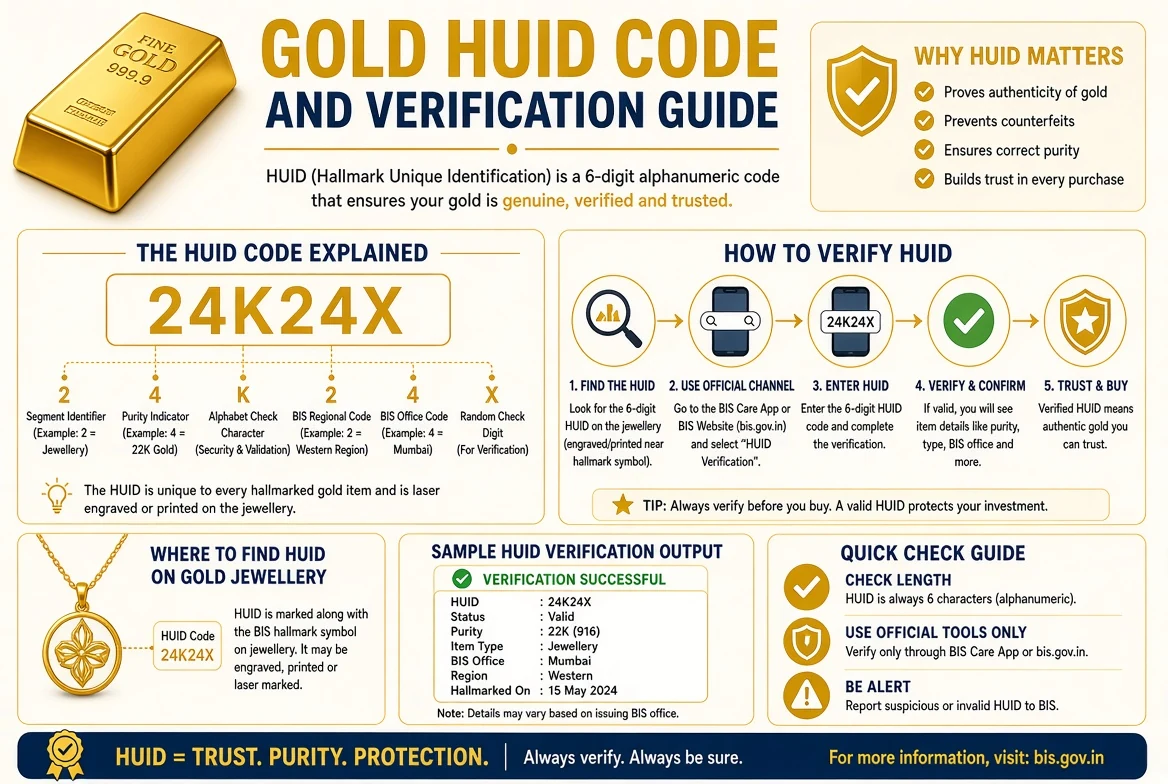
HUID stands for Hallmark Unique Identification and refers to a unique six-character alphanumeric identifier associated with an individually hallmarked article. The official materials sometimes describe it as a six-digit alphanumeric number; that does not mean it is merely a six-digit purity code. It is distinct from 916, 750 or a shop’s private design code. It is typically laser-marked on the jewellery and may require magnification to read clearly.
For a ring or chain, inspect the accessible marked area without causing damage. Paired articles or detachable parts may have their own HUID requirements, as BIS notes in its FAQ. Do not copy a HUID from a social-media demonstration and use it as though it authenticates your own jewellery. Each identifier is linked to a particular record, so seeing any valid number is not enough; the returned details must match the physical article. A deliberately copied mark can mislead someone who only checks that a code looks legitimate.
How to verify a gold HUID using the official BIS Care app
Open the official BIS Care application and select Verify HUID. Enter the jewellery’s six-character code carefully, following the application’s current interface. Review the available record and compare the purity, item type, jeweller or manufacturer details and other information with the physical article and invoice. According to the November 2026 PIB report, upgrades made on 8 June 2026 allow consumers to see photographs of the article and hallmark and automatically recorded weight information, which can strengthen comparison.
Some displayed fields may vary with app version and the available record. Do not treat a “record found” message as permission to skip the actual match. A seller could show a photograph or number belonging to a different product. Equally, a temporary app problem or data-entry mistake is not itself proof of fraud; verify the code and consult BIS support. This article’s purpose is identifying the three hallmark components; our existing detailed HUID checking guide walks through the verification process separately to avoid duplicating search intent.
How to tell a BIS hallmark from generic jewellery stamps
Marks such as “916”, “22KT”, a jeweller’s initials or a brand logo can appear on jewellery, but they are not interchangeable with the current BIS three-part hallmark. The official system requires the BIS standard mark, purity/fineness information and HUID code for an HUID-hallmarked item. A design inspired by the BIS logo or a random laser-engraved six-character string should not be taken as conclusive evidence. The seller’s printed card may describe purity, but the record should independently support it.
Compare both the marked article and official HUID details. In the shop, ask for a magnifying glass if the markings are difficult to read; BIS’s guidance discusses access to magnification. Keep a legible bill with the article’s description, purity and weights, and ask that stones or non-gold components be described clearly. In high-value purchases, clarity about net precious-metal weight is especially important. Avoid relying on online images that crop out the HUID or imply that any 22K engraving proves a valid BIS assay.
Gold hallmark versus silver hallmark and bullion marks
Gold jewellery hallmarking should not be confused with the rules for silver articles or bullion. Under November 2026 official guidance, silver hallmarking remains voluntary, but articles hallmarked under the BIS silver scheme must carry HUID from 1 September 2025. Silver also uses its own fineness grades and a BIS standard mark with “SILVER”. A gold-jewellery poster showing 22K916 is therefore the wrong reference for identifying a silver ring stamped 925.
Similarly, refined gold bars and bullion can be governed by different marking and refinery arrangements than everyday jewellery. Sellers sometimes quote 24K999 or 999.9 purity for investment bullion; do not substitute these terms into the current jewellery hallmark chart where the specified 24KS fineness mark is 995. The product category matters. A consumer should ask whether they are buying jewellery, an artefact, a coin or an investment bar before applying a rule from one category to another.
Checklist before paying for 22K, 18K or 14K jewellery
Use the picture chart to locate the BIS mark, fineness grade and HUID. If necessary, view the article through a magnifier rather than accepting a verbal assurance. Compare the code in BIS Care and confirm that the returned record corresponds to the specific ring, chain or other ornament. Check the net weight of gold, billed purity, making charges, applicable taxes and any stone or non-metal component charges. Preserve your receipt and take a photograph of the marked area where feasible.
Hallmarking is a measure of declared purity and traceability; it does not mean the retail jewellery is a risk-free financial investment, or guarantee an identical resale amount after making charges. If the details differ, ask the seller for clarification before making payment. Buyers can use BIS consumer complaint channels and recognised testing arrangements where necessary. Since a stamp can be copied and packaging can be misleading, use multiple checks rather than trusting a single printed symbol on a tag.
Frequently asked questions about BIS HUID gold markings
What are the three BIS hallmark symbols?
The BIS logo, the purity/fineness mark and the unique HUID identifier.
What does 22K916 mean?
It indicates a gold fineness of approximately 916 parts per thousand, or 91.6%.
Is 9K375 included in India’s gold hallmarking system?
Yes, as a voluntary grade in the 2026 framework; March guidance lists six other grades under mandatory caratage coverage.
Can any six-character HUID prove my ring is genuine?
No. Verify through BIS Care and make sure the record actually matches the physical article.
Is a jeweller’s 916 stamp enough?
Not for the current HUID-based hallmark; look for the complete three-part mark and verify its record.
Conclusion: the mark and the record must match
The three BIS hallmark components are designed to give meaningful purity information and traceability. A 916 stamp by itself is not an adequate check. Look for the complete marking, match the HUID record to the specific item, review the invoice and distinguish 9K voluntary provision from the six mandatory caratages described in 2026 guidance.
Official sources and related guide
Government of India: November 2026 BIS hallmarking update; PIB: March 2026 mandatory caratages and voluntary 9K; BIS official hallmarking FAQs; Vista Hub: How to check your HUID number.





Share Your Opinion
Comments are closed on this post.