 Vista

Direct answer: The Maya numerals and calendar signs chart shows how dots (1), bars (5), and a zero glyph form digits 0–19, and why stacked numbers use a base-20 approach. The calendar adds an important exception: the Long Count tun equals 360 days, while the Tzolk’in uses 20 day names and 13 rotating numbers. Four visual panels explain the difference.
Updated 20 November 2026. Illustrated learning guide; glyph spellings and historical styles vary across Maya languages and sources.
Maya numerals and calendar signs: four illustrated charts
Maya numerals chart: dots, bars and zero explained
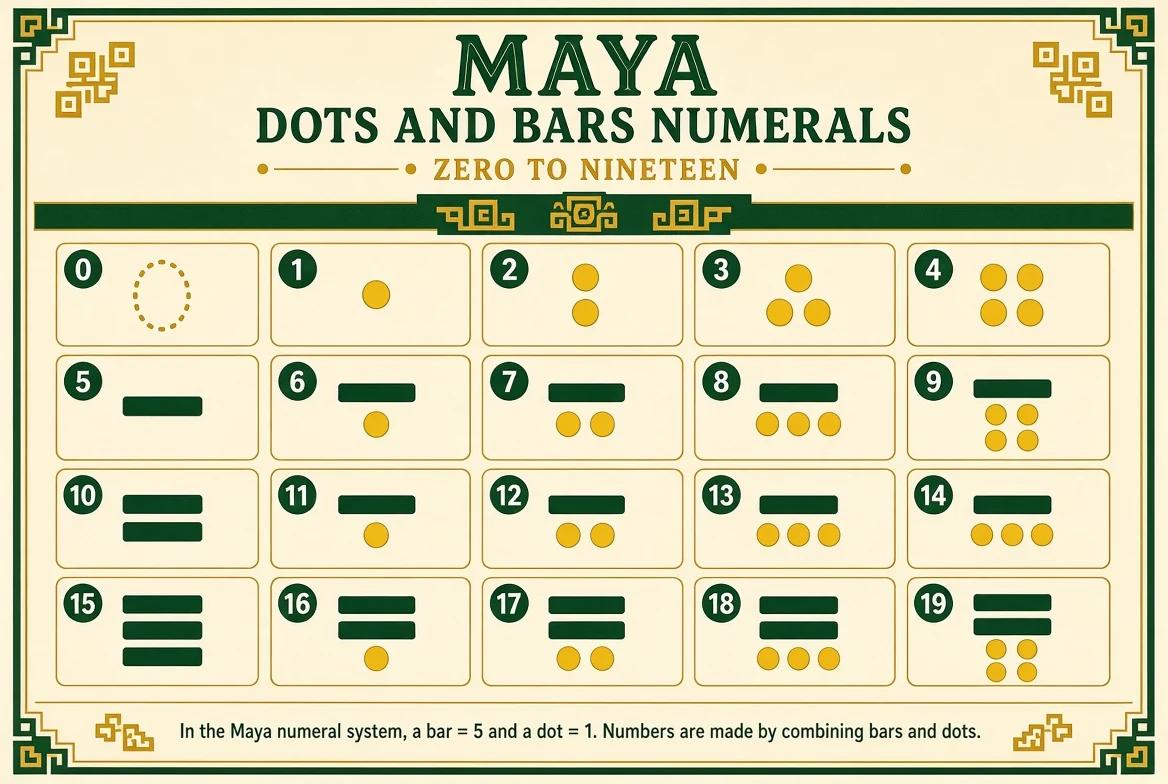
The Maya numeral system is most familiar through a simple combination of dots, horizontal bars and a zero symbol. A dot represents one; a bar represents five; a conventional shell-shaped glyph is often used to teach zero. Combining these elements makes values from zero to nineteen. Three bars and four dots, for example, represent nineteen: 15 plus 4. The marks are compact enough to appear alongside calendar glyphs and to be reproduced clearly in a classroom Maya numerals and calendar signs chart.
Although students often say “the Mayans counted in base 20”, it is useful to separate the ordinary mathematical demonstration from historic calendar notation. The Maya used a vigesimal structure, but their Long Count calendar has an important place-value modification. Written forms also vary by source and period, and historical number glyphs are not always identical to the straight-line icons in a modern school worksheet. The charts here are visual teaching guides intended to clarify numerical logic, not exact reproductions of one inscription.
Maya numbers 0 to 19: examples you can count
Start by counting dots. One dot means 1, two mean 2, three mean 3 and four mean 4. A single bar represents 5. Add a dot over the bar for 6, two dots for 7, three for 8 and four for 9. Two bars make 10; then one through four dots bring the values to 11–14. Three bars make 15, and up to four dots above them form 16–19. The zero sign marks an empty position, not the absence of a number system.
A chart of Mayan numerals 1 to 20 is often misleading if it squeezes twenty into the same single-place dot-and-bar pattern as nineteen. In standard positional teaching, 20 is the beginning of the next place value: one unit in the twenty place and zero in the ones place. This two-level structure is why number layout matters. Look at the first image and test each value by adding the bars and dots. If a poster shows five complete bars to represent 25 as a one-place symbol, it is not explaining the conventional place-value method correctly.
Maya base 20 place value: how to read stacked numbers
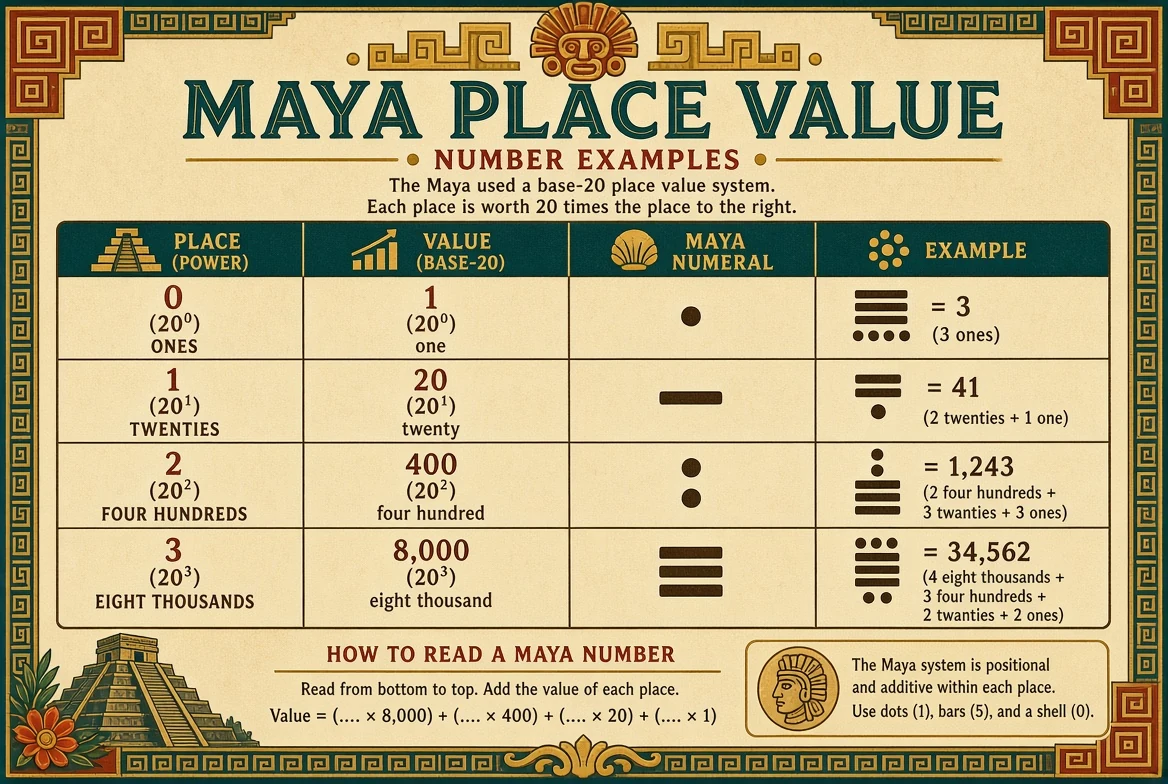
The usual teaching model stacks digits vertically. The bottom level represents ones; the level above represents twenties; higher levels increase by powers of twenty in a purely vigesimal mathematical illustration. Thus 21 can be shown with one twenty above one unit, and 40 with two twenties above a zero sign. Read from the bottom and multiply by the place value before adding the results. For example, a lower digit of 7 below an upper digit of 2 gives 47 in the simplified base-20 model: 2×20+7.
However, the familiar Maya Long Count calendar uses a modified structure: 20 k’in make one winal, while 18 winals make one tun, equal to 360 days. Further calendar periods are twenty tuns per k’atun and twenty k’atuns per bak’tun. A chart that writes the third calendar position as 400 days instead of 360 has confused a simple mathematical base-20 model with calendar notation. The Smithsonian’s Living Maya Time project explicitly explains these named periods and why the calendar must be read on its own terms.
Maya Tzolk’in calendar signs: 20 day names and 13 numbers
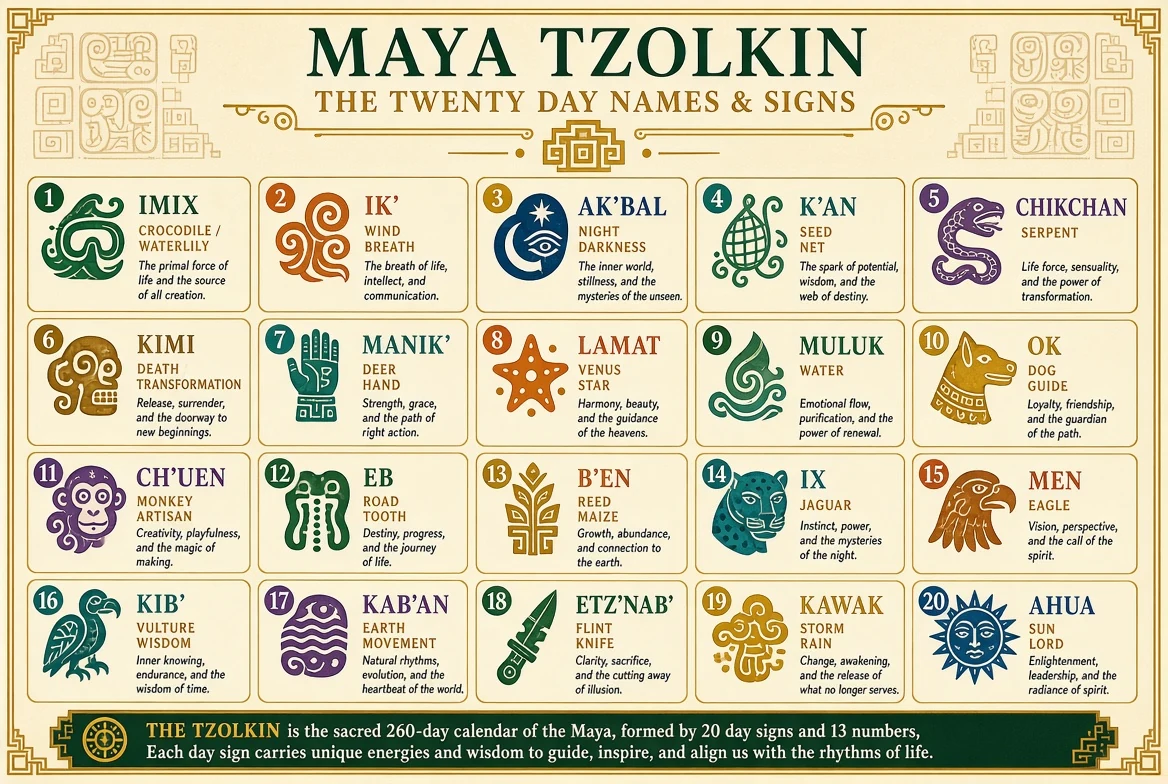
The Tzolk’in is a 260-day sacred count formed through rotating 20 day names and numbers from one to thirteen. As with other related Mesoamerican calendar systems, the names and numbers advance in parallel and the full combination repeats after 260 days. The day-name glyphs are not ordinary single-digit numerals, even when they appear beside dots and bars on a monument. A caption such as “9 Ik’” therefore includes both a numerical coefficient and a particular named day.
Spelling varies with Maya language and transliteration convention. The English-language classroom names commonly seen in reference charts include Imix, Ik’, Ak’bal, K’an, Chikchan, Kimi, Manik’, Lamat, Muluk, Ok, Chuwen, Eb’, B’en, Ix, Men, Kib’, Kab’an, Etz’nab’, Kawak and Ajaw. These correspond to one well-known naming convention; living Maya communities may use other forms. The gallery provides a glyph comparison, not a claim that all Maya communities and historic periods used exactly one English list or identical glyph shapes.
Haab’ calendar versus Tzolk’in: which chart do you need?
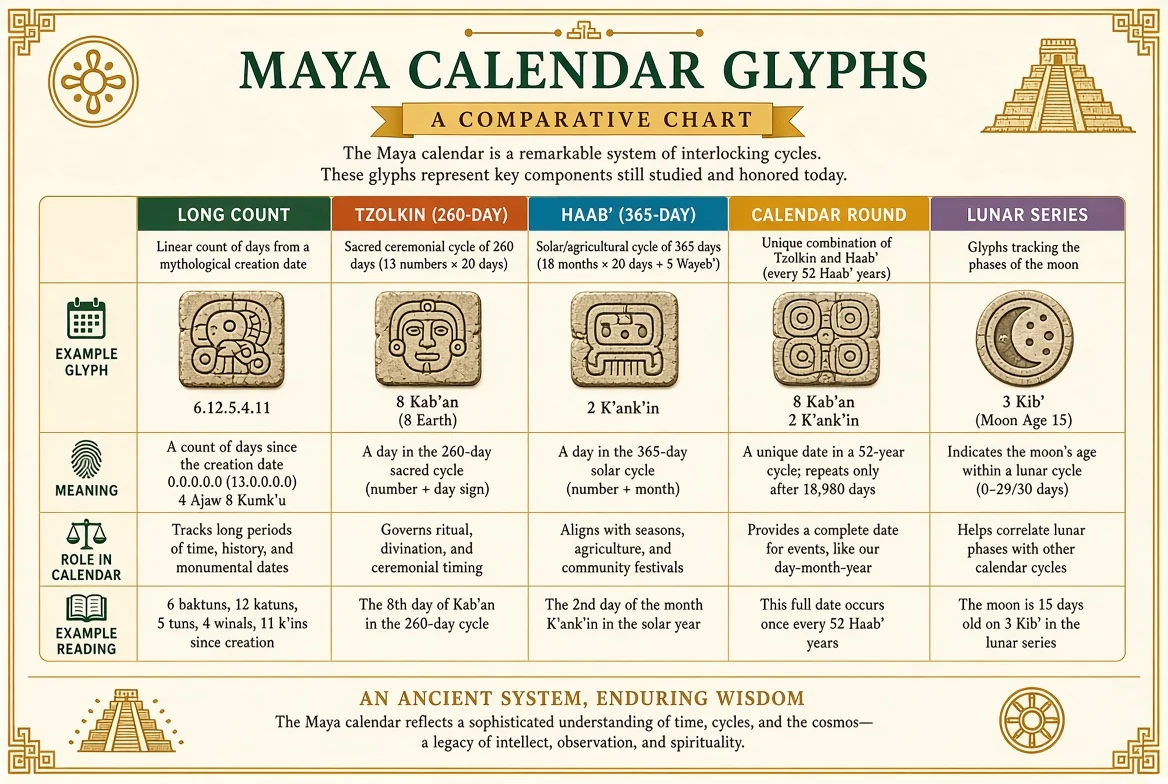
Alongside the 260-day Tzolk’in, the Maya used a 365-day count widely referred to as the Haab’, typically described through 18 months of 20 days plus an additional five-day period. A combined Tzolk’in and Haab’ designation belongs to the Calendar Round, whose pairing repeats after 52 Haab’ years. These calendars describe related but distinct cyclical ways of keeping time. If a viewer searches for “Maya month glyph names”, a Tzolk’in day-name chart will not answer the whole question.
The Calendar Round is also distinct from the Long Count, which expresses the number of elapsed days using named units including bak’tun, k’atun, tun, winal and k’in. A stone inscription may contain pieces of several systems within one date. For a clear educational image, label the 20 day names, month signs and Long Count place symbols separately instead of arranging them into one imaginary “Maya calendar alphabet”. Smithsonian’s calendar converter makes the relationship easier to explore, but it should not be reduced to a universal prophecy calculator.
How to read a Maya date glyph on a monument
Start with the broad visual layout. A carved Maya date can contain an initial series, numerical coefficients, period glyphs and named day or month signs. A series of bars and dots may be a number that modifies the glyph immediately beside it, not an isolated arithmetic problem. In some settings the shape of the day sign resembles a small face or ornament. Comparing the marking to a documented museum or archaeological illustration is more reliable than using modern vector icons alone.
Then look for the script’s actual reading order and the monuments’ conventions. Historical Maya writing is a mixed writing system with logographic and syllabic signs, not one picture for every letter of English. A date glyph is a component of a much larger text that may record rulers, events, offerings or monument dedications. The Smithsonian’s interactive “Reading the Calendar Glyphs” resource and scholarly work on inscribed dates help separate numeral logic from linguistic reading. A number chart is a useful starting tool, not a complete decipherment guide.
Did the Maya invent zero? What the evidence supports
Maya inscriptions and calendrical notation provide clear evidence of a sophisticated zero or placeholder sign, often represented in modern educational images as a shell-like form. Zero is important because positional notation needs to distinguish an empty place from an omitted marking. A modern table therefore shows 0 as an explicit symbol next to 1–19. It is correct to discuss Maya zero as a major intellectual achievement in Mesoamerican mathematics and calendrics.
It is less helpful to claim that the Maya were the only civilisation ever to develop a zero idea, or that the symbol automatically proves the same philosophical history as the Indian zero. Different mathematical traditions developed place-value methods and zero concepts in distinct places and contexts. Separate the history of the glyph and its use in counting from broad comparative claims. The Mathematical Association of America’s discussion of Maya numeral conventions highlights both the power of the system and its specialised calendrical modifications.
Maya calendar myths: 2012, predictions and viral symbols
Modern internet charts often advertise a Maya glyph as proof that an ancient civilisation “predicted the end of the world in 2012”. That claim misrepresents a calendrical cycle transition and the variety of surviving Maya traditions. A calendar reaching a major period boundary is not the same as documented evidence of a universal apocalypse. The living cultural traditions of Maya communities also did not stop at a modern date chosen by sensational articles.
Beware of generic “Mayan birth symbol” products that assign a modern personality slogan to every sign without explaining the underlying text or correlation. The glyph can be authentic in form while the attached caption is a new commercial interpretation. If using the designs for a tattoo, school poster or museum-style infographic, keep the original name, visual source and any translation uncertainty visible. Modern variations can be beautiful, but audiences deserve to know when they are seeing a creative reconstruction rather than a historical facsimile.
FAQs about Maya numbers and calendar glyphs
How do Maya numerals work?
Dots count as one, bars count as five and a zero glyph indicates an empty place. Positions represent larger units.
What is 19 in Maya numerals?
Three bars plus four dots make 15+4=19.
Why is the Maya Long Count not pure base 20?
The tun is 18 winals, making 360 days, instead of 20 winals or 400 days.
What is the difference between the Tzolk’in and Haab’?
The Tzolk’in is a 260-day number-and-day-name count; the Haab’ is a 365-day calendar.
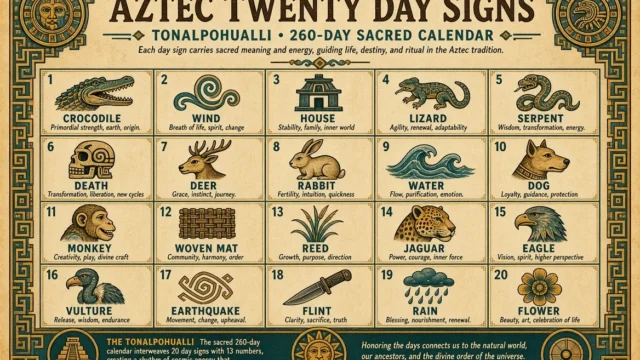
Are Maya day glyphs the same as Aztec day signs?
No. They belong to related Mesoamerican calendrical traditions but differ in names, visual writing conventions and context.
Conclusion: keep arithmetic and calendar notation distinct
The Maya dot-and-bar system is compact and memorable. To understand real calendar inscriptions, look beyond single digits: stack places carefully, recognise the 360-day tun and distinguish Tzolk’in day names from Haab’ month glyphs. That context turns an attractive picture chart into a genuinely useful reading aid.
Sources
Smithsonian National Museum of the American Indian: The Calendar System; Smithsonian: Reading Calendar Glyphs; Smithsonian: Maya Calendar Converter; Mathematical Association of America: The Maya Number System.





Share Your Opinion
Comments are closed on this post.