 Vista
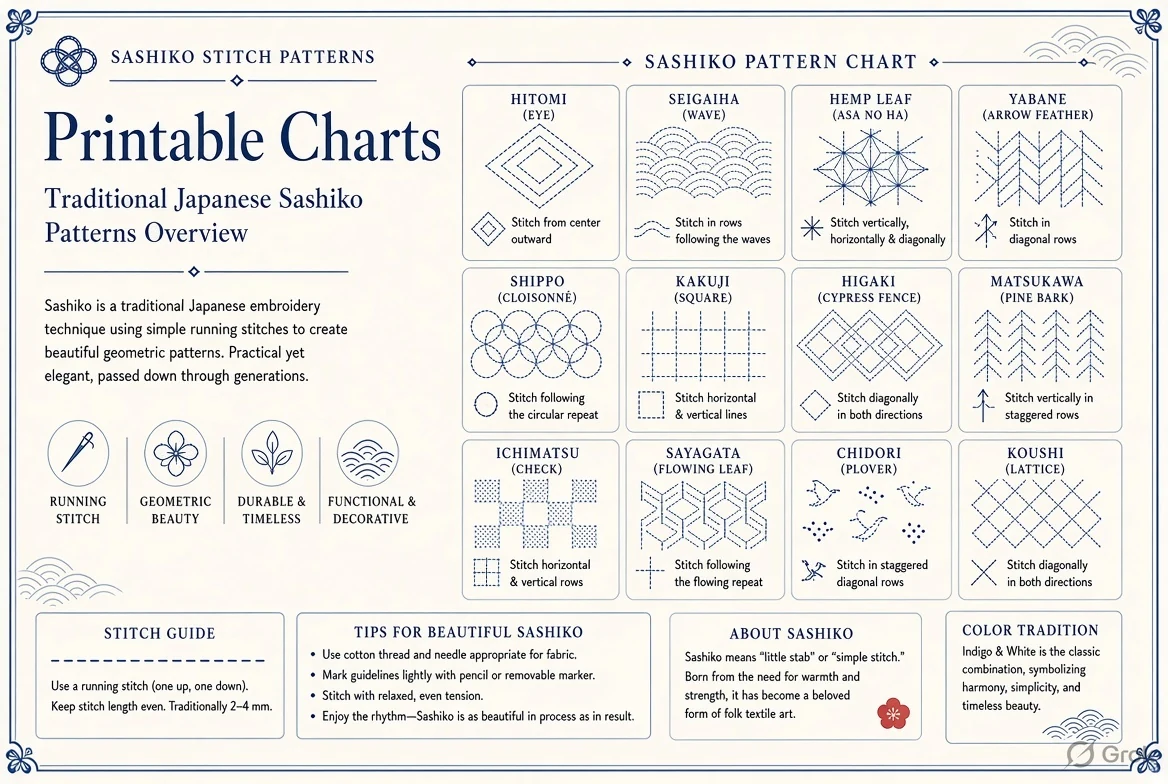
Direct answer: Sashiko is a Japanese running-stitch embroidery tradition with roots in practical clothing reinforcement and decorative geometric stitching. For beginners, its most recognizable chart patterns include asanoha (hemp leaf), shippo (interlocking circles or seven treasures) and seigaiha (stylized waves). A printable Sashiko stitch chart helps plan the spacing, repeats and stitch route, but it is not automatically a ready-to-print PDF file. This guide explains the four existing visuals, the difference between moyozashi and hitomezashi, and how to transfer a pattern onto fabric without distorting the design.
Updated 20 November 2026. These images are educational pattern references, not a separately hosted PDF bundle.
Sashiko stitch patterns printable charts: at a glance
| Main technique | Running stitches on fabric |
|---|---|
| Common classic look | Light thread on dark indigo cloth |
| Moyozashi | Running stitches tracing geometric motif lines |
| Hitomezashi | One-stitch grid approach (separate technique) |
| Featured motifs | Asanoha, shippo, seigaiha |
| Printable limitation | Images can be printed; no separate PDF download is claimed |
Four illustrated Sashiko pattern charts


What are Sashiko stitch patterns and why use a printable chart?
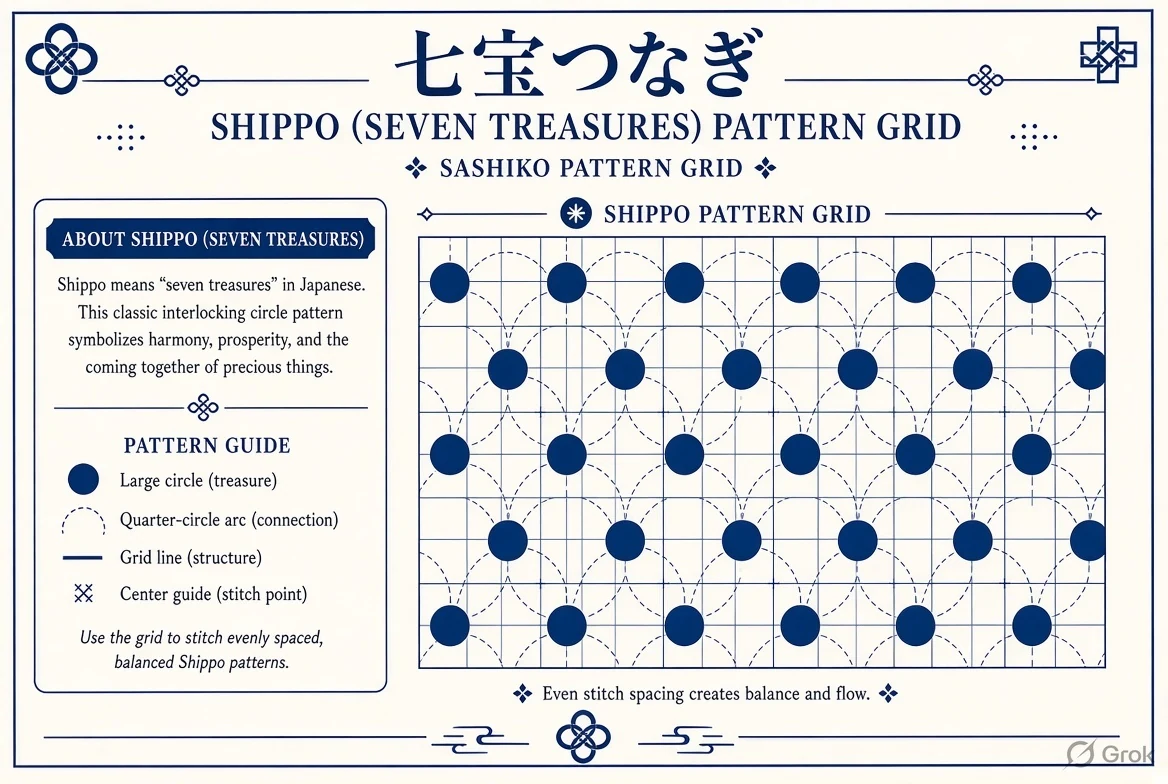
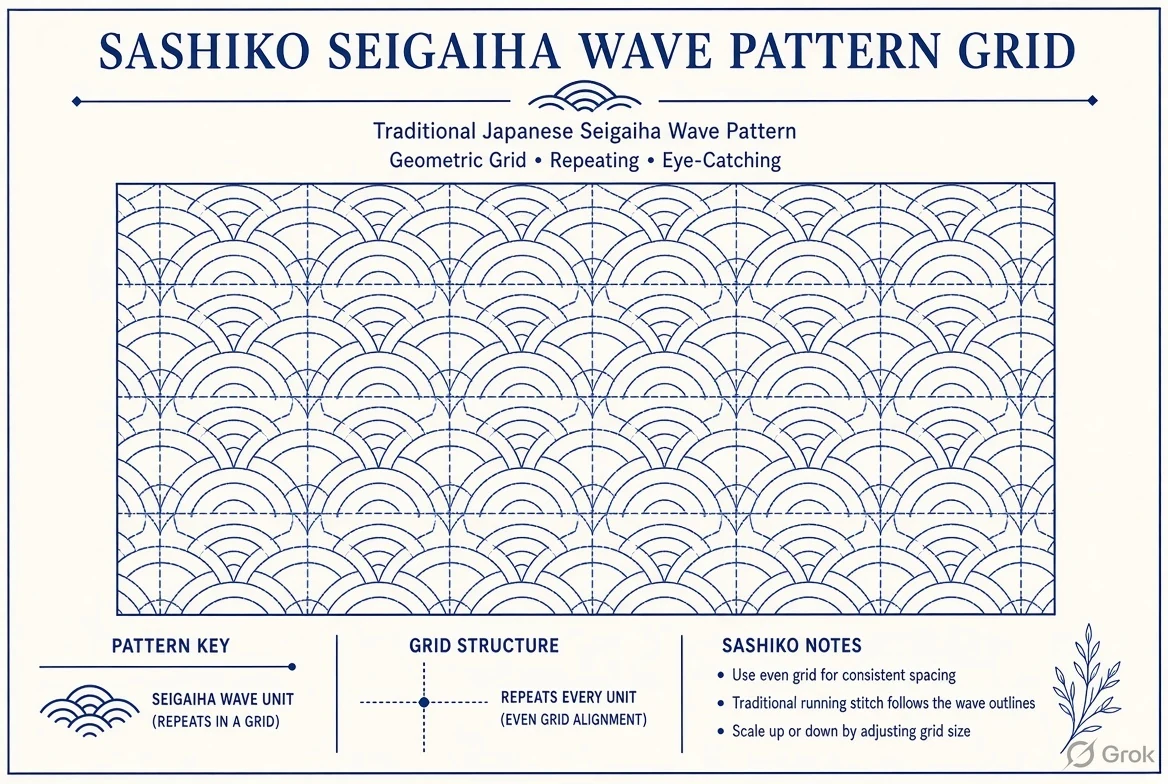
A Sashiko pattern is a route of small running stitches arranged into a repeat or recognizable motif. A chart makes that route visible before a needle touches fabric. Historically, Sashiko stitches could reinforce worn textiles and add warmth or strength, while contemporary embroiderers use them for decoration, visible mending and simple geometric art. A ‘printable Sashiko patterns’ page should therefore help readers transfer a motif, understand the repeat and avoid misleading claims about downloads. The four pictures here are reference images rather than a separate promised PDF bundle. Readers can print the image or page using the browser’s normal print options after checking the preview scale.
Asanoha pattern: hemp leaf geometry and its visual meaning
Asanoha is named for the shape of hemp leaves and is composed of straight lines forming repeating angular star-like or leaf-like figures. Its geometry makes corner alignment more demanding than a simple straight sashiko line. The motif has long-standing associations with strong growth, and traditional explanations also connect it with wishes for children’s health and vigour. For a beginner, begin with a single well-defined unit before marking a large field. Align the central points and avoid tightening the thread until the fabric puckers. The illustration here shows the motif as a modern learning diagram, not as a reproduction of any specific antique textile.
Shippo pattern: seven treasures and interlocking circles
Shippo uses overlapping circular outlines that form lens or petal-like intersections. Because it relies on repeated curves, the motif can drift if one ring is marked slightly off center. Mark the major grid spacing first and use a ruler or template to keep arcs consistent. The Japanese name relates to the seven treasures, and repeated interlocking forms are commonly associated with continuity and connection. A printout is especially helpful when repeating the same arcs across a patch. It can be tempting to stitch across an intersection in one sharp pull, but short controlled running stitches usually produce a smoother curve.
Seigaiha waves: planning even arcs without awkward joins
Seigaiha means a ‘blue sea wave’ pattern, often shown as rows of overlapping semicircular arcs. The motif communicates a gentle wave rhythm and is linked to wishes for continuing peace or good fortune in traditional pattern descriptions. The engineering of the chart matters: adjacent rows must be consistently offset, otherwise the waves lose their recognizable progression. Start at one edge of the cloth and mark the repeat over the entire field before stitching. Use small stitches around curves rather than forcing a long straight stitch to mimic a bend. The aim is regularity, not a racing speed or a rigid universal stitch length.
Moyozashi versus Hitomezashi: which chart is appropriate?
Moyozashi is pattern Sashiko: a motif’s lines, which may curve or form angles, are followed with running stitches. Hitomezashi means one-stitch Sashiko and constructs a repeat using individual grid-unit stitches arranged across rows and columns. Both sit within the broad Sashiko family, but their planning methods differ. Asanoha, shippo and seigaiha are widely treated as moyozashi-style motifs, whereas checkered and dense one-stitch grids belong more naturally to hitomezashi. Never label an image ‘hitomezashi’ only because it contains little square cells. First identify whether the stitches trace a line design or whether the design emerges from the placement of single stitches.
Beginner Sashiko materials: cloth, thread and needle
You need stable woven fabric, a needle able to pass the chosen thread, visible marking tools, and thread suitable for repeated running stitches. Traditionally indigo cloth and white cotton thread are iconic, but beginners can work on other combinations if the fabric is not too stretchy and the markings remain readable. A long Sashiko needle can carry several stitches before you pull through, while a thimble can help with dense cloth. Cut a manageable thread length and avoid very tight knots at the surface. The practical goal is a balanced stitch and cloth movement, not copying an exact thickness from an unscaled photo.
How to transfer a printable Sashiko chart to fabric
First decide the finished width of one repeat, then check the image’s proportions and print preview. Never assume an image will automatically print at 100 percent scale: browsers often fit a page and shrink it. Trace the design onto paper or use a fabric marking method appropriate for the textile. Test the marker on a scrap before using it on the main project. Align horizontal and vertical repeats from one corner of the cloth. If the printed grid is distorted by scaling, the stitched shapes will not meet. A small practice sample is cheaper than ripping a large section after the thread is in place.
Running stitch technique: spacing, corners and tension
Work the needle in and out of the fabric in a repeating rhythm and let a short series of stitches accumulate before drawing the thread through. Keep tension relaxed enough for the fabric to lie flat. In Sashiko teaching, many instructors use roughly balanced visible stitches and spaces, but the precise ratio can vary by motif, fabric and practice; it is not a rule that one online picture can enforce for every design. At a corner, stop and restart the path with a clean turn rather than pulling the thread diagonally across the back. Check the underside periodically to make sure long floats are not snagging.
Choosing a motif for visible mending, cushions and beginners
A short wave repeat or simple line is friendly for a first project because it teaches even tension without too many intersections. Shippo works well for a decorative patch but asks for consistent curves. Asanoha gives a dramatic geometric effect yet needs careful alignment of short segments. For a cushion cover, plan seam allowances before locating the pattern. For denim mending, reinforce the weak fabric with a secure backing where necessary; decoration by itself is not always a structural repair. For clothing, do not place dense embroidery across a highly stretchy seam without considering movement. Design should serve the textile’s actual use.
How to print charts and avoid false free-PDF claims
The images on this page are visual charts that can be printed using a browser’s normal print or save-to-PDF feature where the website permits it. That is different from offering a professionally tiled, true-to-scale printable template or a downloadable PDF file. Preview the output, check one known dimension with a ruler and adjust the scale manually if needed. If you enlarge a small web image too much, the stitch lines may blur, so a clear redraw is preferable for precision projects. Do not treat a decorative screenshot as a stitch-counted pattern unless its spacing and route have actually been verified.
Common Sashiko beginner mistakes and ways to correct them
The most frequent problem is pulling the thread too tightly so fabric puckers. Another is failing to plan where curves and lines meet, producing crossed or floating stitches in awkward positions. A third is assuming that an ornamental diagram proves a particular historical meaning: pattern traditions have multiple interpretations, and modern marketing may simplify them. Keep your practice strip, mark the start and finish, and compare the front and reverse of the work. For grids, measure before sewing; for curves, use shorter stitches. There is no shame in choosing a simpler motif and mastering even running stitch first.
Next keyword ideas for Sashiko embroidery learners
People who discover a Sashiko pattern often search for ‘sashiko patterns printable PDF’, ‘asanoha sashiko template’, ‘shippo seven treasures sashiko’, ‘seigaiha wave embroidery pattern’, ‘moyozashi versus hitomezashi’ and ‘sashiko needle thread for beginners’. Those are useful follow-up intentions, not claims about measured search volume. The best next action depends on whether someone wants a picture for inspiration, a stitch-route chart for practice or a properly scaled printout for a real fabric project. A trustworthy article should distinguish these outcomes instead of promising an unavailable download.
Frequently asked questions
What does Sashiko mean?
It refers to a Japanese running-stitch embroidery tradition, historically linked to practical textile reinforcement.
Are Asanoha and Shippo Sashiko patterns?
Yes. Both are well-known geometric motifs used in Sashiko-style stitching.
What is Seigaiha?
A repeating stylized wave pattern common in Japanese decorative design and Sashiko work.
What is the difference between Moyozashi and Hitomezashi?
Moyozashi traces motif lines; Hitomezashi builds patterns from individual stitches on a grid.
Is there a free PDF download here?
The page contains print-friendly visual images; it does not claim an additional hosted PDF file.
Can I make Sashiko patterns on denim?
Yes, with an appropriate needle, thread, stable backing when needed, and relaxed tension.
Sources and conclusion
For pattern terminology and practical reference, see Japanese embroidery and classic patterns, Types of Sashiko stitches. Related published guide: Crochet patterns for beginners. Check the actual stitch route and print scale before transferring a chart to fabric.








Share Your Opinion
Comments are closed on this post.