 Vista

Direct answer: Kaithi is a historical north Indian script used for Bhojpuri, Magahi, Maithili and administrative correspondence, revenue files and family records, especially in Bihar and Uttar Pradesh. Its official Unicode block is U+11080–U+110CF. Unlike Devanagari, Kaithi generally does not use a connected headline. An alphabet chart helps recognize letters but cannot by itself authenticate a historical land deed.
Updated 20 November 2026. Educational illustrations are not certified historic transcriptions.
Kaithi script alphabet: quick reference
| Detail | Answer |
|---|---|
| History | Administrative and commercial documents |
| Languages | Bhojpuri, Magahi, Maithili and others |
| Unicode block | U+11080–U+110CF |
| Decimal numerals | Devanagari digit code points |
What was Kaithi script used for?
Kaithi was a practical handwriting system for government and commercial records, letters, account books and personal documents. It served several regional languages and was particularly associated with present-day Bihar and Uttar Pradesh. Unicode describes an administrative history extending from at least the sixteenth century until the early twentieth century, when Devanagari increasingly displaced it. Old land and village records may contain dates, names and transactions written in Kaithi. A reader must identify the actual language, rather than assume everything in the script is standard modern Hindi.
A historical manuscript may contain expressions particular to Bhojpuri, Magahi or Maithili, older administrative vocabulary, or abbreviations known to local clerks. The script alone does not settle a legal interpretation. Researchers should keep a clear photographic copy, note the date and provenance, and preserve the original spelling before attempting translation.
Kaithi alphabet: vowels, consonants and signs
Kaithi belongs to the Brahmi-derived family of Indic writing systems. It has consonants, vowel letters and dependent vowel signs, along with extra signs for punctuation and abbreviations. Unicode includes the abstract characters needed to represent these electronically, while individual handwriting can vary. The official character names list is a stronger source for precise letter labels than an AI-generated decorative alphabet picture.
The block U+11080–U+110CF includes characters such as the nukta sign, U+110BA, which distinguishes some consonant sounds. Other special signs identify abbreviations, sections and numeric references. A tiny mark visible in a scan may therefore be meaningful. Be cautious with poster graphics that copy a Devanagari letter and change its appearance slightly; the visual resemblance does not establish a correct Kaithi character.
Kaithi versus Devanagari: differences that matter
Modern Devanagari uses a familiar horizontal headline connecting many letters in a word. Kaithi generally lacks such a continuous headstroke, though some documents have ruled lines and certain fonts include a headline-like feature. Unicode specifically distinguishes such ruled lines from normal Devanagari behavior. Compare several features before identifying a script from one photograph.
Kaithi and Devanagari share broad Indic roots but are not interchangeable writing systems. A correct comparison chart must show genuine letter forms, the pronunciation or value and the text’s language. Historical writers may form the same letter differently. A computer font shows a reference glyph, not every stroke used by a nineteenth-century clerk. Attribution should come from a source document or official character inventory.
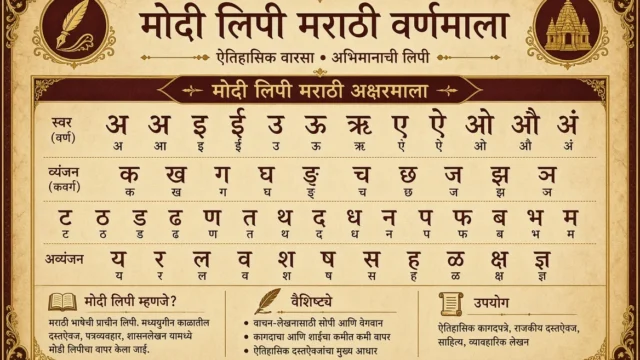
Kaithi script alphabet chart and manuscript gallery


Kaithi numerals in old land records
Account books and revenue documents often contain quantities, currency notations, land units, village names and dates. Unicode treats Kaithi decimal digits as stylistic variants of Devanagari numerals, so the Devanagari code points U+0966–U+096F are used for numerals. Some historical fractions and units belong to the Common Indic Number Forms range. Do not publish a supposedly independent Kaithi Unicode digit alphabet when the standard does not provide one.
Numeric reading is especially consequential because one wrong digit can alter a reported measurement or amount. Abbreviations can also complicate decipherment. If a record is involved in a property claim, obtain qualified documentary advice and appropriate certified translation. This educational guide is not a determination of legal ownership or a substitute for reading the original page.
How to read a Kaithi document step by step
Start with the entire scanned page at sufficient resolution, including its margins, endorsements, seals, page numbering and writing on the reverse if available. Identify the approximate district and historical period. Search for repeated words and compare shapes with a documented set of Kaithi specimens. Transcribe line by line without immediately converting the text into polished modern language.
Mark uncertain characters openly, and preserve alternative readings of ambiguous names. Only after transcription should you produce a normalized version and a translation. If an AI system outputs a fluent paragraph from a faint scan, confidence in its writing does not establish that the letters were read correctly. A trained reader should verify material claims, particularly when the document affects rights or genealogy.
Fonts, Unicode charts and mobile readability
Unicode standardizes text characters rather than one mandatory font appearance. A device without a Kaithi-supporting font may display blank squares. That can be a rendering problem rather than corruption of the source text. Proper placement of vowel signs also depends on shaping support. Use a font known to implement the block and compare displayed text with the official Unicode code-point names.
A student-friendly lesson should include both searchable Unicode text and images with accurate ALT captions. Screenshots alone are hard to search and can hide individual signs. When reusing a historic photograph, record its archival source and rights status. An illustrative chart helps explain broad shapes, but should not be presented as a proven facsimile of a particular antique deed.
Common chart mistakes and useful related questions
A weak Kaithi alphabet chart may mistake Devanagari glyphs for Kaithi, invent digit assignments, omit key signs or imply that every old land record uses the same form. The solution is to make the source explicit and distinguish a typeset reference from handwriting samples. Compare each important label against Unicode and reliable collections. Do not call a themed illustration an authentic historical manuscript.
Readers often search for Kaithi script alphabet in Hindi, Kaithi lipi land paper translation, Kaithi Unicode font, Kaithi versus Devanagari and how to read old Bihar records. These are potential information needs, not verified search-volume measurements. The useful first step is always reliable transcription followed by contextual interpretation.
Kaithi research notes: distinguishing a transcription from a translation
A useful archival workflow retains three different documents: the high-resolution image of the source, a line-by-line transcription of the characters actually visible, and a translated or normalized version. Do not merge these records. If a surname contains one unreadable sign, mark it as uncertain in the transcription instead of inserting a likely modern surname. Likewise, if an account unit cannot be identified confidently, leave the original form visible and add a research note rather than converting a quantity to a modern unit without documentation. This makes later review possible and prevents a seemingly polished translation from concealing mistakes.
When comparing Kaithi examples from different districts, ask whether they belong to the same language variety and approximate period. Unicode’s printed forms are standardized aids for the modern computer, not a replacement for the diversity of historical handwriting. A classroom chart can help students recognize a character, but manuscript expertise also includes understanding damaged paper, scribal abbreviation, pen pressure and the specific subject matter. For a genealogical project, preserve spellings as recorded rather than silently modernizing names that may have changed over generations.
Frequently asked questions
What is the Kaithi script?
A historical Indic writing system particularly associated with north Indian regional languages and records.
Where was Kaithi used?
Especially Bihar and Uttar Pradesh.
What is the Kaithi Unicode range?
U+11080 to U+110CF.
Is Kaithi identical to Devanagari?
No, despite their shared Indic heritage.
Are Kaithi digits separately encoded?
The Unicode Standard directs use of Devanagari digits for Kaithi decimal numerals.
Can I legally rely on an AI-translated Kaithi deed?
Not without expert review of the original and applicable certification.
Sources and conclusion
Learn the characters using Unicode, then compare real archival handwriting before translating names or amounts.
Unicode Kaithi script explanation · Official Kaithi character names

















Share Your Opinion
Comments are closed on this post.