 Vista
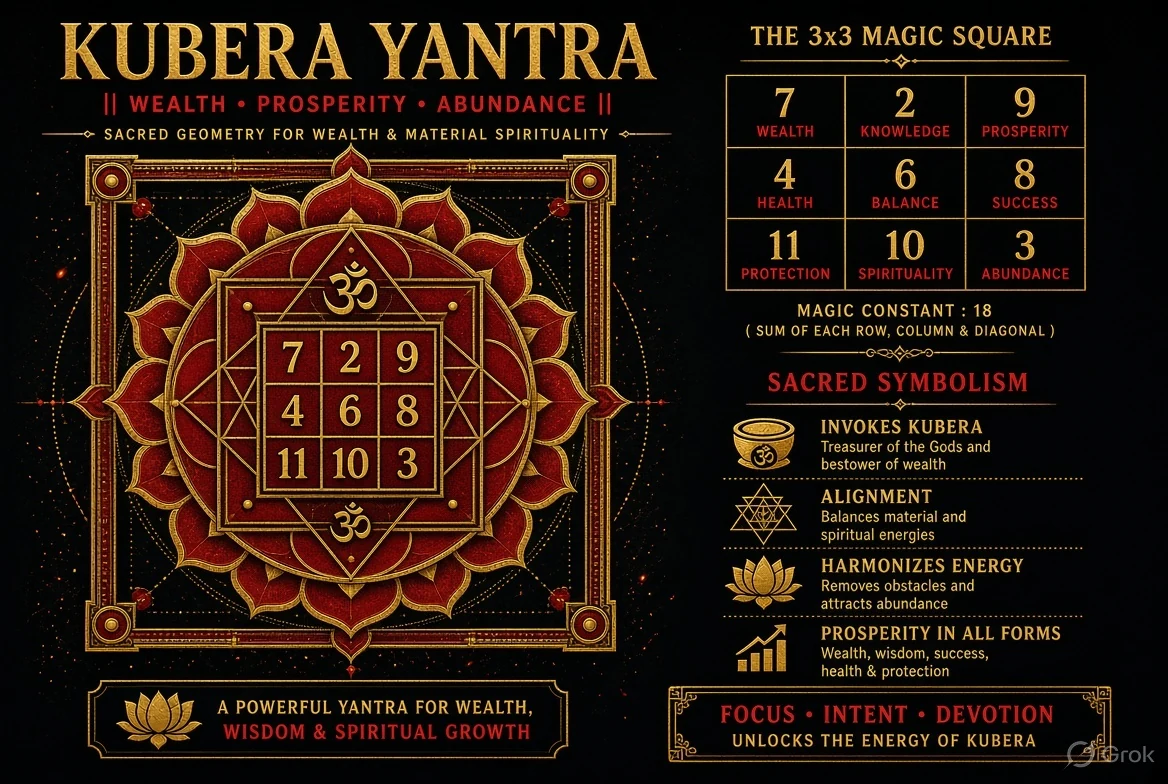
Quick answer: A widely circulated Kubera Yantra number chart is a 3×3 magic square using the nine integers 20 to 28, arranged so that every row, column and both main diagonals add up to 72. One valid arrangement is 23–28–21 / 22–24–26 / 27–20–25. This guide checks the arithmetic, explains why rotated versions can also be valid and separates the mathematics from religious beliefs about Kubera and prosperity.
Updated 20 November 2026. Visuals are educational illustrations; variations in local artistic and ritual traditions are described below.
Kubera Yantra 3×3 Magic Square: quick reference
| 23 | 28 | 21 |
|---|---|---|
| 22 | 24 | 26 |
| 27 | 20 | 25 |
Check: 23+28+21=72; 22+24+26=72; 27+20+25=72. Columns: 23+22+27=72; 28+24+20=72; 21+26+25=72. Diagonals: 23+24+25=72; 21+24+27=72.
What the Kubera Yantra number grid actually shows
Kubera is associated with wealth and the north in Hindu religious traditions. A popular numerical Kubera Yantra uses a square of nine numbers, rather than a drawing of the god himself. In the common arrangement the centre is 24, while the other entries run from 20 to 28. Each row, column and main diagonal has the same total, a property mathematicians call a magic square. This arithmetic makes the chart easy to test and a useful classroom exercise.
A magic square is not inherently evidence for a supernatural force. The number grid can have cultural symbolism and devotional meaning while also being analyzed with ordinary mathematics. Describing both aspects does not dismiss the tradition; it prevents a website or advertisement from presenting simple arithmetic as proof of guaranteed financial success.
How to verify all eight lines add to 72
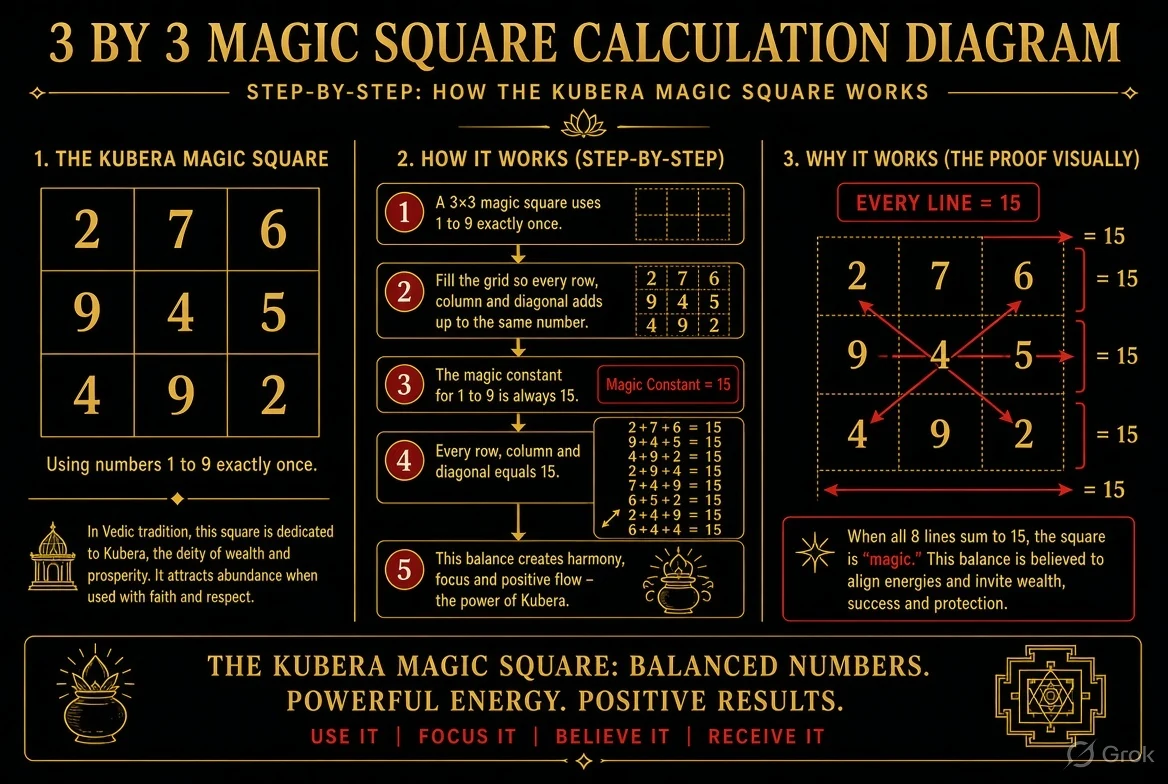
A valid 3×3 magic square must satisfy eight sums: three horizontal rows, three vertical columns and two long diagonals. In the arrangement above, the first row is 23+28+21, the middle row 22+24+26, and the last 27+20+25. Each gives 72. Repeat for the columns and diagonals. The middle element must be 24 for a magic square built from consecutive numbers 20 to 28, because it is the average of the nine values.
A frequent poster error swaps one pair of digits without recalculating the lines. Another mistake puts 24 in a corner while keeping the other numbers, so most rows fail. The simplest quality-control method is to copy the nine numbers into a spreadsheet and check each of the eight totals. If even one differs, the poster is not a correct representation of that particular 72-sum magic square.
Illustrated reference gallery
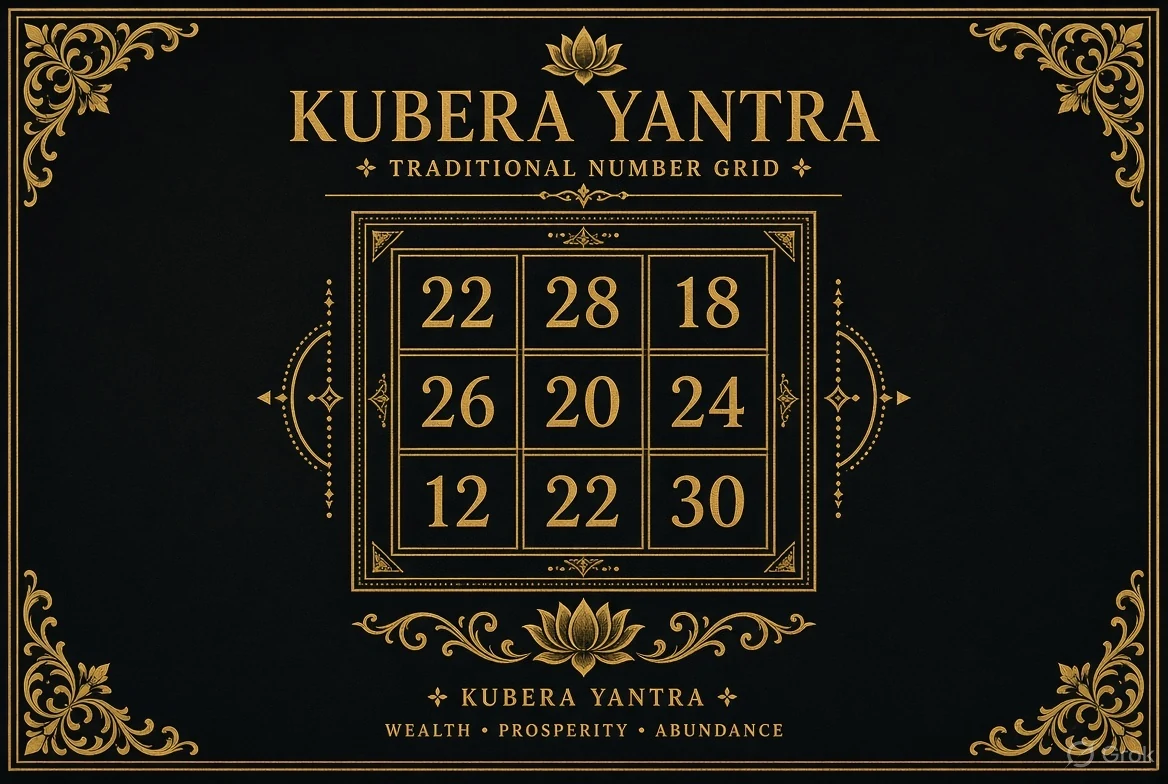
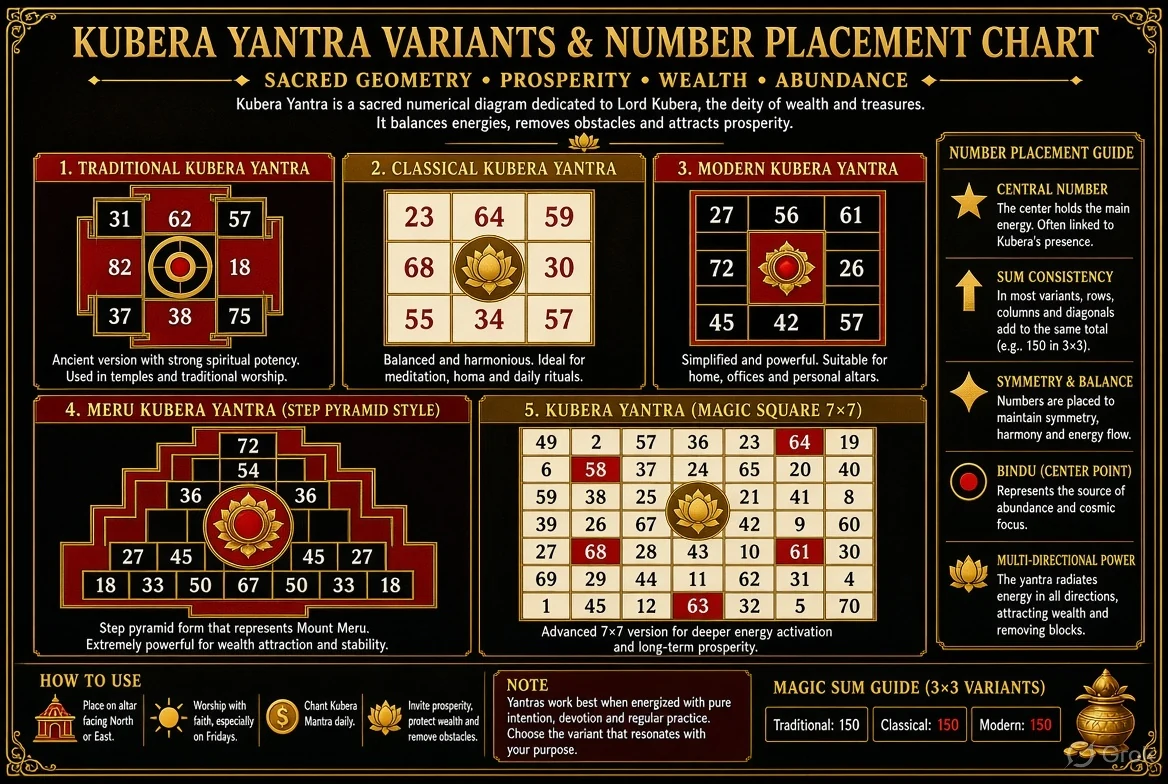
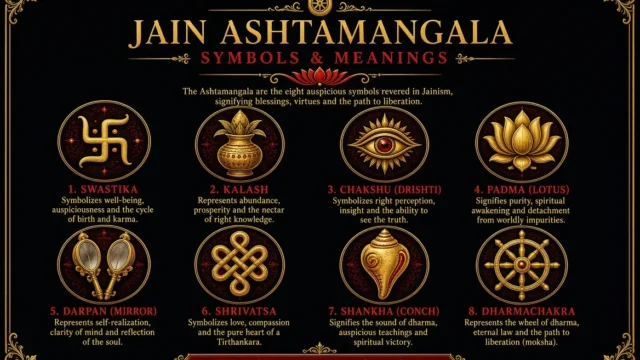
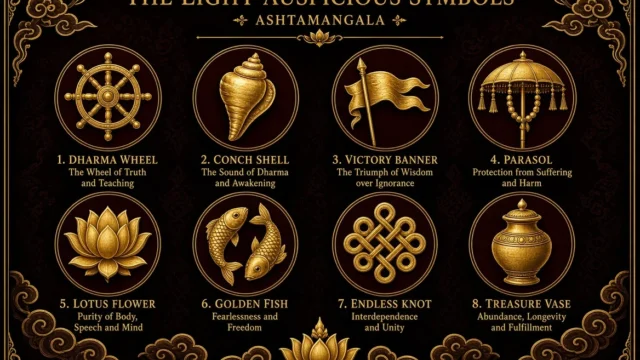
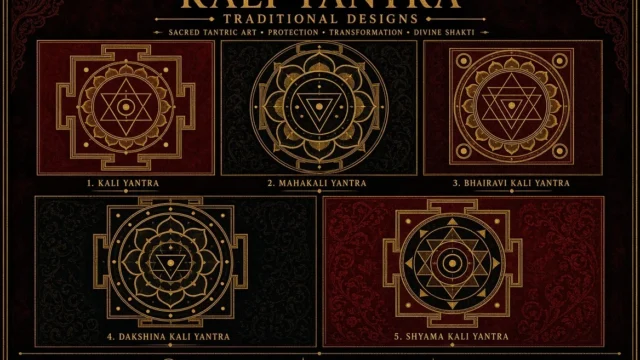
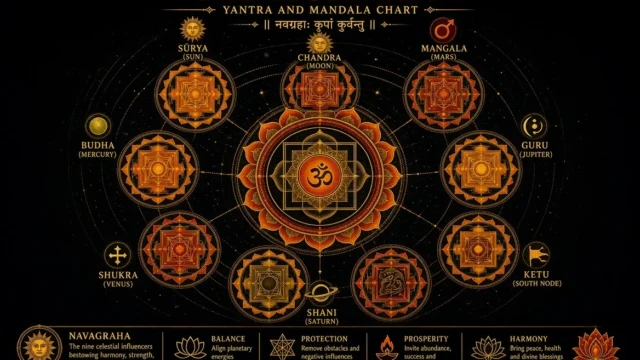
Compare these subject-specific illustrations with the names, figures and cautions in the explanatory text. They are not precision ritual templates.
Why is the constant 72 and the centre 24?
The sum of every integer from 20 through 28 is 216. Because a 3×3 square divides the nine cells into three equal-sum rows, each must total 216 ÷ 3 = 72. That conclusion follows before selecting any particular arrangement. The average value is 216 ÷ 9 = 24; in a 3×3 magic square containing these nine consecutive integers, 24 is the centre. The two numbers opposite each other across the centre sum to 48.
These properties explain why the printed number placements matter and how a teacher can spot errors without memorizing a particular graphic. The number 72 is the result of an arrangement of integers, not a measurement of wealth or a proven cosmic frequency. Other numerical yantras and magic squares use different number ranges and constants, so their sums should not be mixed in the same unexplained table.
Lo Shu, rotations and mirrored Kubera grids
The well-known Lo Shu 3×3 square uses the numbers 1 through 9 and has a magic constant of 15. Adding 19 to each entry produces a new square containing 20 through 28. Each row gets three additions of 19, so the constant rises by 57, from 15 to 72. This is a neat mathematical bridge between two number patterns and makes the construction easy to understand.
Turning a correct square clockwise or flipping it produces another correct square: the sums remain the same even if the top row changes. There are eight related orientations of the basic 3×3 normal magic-square pattern. Therefore two correctly summed posters may not be contradictory. However, whether a particular temple, family or devotional practice favors a particular orientation is a cultural question separate from the mathematical validity of rotations and reflections.
The cultural background: Kubera, directions and prosperity beliefs
Kubera is traditionally described as a guardian of the north and a figure associated with treasures, yakshas and prosperity. The number-grid image has become popular as a simple visual element in households, shops and festive posts. Some traditions use other Kubera-related motifs or inscriptions rather than this specific 3×3 square. In cultural discussion it is appropriate to describe how the diagram is used or believed to work; it is not accurate to present financial results as experimentally established.
A responsible explanation makes room for religious practice while warning that budgeting, lawful income, saving and financial decisions cannot be replaced by an image. Be particularly cautious about paid products promising that buying a special grid will remove debt instantly or guarantee lottery winnings. Mathematical neatness is not a proof of such claims.
Using the illustrated charts without copying a numerical mistake
The featured artwork introduces the idea; the grid chart shows one familiar placement of the numbers. The variation sheet compares layouts that may be mathematically equivalent or culturally different, and the calculation diagram lets you inspect each of the eight sums. On mobile, read the digits from the table in this article if the letters inside the image are too small or decorative.
When reusing a chart, check every digit, note the order, and ensure a genuine 3×3 grid rather than an extra ornamental row that changes the computation. If it is for a school project, show one worked equation and the sum-of-1-to-9 derivation; if it is for cultural discussion, explain that Kubera is associated with the north. Both are useful contexts, but one should not be misrepresented as a test of the other.
Mistakes, myths and safe conclusions
The grid does not need to be called an ancient mathematical discovery unless there is a dated source supporting that specific claim. Magic squares have long and complicated histories across cultures; a contemporary web poster does not establish where a particular sequence originated. Likewise, a shop may place extra symbols outside the nine cells without changing the central arithmetic. Distinguish decorative borders from numbered entries.
A simple final test is to calculate three rows, three columns and two diagonals, then inspect the centre 24. If that passes, you have a valid 72-sum square, though the historical or religious status of a printed design still requires its own evidence. The practical value of the diagram lies in clear mathematics and its place in cultural iconography, not in guaranteed money-making effects.
Frequently asked questions
What numbers appear in the Kubera Yantra magic square?
The common 3×3 version uses every integer from 20 to 28 exactly once.
What is the total of each row?
72; the columns and two main diagonals also total 72.
What number is in the centre?
24.
Why do some Kubera charts have the numbers in different places?
Some are rotations or reflections that preserve the correct sums; other variants are genuinely different.
Is Kubera Yantra an actual mathematical puzzle?
Yes, the well-known number grid is a valid 3×3 magic-square construction.
Does the number 72 guarantee wealth?
No. The number is an arithmetic result and does not establish a financial guarantee.
References and conclusion
The 3×3 Kubera square is easy to check: nine consecutive numbers, 24 in the centre, eight lines that each total 72. Its cultural associations can be appreciated without mistaking arithmetic for a guarantee of financial success.
Further reading: Kubera 72-grid arithmetic and cultural context; Hindu aesthetics: Kubera square.
Note: This is a historical, cultural and educational explainer, not financial, medical, architectural or ritual certification.












Share Your Opinion
Comments are closed on this post.