 Vista
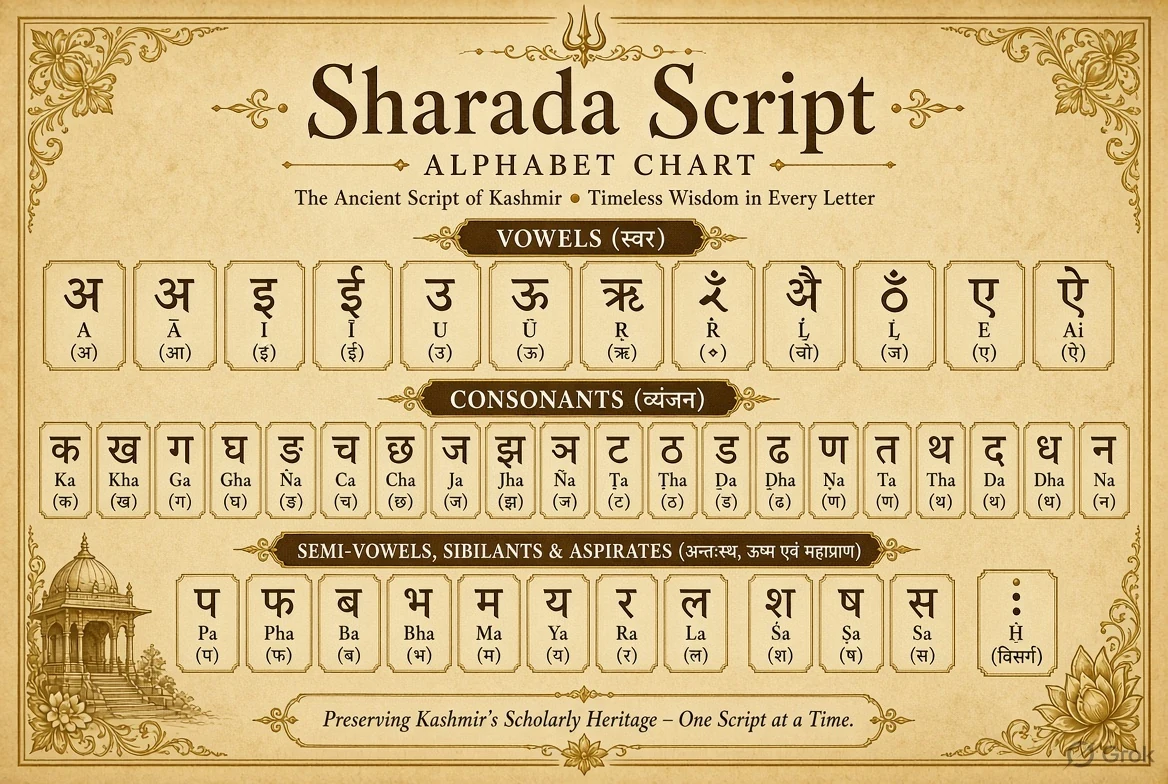
Direct answer: Sharada, also written Śāradā or Sharda, is an important historical script of Kashmir used for Sanskrit, Kashmiri and other northern South Asian languages. It was a major inscriptional and literary hand from approximately the eighth century CE onward. The main Sharada Unicode block is U+11180–U+111DF, with a Sharada Supplement U+11B60–U+11B7F. Unlike Mahajani, Sharada has an encoded set of its own decimal digits. This guide distinguishes authentic character categories from modern artistic imitations.
Updated 20 November 2026. Historical letterform illustrations are learning aids, not certified manuscript facsimiles.
Sharada Script Alphabet Chart: quick reference
| Feature | Sharada fact |
|---|---|
| Historic heartland | Kashmir and surrounding regions |
| Uses | Sanskrit, Kashmiri manuscripts, inscriptions, ritual texts |
| Main block | U+11180–U+111DF |
| Supplement | U+11B60–U+11B7F |
| Sharada digits | U+111D0–U+111D9 |
| Virama | U+111C0 |
What is Sharada script and why does Kashmir matter?
Sharada is a Brahmi-derived script closely linked with the intellectual and manuscript traditions of Kashmir. Unicode describes it as a principal inscriptional and literary script there from around the eighth century CE until the twentieth century. Sanskrit manuscripts, Kashmiri writing and epigraphic records form important bodies of evidence. The name can appear with differing spellings in Romanized text, such as Śāradā, Sharda or Sharada. These refer to the writing system, not an automatically identical font used in every place or century.
Modern Kashmiri is commonly written in a Perso-Arabic script, while Devanagari also appears in certain contexts. Sharada survives in more limited cultural and ritual uses, especially among some Kashmiri Pandit communities. A student interested in old Kashmiri manuscript scans needs to know which script was used, what language the text contains and the period of the copy. Religious tradition, language identity and character encoding are related but different questions.
Sharada alphabet: vowels, consonants and diacritics
Sharada is an abugida: consonant letters carry an inherent vowel unless a sign changes it. The repertoire includes independent vowels, consonants, dependent vowels, marks and the virama. Unicode explicitly notes some vowel letters that must be encoded as a single atomic character rather than broken down into visible parts. For example, the Sharada letter AI is U+1118E. A colorful chart that decomposes it incorrectly can produce text that does not round-trip between systems.
Sharada’s headstrokes are a visible aspect of many character shapes, but unlike ordinary modern Devanagari writing they do not follow a fixed rule of joining all adjacent letters into a continuous top line. Historical handwriting styles vary. The virama U+111C0 normally cancels the inherent vowel and may appear as a visible sign or participate in conjunct rendering. A reliable alphabet guide must explain that the modern standardized glyph is not a guarantee of how a particular scribe wrote the same sound.
Sharada script numerals and character signs
Sharada has its own ten digit characters encoded from U+111D0 to U+111D9. This distinguishes it from Mahajani, whose decimal digits are encoded using Devanagari characters. Digits are especially important when interpreting old manuscript folio numbers, dates and annotation systems. Do not copy a stylized number from an AI image and label it an authentic Sharada numeral without checking the Unicode reference chart or a documented specimen.
Other specialist marks include candrabindu, avagraha and abbreviation separators. The Sharada word separator is U+111C8 and the abbreviation sign is U+111C7. There are also script-specific danda marks. Some phonetic symbols preserve Sanskrit pronunciation details not obvious in modern English transliteration. These marks are not decorative punctuation that can be discarded in a critical edition. A learner should look at the complete character inventory before attempting to typeset or normalize a manuscript.
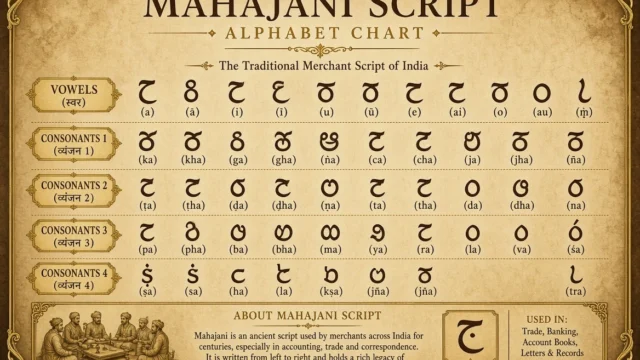
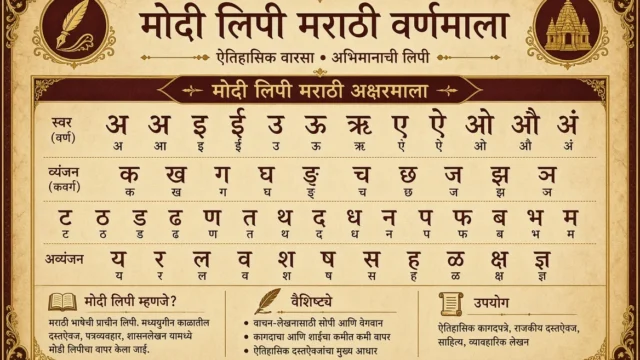
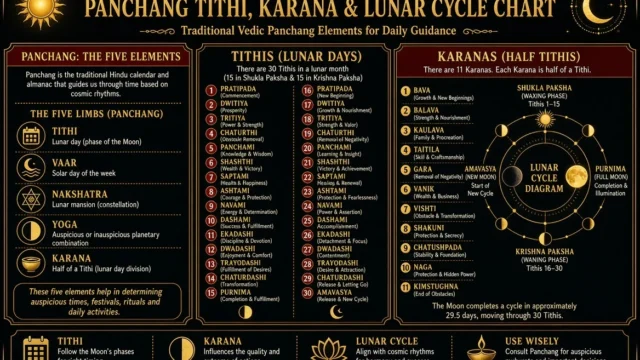
Sharada Script Alphabet Chart: pictures and comparisons
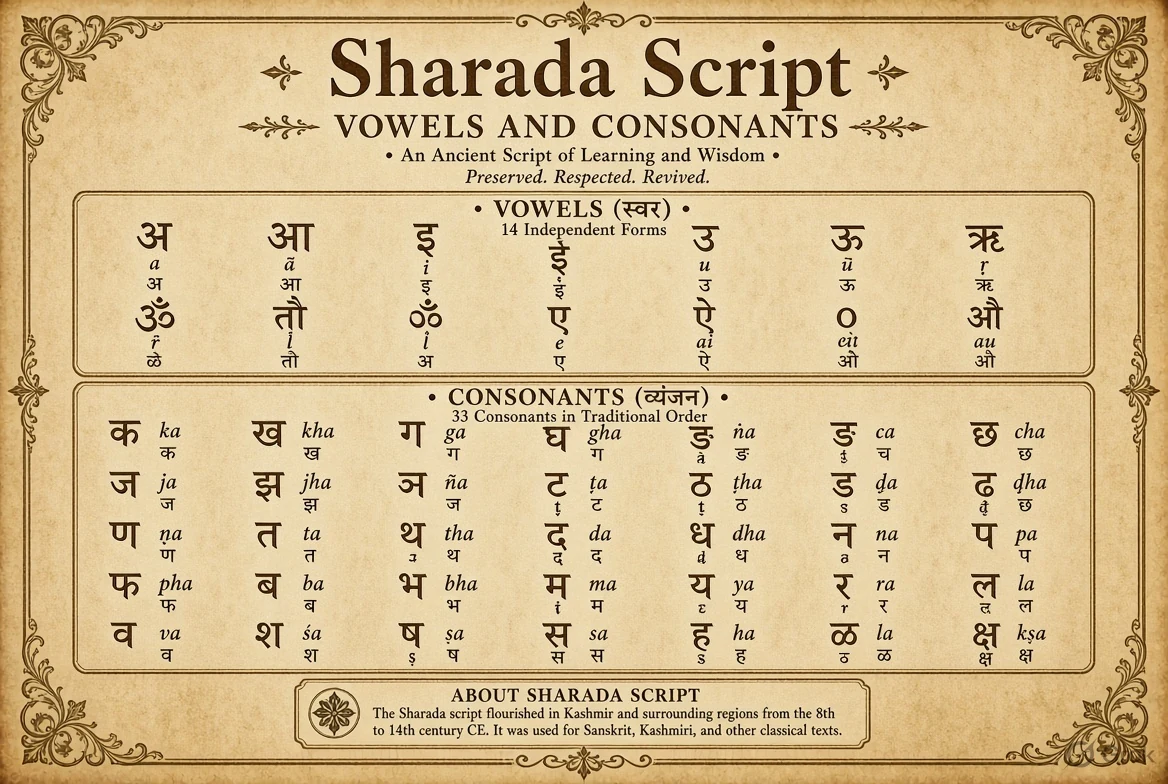

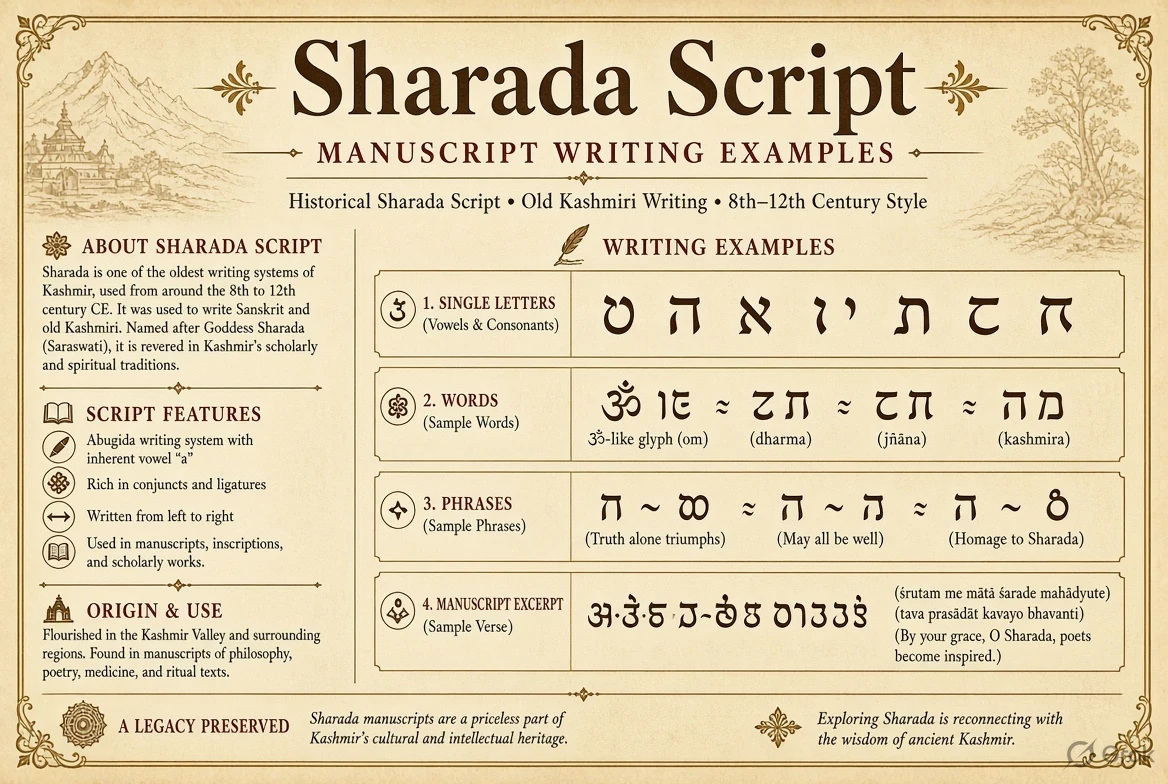
Sharada compared with Devanagari and Takri
Sharada and Devanagari are historically related, but their letterforms and rendering practices differ. Certain Sharada letters have headstrokes that do not necessarily connect across a word. Takri, another important northwestern Indic script, developed through related historical forms and served Himalayan and northern languages. It should not be called the same script as Sharada simply because the two are connected in the wider regional family. Some contemporary comparative charts oversimplify these links into a straight one-to-one alphabet history.
A useful Sharada versus Devanagari chart matches sound values and labeled authentic character forms. When reading older texts, locate the writing’s date and origin, because regional hands can diverge from a modern Unicode sample font. A square-box character on mobile often means missing font support, not an ancient unknown letter. Look at the underlying Unicode code points before concluding that a digit, vowel or conjunct has disappeared.
Kashmiri vowel signs and the Sharada Supplement
Unicode contains a Sharada Supplement block U+11B60–U+11B7F, including combining marks designed for certain Kashmiri vowel distinctions. The corresponding independent vowel spellings can be represented through sequences involving standard Sharada vowels and supplementary signs. This matters because a simplified Sanskrit-oriented alphabet may not show everything needed to represent Kashmiri accurately. An educational article claiming to provide ‘all Sharada characters’ should explain whether it covers the supplementary material.
A manuscript’s spelling may not match modern Kashmiri conventions. Text editors also differ in font support for the supplement. When entering such characters, use a known Unicode implementation and verify the visible combinations against standard examples. It is easy to lose a mark when copying between apps that do not support the script well. If the intended audience only needs a beginner’s vowel-consonant chart, explain that it is introductory rather than a full specialist edition.
How to approach an old Sharada manuscript
Begin with a documented source such as a library, museum or manuscript repository. Preserve the full folio image, margins, notes and colophon. Record the likely date, material and language. Compare common letterforms with the Unicode reference and a dated manuscript sample, then transcribe slowly. Keep uncertainties visible instead of silently choosing a Sanskrit or Kashmiri word that fits your expectations. A modern spelling of a familiar religious phrase should not override a visibly different historical reading.
For family archives or ritual texts, ask a reader experienced in Sharada paleography to check important passages. AI-created transcriptions are starting hypotheses, not verified readings. Apparent punctuation may be part of a particular manuscript convention. Similarly, a title page that names a goddess or a place does not prove the entire manuscript’s origin without further evidence. Public-facing illustrations should distinguish an original photograph from an artwork inspired by Sharada letters.
Sharada Unicode font, typing and accessible charts
The main Sharada block uses U+11180–U+111DF and its supplement has separate code points. Unicode enables storage and exchange of text, but the font and renderer must support each shape and mark. On devices without appropriate fonts, readers may see empty boxes or detached combining signs. Provide readable transliteration and image ALT text while preserving the actual character codes in a searchable version. A screenshot alone cannot be easily searched or corrected.
A chart can be optimized for mobile by grouping vowels, consonants, digits and signs on separate images rather than forcing them into one tiny grid. Use captions like ‘Sharada script vowels and consonants — Unicode reference’ where accurate and avoid asserting that every graphic is a historic facsimile. A high-resolution educational illustration and an authenticated manuscript photo serve different purposes; keep their source descriptions distinct.
Common Sharada chart errors and next-search ideas
Typical mistakes include using Devanagari glyphs with cosmetic changes, omitting Sharada’s own digits, ignoring the Sharada Supplement, confusing Takri with Sharada and declaring all manuscript headstrokes identical. Another is confusing the goddess name Sharada with proof that a particular image was made in Kashmir. Accurate sourcing matters more than fashionable typography. When the exact shape is uncertain, use a reference title rather than an unsupported claim of historical correctness.
Useful follow-up searches include ‘Sharada lipi alphabet chart PDF’, ‘Sharada numerals 0 to 9’, ‘Sharada Unicode font download’, ‘Sharada versus Takri script’ and ‘how to read Kashmiri Sharada manuscripts’. These are plausible related questions, not measured search volumes. A well-explained chart helps readers appreciate Kashmiri manuscript culture while recognizing the limits of unverified visuals.
Frequently asked questions
What is Sharada script?
A historic Indic writing system especially linked to Sanskrit and Kashmiri texts from Kashmir.
What is the Sharada Unicode range?
U+11180–U+111DF; additional characters occur in Sharada Supplement.
Does Sharada have its own digits?
Yes, U+111D0–U+111D9.
Is Sharada the same as Devanagari?
No, despite their common script ancestry.
Is Sharada still used?
In limited cultural and ritual contexts, though it is not the dominant everyday Kashmiri writing system.
Can I translate an ancient inscription from a chart alone?
No; the source, handwriting and language need specialist interpretation.
Sources and conclusion
For character identities and writing structure, see The Unicode Standard: historic Indic scripts. Match historical handwriting with archival originals before claiming an exact transcription.












Share Your Opinion
Comments are closed on this post.