 Vista
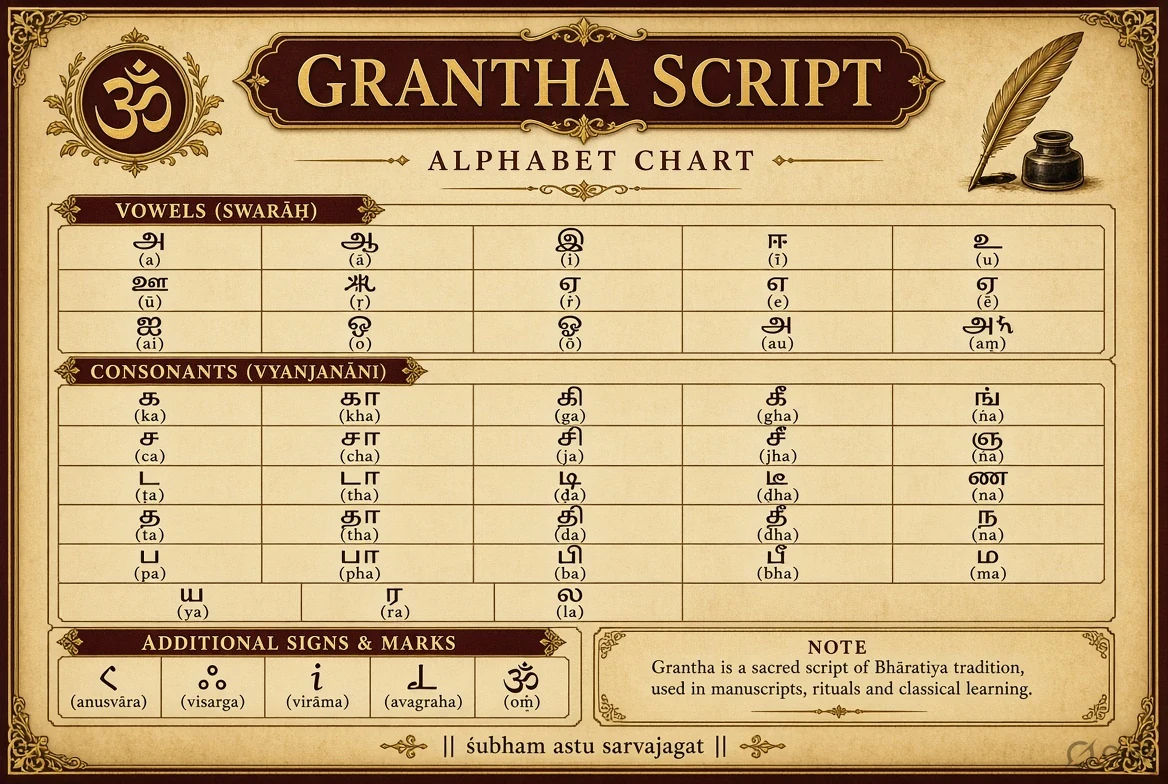
Direct answer: Grantha is a South Indian script chiefly used to write Sanskrit, including Vedic Sanskrit, especially in Tamil Nadu. Its Unicode block is U+11300–U+1137F. Grantha is related to South Indian writing traditions and visually resembles Tamil in places, but it has its own consonant inventory and complex stacked conjuncts suited to Sanskrit. A Grantha alphabet chart is therefore not simply a Tamil alphabet with a few extra letters. This guide shows what to look for in historical texts and modern digital charts.
Updated 20 November 2026. Historical letterform illustrations are learning aids, not certified manuscript facsimiles.
Grantha Script Alphabet Chart: quick reference
| Feature | Grantha fact |
|---|---|
| Primary language | Sanskrit, including Vedic texts |
| Main region | Tamil Nadu; also other southern regions |
| Unicode block | U+11300–U+1137F |
| Writing type | Brahmi-derived abugida |
| Special feature | Consonant stacks and ligatures |
| Mixed context | Tamil-Grantha and Manipravalam writing |
Grantha script history from Pallava inscriptions to later manuscripts
Grantha descends from the Brahmi writing tradition. Unicode traces intermediate early forms to inscriptions associated with the Pallava kings from approximately the fourth century CE. The modern Grantha forms represented in the standard chiefly belong to developments after the thirteenth century. These dates refer to the evolution of writing, not a single inventor creating an alphabet in one year. Manuscripts, temple inscriptions and traditional Sanskrit learning provide several kinds of evidence for the script’s long history.
Grantha is especially associated with Tamil Nadu but also appears in other parts of southern India and Sri Lanka. It was used to write Sanskrit prayers, religious works, Vedic material and learned texts. Some documents combine it with Tamil writing and forms of Manipravalam, which mixes Sanskrit and Tamil. The exact choice of script depends on the writer, tradition, language and time. A picture of Sanskrit text in a South Indian style should be assigned to Grantha only after its actual characters are checked.
Grantha vowels and consonants: what belongs in an accurate chart
A proper Grantha alphabet guide distinguishes independent vowel letters, consonant letters and dependent vowel signs. Some vowel signs sit to the left, some to the right or below a consonant, and certain signs have two components. Unicode notes that the vowel signs for e and ai can be placed to the left of the base, and the o and au signs may use parts on both sides. An illustration that places every vowel sign only after the letter would not accurately represent the writing system.
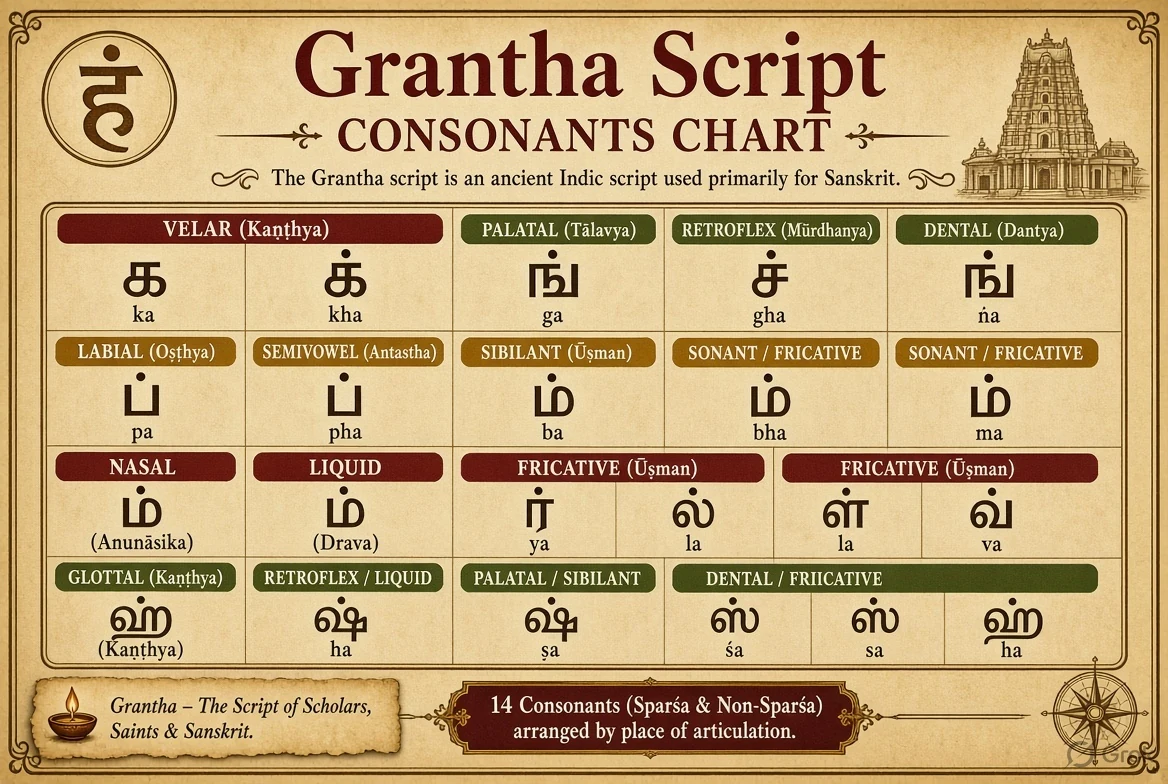
Grantha can represent the full range of Sanskrit consonant distinctions directly, an advantage when a Tamil speaker wants to write Sanskrit without relying on extra diacritical notation in Tamil text. A useful chart should compare sounds, not just visual shapes. A source-based reference avoids the mistake of substituting Tamil characters whose written values do not preserve all Sanskrit contrasts. The international standard names characters by their script and phonetic identity, while the typeface decides how their edges and curves look.
Sanskrit conjuncts: why Grantha letters are stacked
A defining visual trait of Grantha is its handling of consonant clusters. Multiple consonants can be stacked vertically, combined as ligatures or written using mixed patterns. Unicode says that non-Vedic printed text commonly has two-level stacks, while Vedic Sanskrit may have three-level structures. Longer clusters require special handling, sometimes spreading across more than one orthographic grouping. For readers, a complex vertical shape may represent several consonants rather than a single unusual letter.
The virama suppresses the inherent vowel of a consonant. Grantha has distinct visible forms of virama behavior: it may fuse to a letter, connect to it or stand apart, depending on the consonant and print style. Mistaking a conjunct for a new alphabet symbol is a common error in generated charts. Students should begin with simple independent forms and then learn how a short Sanskrit word is assembled. Only authentic examples should be labeled as exact orthographic models.
Grantha Script Alphabet Chart: pictures and comparisons


Grantha vs Tamil: the difference is more than decorative curves
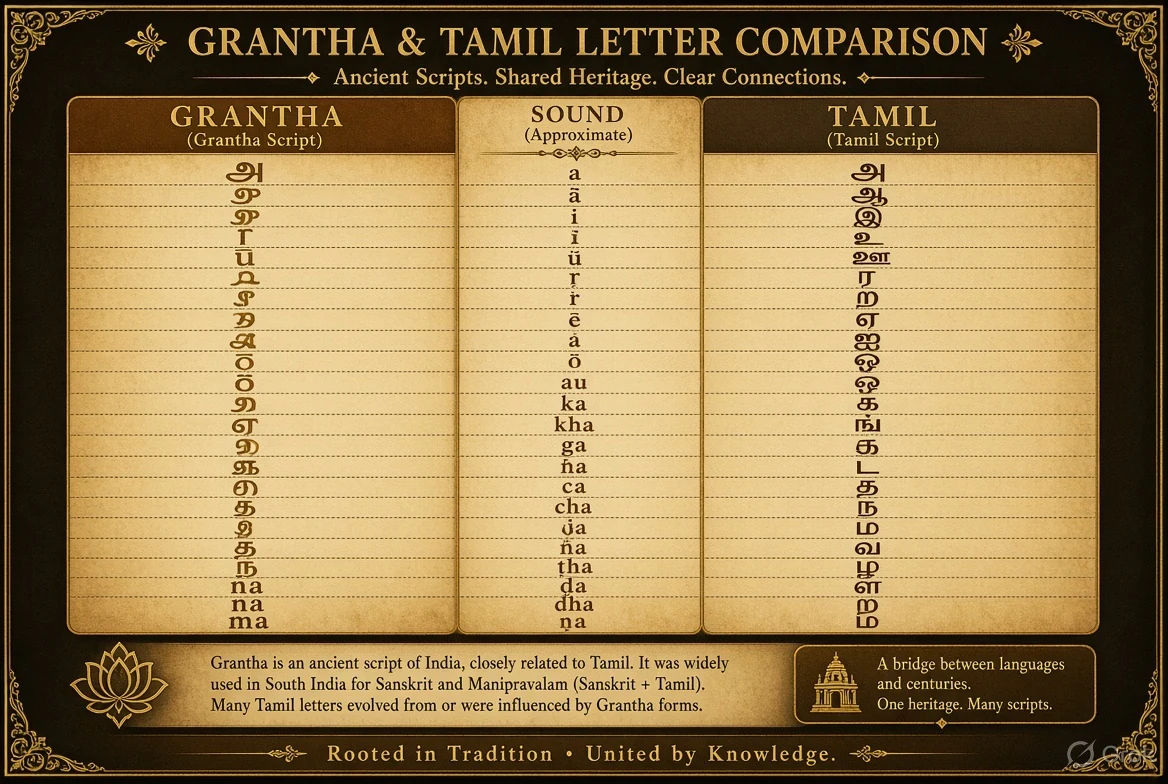
Grantha resembles Tamil in parts of its visual history, and the two writing systems can appear together in the same manuscript or inscription. Yet the written structures differ. Grantha was used to represent Sanskrit phonology more fully, while standard Tamil spelling has a smaller range of basic consonant letters. Historical Tamil–Grantha mixture helps explain why Sanskrit loanwords and ceremonial formulas may use different script forms from the surrounding Tamil prose.
A side-by-side chart should identify which column is Tamil and which is Grantha. It should also note whether the sample is modern Unicode text, a historic hand or a printed reproduction. The same word may be spelled through different conventions depending on language and century, so a naive character-by-character swap can yield incorrect results. Avoid calling a purely decorative Grantha-like font a faithful translation of an old Tamil temple inscription.
Grantha, Vedic Sanskrit and manuscript diacritics
Grantha has features needed for writing Vedic material, including signs for pitch, tone or other recitation distinctions. Unicode’s Grantha block contains a range of cantillation marks, and some additional Vedic signs are encoded elsewhere. Ordinary beginner alphabet charts often leave these out, which is acceptable if the chart does not claim to cover every Vedic character. For a student looking at a mantra or recitation manuscript, these marks can matter to the intended reading.
Other relevant signs include the pluta mark, which indicates vowel lengthening in certain Vedic contexts, and special vowel-sign variants preserved in historical texts. In modern Grantha, some of the old two-part signs have more compact contemporary forms. These variations need an explanatory note so that readers do not assume an older manuscript is wrong because it differs from a digital font. Sanskrit content should not be copied from an illegible image and presented as a verified mantra.
Grantha Unicode typing and correct script rendering
The Unicode block U+11300–U+1137F supports the core Grantha character set, but correct rendering of complex conjuncts also requires suitable fonts and shaping engines. A phone or text editor may display unsupported characters as boxes, detach vowel signs or fail to stack consonants. Such problems are technical rendering failures, not evidence that a historical alphabet lacked those signs. For reliable educational material, keep the official names list and a source-based image side by side.
If a user searches ‘Grantha script alphabet PDF’, an accurate page should make the difference between a basic reference chart and a complete professional transcription clear. ALT text can describe ‘Grantha Sanskrit consonants and conjuncts’ while the caption notes that the illustration is a learning resource. A modern chart should not replace a photographed palm-leaf manuscript for historical claims. It is better to admit that a particular glyph is a stylized form than to present it as the only correct spelling.
Reading Grantha palm-leaf manuscripts responsibly
Begin with a documented manuscript source or temple archive and note the origin, date and physical material. Inspect the whole folio and the order of its lines. Identify a simple word, compare it to an official chart and follow dependent vowel signs before tackling stacked conjuncts. Keep the first transcription literal; only afterward should you transliterate it into Devanagari, Tamil or Roman letters. If an unfamiliar Sanskrit phrase seems familiar, do not automatically change visible characters to fit a known verse.
Palm-leaf manuscripts may contain faded ink, cracks, cuts and margins used for metadata. Scanning only the text center can remove evidence needed for identification. A religious or historical quotation should have a source that readers can trace. For formal academic use, compare more than one manuscript reading and record editorial choices. An automated recognition tool can assist orientation but is not guaranteed to read complex Grantha ligatures accurately.
SEO questions and common alphabet chart mistakes
Likely next queries include ‘Grantha lipi alphabet chart’, ‘Grantha script letters vs Tamil’, ‘Grantha Sanskrit vowels and consonants PDF’, ‘How to read Grantha palm leaf manuscripts’ and ‘Grantha Unicode font’. These are informational predictions, not measured query volumes. They cover different intents: beginners want names and pictures, language learners want sound values, and archivists want source-specific handwriting. Keep those needs distinct in captions and FAQs.
Common errors include presenting Tamil letters as Grantha without labels, mixing Vedic signs into the basic consonant row without explanation, omitting consonant stacking and claiming that all manuscripts used one unchanging calligraphic style. A trustworthy illustrated article cites the official standard and distinguishes the surviving historic artifact from the newly drawn guide. Readability, original context and correct character identities should take priority over decorative typography.
Frequently asked questions
What was the Grantha script used for?
Primarily for writing Sanskrit, especially in Tamil Nadu and related southern traditions.
What is the Grantha Unicode block?
U+11300–U+1137F.
Is Grantha the same as Tamil?
No. They are related historically but distinct writing systems.
Why are Grantha consonants stacked?
The script uses stacks and ligatures to represent Sanskrit consonant clusters.
Is Grantha still used?
It remains relevant to traditional religious, Vedic and manuscript studies.
Does an alphabet image replace a manuscript edition?
No; source-specific spelling and historical hands need independent verification.
Sources and conclusion
For character identities and writing structure, see The Unicode Standard: historic Indic scripts. Match historical handwriting with archival originals before claiming an exact transcription.











Share Your Opinion
Comments are closed on this post.