 Vista
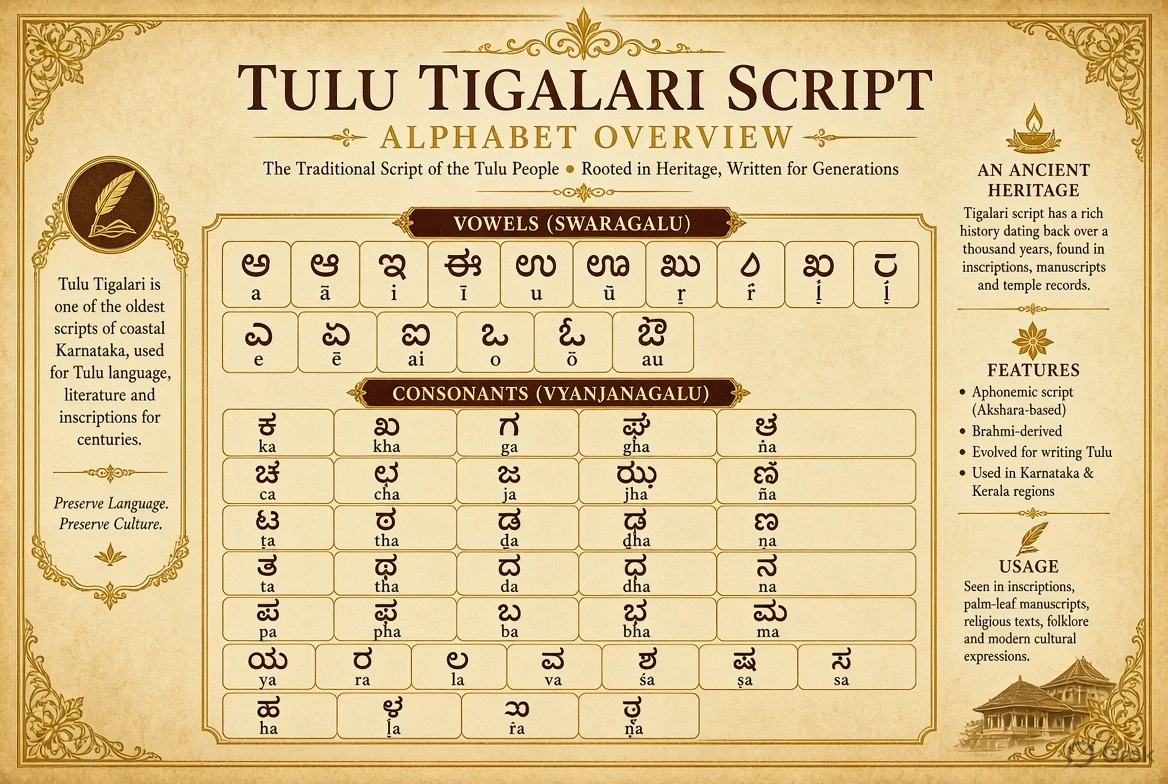
Direct answer: Tulu–Tigalari is a historic South Indian script attested in manuscripts from coastal Karnataka and northern Kerala, especially Sanskrit religious material and some Tulu or Kannada texts. Its Unicode block U+11380–U+113FF was added in Unicode 16.0. The standard records fourteen independent vowels and thirty-six consonants. Tulu–Tigalari is not identical to modern Kannada or Malayalam, even though the scripts share historical influences. This guide compares letters, conjunct rules, digits, manuscripts and mobile font support.
Updated 20 November 2026. Illustration images explain a writing system; they are not certified historical manuscripts.
Tulu Tigalari Script Alphabet: essential facts
| Feature | Verified reference |
|---|---|
| Region | Coastal Karnataka and northern Kerala |
| Main old texts | Sanskrit religious manuscripts; some Tulu, Kannada |
| Unicode block | U+11380–U+113FF |
| First encoded | Unicode 16.0 (2024) |
| Independent vowels | 14 |
| Consonants | 36 |
| Decimal digits | Kannada digits U+0CE6–U+0CEF |
What is Tulu–Tigalari and what languages used it?
Tulu–Tigalari has a manuscript history in western coastal South India. The Unicode Standard describes use dating back to at least about 1250 CE and mentions numerous surviving manuscript witnesses from Karnataka and northern Kerala. Most are Sanskrit religious works, while smaller numbers of Tulu and Kannada texts also occur. This is a crucial distinction: a script associated with Tulu culture did not exclusively write the Tulu language, and an old Sanskrit manuscript should not be mislabeled as Tulu solely because the letters look Tigalari.
The writing system has historical influences from medieval Grantha, Vatteluttu and Telugu-Kannada scripts. It sits within a complex regional evolution rather than having one simple parent and one modern replacement. Communities researching Tulu, Sanskrit scholarship and coastal cultural heritage may have different reasons to learn it. A visually accurate alphabet chart should identify the script first and the manuscript language second. It should not promise that any random contemporary Malayalam or Kannada text is already Tulu–Tigalari.
Fourteen vowels and thirty-six consonants: alphabet structure
Unicode encodes fourteen independent vowel letters from U+11380 through U+11391 and thirty-six consonants from U+11392 through U+113B5. The consonant set includes two comparatively rare Dravidian sounds represented by special RRA and LLLA letters. Like other Brahmi-derived abugidas, Tulu–Tigalari consonants generally include an inherent ‘a’ sound. Dependent vowel marks replace this inherent vowel where needed. A reliable chart distinguishes independent vowels from combining signs and does not count the two categories as the same set of letters.
Vowel signs can appear on the left, right or beneath consonants. Several are formed as ligatures or as two-part signs placed on both sides. That is why a simple copy-paste into a phone lacking script support may misplace accents or detach marks. The visual form can change depending on the consonant it follows. When presenting a student-friendly chart, include readable labels and confirm actual code points rather than relying on a decorative reconstruction.
Virama and conjoiner: a surprising difference from Kannada
Unicode describes Tulu–Tigalari as having both a virama U+113CE and a separate conjoiner U+113D0 used to form conjunct consonant clusters. This differs from common Devanagari and Kannada behavior, in which virama itself participates in making conjuncts. Tulu–Tigalari’s virama also has special functions for the Tulu vowel sounds ŭ and ū̆ described in the standard. A chart that calls every small connecting stroke the same halant risks showing incorrect composition.
The script also has a looped virama for a limited group of letters and a repha mark that can affect how preceding ‘r’ is displayed. These are specialist subjects, so a basic alphabet chart does not have to display every combination. It should, however, avoid pretending that one printed form covers all historical cases. This difference explains why some experimental fonts show broken clusters even when the individual characters render correctly. Choosing a font with real shaping support is part of accurate digital preservation.
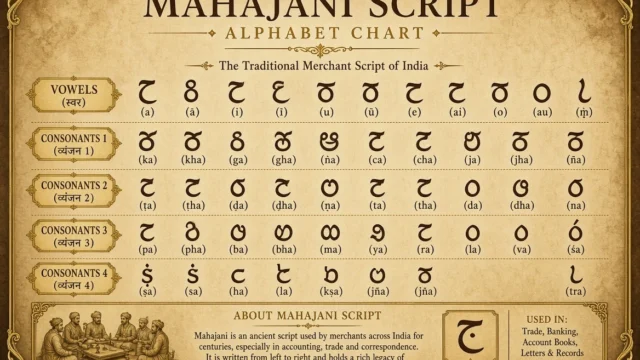
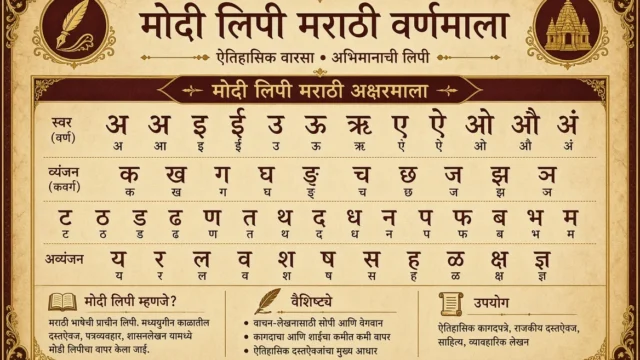
Tulu Tigalari Script Alphabet: pictures and writing samples


Tulu–Tigalari versus Kannada, Malayalam and Grantha
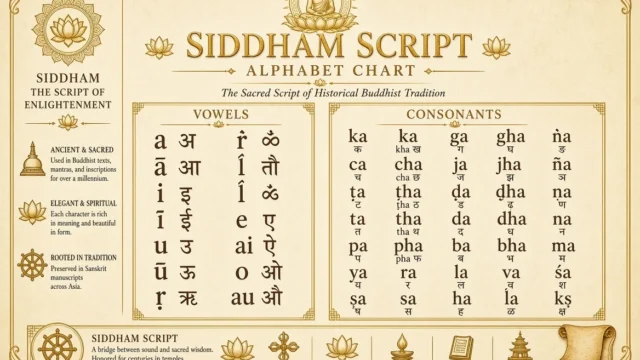
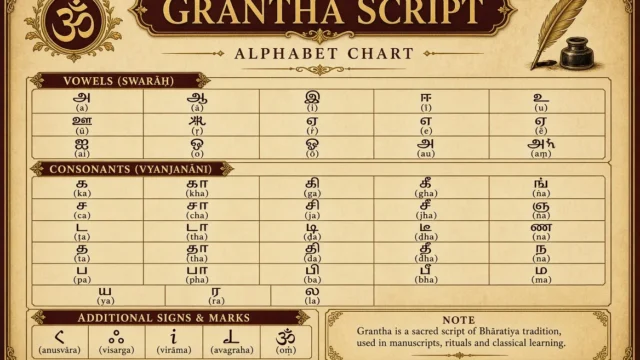
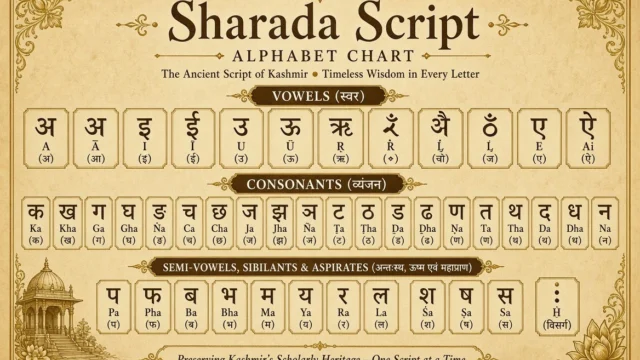
The coastal writing history of the region overlaps with Kannada, Malayalam and Grantha traditions, but the scripts are not interchangeable. A modern Kannada character cannot simply be substituted for every Tulu–Tigalari character. Unicode specifically recognizes the script’s own code points and orthographic rules, which distinguish the shapes and their digital behavior. A responsible comparison chart pairs verified character values and identifies which image is a manuscript example or modern font rendering.
Because Tulu–Tigalari was often used for Sanskrit writing, a Sanskrit word may appear in Tigalari while an equivalent phrase is printed in Devanagari or Malayalam today. That does not make the source text a different language. Historical handwriting includes varied ligatures and regional styles, so an educational poster should say where its character forms came from. Readers seeking to translate a palm-leaf manuscript need language expertise alongside letter recognition.
Kannada digits: avoid invented Tigalari number charts
An easily missed fact is that Unicode directs Tulu–Tigalari text to use Kannada decimal digits U+0CE6 through U+0CEF. This is similar to Mahajani and Kaithi using Devanagari digit code points, but different from Sharada, which has its own digits. A website may show a series of old handwritten numeral shapes and call them the ‘Tigalari numbers 0 to 9’. Those can be historical stylistic examples, but must not be presented as a separate officially encoded decimal block without evidence.
The distinction matters when digitizing account entries, folio numbers, manuscript dates and manuscript catalog records. A digital transcription should preserve source numerals while using valid code points. If a particular scribe’s numbers differ in pen style, document the glyph variation rather than creating unsupported characters. This is especially useful for search engines and accessible text, because genuine Unicode numbers can be found and compared, whereas arbitrary decorative glyphs in an image cannot.
Where Tulu–Tigalari manuscripts survive and how to study them
The script appears in a sizable body of palm-leaf and related manuscript material from Karnataka and northern Kerala. Texts may be Sanskrit religious or scholarly works and occasionally regional-language material. Libraries and family collections may catalog them under variant script names such as Tigalari or Tulu-Tigalari. Before transcribing, record where the manuscript is held, the date estimate, folio numbers and physical condition. A photograph without these details is an illustration, not enough on its own to substantiate a historical claim.
Palm leaves can crack, fade or have damage around stitching holes. Marginal marks and line breaks can change how a text is read. Start with a clear full folio scan and compare several recurring letters, particularly those with contextual vowel marks. First transcribe exactly, then transliterate into modern Kannada, Malayalam, Roman or another script as appropriate. A smoother translated paragraph produced by AI is not proof the source’s ligatures were understood. Important scholarly conclusions should receive independent verification.
Unicode 16.0 support and why some mobile devices show boxes
Tulu–Tigalari entered the Unicode Standard in version 16.0, released in 2024, at U+11380–U+113FF. Font availability and shaping support can lag behind encoding, so older software may show blank boxes or malformed vowel signs. This is particularly relevant for users on phones who see readable Kannada text but missing Tulu–Tigalari glyphs. The correct solution is not to switch all letters into unrelated scripts without telling the reader. A compatible font and rendering engine are needed.
Accessible pages can offer transliteration, descriptions and official Unicode chart links alongside a visual. Keep the original media dimensions rather than cropping reference glyphs. Label the feature image ‘Tulu–Tigalari alphabet educational illustration’ and make the embedded comparison images specific in ALT text. A dynamic image caption should never claim the exact historical shapes have been certified if only an illustration was available.
Common Tigalari alphabet errors and next-search questions
Frequent errors include writing that Tulu–Tigalari has a separate number set when Unicode uses Kannada digits, mistaking the language name Tulu for proof of the manuscript’s content, confusing all old coastal scripts and overlooking the special conjoiner. Another is assuming that all modern Android devices will support the 2024 encoding equally well. Character identity, font support and historic handwriting need different verification steps.
Likely next searches include ‘Tulu Tigalari alphabet PDF’, ‘Tigalari vs Kannada letters’, ‘Tulu script vowels and consonants’, ‘Tigalari Unicode keyboard’, and ‘How to read Tigalari palm leaf manuscript’. These are useful search-intent predictions, not claimed measured trends. The immediate goal for a visual guide is to make the writing system recognizable and direct serious readers to accurate Unicode and archival sources.
Frequently asked questions
Is Tulu–Tigalari the same as modern Kannada?
No. It is a distinct historical writing system.
What is the Tulu–Tigalari Unicode block?
U+11380–U+113FF, added in Unicode 16.0.
How many vowels and consonants are encoded?
Fourteen independent vowels and thirty-six consonants.
Does Tulu–Tigalari have its own Unicode digits?
The standard specifies using Kannada digit code points.
Was Tigalari only used for the Tulu language?
No. Many surviving texts are Sanskrit, with some Tulu and Kannada material.
Why does Tigalari look broken on my phone?
Font and shaping support may be missing, especially on older software.
Sources and conclusion
See The Unicode Standard: Historic Indic Scripts for writing systems, code points and orthographic rules. Compare historical examples with a source catalog before asserting authenticity.












Share Your Opinion
Comments are closed on this post.