 Vista

Direct answer: Siddham, also called Siddhamātṛkā, is a historic Brahmi-derived script that originated in India and remains recognizable in East Asian Buddhist traditions, especially Japanese Shingon and Tendai. It was used to write Sanskrit texts and sacred syllables in Buddhist manuscripts. Its Unicode block is U+11580–U+115FF. Modern Japanese reference charts often call Siddham characters bonji. This guide explains authentic letters, vowel signs, conjuncts, manuscript marks and the difference between documented script forms and decorative tattoo designs.
Updated 20 November 2026. Illustration images explain a writing system; they are not certified historical manuscripts.
Siddham Script Alphabet Chart: essential facts
| Point | Verified reference |
|---|---|
| Script | Siddham / Siddhamātṛkā |
| Historic use | Sanskrit Buddhist texts and manuscripts |
| Modern association | Japan’s Shingon and Tendai traditions, bonji |
| Unicode range | U+11580–U+115FF |
| Virama | U+115BF |
| Head mark | U+115C1 Siddham sign |
Where did Siddham script originate and how did it travel?
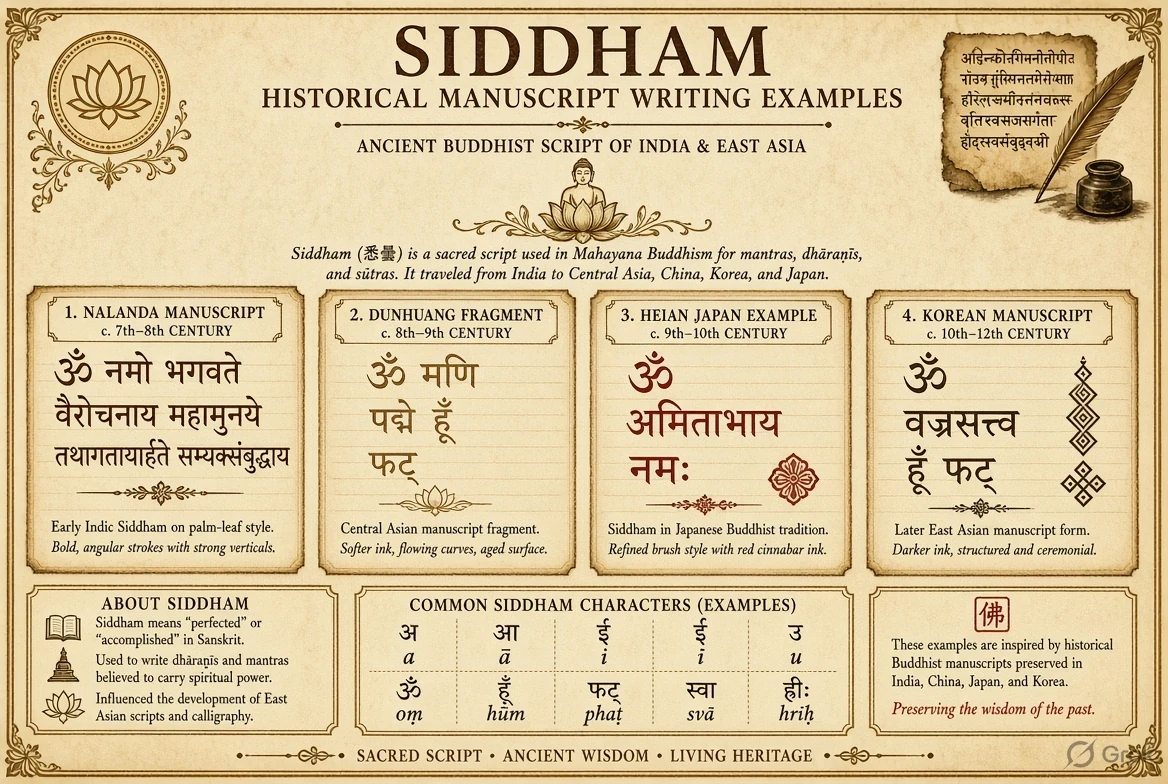
Siddham developed from Indic Brahmi-based writing and was used in historical Sanskrit textual cultures. It travelled through Buddhist exchange networks into Central and East Asia. Manuscripts with Sanskrit in Siddham survive through traditions in China, Japan and Korea. The Unicode Standard notes that modern use is especially prominent in Japanese Shingon and Tendai settings, where letters can be referred to as bonji. These connections make Siddham of interest to historians of Buddhism, writing systems, religion and Asian art, rather than just to collectors of unusual alphabets.
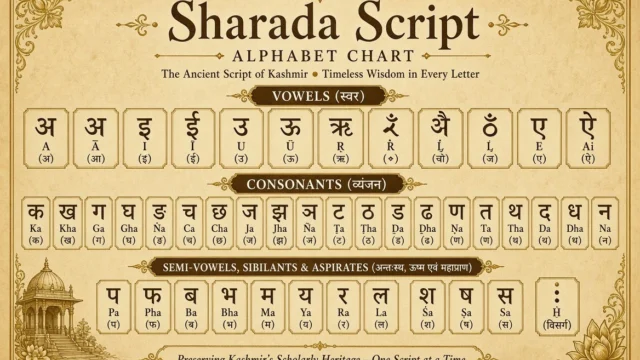
Siddham is related to Sharada in the family of historical northern South Asian scripts, but the two have distinct Unicode blocks and manuscript traditions. When creating a timeline, avoid treating Siddham and Sharada as exactly the same alphabet. A modern Japanese calligraphic form may differ from a South Asian ancient manuscript hand. The current Unicode reference glyphs for Siddham are largely based on Japanese forms; that should be stated when a reader expects an Indian archaeological facsimile.
Siddham vowels and consonants: learning a true alphabet chart
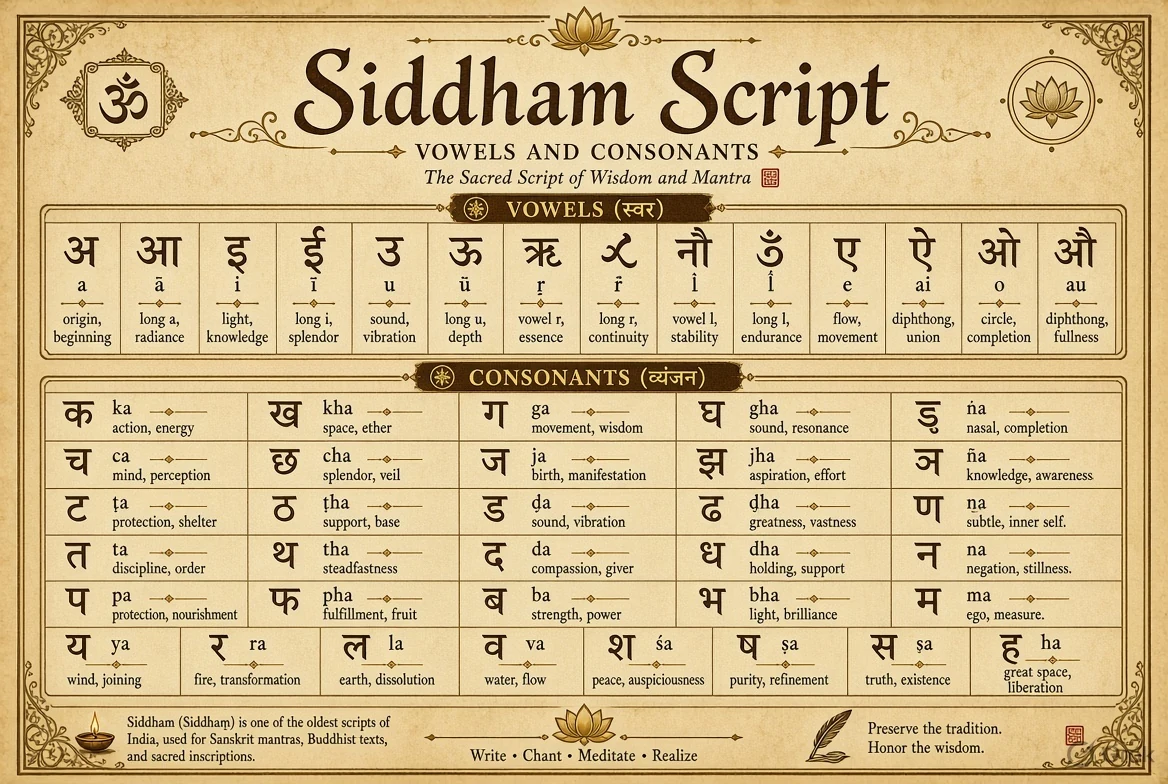
Like many Indic scripts, Siddham uses independent vowel letters, consonants with inherent vowels and dependent vowel signs. The Unicode character set enables digital representation of these forms, but visually complex clusters need a capable font. A beginner should first learn the vowels and their signs, followed by the consonants and how a simple syllable is formed. The official code chart supplies actual character identities; random ornamental strokes on a poster do not.
Siddham has alternative forms of the vowel signs for u and ū. Unicode describes regular ‘cloud’ forms and alternate ‘warbler’ forms, which have separate code points. A chart that only shows one version is introductory, not a complete survey. A source-based study of bonji should identify which form it is displaying. If the script is used in calligraphy or tattoo art, changing the shape purely for design may alter the letter itself. Accuracy is important even when the intention is decorative.
Virama, consonant conjuncts and how compound characters form
The Siddham virama is U+115BF and suppresses the inherent vowel following a consonant. Sanskrit consonant clusters can be represented using conjuncts, sometimes in vertical stacks, horizontal combinations or independent ligatures. This means a large intricate symbol might spell several sounds rather than one letter. The Unicode Standard includes examples with particularly complex consonant clusters. Students should break a sample into constituent characters before assigning a single meaning to its overall appearance.
Some internet posts claim that every elaborate Siddham-looking design is a special ancient mantra. That is not a valid way of reading script. A bonji character should have a specific documented syllabic value, while a longer written mantra contains a sequence of characters. Modern Japanese Buddhist religious practice may assign ritual significance to particular letters, but a researcher must still distinguish linguistic reading, traditional meaning and historical source. A high-contrast educational chart makes the distinction easier.
Siddham Script Alphabet Chart: pictures and writing samples

The Siddham sign, punctuation and Buddhist manuscript structure
Siddham includes a special sign at U+115C1 that can appear as a mark at the beginning of a text, traditionally related to the expression siddham, ‘accomplished’. Unicode also describes repetition marks and several section or punctuation marks. These may separate verses, clauses and recitation segments rather than functioning as ordinary modern English punctuation. Copying a text while omitting such signs can obscure where the original manuscript begins or ends.
The script also has a nukta for representing sounds outside the traditional repertoire. Unicode observes that this is a modern extension for additional languages, including Japanese and English, rather than a universally ancient Siddham mark. When an image caption calls a character ‘the exact original Sanskrit sign’, confirm whether its marks were historically attested or added in a modern writing system. Decorative calligraphy and critical manuscript editions serve different purposes.
Siddham bonji in Japan: script, symbol and religious meaning
In Japanese Buddhist traditions such as Shingon, bonji characters may represent Sanskrit syllables in ritual and artistic contexts. They can appear on calligraphic sheets, temple objects and other religious material. A character’s religious association does not remove its linguistic identity. It matters whether a diagram shows a particular Sanskrit syllable, a deity-associated seed syllable or a sequence from a longer text. A beginner’s alphabet poster should avoid making up deity assignments from the shape alone.
Traditional practices involve cultural and religious interpretations developed within specific schools. Not every artistic use or contemporary tattoo follows those traditions accurately. The language learner should start with a verified chart and the intended Sanskrit reading. A person seeking a permanent tattoo should obtain expert confirmation of both script and spelling, especially if relying on generated images. Altering a single stroke could turn a desired syllable into an incorrect or nonsensical shape.
Siddham compared with Devanagari, Sharada and Japanese kana
Siddham shares broad South Asian ancestry with Devanagari and is historically close to Sharada, but its orthography and forms are distinct. It is also not a form of Japanese hiragana or katakana, even though Japanese Buddhist communities preserve its use. The same Sanskrit term might be rendered in different scripts across regions and times. Script identity cannot be determined by a shared meaning of a mantra or symbol alone.
A reliable comparison chart aligns the same phonetic or Sanskrit reading in Siddham and Devanagari, then notes its Japanese ritual name if relevant. Avoid simplistic one-to-one comparisons that ignore vowel signs or multi-consonant ligatures. Historic samples may have different stroke order, spacing and rendering from the modern Unicode reference glyph. In scholarly work, preserve exact source citations and mark reconstructions as reconstructions.
Unicode fonts, typing and authentic stroke guides
Unicode’s U+11580–U+115FF block allows Siddham text to be stored digitally, but only fonts that implement the script will display all combinations correctly. Complex conjuncts and alternate vowel signs may render differently across browsers. If characters appear as boxes or their marks float in the wrong place, check the font before assuming the source is corrupt. For an accessible learning page, include searchable text along with clear image descriptions and transliterations.
A stroke-order graphic can help with modern calligraphic practice, but it should not claim to reconstruct every ancient writing style. A photograph of a Buddhist manuscript is evidence for a particular historical form, while a digital chart is a teaching aid. Use clean filenames, descriptive ALT text, short captions and source links, and ensure the text remains legible on mobile. Keep the original image uncropped when it contains letter labels.
Common Siddham poster errors and next keyword ideas
Typical mistakes include substituting Devanagari letters for Siddham, treating Japanese bonji as unrelated magical runes, using a fake ‘Siddham font’ that lacks accurate code points and calling a modern tattoo design an excavated Indian manuscript. Another frequent error is reversing a character or using a similar-looking alternate vowel sign without checking its value. Refer to Unicode when character identity matters and to documented Buddhist art sources when the claim concerns religious history.
Readers may next search for ‘Siddham alphabet chart PDF’, ‘Siddham bonji meaning’, ‘Siddham versus Sharada script’, ‘Siddham vowel signs’, ‘Sanskrit Siddham tattoo translation’ and ‘Shingon seed syllables’. Those are plausible next-search intentions, not verified volume data. The practical goal is to learn actual letters, recognize different uses and avoid circulating meaningless invented symbols as authentic religious text.
Frequently asked questions
What is Siddham script?
A historical Indic script used for Sanskrit, especially within Buddhist textual traditions.
What does bonji mean?
It is a Japanese term commonly used for Siddham characters.
What is the Siddham Unicode block?
U+11580–U+115FF.
Is Siddham the same as Devanagari?
No; it is a separate Brahmi-derived writing system.
Are all bonji tattoos historically accurate?
No. Check exact characters and the intended reading before use.
Is Siddham still used?
It remains present in certain East Asian Buddhist ritual and artistic contexts.
Sources and conclusion
See The Unicode Standard: Historic Indic Scripts for writing systems, code points and orthographic rules. Compare historical examples with a source catalog before asserting authenticity.












Share Your Opinion
Comments are closed on this post.