 Vista
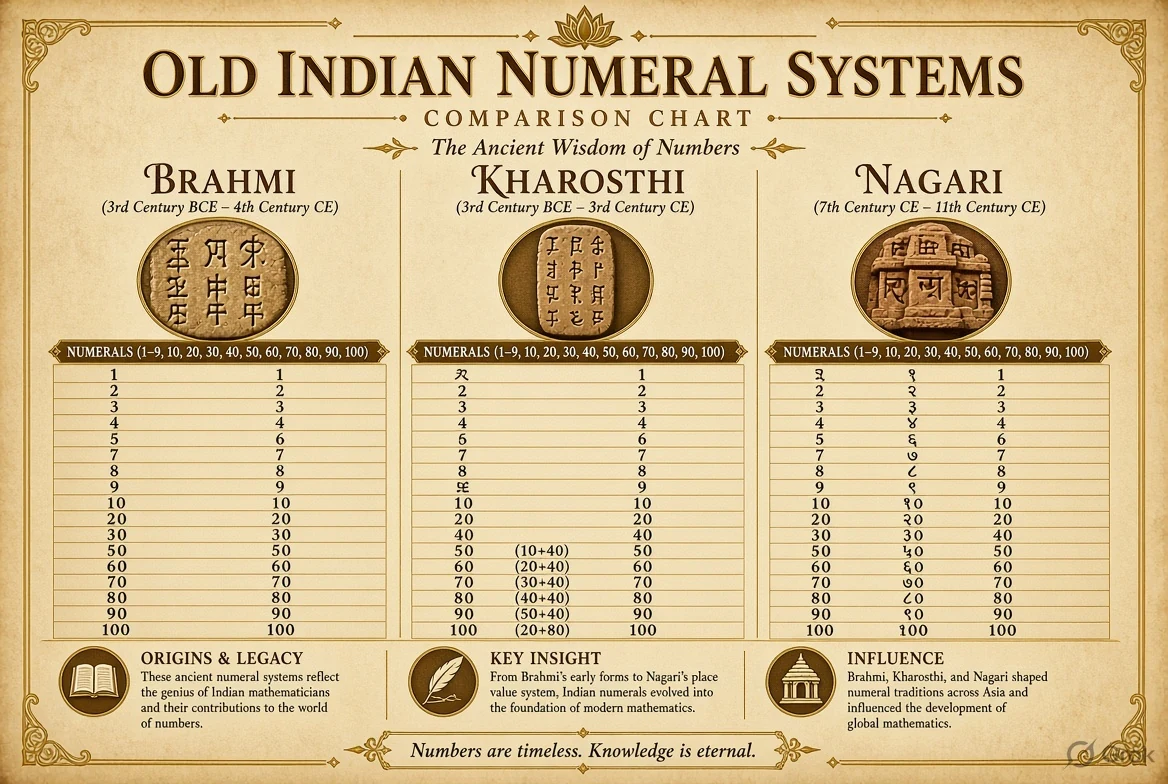
Direct answer: Old Indian numerals are not one timeless set of ten digits. Brahmi inscriptions initially used non-positional signs for units and larger numbers; Kharosthi had a different, right-to-left additive system; later Nagari-style digits belong to the history of the positional decimal numerals in everyday use. A trustworthy comparison chart must separate these dates, directions, notations and writing systems rather than paste a modern zero beside every early symbol. This guide uses five visual references to explain what changed and how to read the examples without making misleading historical claims.
Updated 20 November 2026. Numeral illustrations are learning references, not authenticated facsimiles of dated inscriptions.
Old Indian numeral systems chart: quick facts
| Main systems compared | Early Brahmi, Kharosthi, later Nagari and related numeral forms |
|---|---|
| Brahmi writing direction | Usually left to right |
| Kharosthi direction | Right to left |
| Earliest Brahmi examples | Third century BCE Ashokan inscriptions |
| Important historical change | Development of decimal positional notation and zero |
| Unicode references | Brahmi U+11000–U+1107F; Kharosthi U+10A00–U+10A5F |
Illustrated charts: Brahmi, Kharosthi and Nagari


What does an old Indian numeral systems comparison chart really show?
An effective comparison is not just a poster of glyphs. It tells the reader which notation system a symbol belongs to, how it represents a number and when it is attested. A modern chart might put a symbol alongside Arabic ‘7’ as a convenient gloss, but that does not prove the ancient writer used a positional digit seven in the modern sense. For Brahmi, Kharosthi and Nagari, the evolution of number notation is as important as the appearance of the characters. The key questions are whether the system was additive or positional, whether it marked tens separately and whether a written zero existed in that period.
Early Brahmi numbers and Ashokan inscriptions
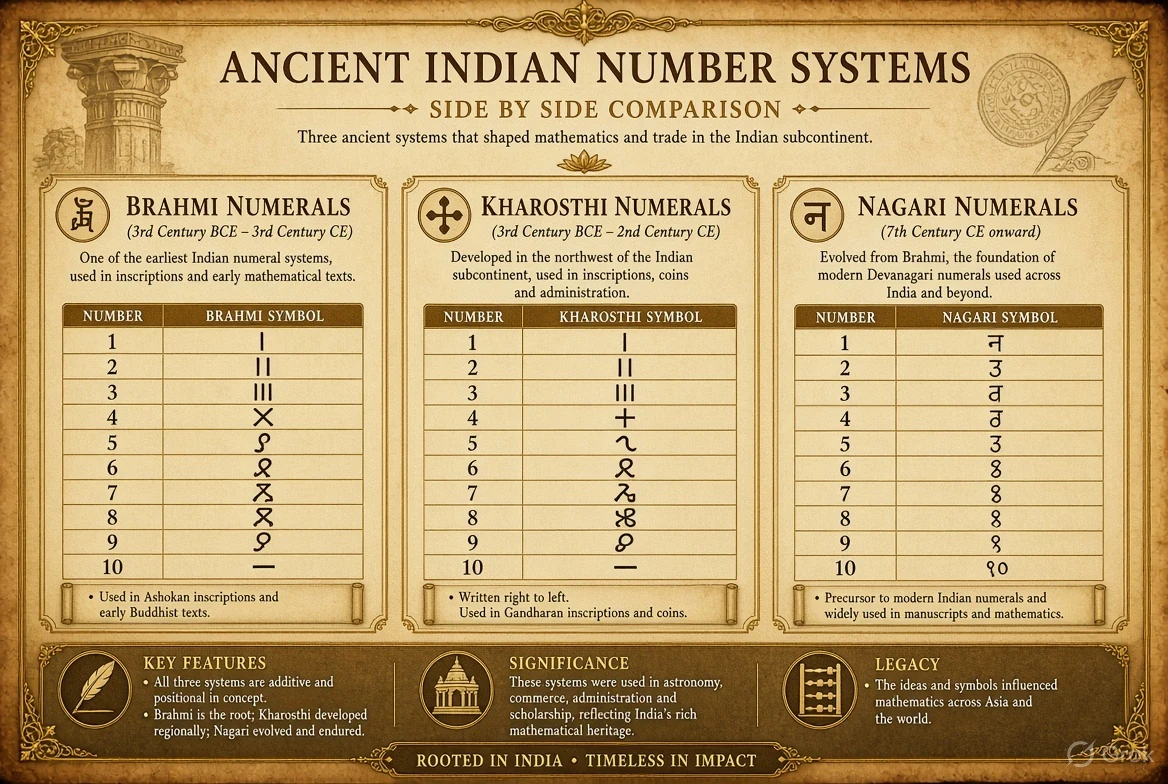
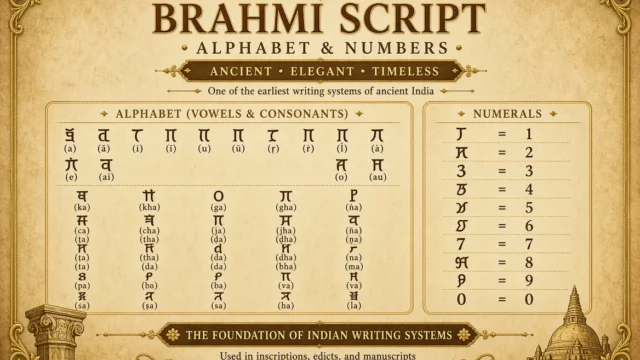
The earliest substantial Brahmi evidence includes inscriptions dating to the reign of Ashoka in the third century BCE. Early Brahmi number notation included signs for one through nine and separate signs for higher values such as tens and hundreds, rather than expressing every number through a sequence of ten positional digits. The exact practice varied over time and region. The Unicode Standard distinguishes an older additive-multiplicative set of Brahmi numbers from decimal digit characters used for later numerical notation. A classroom chart that shows ten equal modern-style columns may be convenient, but it needs a visible explanation that the old system did not function identically to today’s digits.
Why Brahmi zero-to-nine pictures need a date warning
A search for ‘Brahmi numbers 0 to 9’ can produce a neat table with 𑁦-style digit shapes or stylized historical glyphs. That is not enough to establish the antiquity of every item on the page. The Unicode block contains distinct decimal digits and historic number signs because both conventions need digital representation. The ancient additive system predates fully developed positional decimal notation and its use of zero as a place-holder. If a poster implies that Ashokan stone edicts used today’s complete zero-to-nine convention unchanged, it is misleading. The better caption differentiates the earliest inscriptional repertoire from later historical digit traditions.
Kharosthi numbers: right-to-left and structurally different
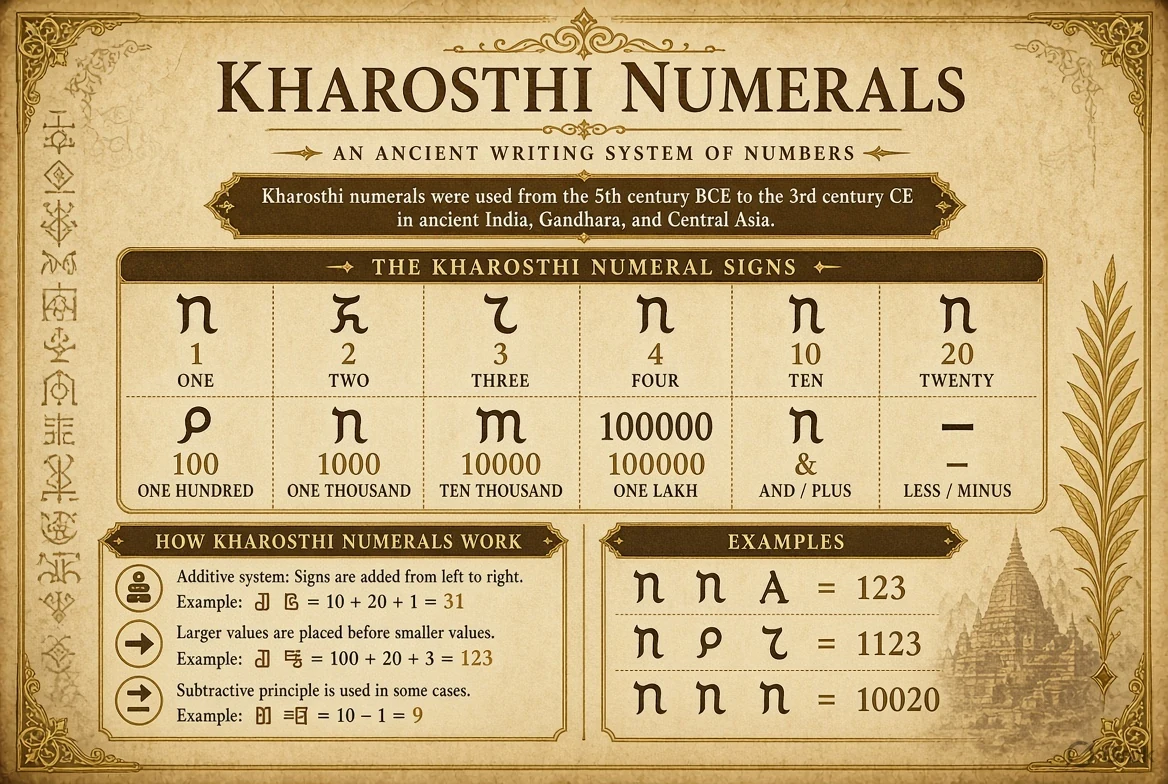
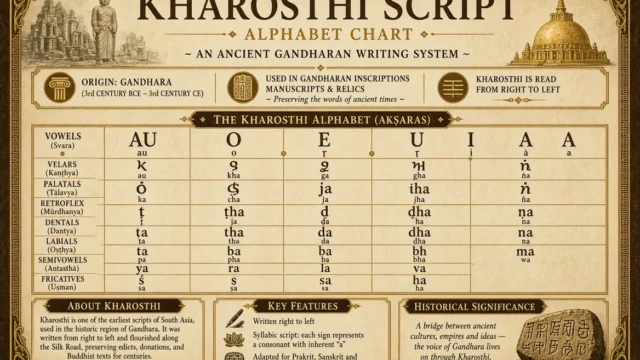
Kharosthi was used in the Gandhara region and is read from right to left, unlike the ordinary Brahmi direction. Its number notation used a limited inventory of distinct numeral signs, combining them to indicate values rather than relying on ten positional digits. The Unicode Standard describes a set of eight numeral signs. That means an apparent ‘Kharosthi numbers 1 to 10’ table must explain how the values are built, rather than invent separate symbols for every modern digit. When reading a Kharosthi inscription, preserve the writing direction and consider the context of an additive sequence. Mirroring an image to fit a layout can create a false reading.
Brahmi versus Kharosthi: comparison table for students
Brahmi and Kharosthi are historically different scripts, so their number signs cannot be treated as decorative fonts for the same alphabet. Brahmi normally runs left to right, whereas Kharosthi runs right to left. Different glyph sets and conventions were used, and both predate the standardized printed Devanagari numbers on most contemporary worksheets. For a student, the best comparison columns are ‘script’, ‘direction’, ‘type of notation’, ‘example from a documented era’ and ‘source’. There should be space to indicate uncertainty when an ancient mark is worn. A source-aware table avoids turning a complex historical development into an inaccurate one-to-one conversion exercise.
From early number signs to Nagari digits
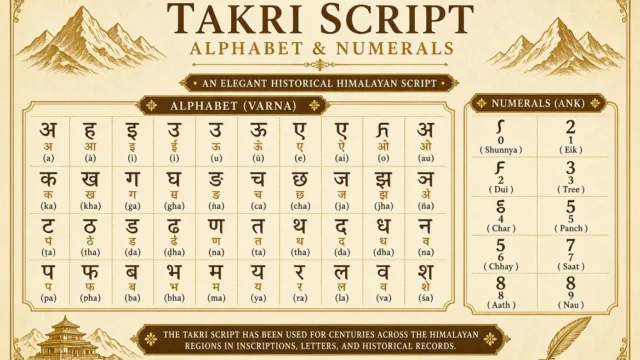
The forms commonly called Nagari numerals developed as part of a much longer history of Indian decimal writing, eventually contributing to the modern Devanagari digit shapes and the international decimal numerals associated with the Hindu–Arabic system. This transformation took place across multiple centuries and communities, not as one abrupt invention. Handwritten digits can vary, and the year of a surviving manuscript matters when comparing forms. A visually striking evolutionary chart is useful as an overview but should not be read as an unbroken chain of exact shapes without evidence. One stroke shared by two numerals does not prove a direct historical link.
How positional notation differs from additive notation
In a positional decimal number, the value of a digit depends on where it appears: in 2026, the 2 at the left represents thousands, while the 2 in the tens position represents twenty. Zero also preserves an otherwise empty place. By contrast, an additive notation builds values from signs that themselves represent quantities or grouped values. This conceptual contrast is more useful than simply drawing a row of glyphs. For children, demonstrate a number using the modern decimal model first, then explain how a historian may have to interpret separate tens and units signs in an earlier system. Never assume an ancient line of number marks is a positional figure.
The history of zero: symbol, placeholder and mathematical idea
‘Who invented zero?’ sounds like a simple question, but it can refer to a place-holder in a written number, a particular graphic symbol or the mathematical treatment of zero as a number. These developments have different evidence and timelines. Later Indian mathematics made foundational contributions to decimal positional calculation and treatments of zero, but a diagram of early Brahmi signs cannot prove all stages at once. A historically responsible article resists naming one inscription as the definitive first occurrence without a carefully dated scholarly source. Readers searching ‘Brahmi zero symbol’ deserve the distinction rather than an invented universally ancient mark.
Unicode Brahmi and Kharosthi numeric characters
Unicode is a system for representing characters in text, not a chronology of when each written form first appeared. Brahmi has the block U+11000–U+1107F; Kharosthi has U+10A00–U+10A5F. The modern standard separates some decimal digit characters from older number signs to support different documentary practices. Fonts choose outlines and may not perfectly mimic a specific stone inscription. For historically faithful transcription, record the code points, the source manuscript or inscription and any transliteration convention. A font that turns squares into glyphs makes text legible, but cannot by itself confirm that the interpretation of the number is correct.
Using old Indian numeral charts for school projects
A school poster works best when it has a short timeline, arrows for writing direction and two or three sourced examples rather than dozens of tiny questionable symbols. Add a legend to distinguish a later standardized numeral from a historical inscriptional sign. Place modern decimal values in a separate column with a heading such as ‘equivalent value’; do not imply that the scripts directly contain every digit in the current system. If an ancient writing sample is reconstructed rather than photographed, say so in the caption. Print at a resolution that keeps fine strokes visible and include accessible alt text for students using a screen reader.
Reading a historical numbered record without guessing
First identify the object, its provenance, date range, medium and script. Look at the entire text line because position and spacing influence interpretation. Confirm whether numbers are written in a separate column, and check for non-decimal units, local calendars or abbreviated monetary conventions. Copy the visible marks without immediately replacing them with modern figures. Then compare the marks with an academic edition or Unicode’s historical description. When the interpretation could affect genealogy, property or financial claims, consult a specialist rather than rely on an unsourced online conversion image. Keeping uncertainty visible is a feature of good historical work.
Five next searches and frequent historical myths
Useful next-search phrases include ‘Brahmi numerals chart’, ‘Kharosthi number symbols’, ‘old Indian numbers 1 to 100’, ‘Nagari numerals evolution’, ‘history of zero in India’, and ‘Brahmi versus Devanagari number chart’. These are practical search-intent ideas, not measured traffic estimates. Beware of charts that put a modern zero into every ancient script, of photos that silently reverse Kharosthi direction, and of claims that all Indian number forms were invented in one century. A good resource is precise about what is known, which form is illustrated, and what remains uncertain.
Frequently asked questions
Did Ashokan Brahmi use the modern ten digits?
No. Early Brahmi number notation was different from later positional decimal digits.
Did Kharosthi have zero to nine signs like modern numerals?
No. It used a historically different, additive numeral notation.
Which direction is Kharosthi written?
Right to left, including its number signs.
What is the Unicode range for Brahmi?
U+11000–U+1107F.
What is the difference between Nagari and modern Devanagari numerals?
Nagari refers to historical script and numeral traditions; modern Devanagari digits are standardized later forms.
Can a chart date the invention of zero?
No. The mathematical, positional and graphic histories require dated evidence.
Sources and conclusion
For an authoritative description of historic numeral systems and Unicode encoding, The Unicode Standard, Chapter 14. For a related historical-script reading guide see Kaithi historical script alphabet. The date and notation type matter at least as much as the shape of a glyph.











Share Your Opinion
Comments are closed on this post.