 Vista
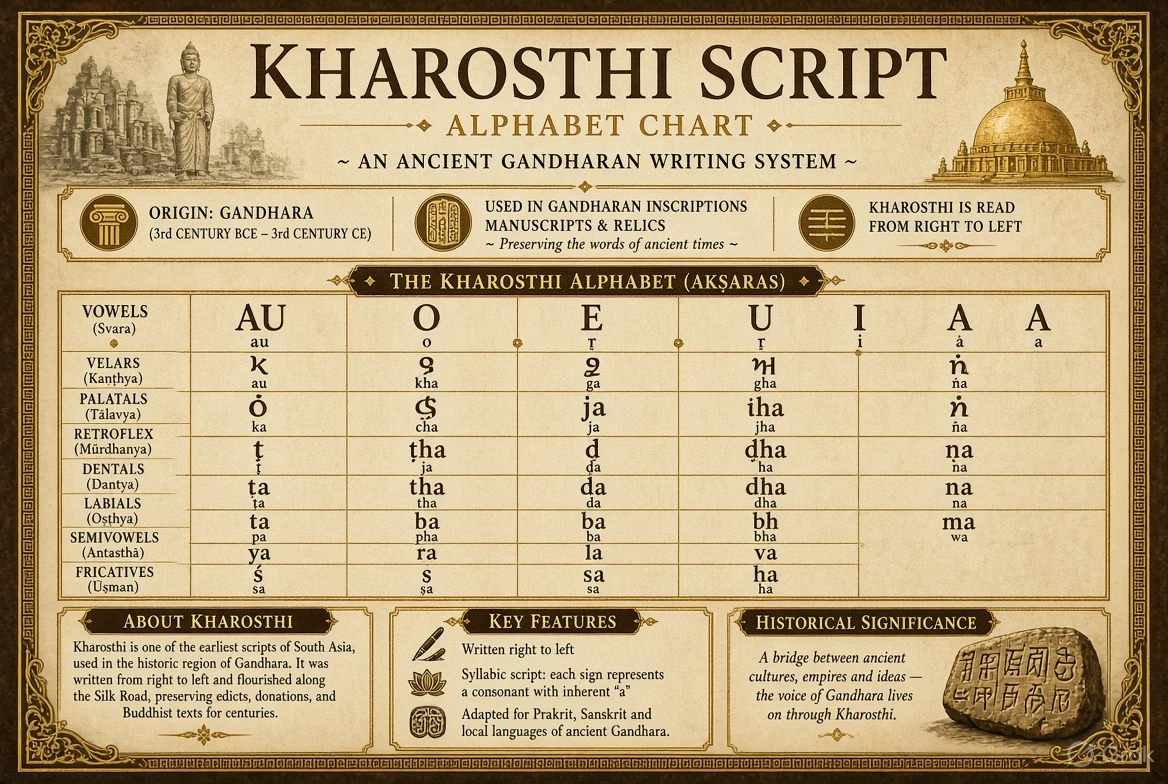
Direct answer: Kharosthi (also written Kharoshthi) was an ancient script used in Gandhara and neighboring parts of northwestern South Asia. Unlike Brahmi, Kharosthi is written from right to left; its letters and numbers follow that direction. It is strongly associated with Gandhari language material and has a separate Unicode block U+10A00–U+10A5F. This article explains historical letterforms, the meaning of its vowel marks and numerals, and how to approach a Kharosthi alphabet chart without accidentally reversing or inventing ancient inscriptions.
Updated 20 November 2026. Historical script posters here are educational illustrations, not authenticated manuscript facsimiles.
Kharosthi alphabet chart: quick facts
| Writing direction | Right to left |
|---|---|
| Historical region | Gandhara and northwest South Asia |
| Related to | Aramaic writing tradition (likely) |
| Unicode block | U+10A00–U+10A5F |
| Ashokan examples | Shahbazgarhi and Mansehra |
| Main caution | Do not mirror or reorder the text |
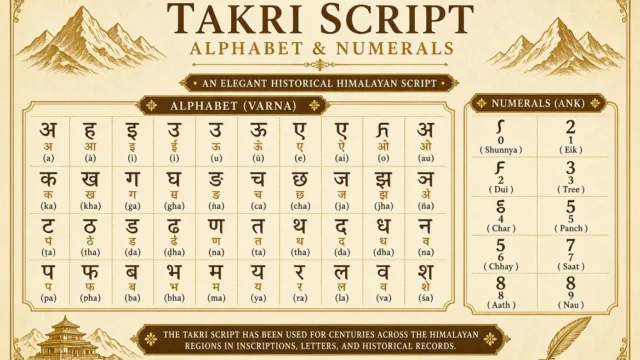
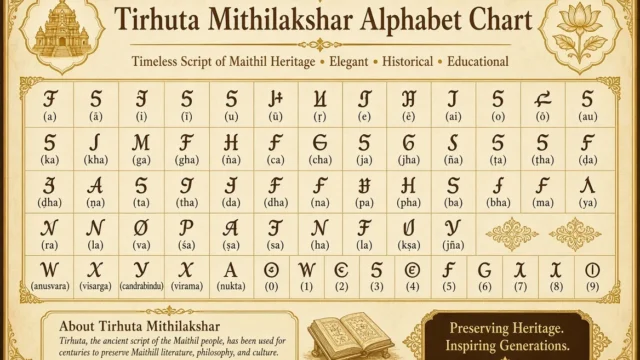
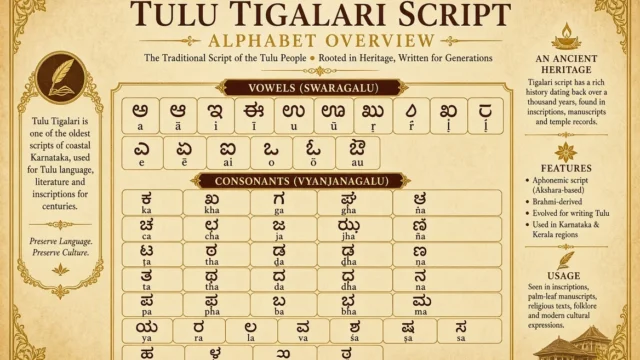
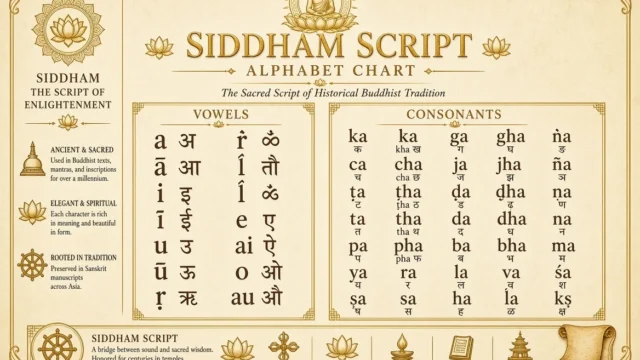
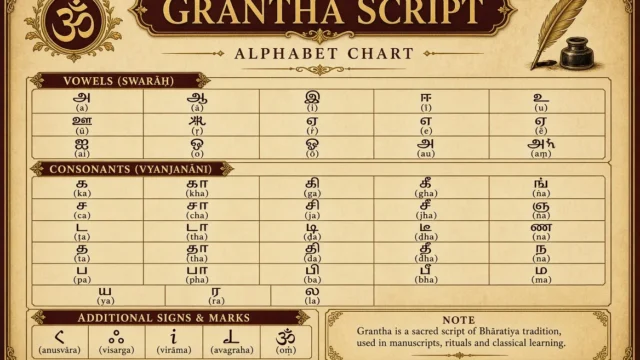
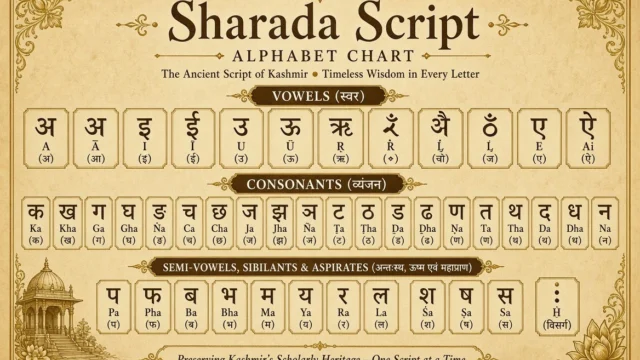
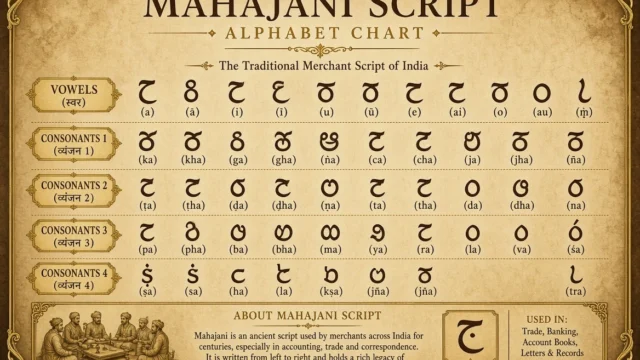
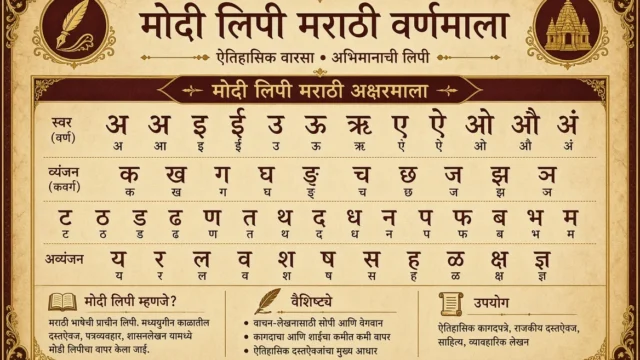
Picture chart and visual references

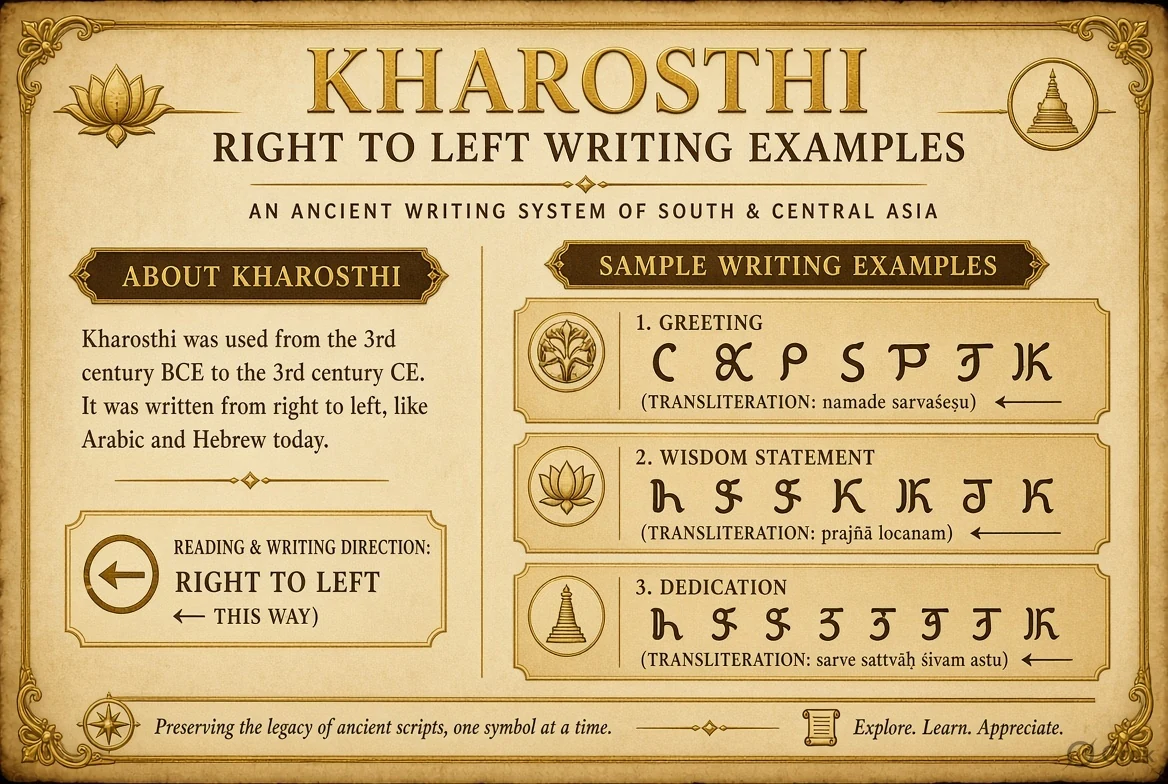
What is Kharosthi and where was it used?
Kharosthi is a historical South Asian script best known from the Gandhara cultural sphere in what is now northwestern Pakistan and adjoining regions. The Unicode Standard describes its early fully developed appearances in the inscriptions of Ashoka at Shahbazgarhi and Mansehra, dated around 250 BCE. It remained important in Gandhara for centuries and appeared later in Central Asian documents. The script is a separate system rather than a right-to-left variant of Devanagari. A helpful chart gives both a period label and the sound associated with each represented character.
Right-to-left direction: the first rule to learn
Both Kharosthi letters and numerals run from right to left. That affects how students arrange examples, read inscriptions and copy characters into digital tools. When creating a chart, the sequence of character names should be logical even when the actual line displays in the opposite direction from English. Copying a screenshot into an editor and flipping the image can make the letters look plausible while destroying their authenticity. Unicode’s bidirectional behavior helps display properly encoded Kharosthi text. If a browser renders an example strangely, test the text rather than using an image editor to reverse it.
Alphabet and inherent vowels in Kharosthi
Kharosthi is an abugida. Many consonant signs represent a consonant with inherent ‘a’, while other vowels are indicated through marks. The Unicode Standard notes several vowel and consonant modifiers, with conventions that differ from those of contemporary Devanagari. This is why a chart that merely pairs each Roman letter A–Z with one Kharosthi glyph is fundamentally misleading. A good classroom reference groups basic consonants, vowel marks, modifiers and punctuation separately. It also identifies which examples are letter identities and which are combined syllables.
Gandhari language, Buddhist manuscripts and texts
A script is not itself a language. Kharosthi frequently records the Gandhari language, and the surviving record includes Buddhist materials, administrative texts and inscriptions. It was also adapted in certain later Central Asian contexts. These sources differ in vocabulary, paleography and scribal convention. Recognizing one consonant is therefore only a small part of translating a text. When an online article claims a Kharosthi line states a modern slogan, ask whether the text appears in a traceable published manuscript or inscription. A modern image overlay without source context is not evidence.
Kharosthi versus Brahmi in Ashokan inscriptions
The Ashokan inscriptional tradition demonstrates why it matters to name the script accurately. Many edicts are written in Brahmi, which generally reads left to right. In the northwest, the Shahbazgarhi and Mansehra edicts use Kharosthi. The two systems are not interchangeable alphabets. They have different origins, letterforms and reading directions, even though both belong to the history of South Asian writing. Comparing them side by side is educational only when the orientation and provenance of each sample are preserved. Avoid using the same decorative image to represent both scripts.
How Kharosthi numerals work
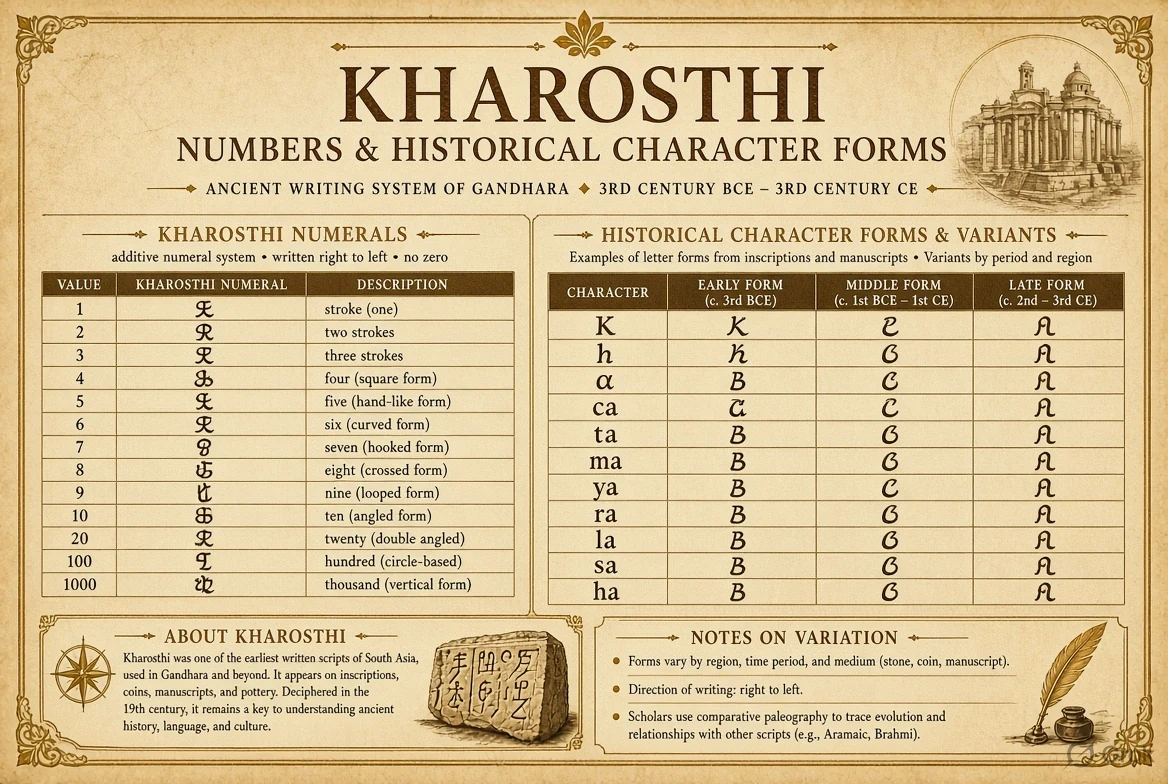
Kharosthi used its own number signs, including additive numerical conventions rather than a simple copy of modern decimal digits. A ‘Kharosthi 0 to 9 chart’ must be treated with caution: it can accidentally imply that the historical system had the same sequence and place-value interpretation as contemporary numerals. The Unicode Standard places several Kharosthi number characters in its block, but the encoding is not a time machine that makes all historic inscriptions uniform. To read a number from a scroll or edict, inspect the sign group, the direction, the possible unit and the manuscript’s date.
Unicode range, fonts and bidirectional rendering
Kharosthi occupies Unicode U+10A00–U+10A5F. Correct storage requires script-specific code points, while correct appearance also requires font support and an implementation of bidirectional text behavior. A line that looks scrambled in one app may be perfectly ordered in the underlying encoded string. Do not substitute similar-looking symbols from Arabic, Hebrew or another script to ‘fix’ a display problem. Such substitutions break searching and scholarly comparison. For educational PDFs, supply the original Unicode transcript beside a properly oriented image and keep a reference to the source edition.
History beyond Gandhara: Central Asian documents
Kharosthi was not confined forever to the immediate place where its earliest examples survive. The script appears in documents associated with Khotan and Niya in Central Asia in the third and fourth centuries CE, with evidence of later continuation in other communities along the northern Silk Road. Those later forms may differ from the early Gandharan samples chosen for modern typefaces. An alphabet poster should not pretend that one idealized letter form reproduces every century of writing. The time and geographic scope belong in the caption, especially when images are reused in general-history posts.
How to study a Kharosthi manuscript photograph
Identify the archive, inventory number and published source first. View the whole manuscript before zooming, and mark the original right-to-left direction. Separate text from holes, tears, cracks and other background marks. Transcribe only confidently identifiable characters, using a consistent convention for damage or uncertainty. Compare other examples by the same scribe whenever possible. Then transliterate the sequence and investigate language and meaning. A machine-generated translation can be a starting hypothesis, but it is unsafe to treat it as authentication of a rare fragment without philological verification.
Designing a reliable Kharosthi alphabet PDF
A useful educational sheet provides the name of the script, right-to-left reading direction, historical scope, Unicode range and documented character labels. It has separate tables for basic consonants, combining marks, punctuation and historical number signs. Romanized sound labels can appear alongside the glyphs, but they should not turn an abugida into a false A–Z alphabet. Fonts must be tested for proper bidirectional handling, and reproduced artwork must be identified as artwork. Consider including a small sample with arrows to demonstrate reading order rather than mirroring historical text.
Facts versus myths and the next search questions
Misconception: Kharosthi is an early version of Arabic because it reads right to left. In fact, its origin is complex and scholars identify a strong connection with Aramaic, not a direct identity with Arabic. Misconception: every Ashokan edict is Brahmi. The northwestern exceptions matter. Misconception: a list of ten modern decimal digits is automatically a historically correct Kharosthi number table. For deeper study, search ‘Kharosthi script alphabet chart’, ‘Gandhari Kharosthi manuscript’, ‘Kharosthi numbers explained’, ‘Kharosthi vs Brahmi direction’, ‘Kharosthi Unicode font’ and ‘Shahbazgarhi edict script’. These are useful questions rather than asserted trends.
Frequently asked questions
Is Kharosthi written right to left?
Yes. Both letters and numbers are traditionally written from right to left.
What language did Kharosthi write?
It is especially associated with Gandhari and also appears in later Central Asian material.
What is the Kharosthi Unicode block?
U+10A00–U+10A5F.
Is Kharosthi the same as Brahmi?
No. They differ in direction, origin and character forms.
Does Kharosthi use modern decimal digits?
Its historical numeric notation should not be treated as a copy of today’s 0–9 place-value system.
Are all Ashokan edicts written in Brahmi?
No. Important northwestern inscriptions use Kharosthi.
Source, related reading and conclusion
Character structure, historical use and encoding details were checked against The Unicode Standard, historic South Asian scripts. For a related Indian alphabet resource, read our Kaithi script alphabet reference. Use these illustrations to learn the framework, then verify fine glyph differences against official charts and documentary facsimiles before making a manuscript claim.









Share Your Opinion
Comments are closed on this post.