 Vista
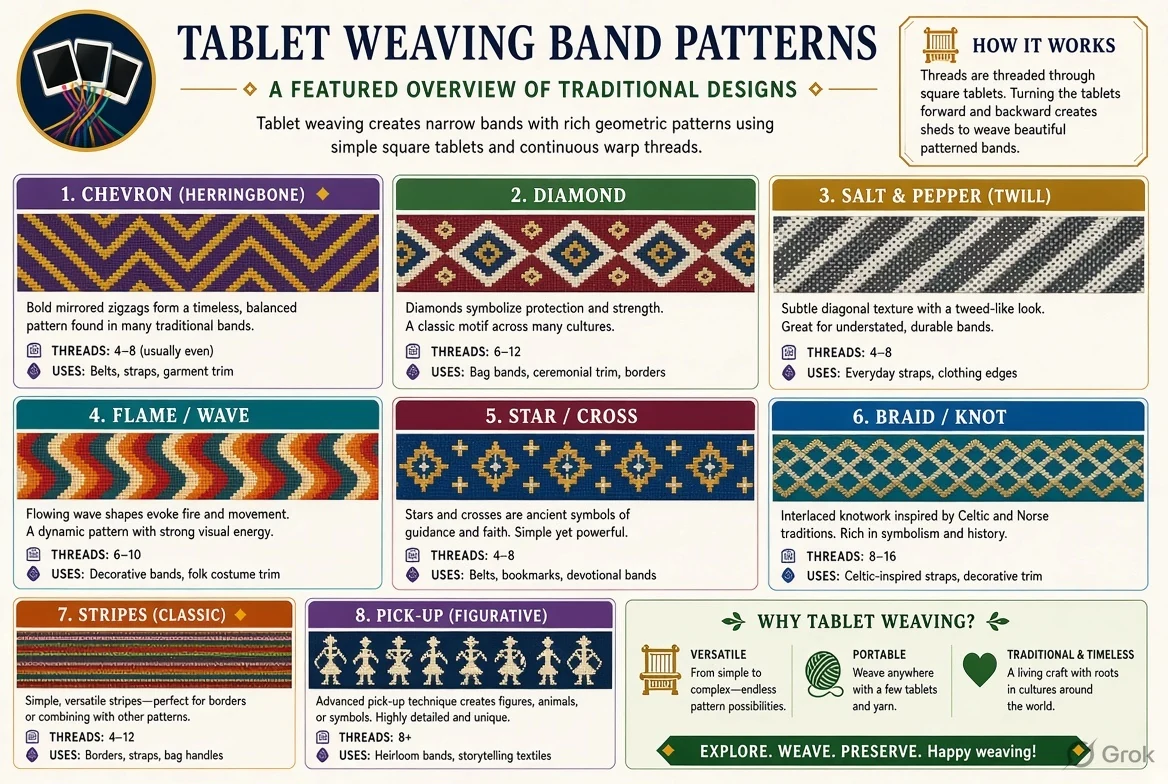
Direct answer: Tablet weaving (also called card weaving) creates narrow patterned bands by turning perforated cards threaded with warp yarns. A basic four-hole tablet chart records each hole’s thread color, the direction in which a card is threaded and the order in which cards rotate. That is different from a simple picture of a finished geometric band. Three illustrated diagrams here show a four-hole setup, forward/backward turning and a sample geometric band, with practical advice for tension, reading notation and reversing turns before excessive twist accumulates.
Updated 20 November 2026. Diagrams are educational references, not tested complete weaving instructions unless stated.
Tablet weaving band patterns: quick facts
| Other name | Card weaving |
|---|---|
| Common beginner card | Square tablet with four labeled holes |
| Draft needs | Card order, colors, hole positions, threading and turning sequence |
| S and Z | Threading direction conventions, which must be declared |
| Turning | Quarter-turn forward/backward as defined by the pattern |
| Primary product | Narrow woven bands, straps and trims |
Four-hole threading, turns and geometric band charts
What is tablet weaving and what makes a band pattern usable?
Tablet weaving is a narrow-band weaving technique using cards with holes for warp threads instead of a conventional multi-shaft loom. As the cards turn, different groups of warp yarns form a shed through which a weft thread travels. The resulting structure can be a strong patterned strap, edging or decorative band. A usable tablet-weaving draft is more than colorful stripes. It needs the number and order of tablets, each hole’s thread color, S or Z threading convention and a turning plan. If a photo supplies only the finished design, the viewer may appreciate the colors but cannot reliably reproduce the exact structure without reconstructing the missing setup.
Four-hole card weaving setup: understand A, B, C and D
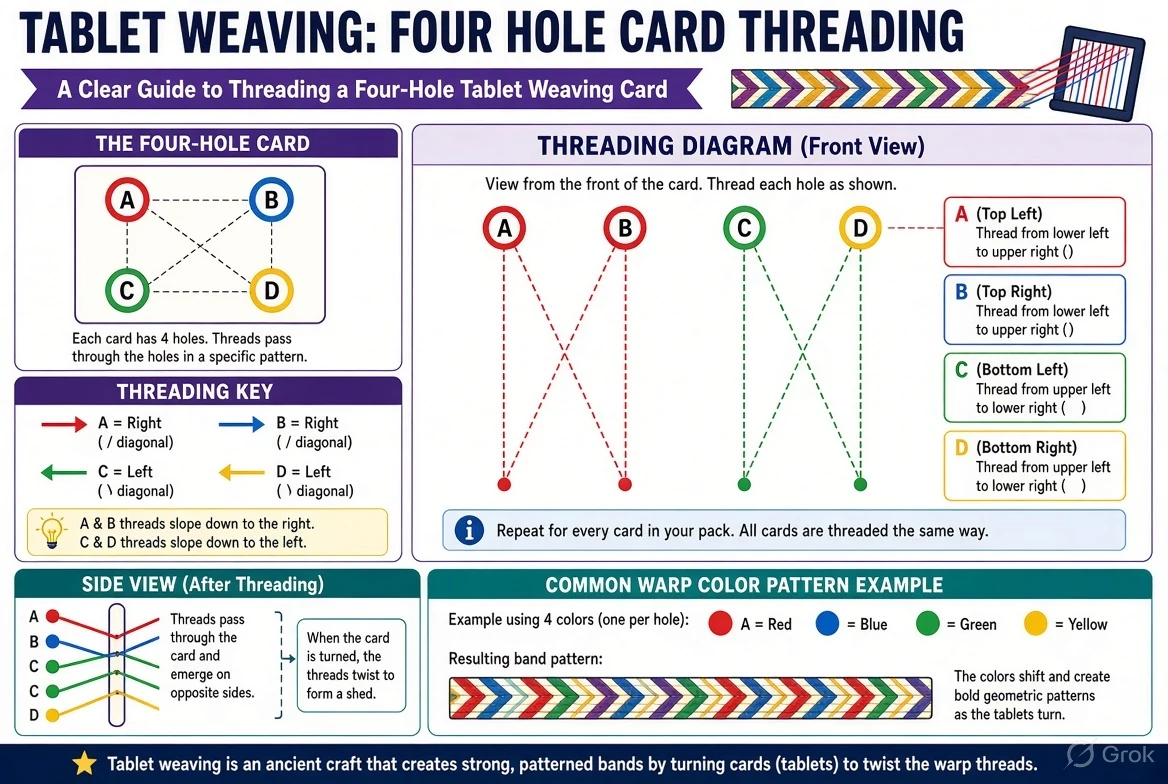
The common teaching card has four holes, often labeled A through D. A draft can show one column per tablet and one row per hole, with symbols for thread colors. Feed the correct warp yarn through each hole and keep the group of cards arranged in the same sequence shown by the design. Beginners may choose a small number of cards and two contrasting colors to make the geometry easier to see. Align the starting hole positions before the first turn. The illustration is a teaching reference, not a guarantee that every published pattern uses the same orientation for holes or the same viewing side. Always match the diagram to its legend.
S and Z threading: why orientation matters
Many tablet-weaving patterns describe threading as S or Z. These indicate the direction in which a yarn passes through a card relative to the viewer and the other cards. The exact representation can be confusing because different authors also use S and Z to describe the slant or twist of the resulting yarn, and those are not necessarily the same label. Do not copy a slash or backslash from one website into another pattern without reading its convention. The practical method is to choose one reference, follow its diagram of the threading direction and mark the physical cards before weaving. One reversed card can change the expected diagonal pattern.
Forward and backward quarter-turns in a weaving chart
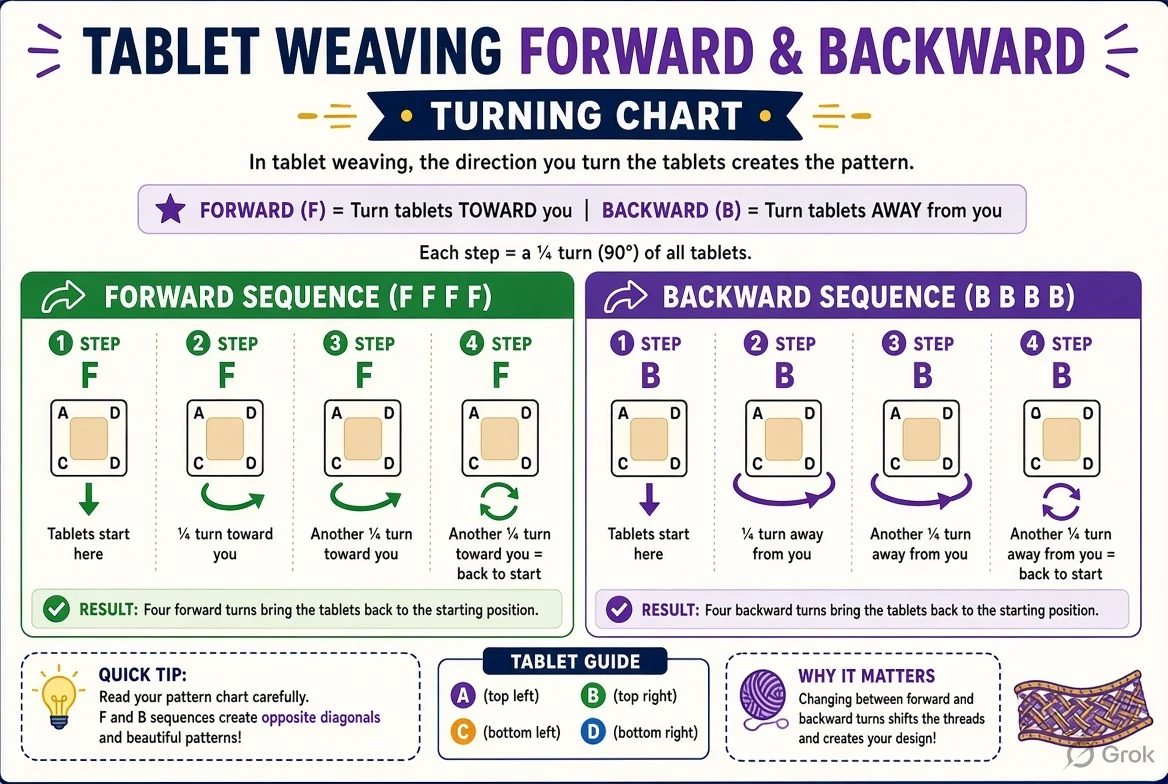
Turning a four-hole card one quarter-turn changes which warp threads are raised and lowered, affecting the pattern and twist. A turning chart can show a row for each pick of weft and a direction for the group or for individual tablets. Forward and backward must be defined from a particular viewing side of the cards. A widely taught simple threaded-in exercise uses repeated forward turns followed by backward turns to manage twist, but that does not mean every geometric draft uses the same sequence. Note the start orientation and direction convention. When returning backward, check that the cards have not slipped out of the planned order.
What changes when a card reverses direction?
A card’s thread twist builds as it turns repeatedly in one direction. Reversing can unwind some accumulated twist and may also alter the apparent diagonal direction or pattern structure. In some designs, reversal is deliberately part of the visual repeat; in others, it is a technical adjustment. A mismatch between S/Z threading and turn notation can make a planned zigzag look unlike the chart. Stop after a short practice sample and compare it with the intended design before cutting a long strap. Learn to recognize the point where twist is accumulating behind the tablets and decide how the original pattern author expects it to be controlled.
How to read the geometric band pattern image
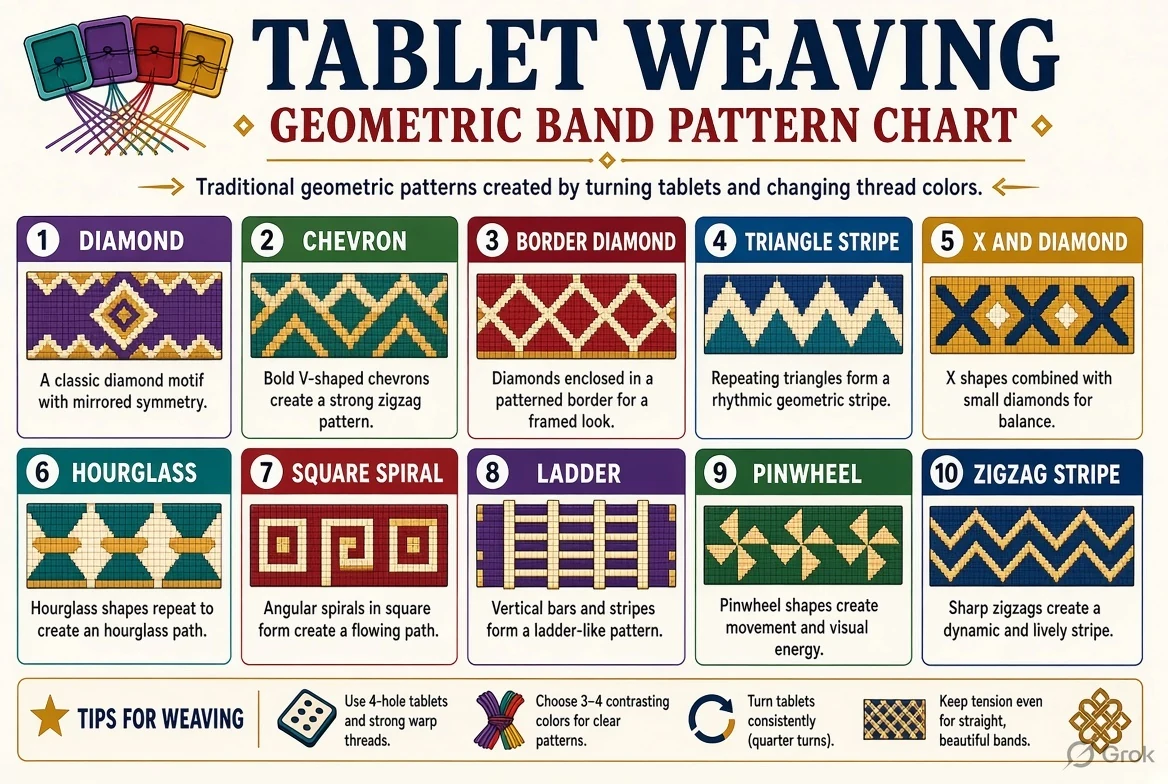
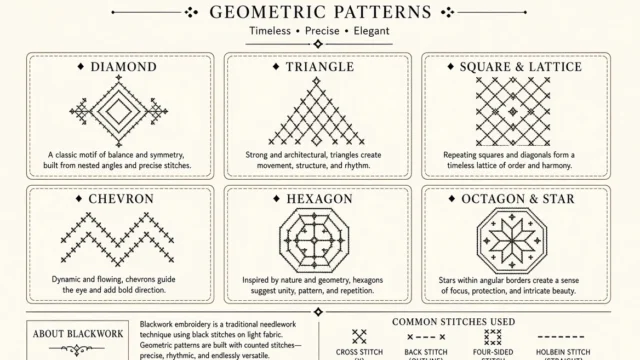
A geometric band may contain diamonds, chevrons, zigzags or stripes. Some visual charts represent thread colors, while other drafts show the shape emerging after a sequence of cards turning. Identify whether the image is a threading diagram, a turning diagram or an illustration of a finished woven band. The same colored stripe cannot be treated as a direct instruction for every card hole. Start by listing the tablets from left to right, then the colors of their four holes and finally the turns for each pick. If any of those columns is missing, the chart is an inspiration reference rather than a complete reproducible weaving draft.
Beginner supplies: cards, shuttle, yarn and tension
For a modest practice band, use several smooth four-hole cards, strong warp yarn that does not snag easily, a weft thread and a simple shuttle or blunt needle. Keep the warp stretched between stable anchor points according to an appropriate beginner setup. Yarn thickness determines the width and density of the woven band, so test the chosen thread rather than assuming a photo reveals the exact material. Some card-weaving systems use a fixed loom; others can be made with portable supports. Consistent tension is more useful than extreme tightness. If the cards rub harshly or the yarn breaks at holes, check card edges and material choice.
First practice band: a safe step-by-step sequence
Choose a tested beginner threaded-in pattern with clearly written S/Z directions and a turning sequence. Label the four holes on every card and thread the warp colors exactly as specified. Arrange the cards in order, align the starting position and pull the warp gently into an even working tension. Insert a weft through the shed, turn the cards as directed and insert the next pick. Beat the weft gently so the band stays uniform, then repeat while recording turns on paper. After several centimetres, inspect the front and reverse. If the design unexpectedly shifts, stop and check the most recent card orientation rather than continuing blindly.
Why two drafts showing the same colors can weave differently
Pattern color alone does not fully determine the weave. Card order, hole positions, S/Z threading, turning direction, twist and the side from which the band is viewed all influence appearance. A four-hole chart with the same blue and white yarns can yield a striped band in one arrangement and a more complex diagonal in another. This is why a downloadable picture of a finished band is not necessarily an operational pattern. When a beginner compares two charts, the most useful step is to align their legends and coordinate systems rather than compare only the bright surface colors. Working a tiny sample helps identify a mirrored draft.
Tablet weaving vs inkle weaving and Kumihimo
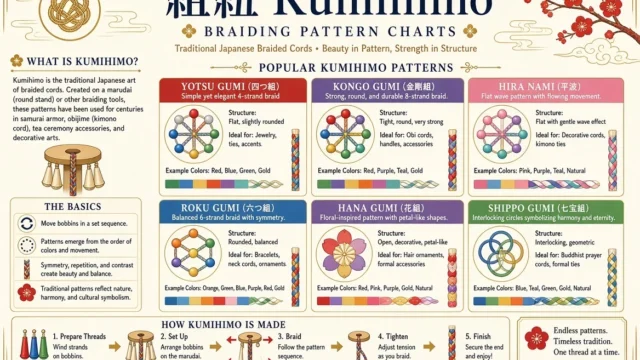
Tablet weaving uses turning cards to change the warp shed. Inkle weaving is often worked on a band loom and may create patterns through techniques such as pick-up without turning tablets. Kumihimo, a Japanese braid craft, crosses groups of strands through a repeated movement sequence and is not the same structural method as passing weft through a tablet-woven shed. All three can produce narrow decorative bands or cords, but their patterns and tools cannot be swapped without redesign. If a reader is interested in circular braided cords rather than woven flat tapes, our related Kumihimo guide is a more relevant starting point.
Printing charts and troubleshooting wrong band direction
These three images are educational visual references rather than a separately hosted, fully tested card-weaving PDF. You may print the pictures through normal browser tools, but verify whether card numbering, hole directions and turn arrows are large enough to read. If the design comes out mirrored, check the side from which the cards are viewed and the S/Z convention. If the band narrows, inspect weft tension and beating consistency. If color changes appear in the wrong places, look for a card threaded through the wrong hole or turned in the opposite direction. Correct the setup before making a long strap.
Next searches, glossary and a practical conclusion
Useful follow-up phrases include ‘tablet weaving patterns printable’, ‘four hole card weaving chart’, ‘S and Z threading tablet weaving’, ‘tablet weaving forward backward turns’, ‘tablet weaving geometric bands’ and ‘card weaving beginner setup’. They describe likely reader questions rather than verified search-volume figures. The central lesson is to read three layers of information together: which threads pass through which holes, how each tablet is oriented and which turns happen at each row. When a visual poster omits one of those layers, treat it as inspiration until a complete draft is available.
Frequently asked questions
Is tablet weaving the same as card weaving?
Yes, the two terms usually describe weaving bands by turning perforated cards.
What are S and Z in card weaving?
Threading orientations; confirm the author’s specific diagram convention.
How many holes does a basic tablet have?
Four is common, though other tablet designs exist.
Why are forward and backward turns needed?
They change the warp shed and can manage accumulated twist, depending on the pattern.
Can I weave a geometric chart from the picture alone?
Not reliably unless complete threading and turning instructions accompany the illustration.
Is Kumihimo the same as tablet weaving?
No. Kumihimo is braiding rather than card-operated narrow-band weaving.
Sources and conclusion
For complete notation conventions, consult Tablet weaving notation guide and Tablet weaving threading theory. Related published guide: Kumihimo braiding charts. Match threading, card order and turning directions before weaving a full-length band.






Share Your Opinion
Comments are closed on this post.