 Vista
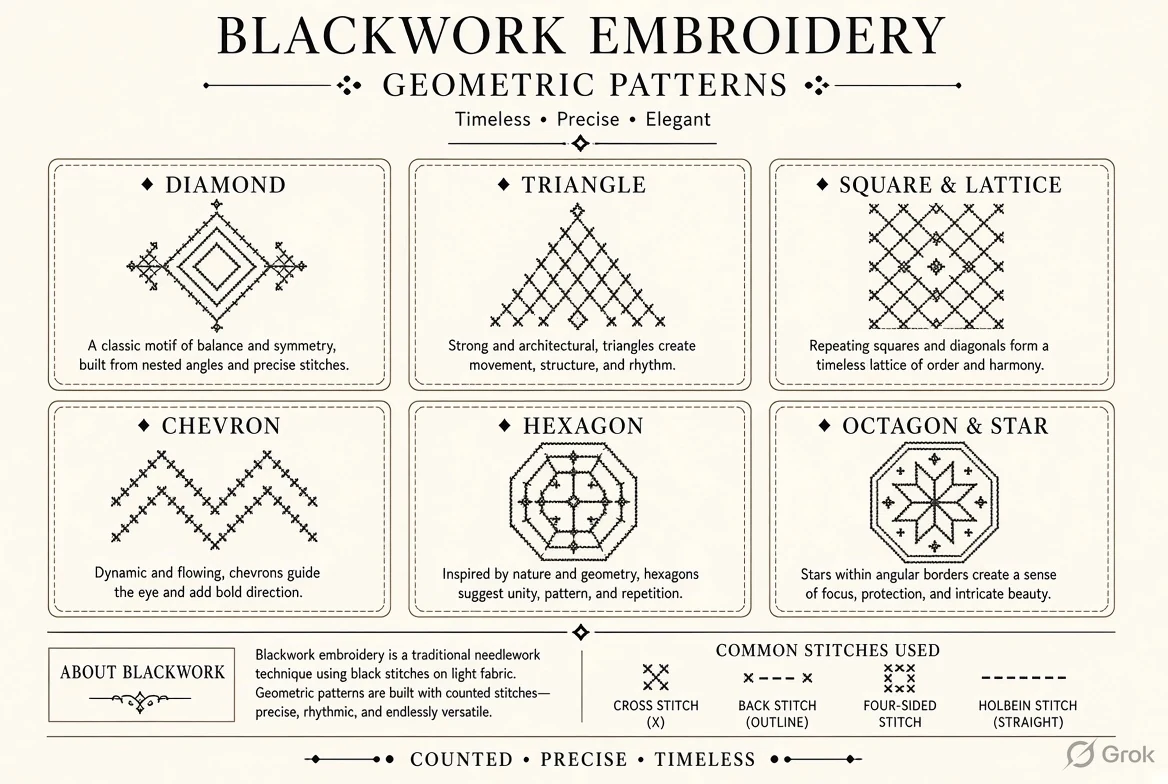
Direct answer: Blackwork embroidery is a counted-thread embroidery style traditionally associated with dark stitches on light fabric and repeated geometric or floral filling patterns. Its signature reversible technique is double running stitch, also called Holbein stitch, although backstitch and other stitches are also used. This article brings together four illustrated blackwork pattern references: a diamond grid, floral repeat, geometric border and fill sampler. It explains how to count fabric threads, use the charts without claiming a separate PDF download, and distinguish a decorative grid from a fully planned reversible stitch path.
Updated 20 November 2026. Pattern graphics are educational; reversible stitch routes must be checked separately.
Blackwork geometric charts: quick reference
| Technique | Counted-thread embroidery |
|---|---|
| Signature stitch | Double running or Holbein stitch |
| Other stitch | Backstitch is common for outlines and fills |
| Visuals | Diamond grid, floral repeat, border, fill sampler |
| Material | Evenweave fabric, needle, embroidery floss |
| Important nuance | A pretty chart does not automatically include a reversible thread route |
Four blackwork diamond, floral, border and fill charts
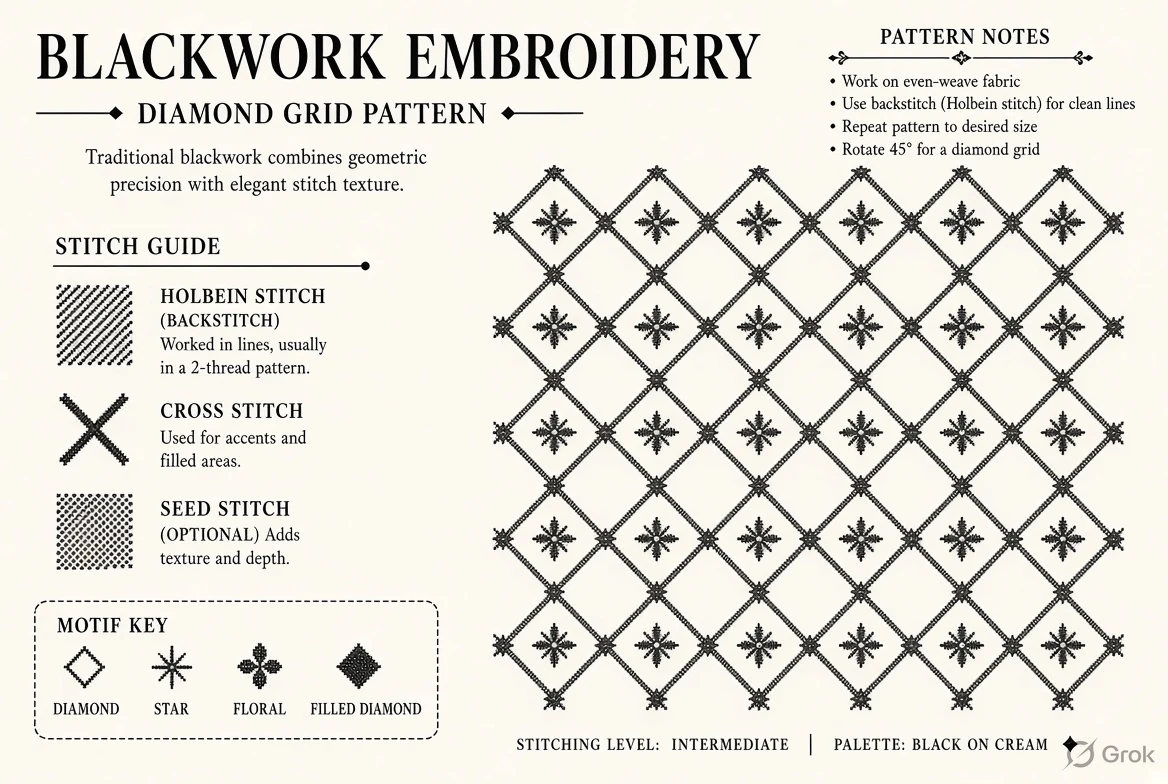
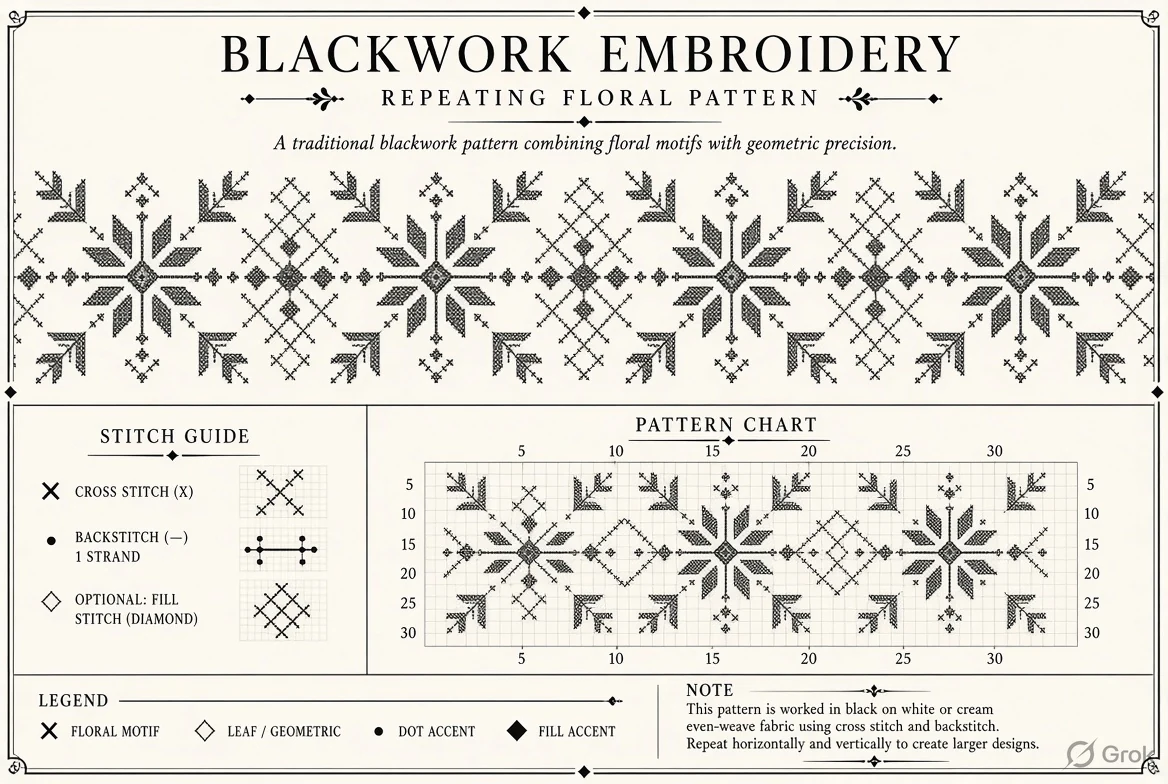
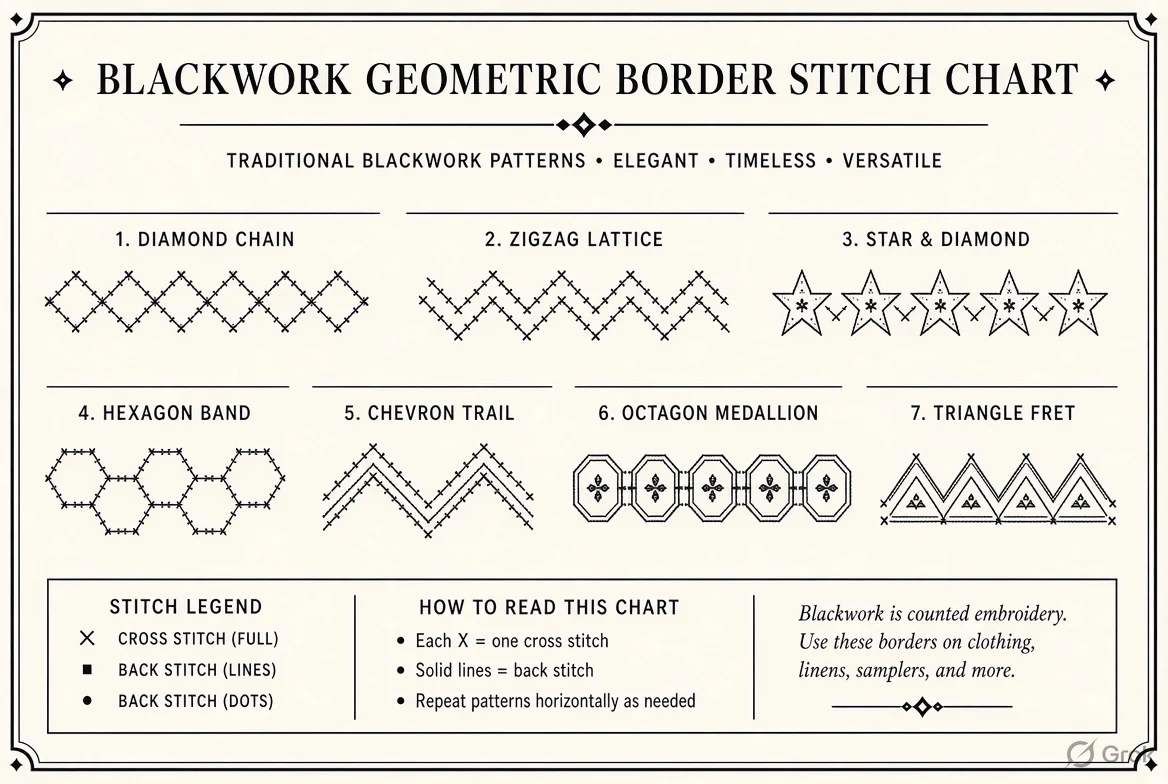
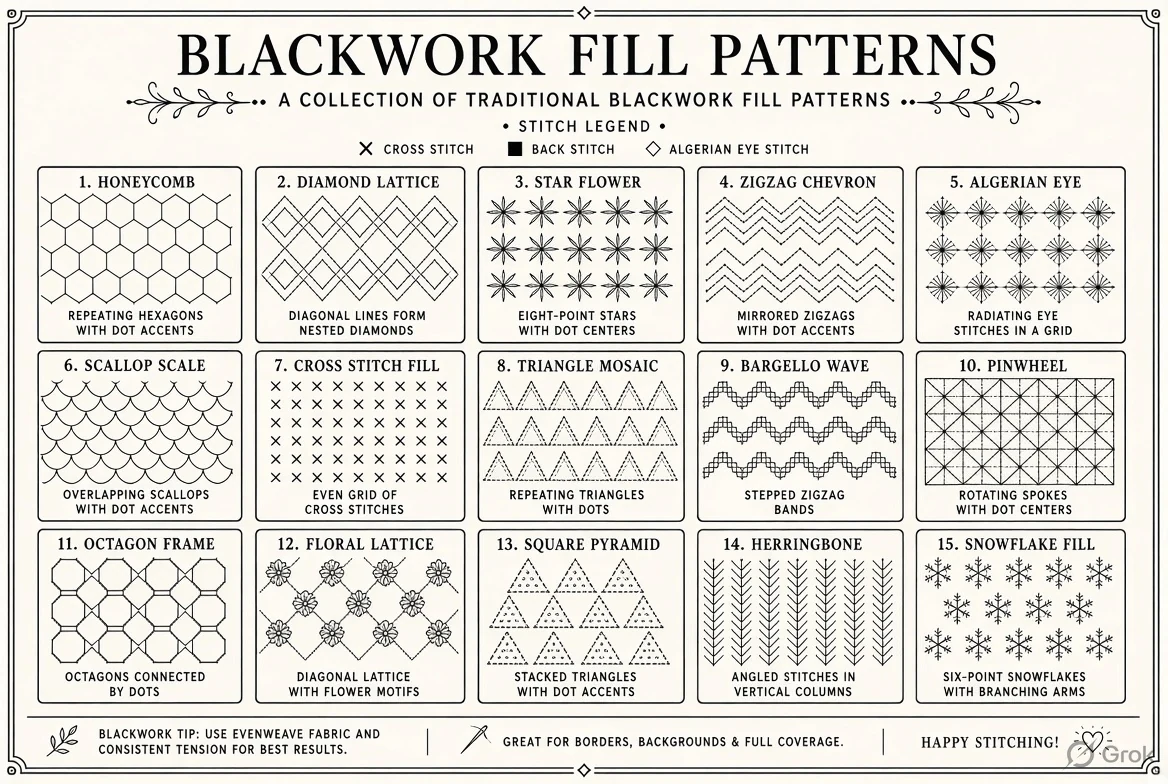
What is blackwork embroidery and what does a pattern chart contain?
Blackwork is a family of counted embroidery techniques that became prominent in European needlework, including early modern English clothing. Dark thread on a light fabric is a famous appearance, but historical and contemporary examples may include additional colors. A chart usually maps each visible segment to a regular woven grid so that the stitcher can count the warp and weft threads. Some charts show only the design; others include a suggested order of stitches. Those are different levels of instruction. For a beginner, the essential distinction is that the printed pattern can show where stitches belong without explaining exactly how to make a reversible route on the back.
The Holbein stitch: why it is called double running stitch
Holbein stitch is worked in two passes. On the first pass, you make spaced running stitches along the planned line, leaving the intervening gaps open. On the return journey, stitches fill those gaps, producing an apparently continuous outline. When properly planned, this can give a similar pattern on both faces of the fabric. The route is particularly easy to understand along a simple straight border and becomes more involved at branches and crossings. The technique takes its name from artist Hans Holbein the Younger, whose period portraits depict elaborate embroidered garments. The name does not mean he invented the stitch.
Blackwork versus cross stitch and backstitch
In counted cross stitch, an X is usually built from diagonal stitches spanning the chosen fabric units. Blackwork focuses on lines, geometric fills and repeated motifs; the Holbein and backstitch routes can be used instead of individual X-shaped crosses. A backstitch line can look similar from the front but normally differs on the reverse. Because the finished picture may resemble a pixel chart, some websites incorrectly treat blackwork as simply black cross stitch. The most useful comparison is to show one motif with each thread path and note where the needle enters and exits. A stitched sample clarifies more than terminology alone.
Diamond grid blackwork pattern: planning the repeat
A diamond grid is an approachable pattern because its repeated diagonals form a predictable lattice. Mark the design center and count the same number of fabric threads between neighboring corner points. If one diagonal spans four fabric intersections while the next spans five, the entire lattice can drift. Start on a small square of evenweave cloth and outline a single diamond. Work the return pass before repeating the unit across a longer band. For clothing, consider the movement and edge seams so the diamonds do not suddenly end at an awkward cropped segment. A complete chart should explain the boundary of the repeat, not just display an attractive central shape.
Blackwork floral pattern: balancing outline and fill
Floral patterns may be constructed from small repeated stems, leaves or symmetrical petal-like geometry. A motif can look curved when viewed from afar while actually being made from short counted straight stitches. Use a simple outline first if the flower is unfamiliar, then fill the interior with a compatible repeat. Dense stitching and long jumps on the reverse can make a fabric heavy, so examine the back periodically. For a flower pattern intended as a decorative panel, avoid putting the heaviest fill right across an area that must stretch or fold. The image provides a visual example, but the exact route should be tested on a scrap.
Geometric blackwork borders: corners and clean joins
A border pattern relies on a repeat that connects at both ends. Before sewing, count the total available fabric width and decide whether the segment must be mirrored, repeated whole or shortened near a corner. A repeating border that fits perfectly across one edge can fail to meet when turned around a collar. Mark the corners first and work toward them in a planned route. Holbein stitch can be especially satisfying for a border because the return pass fills gaps, but every branch should be considered before starting. If reversibility is essential, draw the travel line on paper rather than assume a visually continuous pattern is also reversible.
Fill patterns and blackwork shading without relying on thread color
Blackwork shading often changes the density of stitch marks instead of changing the color of the thread. A loose lattice looks lighter, while a denser repeated motif can appear darker at viewing distance. This visual effect makes geometric fills useful for depicting shapes and tonal transitions. It is also a reminder that ‘one color’ embroidery can produce rich detail. A fill sampler helps readers test pattern size and apparent darkness on the actual fabric. Work a small square in several densities and view it from arm’s length. Do not promise precise grayscale values from a screen image because thread weight and fabric count affect appearance.
Fabric count, needles and thread selection
Evenweave linen or another countable woven fabric makes each stitch interval consistent. Some blackwork embroiderers choose fine linen such as 28- or 32-count material, but beginners can select a larger, more visible grid while learning. Thread thickness should suit the fabric. A tapestry needle with a blunt point is often convenient for counted fabric holes, while other projects may call for a sharper embroidery needle. Use a small hoop or frame if necessary to manage tension, but do not stretch the cloth until the holes distort. Starting with a high-contrast thread and a compact motif is simpler than attempting an intricate garment cuff immediately.
How to use the four illustrated chart images
The four visuals on this page are a diamond grid, floral repeat, border and fill sampler. They can be printed through normal browser tools where supported, but they are not guaranteed exact-size, ready-to-stitch PDF templates. Identify the chart’s grid unit and the intended fabric count before transferring anything. A cell may stand for one fabric intersection or a multi-thread step depending on the source diagram. Add a small stitch legend if it is missing. For precise reversible stitching, plan the two-pass route by hand on a copy of the printed chart. A finished pattern picture is not automatically a thread-path diagram.
First blackwork project: a small reversible border
Choose a short band with only one repeated diamond or zigzag segment. Count the fabric threads across your working area and mark two endpoints. Bring the needle up at the first point and work a running stitch sequence with regular gaps. At the end, turn and fill those gaps without adding unnecessary long jumps on the reverse. If the pattern branches, deal with one branch at a time and compare the two faces of the fabric. Secure the thread carefully so the knots do not show through a pale fabric. After the first band, attempt a small floral or fill square only when the return pass feels comfortable.
Historical authenticity and modern blackwork patterns
Contemporary charts often combine motifs from different eras, or use digitally generated symmetry to create new arrangements. That is perfectly reasonable craft design if clearly labeled as a modern interpretation. A pattern should not claim to be copied from a specific Tudor garment unless it has a traceable source and permission where needed. Likewise, not every black line on a light textile is automatically blackwork embroidery. Recognizing the counted-thread construction, characteristic stitch paths and repeated fills is more useful. Published guild resources can provide a reliable overview; historic surviving objects require separate textile scholarship.
Mistakes and useful next-search ideas
Beginners frequently miscount intersections, work only one half of the Holbein route, confuse a printed grid cell with a stitch length or pull the thread too tight. Start with a single repeated motif, count aloud if necessary and check the reverse after each return pass. Follow-up search queries include ‘blackwork embroidery geometric patterns’, ‘Holbein stitch diagram’, ‘blackwork diamond grid’, ‘blackwork border pattern PDF’, ‘reversible double running stitch’ and ‘blackwork fill patterns printable’. These are anticipated reader questions rather than measured trend data. The most valuable chart pairs a clear image with a realistic explanation of the stitching route.
Frequently asked questions
What is blackwork embroidery?
A counted-thread embroidery tradition emphasizing outlined and repeated geometric or floral patterns.
What is the Holbein stitch?
The double running stitch: two passes fill alternate gaps to create a continuous line.
Is blackwork always reversible?
No. Reversible Holbein stitch is a major technique, but not every blackwork project uses that route.
Is blackwork the same as cross stitch?
No. The characteristic counted lines and fills often use double running or backstitch.
Can I use a floral blackwork chart on linen?
Yes, with a grid suited to the fabric count and a tested thread path.
Do the four charts include a separate PDF?
No separately hosted tested PDF is claimed; these are illustrated visual references.
Sources and conclusion
For documented stitches and traditional blackwork context see Embroiderers’ Guild of America: Blackwork and Royal School of Needlework: Holbein Stitch. Related published reading: Crochet beginner patterns. Count your ground fabric and plan the full path, not just the front-facing design.






Share Your Opinion
Comments are closed on this post.