 Vista
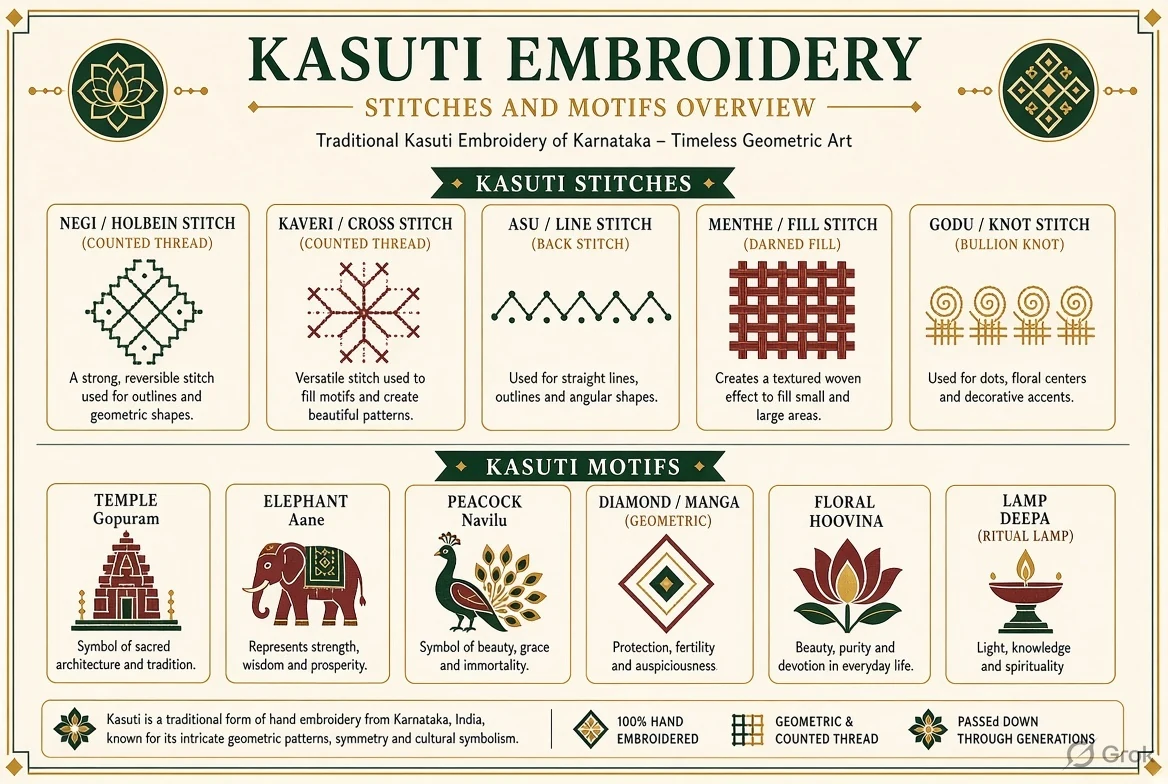
Direct answer: Kasuti embroidery is a counted-thread needlework tradition associated with Karnataka, India. Four commonly described stitch types are Gavanti (double-running or line work), Murgi/Muragi (zigzag effects), Negi/Neygi (a running or darning-style technique) and Menthi (cross-stitch-like marks). Kasuti designs commonly feature temple forms, chariots, lamps, flowers and geometric arrangements. This visual guide uses three diagrams—Gavanti, Murgi and Negi, and temple-floral motifs—and explains why the missing separate Menthi poster does not mean the fourth stitch is absent from the tradition.
Updated 20 November 2026. Menthi is the fourth major stitch; this image group lacks a separate Menthi illustration.
Kasuti four stitches: quick comparison
| State | Karnataka, India |
|---|---|
| Four recognized stitches | Gavanti, Murgi, Negi/Neygi, Menthi |
| Gavanti | Double-running-line technique |
| Murgi | Zigzag or stepped decorative stitch |
| Negi | Darning/running-style filled lines |
| Menthi | Cross-stitch-like form |
| Motifs | Temples, lamps, palanquins, birds, flowers, geometric patterns |
Illustrated Gavanti, Murgi, Negi and temple motifs
What is Kasuti embroidery and where is it practiced?
Kasuti belongs to Karnataka’s textile heritage and is especially associated with intricate handwork on clothing. Traditional Kasuti designs may be arranged on saris, blouse pieces and other fabrics, while contemporary makers adapt the patterns to home textiles and accessories. The defining feature is the attention paid to stitch structure and geometric arrangement, not merely the use of bright colors. Many designs are built by counting the woven fabric threads rather than tracing a completely freehand curved drawing. Historical practice varies by maker and region, so a single online chart should not claim to be the only authoritative Kasuti alphabet. An effective learning guide starts with the four named stitch families and the type of motifs they create.
The four Kasuti stitches: Gavanti, Murgi, Negi and Menthi
Indian handicrafts sources and design-learning resources describe four prominent Kasuti stitch types. Gavanti is a line or double-running stitch, sometimes planned so the design looks similar from either side. Murgi produces a zigzag-like or stepped visual effect. Negi, also written Neygi in some sources, is associated with a darning or running-fill method. Menthi is described as a cross stitch or related cross-like form. Transliteration differs, so Murgi and Muragi may refer to the same named stitch in different guides. These are not four substitute spellings for one stitch. The three illustrations on this page show Gavanti, Murgi/Negi and motifs; Menthi is explained in text because a separate image was not uploaded.
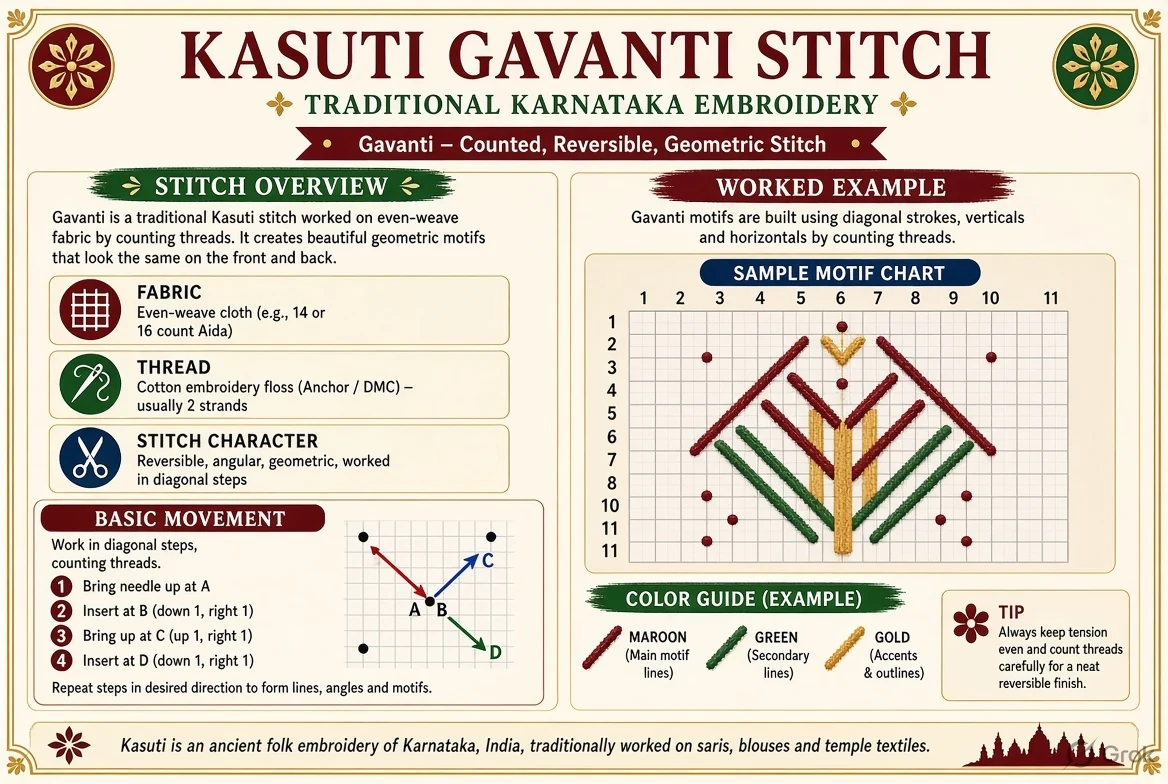
Gavanti stitch diagram: understanding a double-running line
The Gavanti stitch is commonly compared with double-running work. A line is built using regular in-and-out movements, often with a planned return path to complete missed spaces. This approach can help form the fine repeated outlines used in geometric Kasuti. The precise route and how identical the two faces become depend on the motif. Begin with a small straight-line sample and examine the front and reverse after completing the return. When a pattern branches, mark the points where the needle should change direction instead of making long floating thread jumps. A decorative diagram is a useful starting reference but does not automatically guarantee a perfectly reversible result.
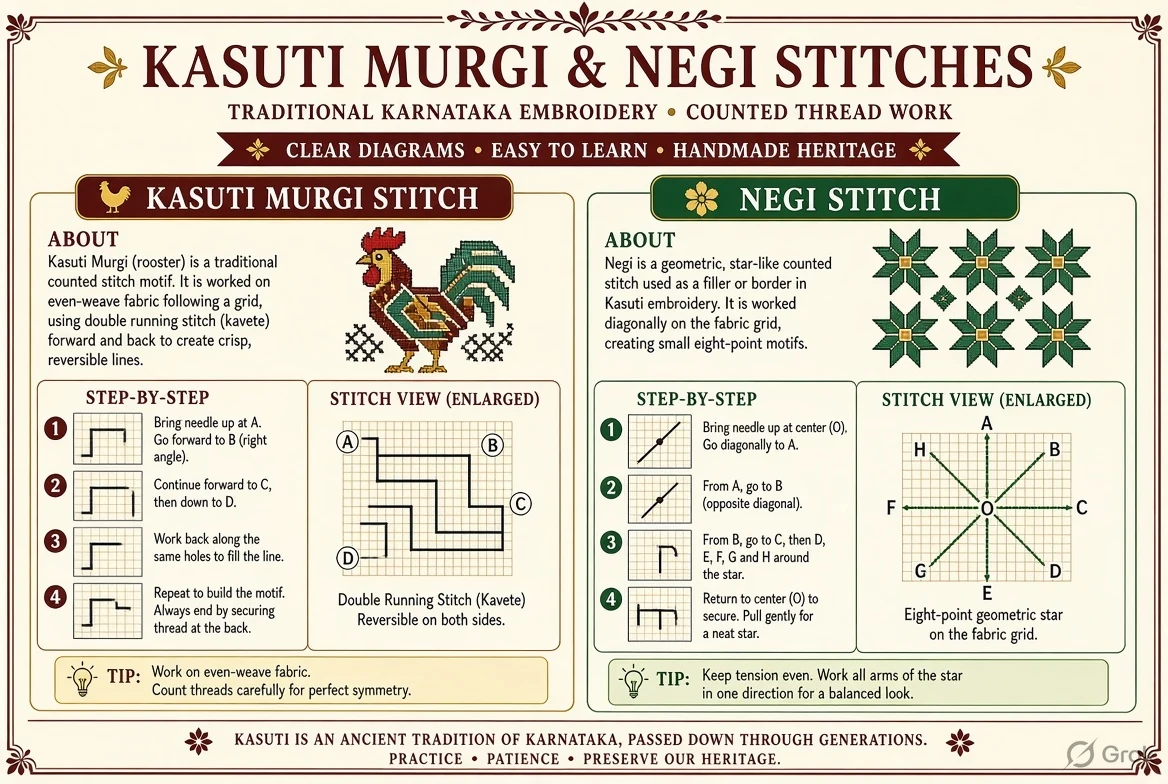
Murgi or Muragi stitch: why the design looks stepped
Murgi is described in craft references through zigzag-like or stepped line work, often used for patterns that seem to move diagonally across the counted grid. When stitches are counted from fabric threads, a diagonal can emerge from short straight steps instead of one continuous diagonal sweep. Start with a small zigzag on evenweave fabric, maintaining the same interval at each corner. The pattern may shift if one turn spans an extra thread, so counting is more important than visual guesswork. Different explanatory diagrams may use slightly different naming and steps; use a consistent source rather than mix instructions from several unrelated pictures. The image here helps readers recognize the general construction.
Negi or Neygi: running and darning-style filling
Negi is another Kasuti stitch family described in official and craft-learning references. It is often associated with running or darning-style treatment that can create filled areas or elongated marks. Instead of assuming the pattern requires the same return path as Gavanti, look carefully at how parallel elements are placed and how much fabric is covered. On a small practice square, make a short row of evenly spaced stitches and compare its texture with the Gavanti sample. The amount of thread used and appearance can change with cloth count and thread thickness. A labeled diagram is helpful, but a full working pattern should include exact needle entry and exit points before the technique is reproduced in a larger garment.
Menthi cross stitch: the fourth Kasuti stitch
Menthi is often described as a cross stitch or a cross-like counted form. The name is sometimes compared with fenugreek-seed shapes in explanations, but that association should not be used to invent one rigid historical needle path. A learner can practice small X-shaped marks on an evenweave square to understand how the visible dots and crosses differ from lines created by Gavanti or Negi. Keep the lower diagonal of each X in a consistent direction when making a neat row. The important factual detail is that Menthi belongs in a complete Kasuti overview even though this batch has no separate dedicated Menthi poster. A visual guide should not quietly reduce the recognized four stitches to three.
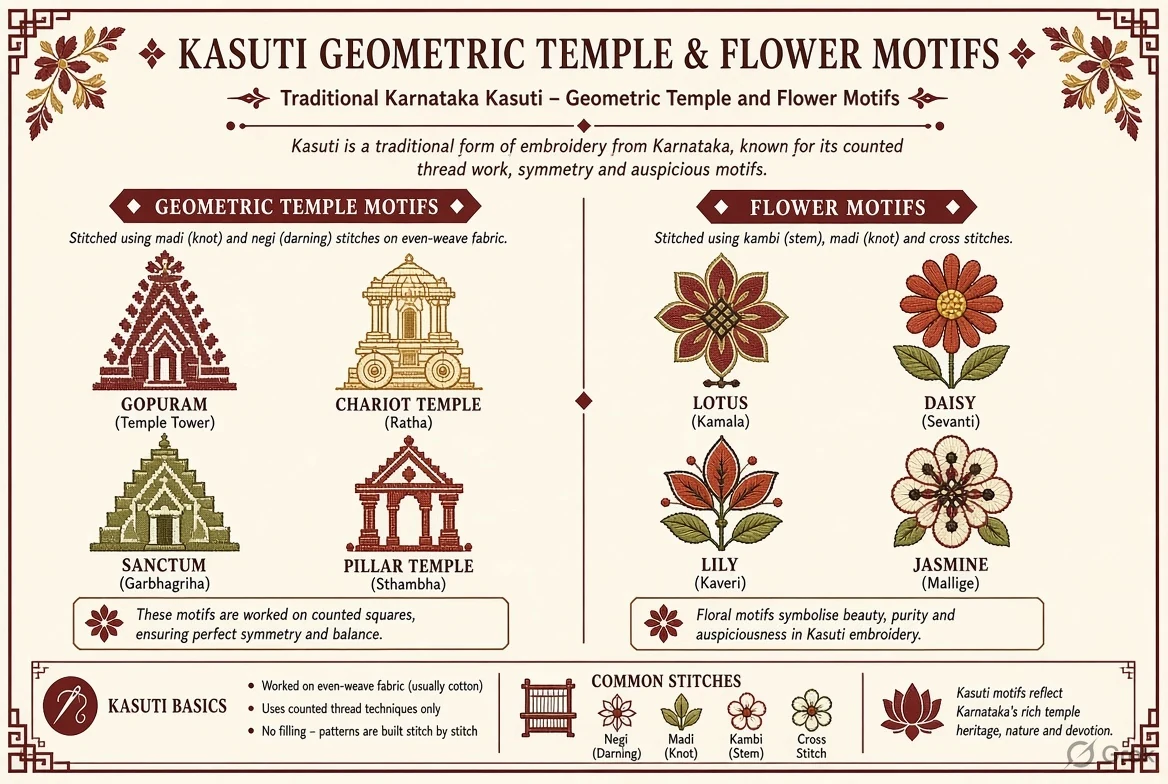
Temple motifs and architectural shapes in Kasuti
Temples, towers, shrines, lamps and other architectural outlines are among the familiar subjects of Kasuti embroidery. Their recognizable silhouettes can be created using steps and straight counted segments, making the craft particularly suited to planned geometry. A beginner can simplify a temple-like motif into a central vertical structure with paired side details and a symmetrical top. That is a modern exercise, not a historically verified reproduction of any specific shrine. Work out how many fabric threads the motif occupies before starting. If a design includes a tall tower, choose a stitch technique that gives continuous lines without excessively long carries on the back. A clear border can frame the temple without crowding it.
Flowers, birds and Karnataka geometric embroidery patterns
Kasuti also includes flowers, birds, decorative lamps and repeated geometric forms. The motifs can appear stylized rather than naturalistic because counted threads guide where the stitches fit. For a floral practice pattern, begin with a central vertical axis and build paired petals or leaves on either side. Contrast thread can make the shape readable, although one color is enough for learning. If the design includes several birds or lamps, plan spacing before copying the motif repeatedly. Cultural meaning should be discussed with care: the presence of a particular flower on a modern diagram does not prove that it had one universal ritual function in every household. Good captions identify the object and technique rather than inventing symbolism.
How to choose fabric, needle and embroidery thread
A regular, countable woven fabric is useful because Kasuti stitches rely on accurately placing small line segments. Beginners can select cotton with visible structure and a needle suited to the cloth; very fine fabric may make counting difficult at first. Choose thread that passes through without opening large holes. Cotton embroidery floss is a practical modern option, but thicker or shiny threads can change the texture. Test whether the thread bleeds when washed if the piece will be part of clothing. A hoop can stabilize some fabrics, but pulling it too tight will distort the grid you are trying to count. Mark the motif center lightly instead of drawing every thread position with a permanent pen.
Step-by-step first Kasuti sampler with three illustrated charts
Make a small sampler with three panels: one Gavanti line, a Murgi zigzag and a Negi practice fill. Before stitching, mark equal-sized rectangles and count the fabric threads across each area. Work the Gavanti outline and check its return path. Then stitch a short Murgi stepped pattern using consistent intervals. Finally, experiment with parallel Negi-style marks following a dependable reference. In a separate corner, add a tiny Menthi cross-stitch sample so the four techniques are represented in practice. Use the temple or flower motif illustration for a final small outlined design only after the core movement is comfortable. Keep a note of thread count, stitch length and tension.
Kasuti vs Chikankari, Kantha and Blackwork
Kasuti, Chikankari, Kantha and European blackwork all may include detailed hand embroidery, but their local traditions and technical vocabularies differ. Kasuti is associated with counted geometric designs in Karnataka. Chikankari has characteristic Lucknow stitches such as Bakhiya shadow work and Tepchi; Kantha is linked to Bengal’s layered running-stitch textiles; blackwork commonly uses counted geometric fills and double running. The resemblance of one line stitch does not establish that these crafts are interchangeable. If you adapt a motif for a contemporary garment, credit the source tradition accurately rather than calling it an authenticated antique. This matters when creating educational charts and SEO descriptions about regional arts.
Printing charts, avoiding misleading PDFs and next keywords
The three images here are hosted visual learning aids: Gavanti, Murgi/Negi and geometric temple-floral motifs. They are not advertised as a separately downloadable, tested stitch-counted PDF pack. The actual scale will depend on browser printing, so practice the grid on your chosen fabric first. Follow-up reader questions include ‘Kasuti embroidery stitches’, ‘Gavanti stitch diagram’, ‘Murgi and Negi stitch difference’, ‘Menthi cross stitch’, ‘Kasuti temple motif’, ‘Karnataka Kasuti design chart’ and ‘Kasuti embroidery step by step’. These are search-intent ideas, not measured keyword volumes. Read the stitch chart together with authoritative craft descriptions before making factual claims about traditional technique.
Frequently asked questions
What are the four stitches of Kasuti?
Gavanti, Murgi/Muragi, Negi/Neygi and Menthi.
Which Indian state is Kasuti associated with?
Karnataka.
What is Gavanti?
A double-running-line technique described in Kasuti craft guides.
What does Menthi mean in Kasuti?
A cross-stitch-style counted stitch within the four recognized groups.
Do temple and flower patterns belong to Kasuti?
Yes. Such stylized architectural, floral and geometric motifs are well documented.
Is this a complete counted PDF pattern?
No. The three figures are reference images, and a separate Menthi poster is not supplied.
Sources and conclusion
Kasuti stitch terminology and craft practice: D’source: Kasuti Embroidery Stitches and Global InCH: Kasuti Embroidery of Karnataka. Choose a counted fabric, practise all four recognized stitch types, and check exact needle routes before working large motifs.























Share Your Opinion
Comments are closed on this post.