 Vista
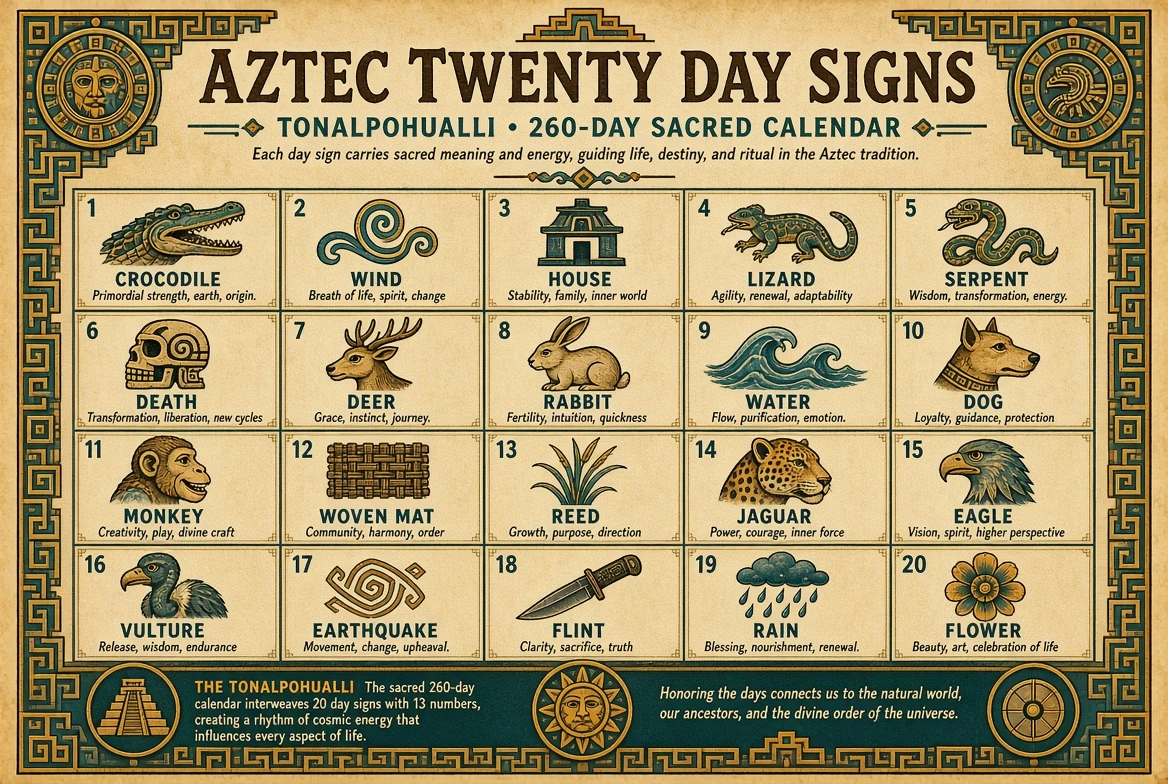
Direct answer: The Aztec twenty day signs chart shows the Nahuatl glyph names used in the tonalpohualli. Its 260-day cycle pairs 20 named signs with numbers 1–13, not one fixed sign for every English-language zodiac personality. The four illustrated panels below show the conventional full sequence, from Cipactli to Xochitl, with historical context and pronunciation-sensitive spellings.
Updated 20 November 2026. Educational visual references, not a reproduction of one specific codex folio.
Aztec 20 day signs chart: four image panels, all signs in order

Aztec 20 day signs: how the tonalpohualli calendar works
The Aztec 20 day signs belong to the tonalpohualli, a 260-day count used in central Mexican Nahua cultural and religious traditions. Each day is labelled by two components: one number from 1 to 13 and one named sign from a group of twenty. The numbers advance in their own cycle, and the signs advance in a separate cycle. Together they generate 260 distinct combinations before the same pairing repeats. This is why a picture of twenty symbols is only part of the calendar, not a complete 260-cell daybook.
Historic codices and other documents depict the names as glyphs, frequently with numerical markers. The Visual Lexicon of Aztec Hieroglyphs describes twenty day-sign glyphs used with rotating numbers in the tonalpohualli. Contemporary search pages sometimes present the signs as a “Mexican zodiac”, but this modern comparison can obscure their original calendrical and ritual setting. A simple personality profile for each sign is a reinterpretation, not a direct replacement for the recorded practice of reading days and auspicious circumstances.
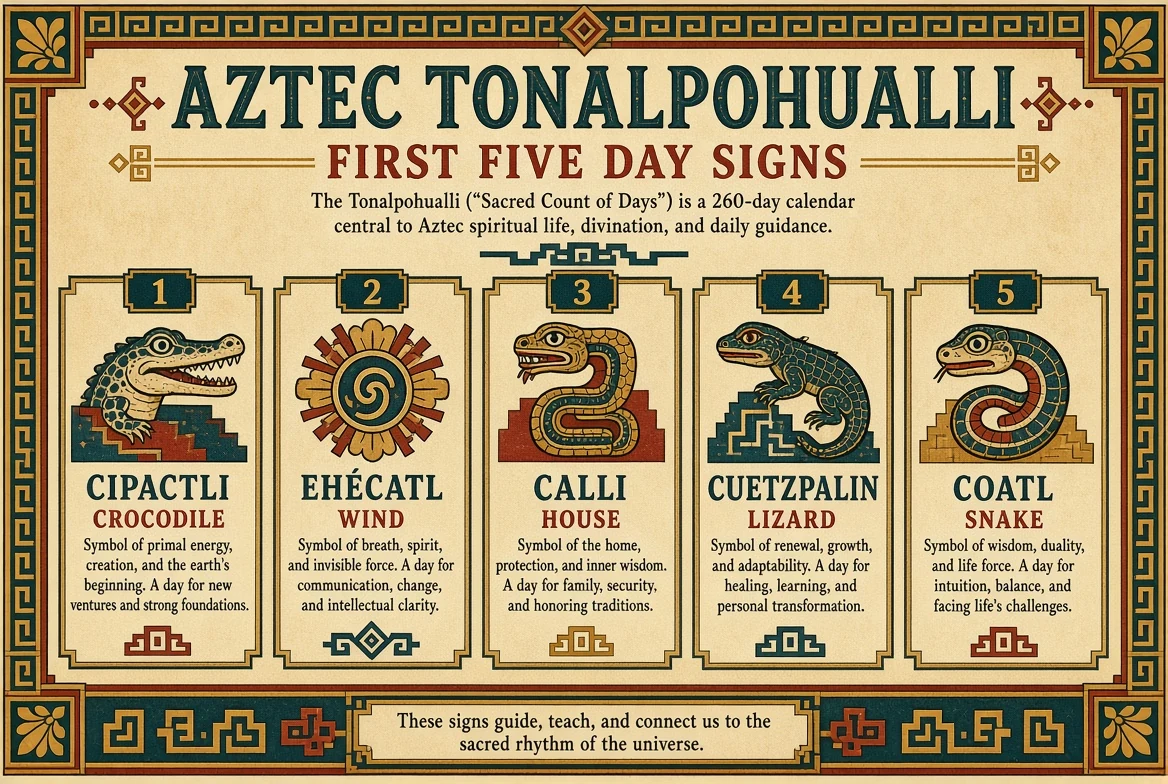
Aztec calendar signs 1–5: Cipactli to Coatl
The familiar starting sequence is Cipactli (a crocodilian or mythic crocodile-like creature), Ehecatl (wind), Calli (house), Cuetzpalin (lizard) and Coatl (serpent). Their glyphs can be stylised and differ among codices, but the names and recognisable iconographic categories are useful beginner reference points. Cipactli is not simply an illustration of a modern species in every source; its role in Mesoamerican imagery has mythic associations as well as an English shorthand name.
Ehecatl is written without an accent in many simplified English lists, while specialist Nahuatl orthography may display different transliteration conventions. Likewise a drawing of Calli can vary in architectural detail. Do not compare your printed icon with one contemporary emoji and conclude the ancient sources used that exact icon. The educational first-five chart establishes the sequence. For historical research, pair it with an actual annotated codex page rather than treating a clean vector illustration as a facsimile.
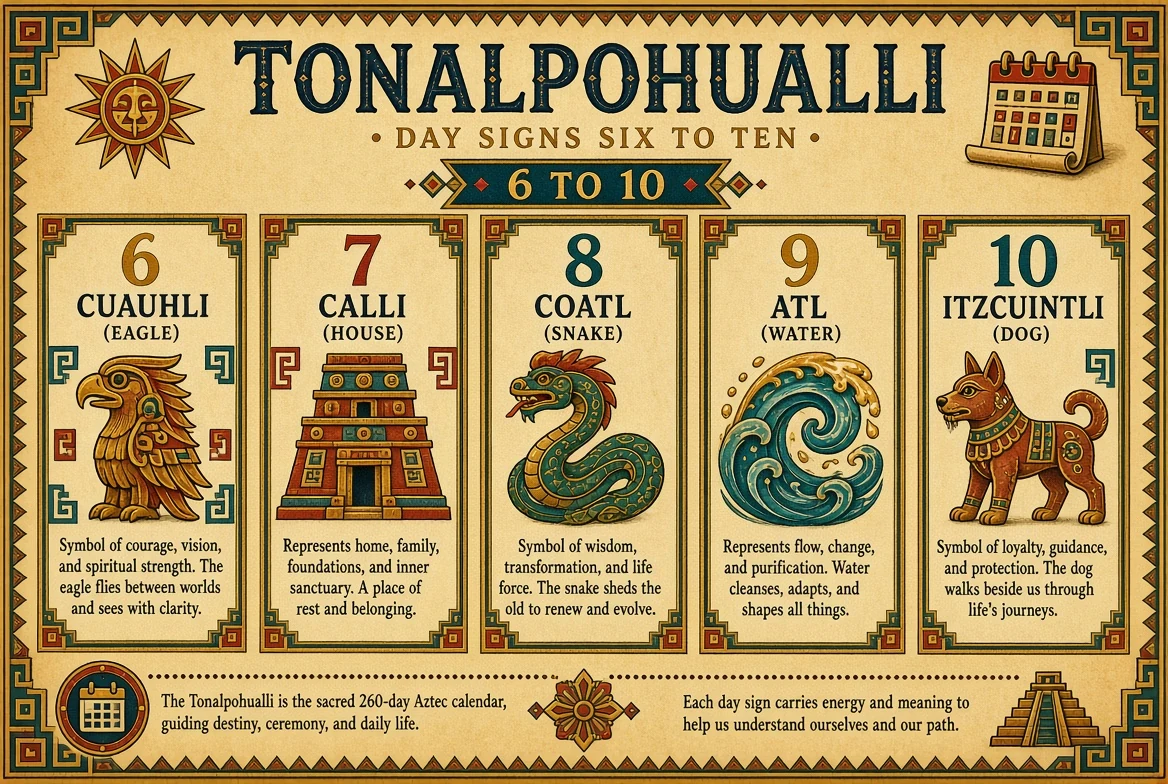
Signs 6–10: death, deer, rabbit, water and dog
Positions six through ten are Miquiztli (death), Mazatl (deer), Tochtli (rabbit), Atl (water) and Itzcuintli (dog). The short English terms are useful for identifying a glyph in the gallery, but they are not complete interpretations of what a particular ceremonial day meant. Miquiztli should not be turned into a sensational claim that people born under the sign were fated to die young; that is not a historically established rule drawn from the name alone.
Atl refers to water and can be illustrated using flowing or curling forms depending on the document. Tochtli can also appear in year-bearer discussions, which introduces another layer of calendrical notation. A reader studying a date must not substitute the icon’s English meaning for the number-and-sign pairing. “One Rabbit” and “Two Rabbit” are different dates in the count. The same animal term also appears in other storytelling contexts, so the presence of a rabbit does not automatically prove an object was a calendar.
Signs 11–15: monkey, grass, reed, jaguar and eagle
The third five-sign group contains Ozomatli (monkey), Malinalli (grass), Acatl (reed), Ocelotl (jaguar) and Cuauhtli (eagle). These categories draw from plants and animals familiar in the symbolic universe of central Mexico. Some modern art reproductions turn the jaguar into a generic house cat or the eagle into a bird silhouette with too little detail. That may still be recognisable as modern decorative design, but it is not sufficient to identify a particular glyph from a historic codex.
Acatl is especially likely to appear in discussions of dates and year names. The number and sign together matter, and chronology cannot be inferred from a reed pictogram alone. English-speaking readers should distinguish Cuauhtli, eagle, from Cozcacuauhtli, vulture, which comes immediately in the next group. These Nahuatl spellings are similar in the middle, so the exact term and visual context help prevent mislabeled image metadata or an inaccurate learning chart.
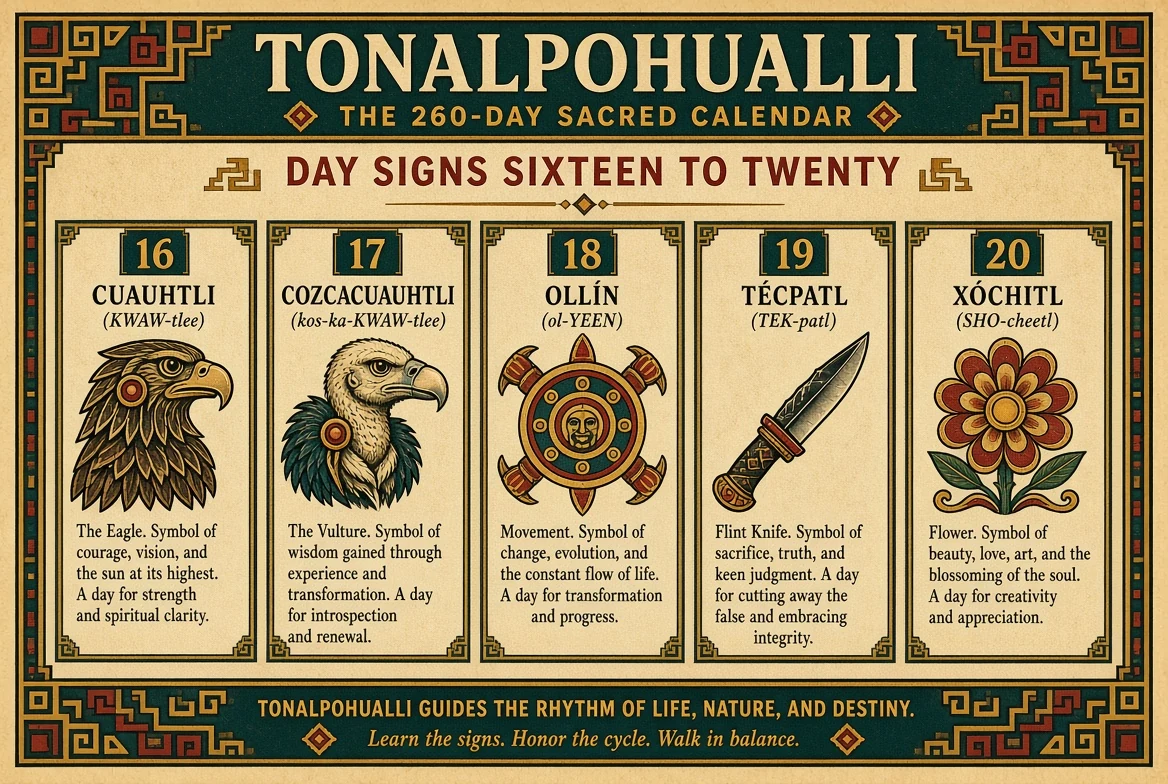
Signs 16–20: vulture, movement, flint, rain and flower
The final five are Cozcacuauhtli (vulture), Ollin (movement), Tecpatl (flint), Quiahuitl (rain) and Xochitl (flower). The movement sign has a distinctive visual association in famous Mexican imagery and is widely used in contemporary art, but not every simplified geometric form has the same historic source. Tecpatl names flint and may involve knife-like imagery; avoid replacing it with a random modern dagger icon if the goal is manuscript comparison.
These five complete the twenty-sign sequence, after which the sign count begins again with Cipactli while the thirteen-number count continues independently. That mathematical point is the key to understanding why 20 signs and 13 numerals yield a cycle of 260 days. The last chart in the gallery helps readers check the final names without mixing them up with the glyphs used for Maya calendars. Different Mesoamerican peoples had related calendar systems, but their names, visual traditions and written languages should not be conflated.
Tonalpohualli vs xiuhpohualli: 260 days and 365 days
The tonalpohualli cycle of 260 days is distinct from the xiuhpohualli, the 365-day seasonal count often described as eighteen periods of twenty days plus five additional days. Both are central to explaining the Aztec calendrical worldview, but a twenty-sign image does not list all the named months of the 365-day count. Readers searching for “Aztec calendar months names” need a different chart from those searching for “20 Aztec day signs”.
The familiar round Aztec Sun Stone also should not be treated as a simple wall calendar or personalised horoscope calculator. It is a monumental carving with complex ideological and cosmological imagery. The stone includes a ring of twenty day signs, but identifying an isolated glyph in a photograph is a separate task from calculating a historic date. Online converters may rely on assumptions about correlations or translations that are not shown to users. Always record the counting system and source rather than announcing an exact birth sign from a generic image.
How to read the 260-day sign-and-number combinations
Imagine the count starts at 1 Cipactli. The next day is 2 Ehecatl, then 3 Calli, and so on. After 13 the number returns to 1, while the twenty-sign list keeps moving. When the twentieth named sign has been reached, the sequence of names restarts, but the number sequence is at a different position from where it started. Only after 260 elapsed day positions do both elements return to the same combined label. This is a rotating modular pattern rather than twenty rows of thirteen consecutive identical sign names.
For a teaching worksheet, make two movable rings or columns: one for 1–13 and one for the twenty Nahuatl names. Advance both by one on each day and observe when the combination repeats. That demonstrates the principle without claiming to reproduce every calendrical tradition across Mesoamerica. The exact connection to a modern Gregorian date depends on the correlation and historical assumptions used by the converter. This article illustrates the historical day-sign vocabulary and count rather than offering a guaranteed personal fortune reading.
Aztec glyph charts, tattoos and heritage: how to label them
If you use an Aztec tonalpohualli symbols chart for an educational poster, include both the Nahuatl name and its common English gloss. Do not mix the order to make a more symmetrical design. When creating a tattoo or jewellery piece, compare the modern illustration with an actual codex reference, because stylised glyphs often lose their distinctive historical details during redrawing. A modern glyph is not necessarily a direct copy of a pre-Hispanic original, and a symbol’s appearance can vary among manuscripts.
Culture-specific sources provide better context than anonymous “secret Aztec zodiac meanings” infographics. Avoid claiming that a particular animal sign scientifically determines someone’s character or destiny. At the same time, do not flatten the tradition into generic clip art: the calendar is part of a complex body of Nahua knowledge and belief. Discuss the difference between documented historical practice and contemporary adaptation plainly so that people can appreciate the designs and understand how they were used.
FAQ: Aztec day signs and the 260-day calendar
What are the twenty Aztec day signs?
They begin with Cipactli, Ehecatl, Calli, Cuetzpalin and Coatl, and end with Cozcacuauhtli, Ollin, Tecpatl, Quiahuitl and Xochitl.
Why does the tonalpohualli have 260 days?
It combines a rotating set of 13 numbers with 20 named signs, giving 260 distinct number-and-sign combinations.
Is the Aztec calendar the same as the Maya calendar?
No. Related Mesoamerican counts existed, but Nahua and Maya calendars use their own names, glyph styles and historical contexts.
Is the Sun Stone a zodiac chart?
Not in the ordinary modern sense. It is a monumental object with cosmological imagery, including a ring of day signs.
Can a day-sign chart predict my future?
A chart can document a historical symbolic system, but no scientific evidence shows the sign alone determines personal destiny.
Conclusion: the complete day sign sequence matters
The twenty Aztec glyphs make sense within the 260-day tonalpohualli count, where names and numbers advance together through different cycles. Keep the Nahuatl order intact, distinguish calendar systems and treat modern horoscope claims as interpretations rather than established historical facts.
Sources
University of Oregon Visual Lexicon of Aztec Hieroglyphs: Tonalpohualli; Visual Lexicon: Tonalpohualli in the Codex Magliabechiano; INALCO: Aztec diviners and the 260-day count; Yale-New Haven Teachers Institute: Mexican Culture Taught Through the Aztec Calendar.
















Share Your Opinion
Comments are closed on this post.