 Vista

Direct answer: A heraldry shield shapes and symbols chart helps identify shield outlines, tincture names, animals in heraldic poses and geometric ordinaries such as a fess or chevron. But a shield’s shape or a surname alone does not prove a historical family crest. These four charts explain the visual vocabulary used to read coats of arms without inventing ancestry.
Updated 20 November 2026. Illustrated learning guide; ancestral arms must be checked against documentary evidence.
Heraldry shield shapes and symbols: four illustrated reference charts


Heraldry shield shapes and symbols: how to read a coat of arms
Heraldry is a system of identifiable emblems associated with individuals, families and institutions in several historical traditions, especially in medieval and later Europe. A heraldry shield shapes and symbols chart is useful because the same shield can combine colour, geometric divisions, animals and objects in a structured arrangement. The image can look like decorative medieval art, but its specific composition may be described using a formal vocabulary called blazon.
The central shield is an escutcheon. It may appear alone or within a larger achievement of arms that includes a helmet, crest, mantling, supporters or a motto, depending on the tradition and entitlement. Popular websites often call the entire arrangement a “family crest”, yet technically the crest is only one component above the shield in many systems. That distinction matters when researching an authentic coat of arms or trying to describe a historical image without inventing a family connection.
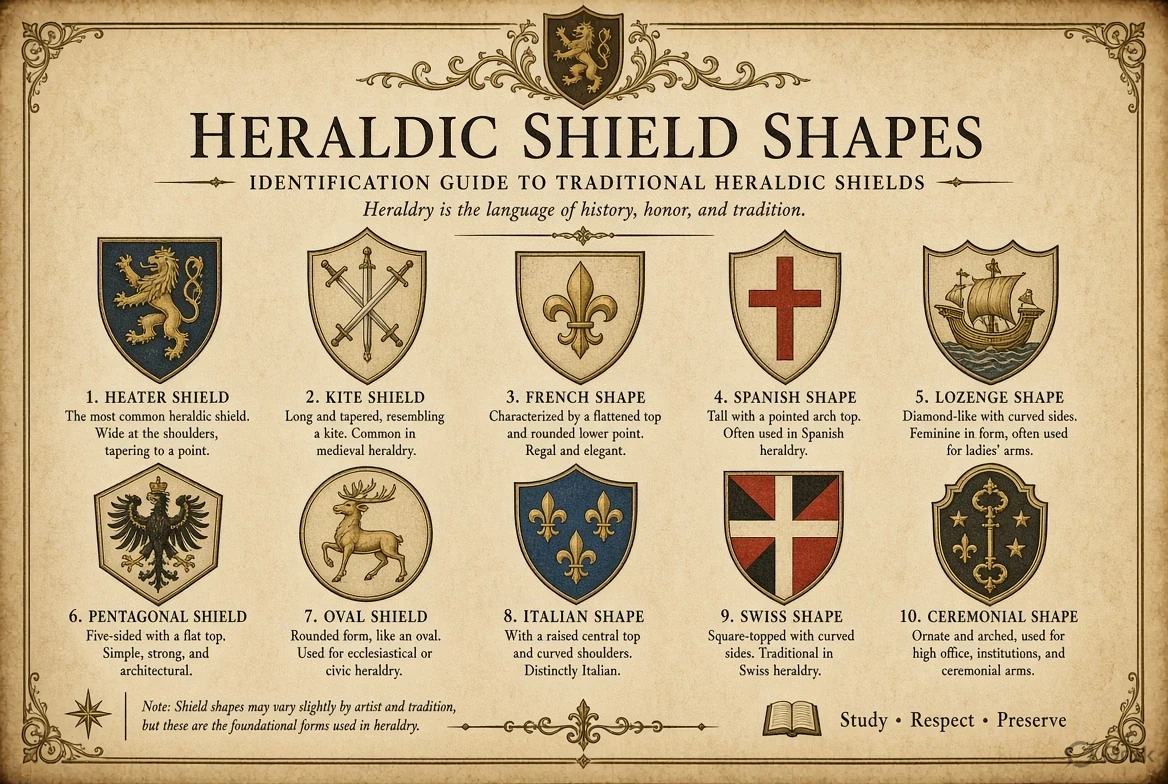
Common heraldic shield shapes: what the outline can tell you
Shields can be pointed, rounded, heater-shaped, oval or strongly decorative. Their appearance varies across centuries, regions and types of artwork. A late medieval shield in a manuscript may have a very different silhouette from one carved on an eighteenth-century monument, even when both display the same arms. Some shapes are chosen for design convenience; others have associations with particular periods or local artistic customs.
A crucial limitation is that shield outline by itself usually does not identify a coat of arms. Modern reproduction artists may place the same historical blazon into a different frame, especially for stationery, digital icons or flags. Avoid claiming every curved-bottom shield belongs to a particular country or dynasty. When comparing two reference images, focus first on the field, the charges and their arrangement; only then consider stylistic features such as the shield border and the external ornamentation.
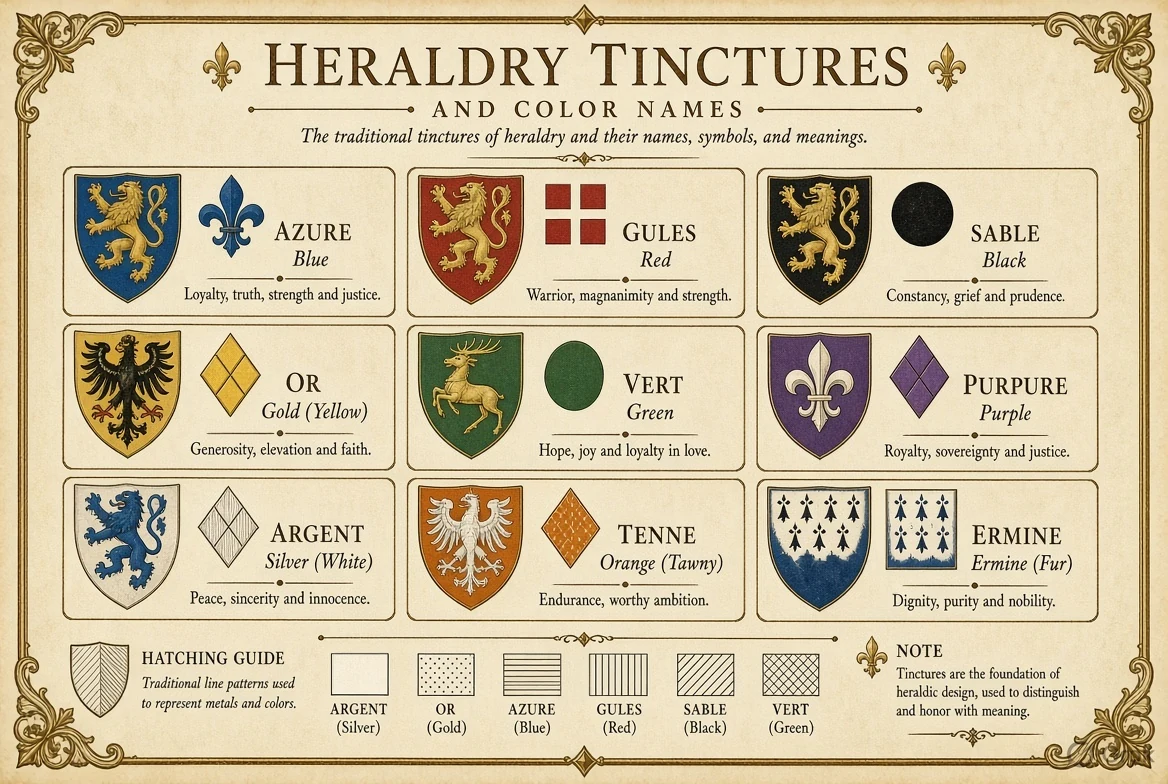
Heraldry colours and tinctures: Or, Argent, Gules and more
Heraldic colour vocabulary traditionally uses tinctures. The metals are Or (gold or yellow) and Argent (silver or white). Common colours include Gules (red), Azure (blue), Sable (black), Vert (green) and Purpure (purple). Historical heraldry also makes use of furs, particularly ermine and vair, which do not behave exactly like ordinary plain-colour fills.
A classic guideline known as the rule of tincture generally discourages placing one colour directly on another colour, or one metal on another metal, to preserve visible contrast. It has exceptions and depends on context, so it is not a mechanical test that declares every historical design invalid. Heraldic art sometimes uses hatching, outlines or engraving rather than full colour. The blazon and the underlying tradition are more reliable than guessing a tincture from a faded photograph.
Heraldic lion and eagle positions: rampant, passant and displayed
Animals are among the most recognisable heraldry symbols. The lion and eagle appear frequently, but the way an animal is depicted can be more important than the species alone. A lion rampant is commonly shown upright in an active pose, while a lion passant is walking. Guardant indicates that the animal’s head faces the viewer in conventional heraldic descriptions. An eagle displayed typically has wings extended to either side.
Because the artistic details are flexible, students should learn the posture vocabulary before memorising internet claims about what every lion represents. One post may assert that all lions mean courage, all eagles mean empire and all wolves mean loyalty. Such phrases are broad modern generalisations, not a dependable method for identifying a historical coat of arms. Exact posture, number, relative position, colour and surrounding charges are the searchable characteristics that can match a blazon or archival record.
Ordinaries and divisions: pale, fess, bend, chevron and cross
Heraldic shields also use simple geometric shapes called ordinaries. A pale is a vertical band; a fess is horizontal; a bend runs diagonally; a chevron forms an inverted V-like shape. Crosses, saltires and borders can also structure the field. The location of these features is part of the formal description, and a small change in arrangement may distinguish two coats of arms.
Another category is the division of the field, such as a shield divided vertically, horizontally or diagonally into differently tinctured parts. An image showing two colours may represent a partition of the shield, not a coloured band placed over an undivided field. For beginner charts, show a separate panel for field divisions and one for ordinaries. Otherwise similar-looking diagrams can produce the wrong labels. English Heritage’s guide illustrates how this vocabulary makes even a relatively complex design describable in a short formula.
Reading a heraldic blazon: a beginner’s worked example
Consider the phrase Gules, a lion rampant Or. In simplified terms it means a red field bearing a gold lion shown in the rampant pose. The order matters: the field comes first, then the principal charge and attributes. Add another animal, change the colour or alter its posture and the formal description changes. As a second example, a shield bearing a gold chevron on a blue field requires noting both the background colour and the chevron. The shield’s outer silhouette may vary without changing those essential elements.
Historical blazons are specialised descriptions and not always self-evident to beginners. Regional rules and grammatical conventions differ. Use the chart as a vocabulary aid and confirm unusual terminology in a reputable manual. A random image-search caption may mislabel an animal posture or overlook a small secondary charge. For research, a correctly written blazon plus the bearer and period is usually more informative than an isolated “medieval crest meaning” keyword.
Does a surname have one authentic family crest?
Many commercial sites sell a ready-made “coat of arms for your surname”. That presentation can be misleading. Historically, arms often belonged to specific persons or lineages under the rules of the relevant heraldic tradition, not automatically to everyone who shares a modern surname. Two unrelated people with the same last name may have no heraldic connection. Many historical bearers of arms had variant or differenced designs, which cannot be discovered reliably from a simple name lookup.
For family-history research, start with documented ancestry and the rules applicable to the jurisdiction and period. Archival deeds, grants, pedigrees and reliable heraldic registers are more useful than a clip-art database. Where heraldic authorities operate, their procedures may differ by country. In a classroom or design context, creating a new fictional shield can be perfectly reasonable—just label it as a modern design rather than assigning it to a historical ancestor without evidence.
Heraldry versus Japanese Kamon and modern logos
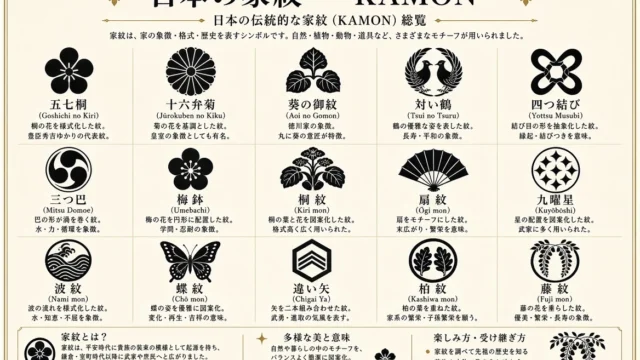
Japanese Kamon are traditional family-associated emblems, often featuring plants, birds or geometrical motifs. Their visual simplicity can resemble a minimalist company mark, yet their cultural and historical conventions differ from European heraldic blazon. A heraldic shield typically incorporates formalised fields, tinctures and charges, while a Kamon often appears as a compact one-colour motif without a shield background. Similar-looking circles, leaves or animals do not prove that two systems share the same origin.
Likewise a football club badge, school logo or fantasy-game crest can borrow heraldic aesthetics without being an officially granted coat of arms. For accurate labelling, ask whether the symbol is an authenticated historical achievement, an institutional emblem or a creative design. This distinction makes symbol charts useful across genealogy, gaming, art and history without blurring the evidence. When using a posted image, preserve the identifying details rather than applying decorative edits that change the charges.
FAQ: shield names, colours and family symbols
What is the difference between a crest and a coat of arms?
The coat of arms centres on an armorial shield; the crest is a particular element above a helmet in many fuller achievements. In casual speech the terms are often mixed.
What are the two heraldic metals?
Or is gold/yellow and Argent is silver/white. They are distinguished from traditional heraldic colours.
What does a lion rampant mean?
It is a conventional heraldic posture showing the lion upright. It is more specific than simply saying “lion symbol”.
Can a shield shape tell you the family?
No. Identify the precise field, colours and charges, then check documented historical attribution.
Does everyone with the same surname share a crest?
No. Heraldic rights and lineages cannot be inferred from a surname alone.
Conclusion: a heraldic shield is a readable design, not a generic surname logo
To identify a coat of arms, combine the tinctures, field divisions, charges, their orientation and a documented historical bearer. Shield shapes help date or contextualise illustrations, but the blazon provides the essential description. Compare our charts with established heraldic guides and resist treating commercial surname graphics as genealogical proof.
Sources
English Heritage: A beginner’s guide to heraldry; College of Arms Foundation: Language of Heraldry.



Share Your Opinion
Comments are closed on this post.