 Vista
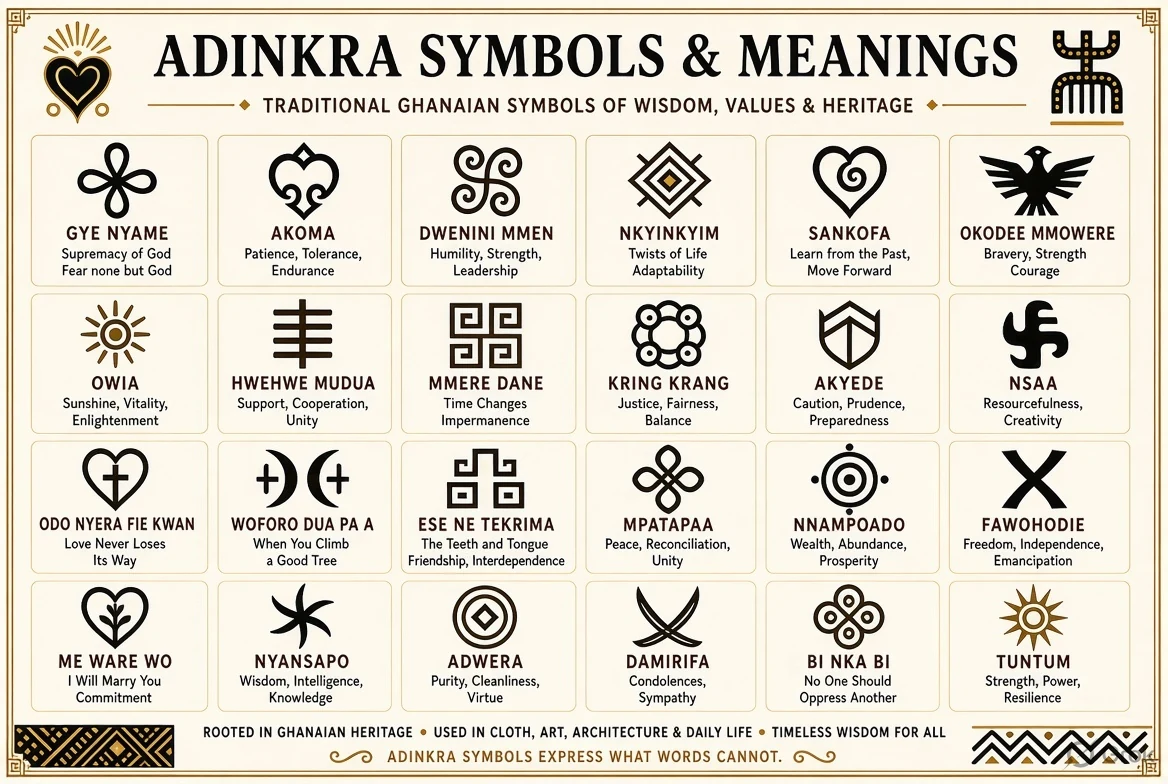
Direct answer: Adinkra symbols are Akan visual emblems associated with Ghana and West Africa. Names such as Gye Nyame (divine supremacy) and Sankofa (learning from the past) describe ideas, not individual alphabet letters. This Adinkra symbols and meanings chart combines four illustrated guides with historical context, correct names and practical interpretation.
Updated 20 November 2026. Illustrations are educational references, not substitutes for historic textile or museum verification.
Adinkra symbols and meanings: four illustrated charts
What are Adinkra symbols and why do their meanings matter?
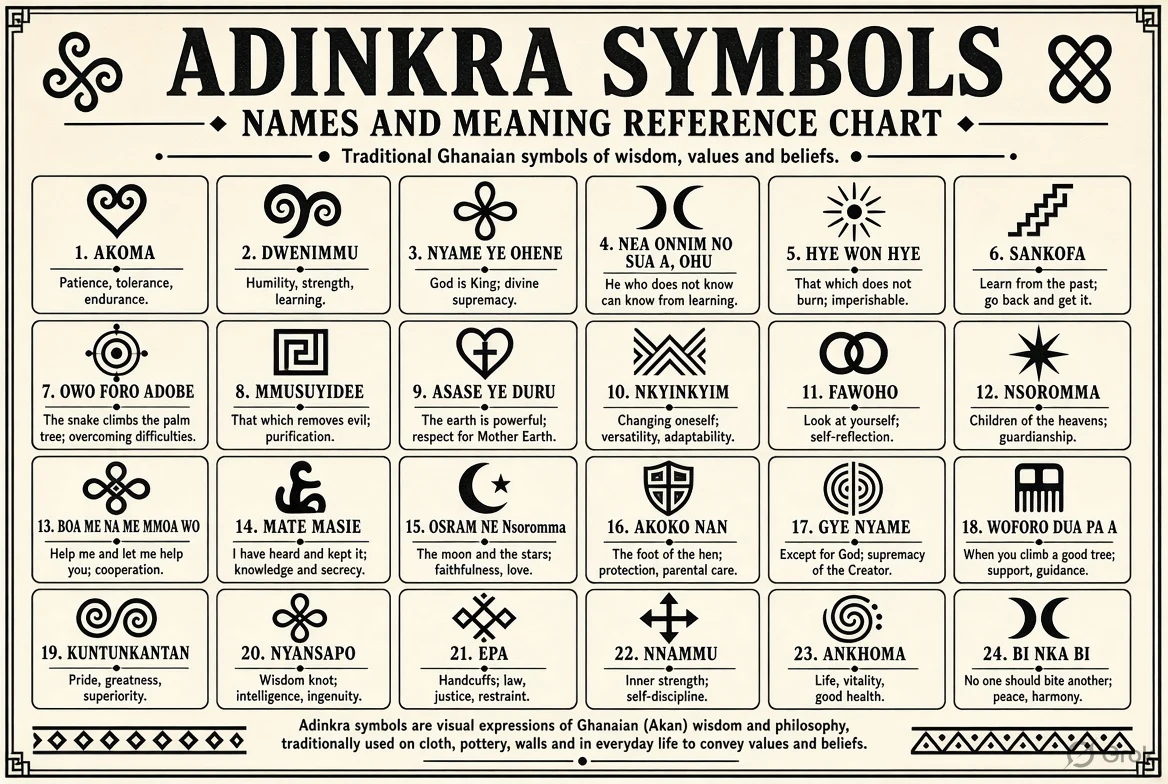
Adinkra symbols and meanings are visual expressions of proverbs, ethical ideas and shared knowledge associated particularly with Akan cultural traditions in Ghana and neighbouring parts of West Africa. A single compact design can communicate themes such as wisdom, the importance of learning from the past, divine power, humility, unity or adaptability. Adinkra is not an alphabet in which every mark simply stands for a sound. It is better understood as a culturally situated symbolic language whose names and interpretations accompany the shapes.
Adinkra appears on printed cloth, carved objects, architecture, jewellery, educational materials and contemporary graphic design. Many people first encounter the marks as black-and-white icons and want an Adinkra symbols chart with names. The picture is a useful entry point, but the meaning is richer when paired with the original Akan or Twi term and the proverb it evokes. Different catalogues sometimes use slightly different English glosses; do not treat a single short translation as the only possible meaning.
Gye Nyame and Sankofa: the two designs people search for most
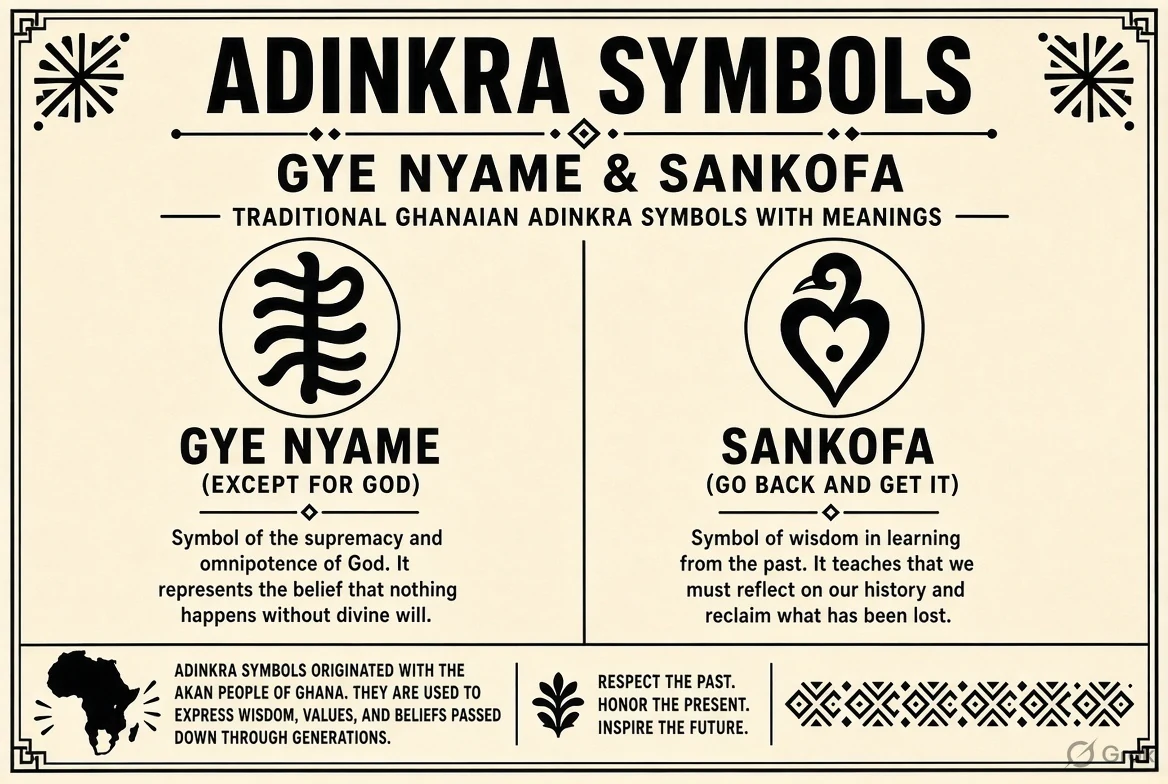
Gye Nyame is usually explained as “Except God” or as an expression of God’s supremacy. It is one of the most widely recognised Adinkra designs, and a historic Ghanaian stamping block held by the Smithsonian documents its use on cloth. Its bold interlocking curves make the emblem particularly visible in textile patterns. It is not a generic logo that originated in modern social media design.
Sankofa expresses the importance of returning to recover useful lessons from the past. It can appear as a bird looking backward while moving forward, or in a stylised heart-like form. Both are associated with the idea rather than being two unrelated symbols. That distinction matters when searching for “Sankofa symbol meaning”, “Sankofa bird” and “Sankofa heart”: an illustration may show one design even when a source discusses the other. The best explanation is not “live in the past”, but “carry valuable learning into the future”.
Adinkra symbol names: wisdom, unity, humility and resilience
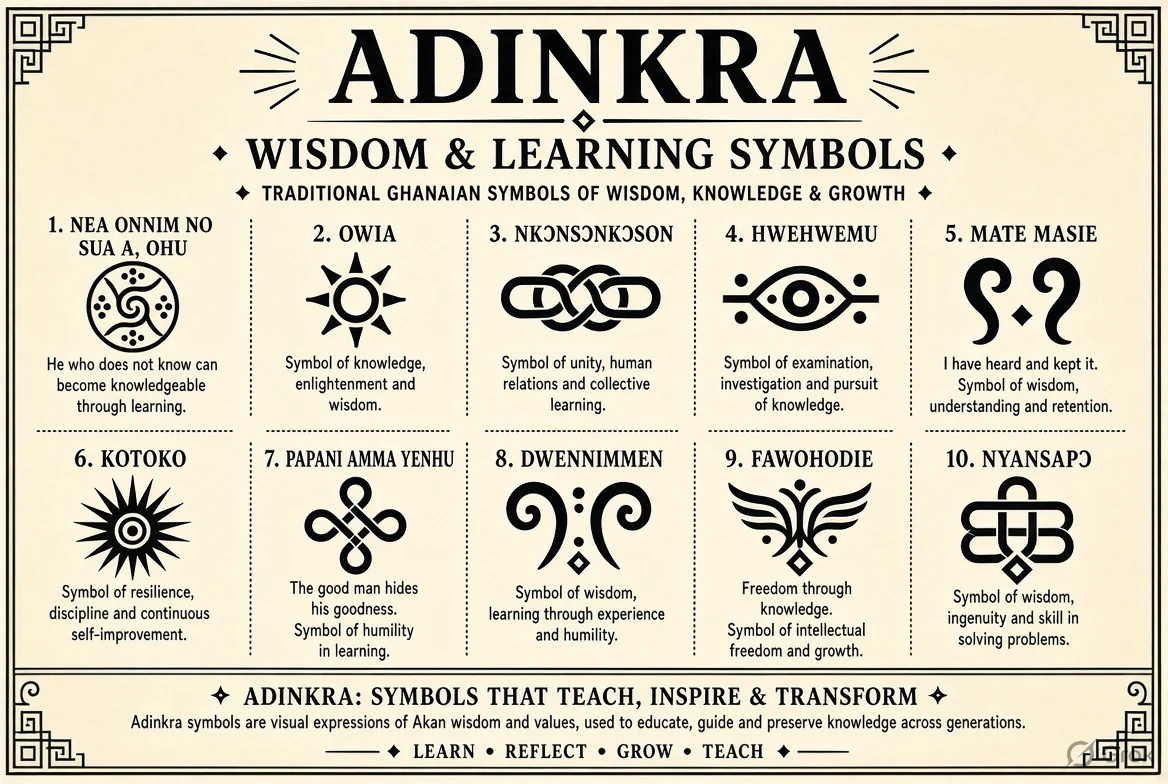
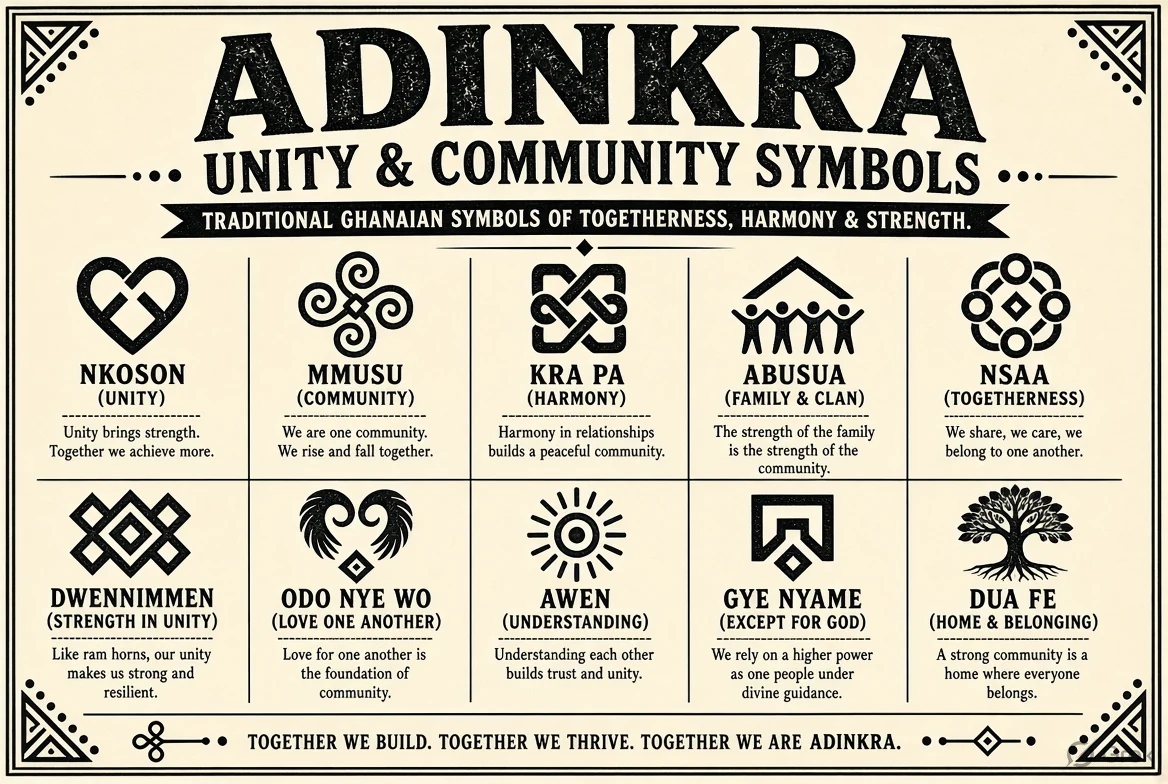
Other widely discussed motifs help make a Ghana Adinkra symbols and meanings chart more useful. Mate Masie concerns attentive listening, knowledge and prudence. Dwennimmen, often illustrated as ram’s horns, combines strength with humility. Funtunfunefu Denkyemfunefu uses joined crocodiles to evoke unity despite different interests. Akoma Ntoaso is linked to mutual understanding and agreement, while Denkyem invokes adaptability. These are value-oriented explanations, not promises that a tattoo or printed mark can mechanically change somebody’s life.
When comparing a poster with a museum catalogue, match three things together: the outline, the traditional name and the associated explanation. Sometimes two images use similar geometry but represent different named signs. Contemporary vector redrawings also simplify curved or stamped details. A designer should avoid confidently renaming a symbol merely because a Pinterest image attaches a popular English adjective to it.
Adinkra meaning chart: how to read the four image references
The first chart highlights Gye Nyame and Sankofa, the most common starting points for beginners. The second concentrates on learning and wisdom: look for how abstract shapes act as reminders of social teaching rather than as literal illustrations of a schoolbook. The third groups unity and community motifs. The fourth is a quick comparison sheet for names and appearances; it should be used as a visual index, not as a substitute for sources from Ghanaian cultural practitioners or collections.
Image charts may use modern, clean illustrations, whereas authentic cloth can contain repetition, stylised stamps, worn edges or scale differences. Older textiles and contemporary digital versions are not always identical. If a symbol must be reproduced for public signage, jewellery, an educational handout or commercial packaging, compare it with multiple authoritative references and check its spelling before publishing the design.
Where Adinkra comes from: textiles, history and living culture
Adinkra is closely linked to Akan-speaking communities and is prominently associated with Asante traditions. As documented by art historians and museum collections, decorated cloth carried social meanings and historically related to forms of prestige and ceremonial use. Its contexts changed with time; Adinkra prints are not restricted to a single event or one social rank today. A Smithsonian collection entry describes a stamp used for Gye Nyame and notes that Adinkra cloth is now worn for a widening range of occasions.
This is why it is misleading to call every Adinkra sign an “ancient tribal tattoo meaning” without explanation. The visual tradition is neither frozen in one historical period nor an undifferentiated symbol system for the whole continent. Descriptions should identify Ghana, Akan/Asante context and the particular motif when possible. The person who wears or prints a symbol may attach personal significance, but that does not erase the cultural source of the design.
Can you use Adinkra symbols for tattoos, logos or classroom posters?
Adinkra designs are frequently adapted in educational graphics and design projects. A responsible approach begins with choosing a symbol because its associated concept genuinely fits the message. For a community event, a unity motif makes more sense than randomly selecting whichever icon looks visually dramatic. For a school poster, print both the original name and an explanation that readers can question or explore further. For a tattoo, review how the design appears in traditional sources and how its meaning is represented by people familiar with the tradition.
Do not claim an icon is “free of cultural meaning” merely because a graphic marketplace offers it as clip art. Avoid turning sacred or community-focused symbols into caricatures. Double-check that a design has not been flipped, cropped or merged with another motif. Credit the tradition in your accompanying description and do not invent supernatural benefits, absolute translations or fabricated historical dates. A thoughtful explanation will usually provide more value than a vague statement that a symbol means “power”.
Adinkra vs hieroglyphs, runes and modern decorative icons
Adinkra is sometimes grouped online with Egyptian hieroglyphs, Irish Ogham and Norse runes because all can be shown as attractive black line art. That comparison can help readers discover images, but the systems serve different purposes. Ogham and runes are writing systems with signs representing linguistic values; Adinkra symbols encode named ideas and proverbial teaching rather than functioning as a routine phonetic alphabet. Hieroglyphic writing can represent sounds and words as well as determinatives. A modern minimalist icon often carries meaning mainly through user-interface convention.
Keeping those categories separate stops a common SEO error: placing an “Adinkra alphabet A–Z translation” headline above a set of moral symbols. There is no standard one-to-one English-letter conversion for Adinkra. A more accurate guide provides a visual index, name, contextual meaning and source. If a chart claims one symbol per modern English letter, treat it as a newly invented mapping rather than historic Adinkra orthography.
Frequently asked questions about Adinkra symbols
What does Gye Nyame mean?
It is commonly glossed as “Except God” and expresses divine supremacy. The Akan context and usage are important to a full interpretation.
Does Sankofa mean “go back and get it”?
Yes, the idea of retrieving lessons from the past is central. It may be represented as a backward-looking bird or a heart-like emblem.
Are Adinkra symbols from Ghana?
They are particularly associated with Akan communities in Ghana and neighbouring West African areas, and have a living textile and design tradition.
Is Adinkra a letter-by-letter alphabet?
No. Adinkra motifs are symbolic designs, not a standard phonetic alphabet for spelling modern English words.
Do all Adinkra charts use the same English meanings?
No. Short translations vary between references and can omit the proverb or social context. Compare reputable cultural sources.
Conclusion: read the symbol and the story together
An accurate Adinkra symbols list combines the design, its name and the wisdom associated with it. Gye Nyame, Sankofa and motifs of unity or humility are easier to remember in a visual chart, but their context is what prevents mistaken labels. Use the illustrations to compare shapes, then consult cultural and museum references before drawing firm conclusions.
Sources and further reading
Smithsonian National Museum of African Art: Gye Nyame stamp; Smarthistory: Adinkra cloth; US National Park Service: Adinkra symbols explained; Open University: meanings of Adinkra.















Share Your Opinion
Comments are closed on this post.