 Vista

Direct answer: Medieval alchemy symbols and meanings include the seven planetary metals, triangles for classical elements and signs used in laboratory writings. Some represent materials, others processes or symbolic associations. Our four illustrated charts explain the historical categories without confusing alchemy with modern chemistry or promising supernatural results.
Updated 20 November 2026. Historical-symbol explainer only, not laboratory or health advice.
Medieval alchemy symbols chart: four image references
Medieval alchemy symbols and meanings: the essential context
Medieval alchemy symbols were a practical shorthand and a symbolic vocabulary used by natural philosophers, physicians and laboratory workers in different regions and periods. An alchemist’s notebook might combine signs for substances, planetary associations, apparatus and experimental operations. Some were conventional within particular scholarly traditions, while others were highly local. That variation is the first reason a modern alchemy symbols and meanings chart must be treated as a guide rather than as a single universal codebook.
Alchemy is closely connected to the development of laboratory practices and the history of chemistry, but the two are not interchangeable. Historical alchemical writing combined theories about the composition of matter with experimentation, allegory and sometimes spiritual frameworks. Modern chemistry relies on tested atomic theory, measurements and reproducible explanations that are not supplied by a drawing of a planetary sign. A chart can help readers identify an old symbol; it cannot validate an old claim about transforming lead into gold.
Seven planetary metals: gold, silver, iron, copper and more
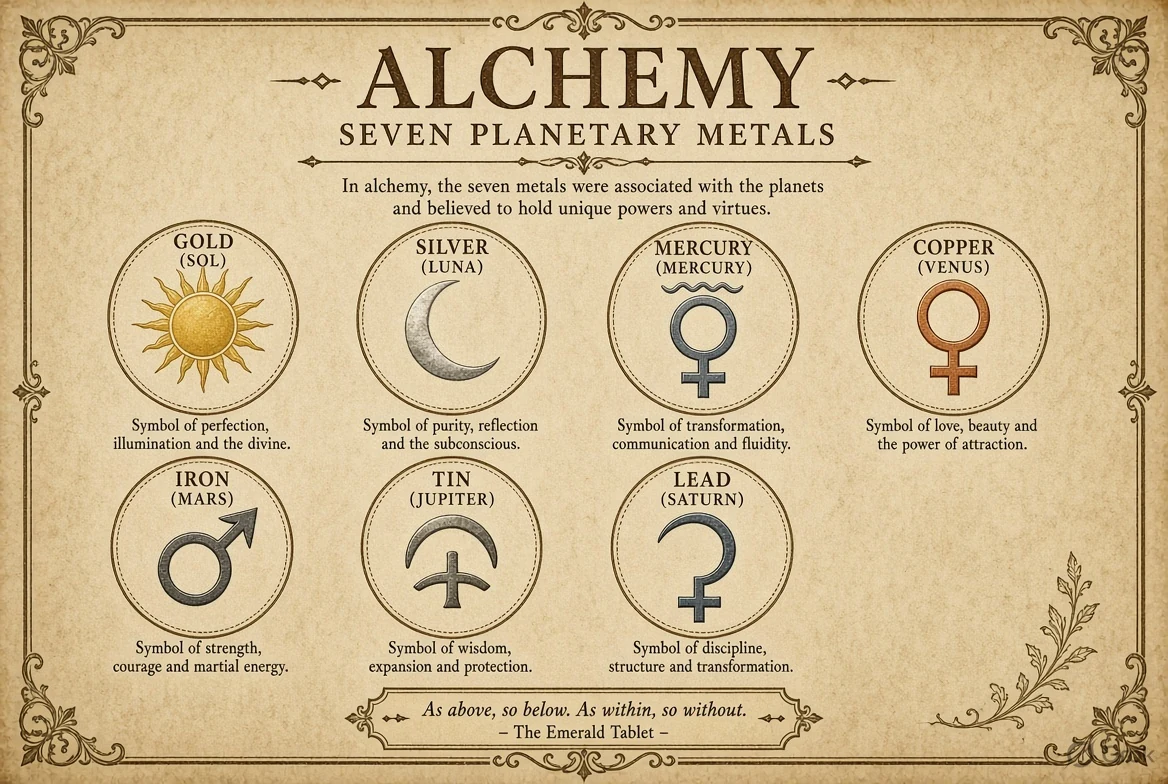
A particularly useful seven planetary metals alchemy chart maps traditional planets or luminaries to metals. The common pairings are the Sun with gold, Moon with silver, Mercury with quicksilver, Venus with copper, Mars with iron, Jupiter with tin and Saturn with lead. Each planet had an associated sign that could serve as a convenient shorthand in a manuscript. This combination of astronomy, astrology and metallurgical practice was familiar in many learned settings, although precise notation varied.
Because modern people recognise the signs for Venus, Mars or Mercury, they sometimes assume the labels are purely astrological. In a historical recipe, the context could instead indicate a material. The gold sign does not mean every circle with a dot is a promise of wealth, and the Saturn sign is not automatic evidence of a sinister cult. Read the surrounding writing, recipe and dating before attaching a meaning. In visual-reference charts, show both the planet and metal name to minimise confusion.
Alchemy four elements symbols: fire, water, air and earth
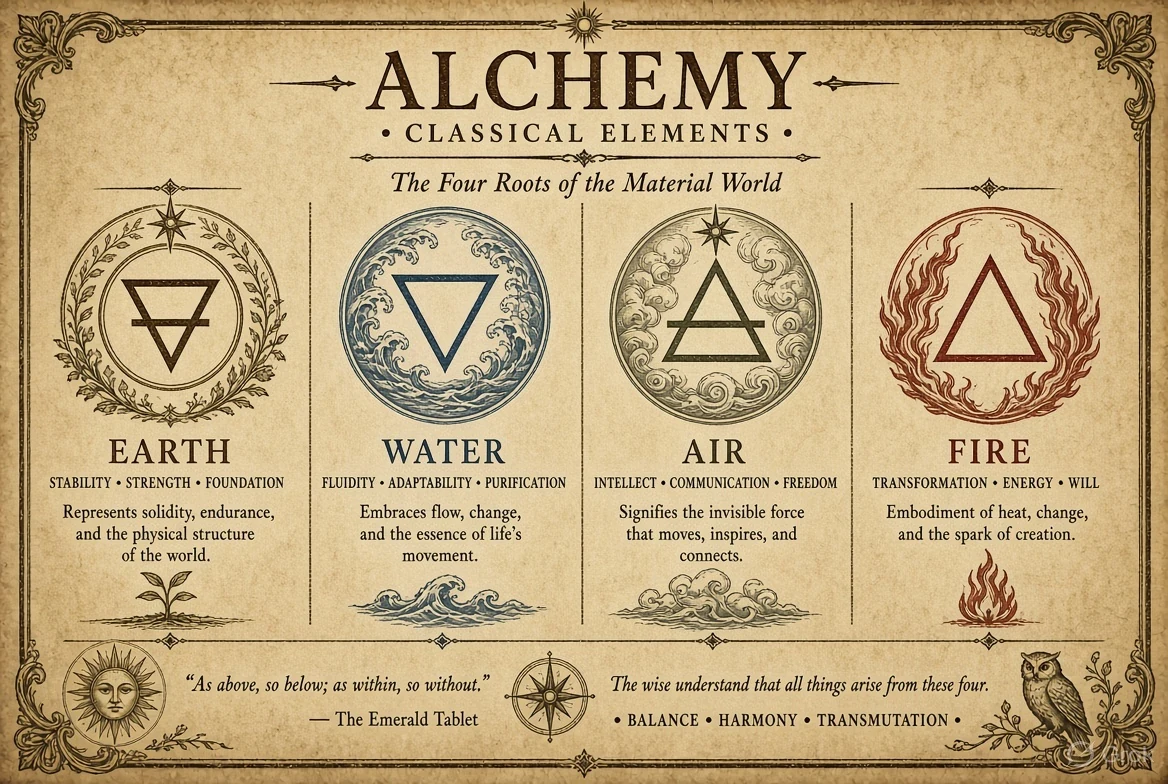
The four classical elements, fire, water, air and earth, were central to several influential ancient and medieval natural philosophies. In widely circulated later symbolic conventions they are represented by triangles: upward for fire, downward for water, upward crossed by a horizontal line for air, and downward crossed by a line for earth. This is a convenient visual memory aid, but manuscript illustration traditions were not completely uniform.
These elements were philosophical categories, not the chemical elements of the modern periodic table. A medieval writer using “earth” might be discussing properties such as dryness or heaviness, rather than a single substance with a fixed atomic number. Likewise the fire triangle is not laboratory safety signage. When teaching students the chart, use the label “classical elements in alchemical traditions” and explicitly contrast it with modern definitions of an element. That small clarification prevents a historical diagram from becoming scientific misinformation.
Laboratory process symbols: distillation, calcination and sublimation
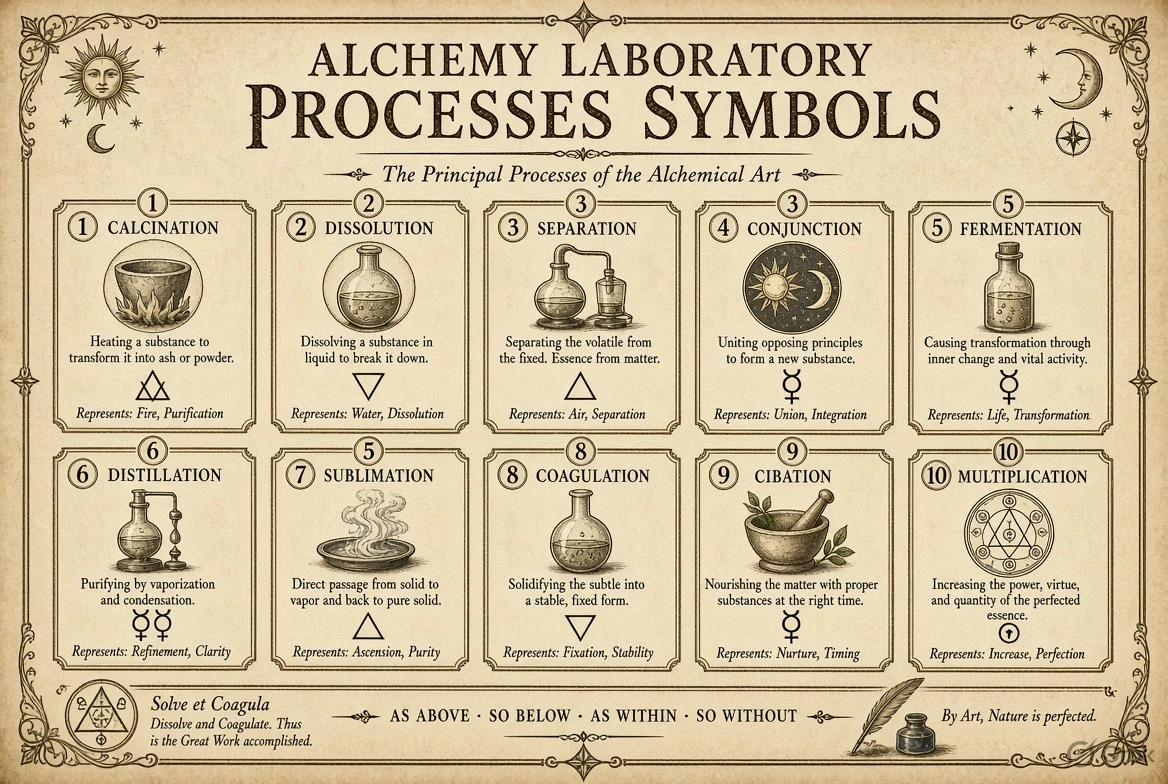
Alchemical texts also discuss operations such as distillation, calcination, dissolution, filtration and sublimation. Some manuscripts represent processes with specialised glyphs or abbreviated terms, while others use drawings of furnaces, vessels or human figures in allegorical scenes. The same basic operation may therefore appear as a word, pictorial emblem or sign. Different scholars did not always adopt exactly the same symbols, and one pictogram could change interpretation with context.
The historical significance of these recipes lies partly in the development of tools, observations and methods. Distillation can involve separating materials by differing volatility; calcination concerns heating in ways that cause material transformations. The historical vocabulary does not automatically offer safe modern instructions. Never reproduce an unidentified alchemical recipe as a home experiment: early texts may involve mercury compounds, arsenic materials, lead salts, strong acids or toxic fumes. Consult current safety guidance and use contemporary chemical protocols instead.
How to compare an alchemical symbol with a real manuscript
Start with the title, approximate date, language and archive of the manuscript. Next identify whether the sign appears in a list of materials, a diagram of cosmic correspondences or the body of a practical instruction. An isolated mark in an ornamental border is not necessarily a reagent symbol. Compare several appearances in the same document and note whether the scribe used a variant character. The University of Manchester’s digitised alchemical manuscripts and the Chymistry of Isaac Newton project demonstrate why context and transcription matter.
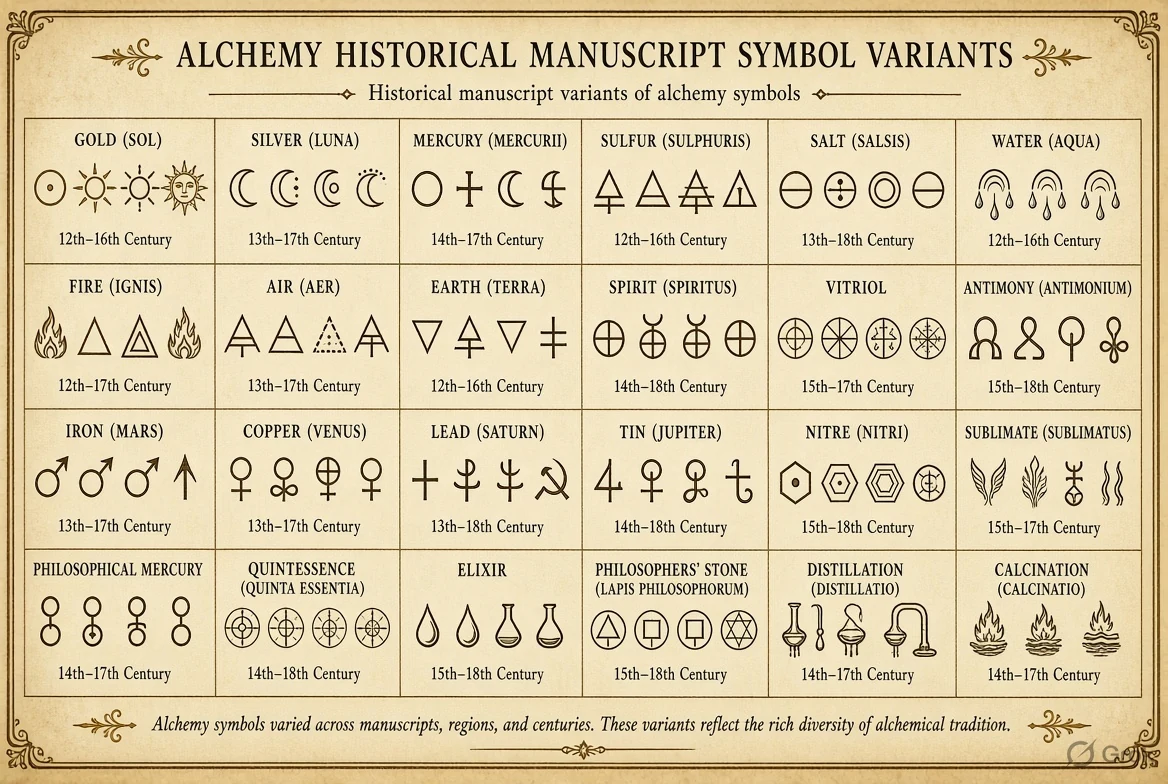
A modern graphic designer may redraw a faint mark with exact lines and symmetry. That makes a symbol easier to recognise but can erase clues about handwriting, uncertain strokes and later corrections. When the image chart here says “historical manuscript variants”, it is a comparison aid rather than a facsimile of one authenticated folio. For academic attribution, link to the institution’s digitised source and record a folio or page when available. If two charts disagree, do not silently combine the labels.
Alchemy symbols vs astrology symbols: common mistakes
Alchemy and astrology shared terminology and imagery in numerous historical contexts, especially the planetary associations. That overlap causes modern search pages to merge them into a single magical-symbol list. The context often determines whether a mark represents a planet, a metal, a spiritual correspondence or a decorative motif. A symbol for the Moon on a manuscript page is not necessarily a claim about moon phases; in a recipe it may refer to silver. Conversely, a horoscope illustration is not automatically an alchemical experiment.
Another mistake is claiming every old glyph has one timeless secret meaning. Printed dictionaries often normalise symbols chosen from many manuscripts. Symbols and words evolved with regional practice, the copying of texts and the rise of early modern chemistry. Readers should therefore favour charts that identify the historical category, label uncertainty and link to primary material. Avoid “guaranteed philosopher’s stone formula” marketing, particularly where a post is actually presenting a historical illustration rather than tested science.
Using medieval alchemy charts in art, tattoos and education
An illustrated alchemical symbols reference is useful for museum visits, historical fiction research, tabletop designs, illustration and lessons on the history of science. For an educational poster, organise the page into separate panels: seven metals, four classical elements and operations. Label each panel to avoid mixing conceptual categories. If a tattoo combines the sign of gold with a four-element triangle, understand that the resulting composition may be a contemporary creative design, not a discovered medieval talisman.
Researchers should not extrapolate a chemical identity from icon shape alone. “Mercury” can denote the metal, a planet or a broader principle, depending on the source. Artistically dramatic images of laboratory smoke can also distort what an actual documented procedure involved. Use sober captions and avoid invented quotations from Isaac Newton or Paracelsus. For further reading, a source maintained by a university or museum is more valuable than anonymous social media charts promising magical efficacy.
FAQ: alchemy symbols, elements and metals
What do the seven alchemy metal symbols stand for?
The traditional pairings include Sun–gold, Moon–silver, Mercury–quicksilver, Venus–copper, Mars–iron, Jupiter–tin and Saturn–lead.
What is the upward triangle in alchemy?
In a common classical-elements diagram, an upward triangle stands for fire. A crossed upward triangle is used for air.
Are alchemy symbols the same as modern chemical symbols?
No. Modern notation such as Au for gold and Fe for iron comes from chemical standardisation, whereas historical alchemical glyphs varied.
Was alchemy just magic?
Its history includes hands-on laboratory activities, natural philosophy and symbolic or spiritual interpretation. Reducing it to only one of those categories is misleading.
Can old alchemical recipes be tried safely at home?
Do not assume so. Historic procedures may include hazardous substances and should not replace modern laboratory methods and safety standards.
Conclusion: read old alchemy symbols in context
For historical identification, the most useful chart does more than associate a strange glyph with a modern keyword. It tells readers whether it depicts a metal, a classical philosophical element, an operation or a manuscript variant. Check the surrounding source before treating the sign as a universal formula, and keep historical alchemical ideas separate from modern chemical evidence.
Sources
Indiana University: The Chymistry of Isaac Newton symbol guide; Getty Research Institute: Alchemical Symbols and Terms; Leiden University: Planets, metals and elements in manuscripts; University of Manchester: historic alchemical manuscript.


Share Your Opinion
Comments are closed on this post.