 Vista
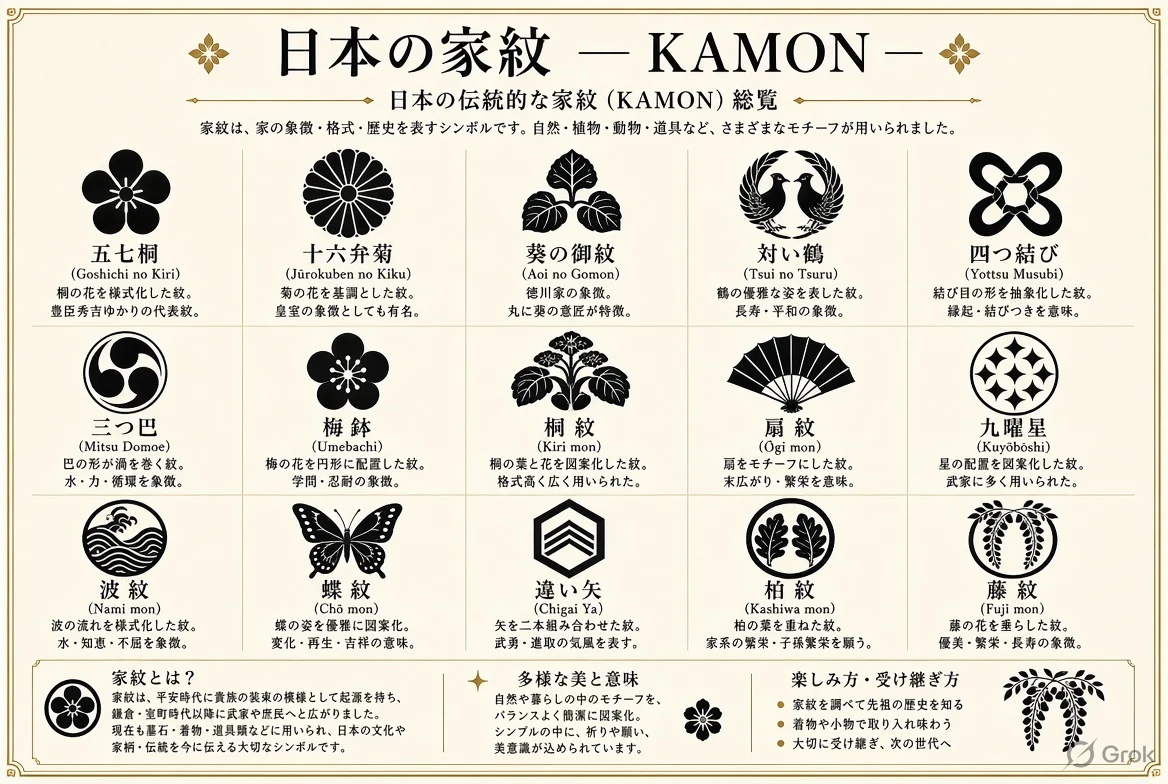
Direct answer: Kamon (家紋) are traditional Japanese family crests, often expressed as compact symbols based on plants, flowers, birds, animals and geometric forms. They have been used on formal garments, banners, buildings and possessions. Four illustrated grids here explain visual categories and names. However, identifying a Kamon in an image does not prove the person using it belongs to a particular samurai lineage: multiple families may adopt related designs, while subtle changes to petals, circles or leaves create different variants.
Updated 20 November 2026. These are illustrated crest categories, not authenticated genealogy certificates.
Japanese Kamon family crest symbols: quick facts
| Japanese term | 家紋 (Kamon) |
|---|---|
| Types | Plant, geometric, bird and animal motifs |
| History | Family-associated emblems used across many periods |
| Critical caveat | Crest alone does not establish surname or samurai descent |
Four illustrated Kamon symbols and names charts
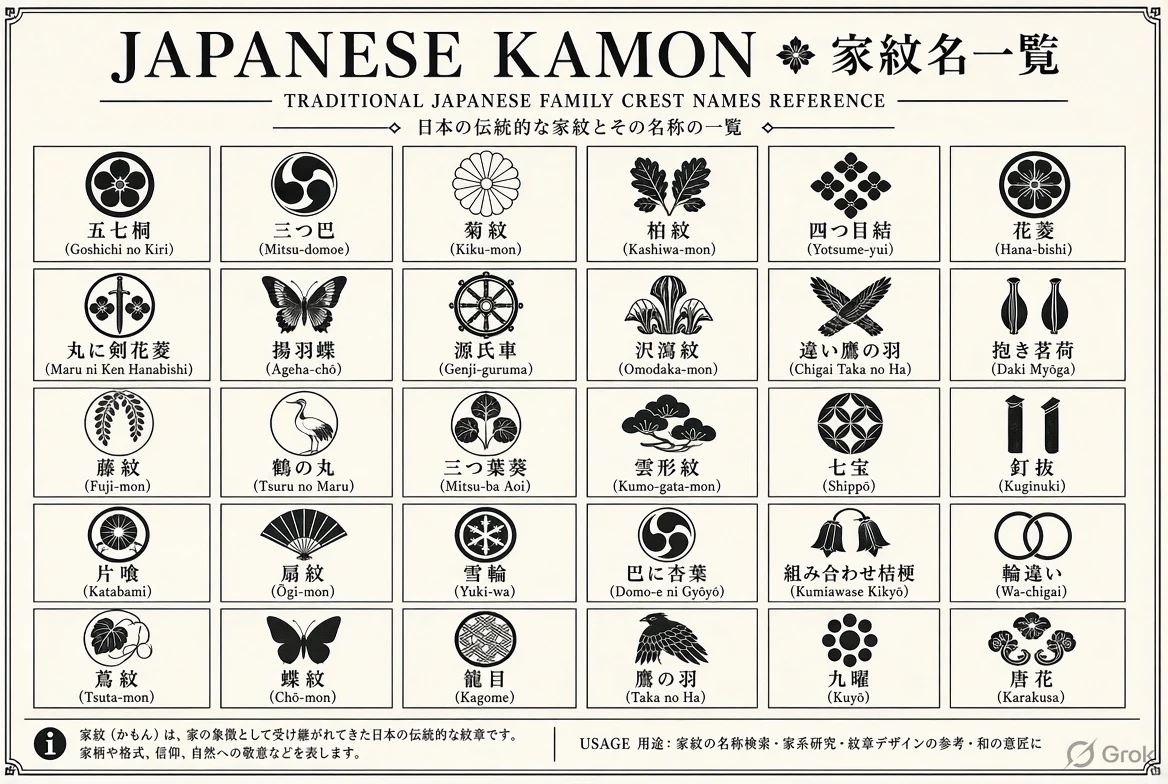
What is a Japanese Kamon family crest?
A Kamon is a family-associated emblem within Japanese visual culture. The Japanese character 家 means house or family and 紋 refers to a pattern or emblem. Many crests are elegant because their designers used balanced outlines and limited visual detail. Their use is historically connected to family identity, social status and ceremonial objects. A modern viewer may confuse the simple designs with contemporary logos, but their origin and social function are not identical to corporate branding. When reading a crest chart, separate the broad category of a motif from any specific documented family association. A clean flower symbol is a visual description; it is not a signed genealogy certificate.
Where did Kamon symbols come from historically?
Japanese cultural publications describe early emblem use among aristocratic groups, including identifying patterns displayed on vehicles and possessions. Warrior families later adopted symbols for recognition on equipment and banners; crest use spread beyond those settings over successive centuries. Formal garments, household items and ceremonial contexts all contributed to the visual language. The history cannot be simplified into one date when every surname was permanently assigned a unique crest. Different periods and communities developed local practices. If a website names one famous warrior as the exclusive creator of a generic plant motif, it should show the dated evidence. For credible history, begin with museums, Japanese cultural agencies and documented family objects.
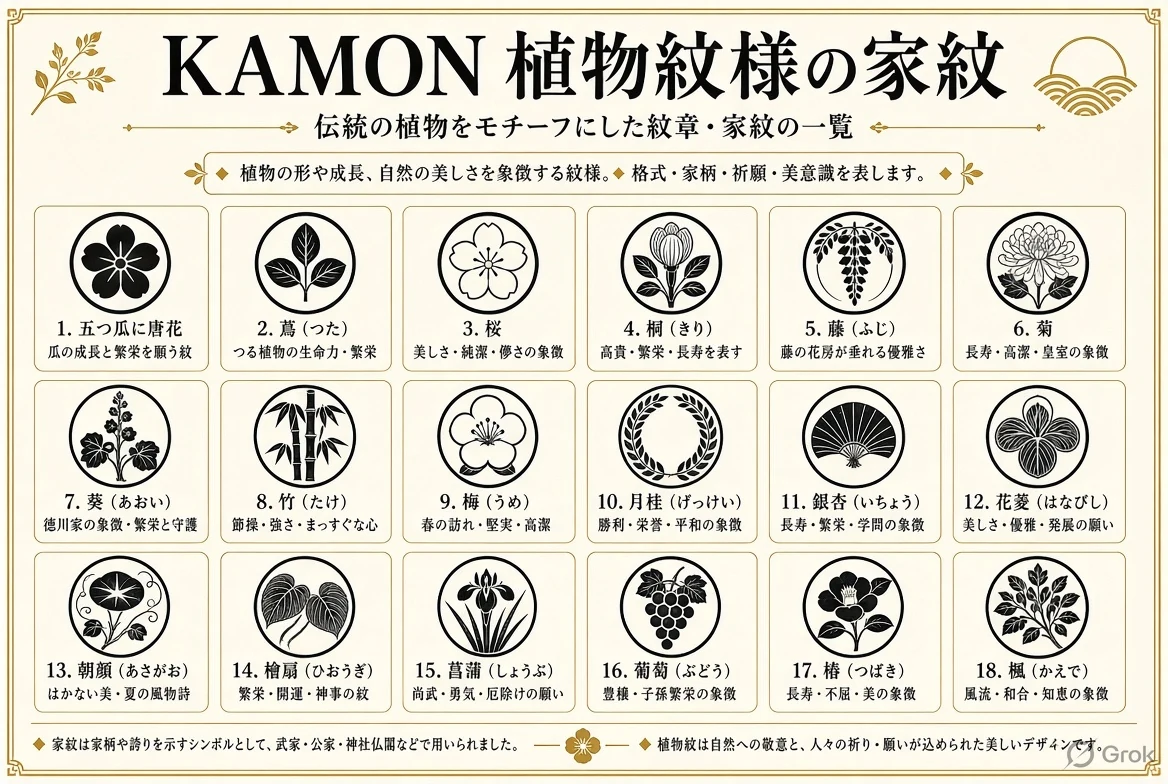
Plant and flower Kamon: botanical families of motifs
Botanical crests are among the most familiar Kamon designs. Stylized paulownia, chrysanthemum, plum blossoms and other plants may appear inside circles or as free-standing shapes. Specific paulownia and chrysanthemum forms have links to important institutions and imperial symbolism, but a broad flower category does not identify a unique institution. Count leaves, petals and branch points; small variations distinguish forms that look identical in thumbnail illustrations. An accessible chart should label the general category without assigning every example to a famous dynasty. The plant visual on this page helps readers recognize motifs rather than asserting that its simplified drawings reproduce archived family insignia perfectly.
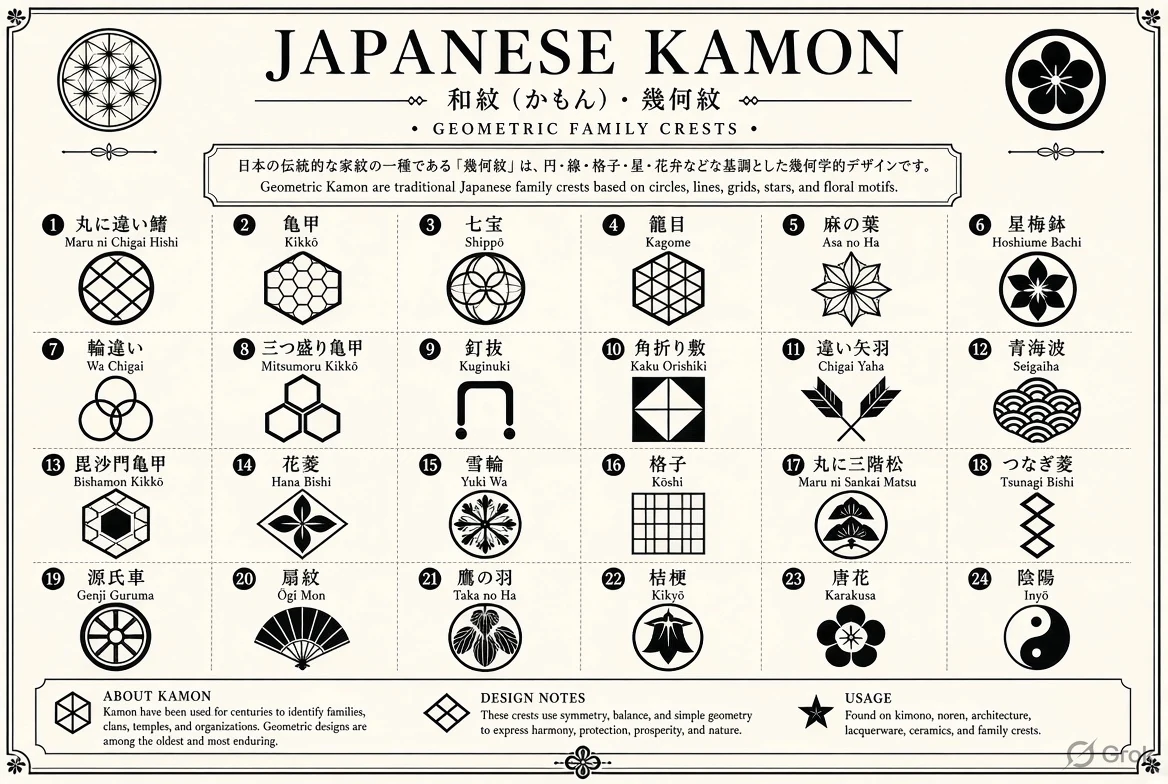
Understanding geometric Kamon circles, diamonds and lines
Geometric Kamon use arrangements of rings, straight bars, diamonds, triangles or other repeated shapes. Their apparent simplicity can hide a great many variants. The number of circular outlines, whether an element sits inside or outside a ring, and whether two lines overlap can all matter. If you are trying to identify a crest on a family object, do not start by guessing a surname. First describe each component precisely and photograph it at high enough resolution to preserve the shape. Some web graphics are decorative redrawing exercises and may smooth away the distinctive features. A verified name requires comparing an exact variant with a documented source.
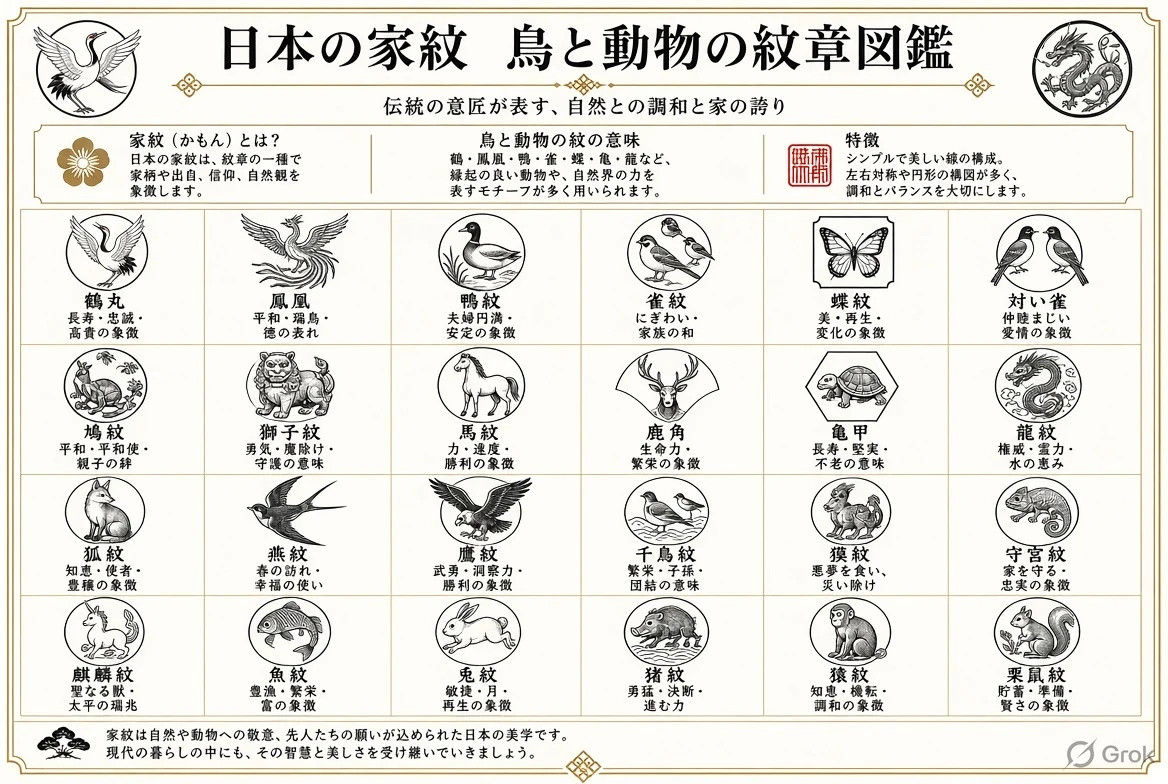
Bird and animal Kamon: different designs, uncertain ownership
Birds and other animals are used as themes in Japanese crests, often reduced to a compact recognizable outline. The position of a wing, the number of repeated animals and the design’s border can change the resulting emblem. An animal shape might be associated with one documented household in a given historical source, but that does not mean all appearances of the same animal identify the same family. A classroom image can responsibly say ‘bird motif’ or ‘animal design’ without inventing a clan attribution. For scholarly identification, compare the drawing with historical examples and note when the original piece lacks provenance. Cultural symbolism is best explained with dated sources instead of universal myths.
How to use a Kamon crest names reference grid
A reference chart may pair a simplified symbol with Japanese writing, a romanized word or a general translated description. Those labels are useful entry points, not a substitute for specialized crest catalogues. Check whether a name refers to a motif family or the exact arrangement displayed. Romanization conventions can vary, and a generic picture may omit a ring or petal count that separates two variants. For an old textile, record where the crest appears on the garment, whether the embroidery is damaged and any surviving labels. Then compare against a Japanese-language or institutional source with precise illustrations. If a matching name cannot be verified, identify the symbol cautiously instead of making up a family history.
Does a Kamon prove samurai ancestry or a particular surname?
A crest can be a useful clue in family history research, but it cannot establish ancestry alone. Similar emblems were used by different households; branches of a family might modify their original pattern. Some crests also entered wider decorative and ceremonial use. A vintage kimono bearing an appealing symbol does not automatically become evidence that its wearer belonged to a famous samurai clan. Documentary provenance matters: dates, ownership records, family papers and an exact motif comparison can strengthen an interpretation. If any part is missing, present the hypothesis as uncertain. Avoid ancestry websites that offer a one-symbol-to-one-surname answer for every pattern, because the historical situation is more complicated.
Kamon on kimono, flags, objects and buildings
Emblems appear in a variety of Japanese material settings. Traditional formal garments can feature a crest in specified positions, while other contexts include household objects, architectural details and ceremonial banners. The setting helps interpret how a symbol was used, but it rarely proves the identity of the wearer or owner. When examining a kimono, photograph the whole garment, not only the small mon. Record fabric type, stitching method, number of crests and the location of each emblem. Modern makers sometimes add crest-inspired motifs for design rather than family identity. An online seller’s claim that a garment is antique or associated with a named family requires more than a close-up of the motif.
How Kamon differ from European coats of arms
Japanese Kamon and European coats of arms can both represent inherited or family-linked symbolism, but their design conventions and legal histories should not be treated as identical. Kamon often use stark monochrome shapes and may be displayed without the shields or multicolored formal heraldry common in European traditions. The fact that a crest appears in a Japanese family name dictionary does not prove it was exclusively registered to one lineage under a universal system. A useful comparison focuses on function, shape and documented use while acknowledging different historical institutions. Copying European heraldic rules wholesale into Kamon explanations produces misleading assumptions about legal ownership and genealogy.
Creating a Kamon-inspired graphic responsibly
A designer may admire the balance and simplicity of Kamon patterns and use those principles for an original icon. It is better to describe the result as inspired by Japanese crest aesthetics when it is not a documented family emblem. Avoid implying endorsement by an existing family, cultural institution, state office or historical authority. Some individual designs have connections with national or imperial symbols; their present-day reuse can raise specific trademark or other legal issues. Do not assume that every historic-looking symbol is automatically safe for any commercial application. For an educational poster, label the illustration as a reference, supply credible sources and avoid dramatic invented stories about secret clan powers.
How to research an unidentified Kamon step by step
Begin with a clear, unedited photograph of the original object and a close-up of its emblem. Note the number and arrangement of petals, leaves, rings and other parts, including negative spaces. Identify whether the object is a garment, document, vessel or building ornament and record any known provenance. Search a reliable crest reference by general shape before considering family names. Compare candidate variants carefully and look for dated examples that match. If two variants remain plausible, keep both possibilities in your notes. Do not reverse, rotate or redraw the original photograph to force a match. Good historical documentation makes uncertainty explicit rather than pretending every crest is instantly identifiable.
Printing the four charts and likely next questions
The four images here cover plant motifs, geometric forms, birds and animals, and a names reference grid. They can be viewed or printed through normal browser functions, but the page does not claim a separately downloadable, authoritative PDF registry. Details may become illegible when a chart is printed too small; zoom and compare Japanese labels to credible sources. Follow-up search ideas include ‘Japanese Kamon family crest symbols’, ‘Kamon crest names chart’, ‘Japanese samurai crests’, ‘paulownia Kamon’, ‘chrysanthemum family crest’, ‘identify Kamon from kimono’ and ‘geometric Japanese crests’. These are possible reader intentions, not measured search volumes. The difference between identifying a shape and proving a lineage remains the most important takeaway.
Frequently asked questions
What does Kamon mean?
A traditional Japanese family crest or emblem.
Are all Kamon associated only with samurai?
No. Their history includes aristocrats, warriors and wider society.
Does one Kamon prove a family name?
No. Similar patterns may occur among more than one family.
Are plant crests common?
Yes. Flowers, leaves and paulownia-like motifs are common design categories.
Can I identify a vintage kimono’s owner from its crest?
Not reliably without provenance and historical documentation.
Is a separate full PDF family crest catalogue offered?
No. This article contains four illustrated educational charts.
Sources and related reading
Documented historical context: Government of Japan on Kamon and University of Sydney family-crest collections. Related Japanese craft: Kumihimo braiding diagrams. Recognizing a crest motif is only the first step toward researching its documented historical use.






















Share Your Opinion
Comments are closed on this post.