 Vista
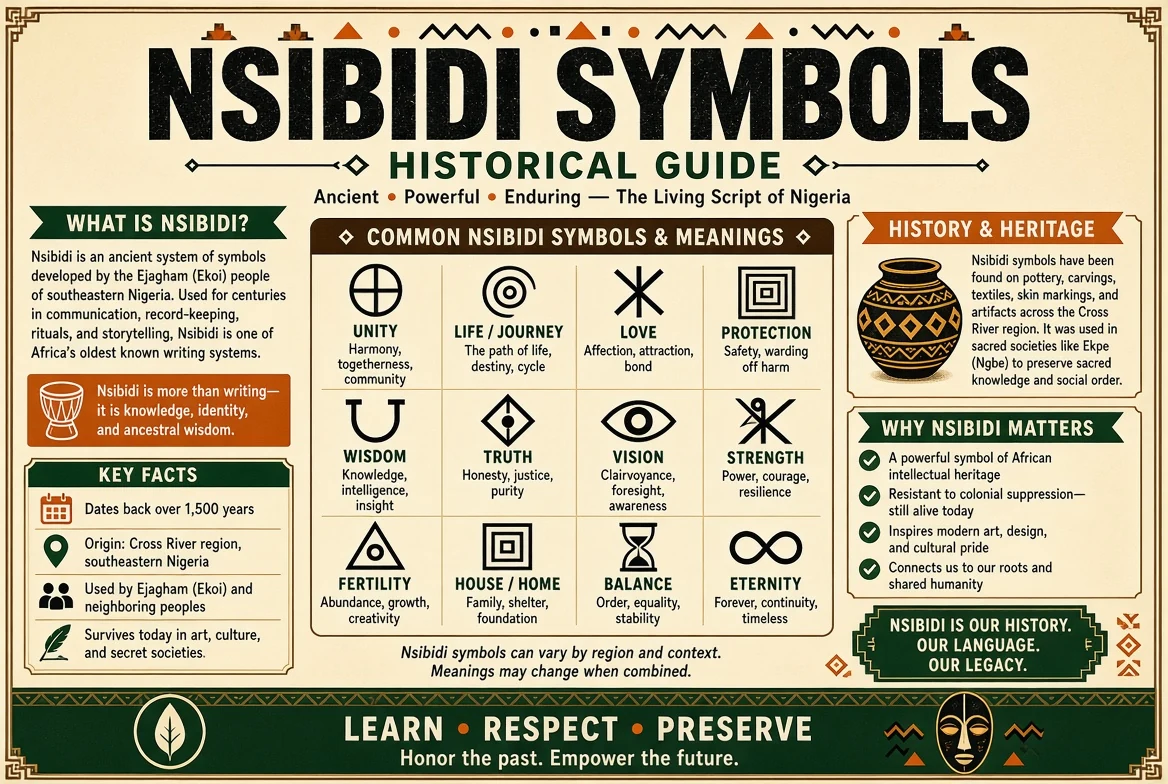
Direct answer: Nsibidi symbols are part of a documented Indigenous African graphic communication tradition associated particularly with Ejagham communities in the Cross River region of Nigeria and Cameroon. Their shapes and meanings depend on social context; Nsibidi is not a standard English A–Z alphabet. This historical illustrated guide explains the symbols, Ukara cloth, social uses and the limits of modern translation charts.
Updated 21 November 2026. Reference images are interpretative educational illustrations, not verified facsimiles of specific historical objects.
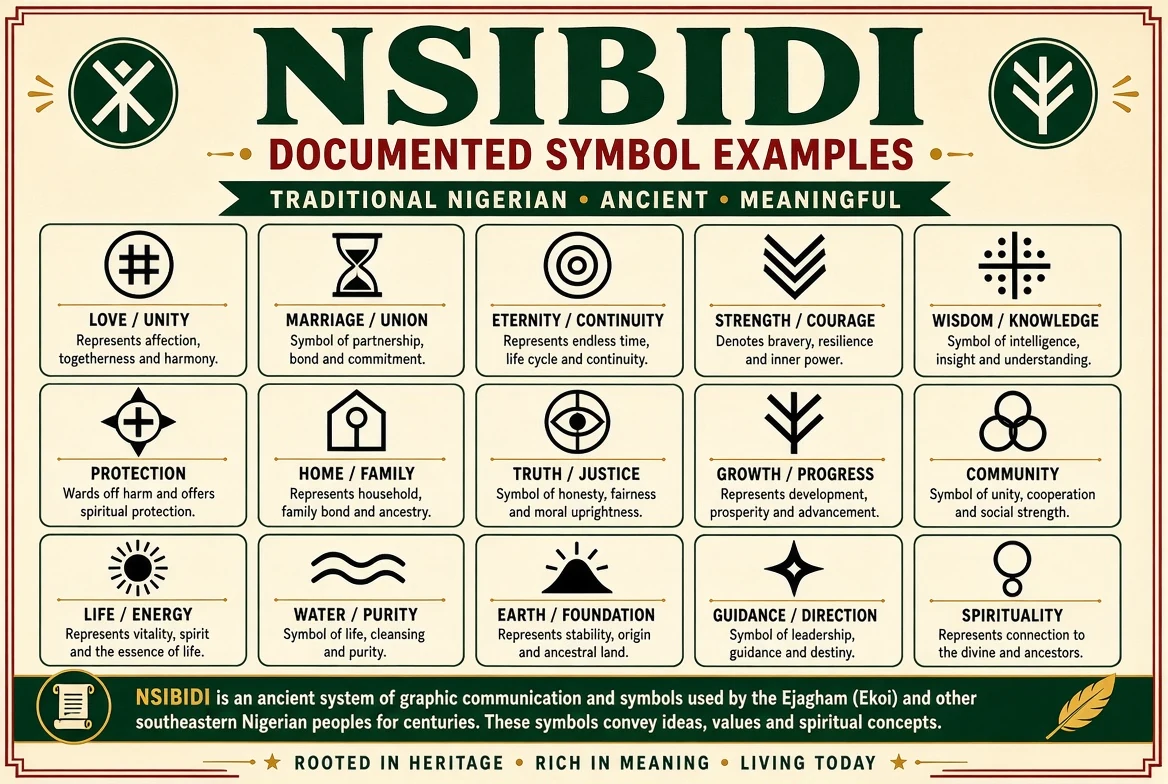
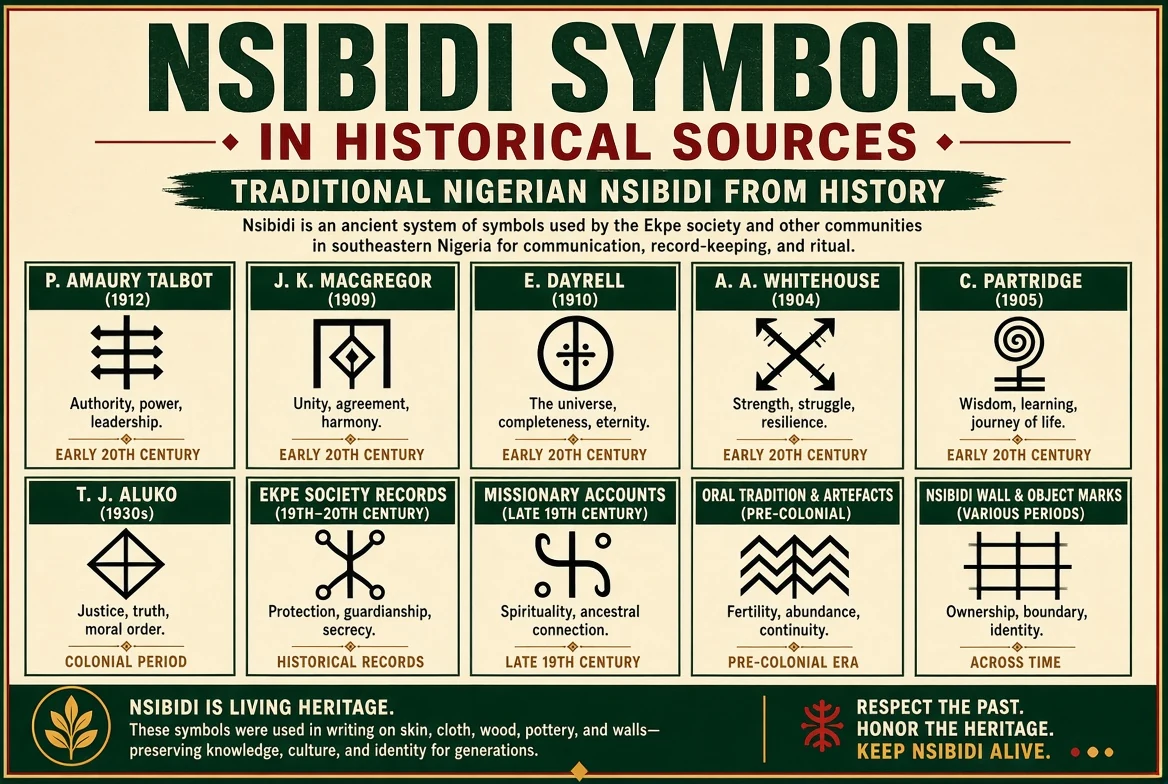
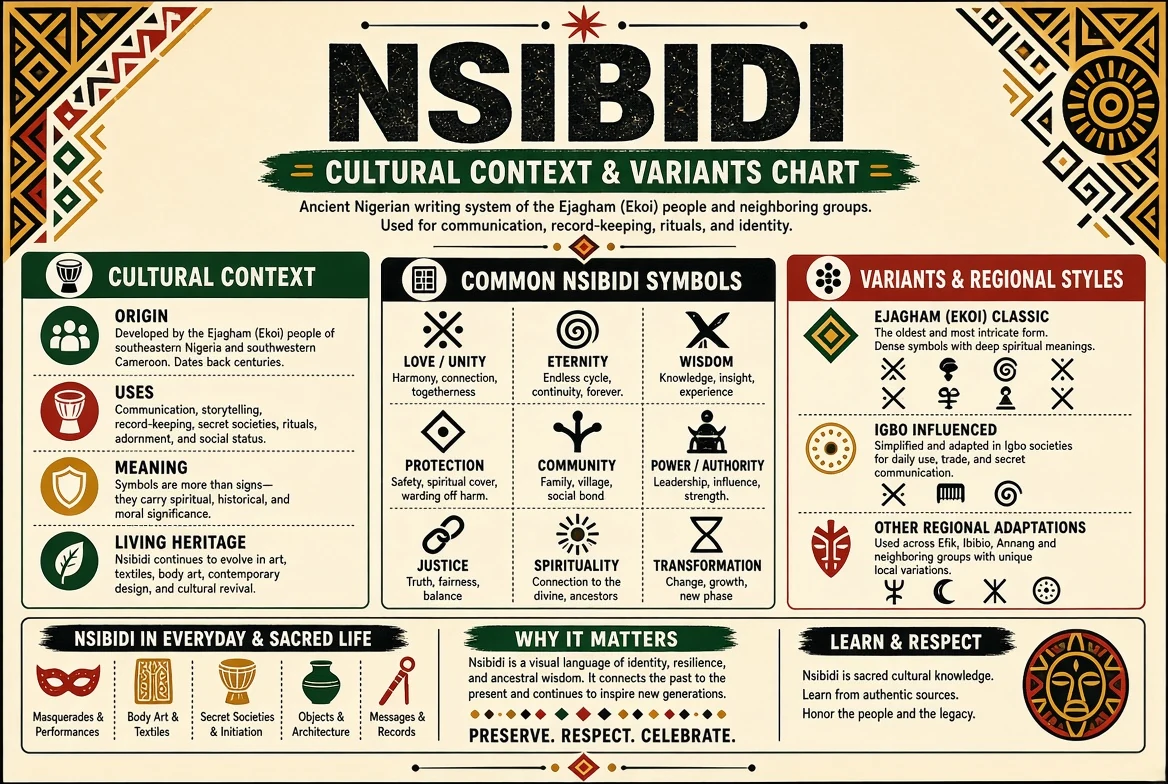
Nsibidi symbols historical picture guide: three charts
What is Nsibidi? A visual communication system, not English A–Z
Nsibidi is an Indigenous graphic communication tradition closely associated with the Ejagham people of the Cross River region of southeastern Nigeria and southwestern Cameroon, with related uses and histories among neighbouring communities. It uses geometric and figurative signs to communicate concepts, relationships and socially meaningful information. It can be described as a graphic system or visual language, but it should not be presented as an ordinary alphabet where each mark corresponds to one English letter. An “Nsibidi alphabet A–Z” found on a template site is usually an invented mapping rather than an authenticated historical spelling system.
For readers researching Nsibidi symbols and meanings, the central question is what a particular design represents in a particular source. Unlike a single standardised modern font, the tradition exists within living cultural practices, craft, social institutions and scholarly documentation. A picture of a mark detached from a cloth or ceremony cannot provide all of its meaning. This guide therefore focuses on documented use and responsible interpretation rather than an oversimplified dictionary of supposed secret signs.
Where did Nsibidi originate? Ejagham and Cross River connections
Smithsonian’s National Museum of African Art describes Nsibidi as a long-standing system of graphic communication Indigenous to the Ejagham people of the Cross River region. The wider geography matters: this history cannot accurately be reduced to a single modern national border, as the region extends across present-day Nigeria and Cameroon. Accounts also discuss use by Efik and other communities, sometimes in different social settings. That does not mean every community interpreted each graphic in exactly the same way or had identical access to the full range of designs.
Older writings sometimes treated Nsibidi as a forgotten secret language, whereas contemporary scholarship points to continued practices, object traditions and reinterpretations. The system has a history in which different communities and researchers encountered and recorded different aspects. It is better to distinguish early documentation from absolute origin myths. When a webpage says a sign is “10,000 years old” or names one inventor without historical evidence, ask for an archaeological or documentary source. The age of a cultural tradition is not the same as the date of the oldest photograph or modern vector illustration.
The visual forms: lines, figures, relationships and gestures
Nsibidi signs include geometric patterns, stylised human forms and other figures capable of expressing socially significant ideas. A design can involve paired figures, interacting shapes or an arrangement whose relationship matters as much as each individual stroke. Some descriptions focus on marks placed on objects; the Smithsonian exhibition also notes communication expressed through gestures and on surfaces such as ground, skin, houses, textiles and masks. Therefore an image chart captures only one part of the tradition’s range.
The three charts in this post offer a beginner’s visual index. The first groups illustrated motifs; the second draws attention to historical-source comparison; the third reminds readers that a design and its interpretation may change across contexts. These diagrams are educational representations, not tracings of one specified museum object and not a comprehensive register of sacred signs. If a line appears mirrored, redrawn or removed for cleaner graphic design, the result may no longer convey an authenticated historical form. Learn a mark’s context before sharing its presumed translation.
Nsibidi on Ukara cloth and in the Ekpe cultural world
Ukara cloth is one of the well-discussed contexts for Nsibidi imagery. Such textiles have associations with Ekpe, a historically important socio-cultural institution in the Cross River region, and the arrangement of motifs can carry meanings understood within a particular community. It is reductive to say the cloth is simply “random African symbols” or that every design is a general public sign. Scholarship on Efik Ukara discusses how a visual vocabulary can remain active while meanings and social uses change.
Not all Nsibidi expressions are restricted in the same way, yet access to certain interpretations may depend on membership, initiation or cultural knowledge. The point is not to dramatise every graphic as forbidden magic. It is to recognise that public museum interpretation and particular society-based knowledge may differ. A responsible reference guide explains what a museum or scholar openly documents and avoids inventing protected meanings. Readers interested in a cloth should examine its full layout, provenance and use instead of copying one isolated graphic into an anonymous “secret code” wallpaper.
Does Nsibidi have fixed meanings for love, marriage or conflict?
Many internet queries focus on “Nsibidi love symbol”, “Nsibidi marriage sign” or “Nsibidi peace symbols.” Existing published accounts do discuss themes such as social relationships and communication, but a confident one-word English gloss may omit important conditions. A form can vary by region, and a scholar’s description of one object cannot automatically be extended to every similar shape. Visual similarity is an entry point for investigation, not proof of identical meaning.
For example, a diagram portraying two human figures may invite a modern viewer to label it “friendship,” “union” or “family.” Only contextual documentation can justify one such reading for the specific historical sign. The museum catalogue, maker’s explanation and academic publication are better evidence than an image-sharing site’s caption. Even when a term is correctly reported, translators may choose different English phrases. Treat all simplified charts—including ours—as references that must be checked against cultural source material before claims of exact translation are published.
Nsibidi and Igbo writing: a common search confusion
Because Nsibidi is found within southeastern Nigeria, it often appears in searches for “ancient Igbo alphabet” or “Igbo hieroglyphics.” The region contains multiple communities and languages; Nsibidi’s strongest documented Indigenous association with Ejagham should not be erased by relabelling it as one exclusive national or ethnic alphabet. Igbo uses writing conventions, including a modern Latin-script orthography, that are not simply interchangeable with Nsibidi graphic motifs. A design labelled “Nsibidi” cannot be converted automatically into a phonetic transcription of arbitrary Igbo sentences.
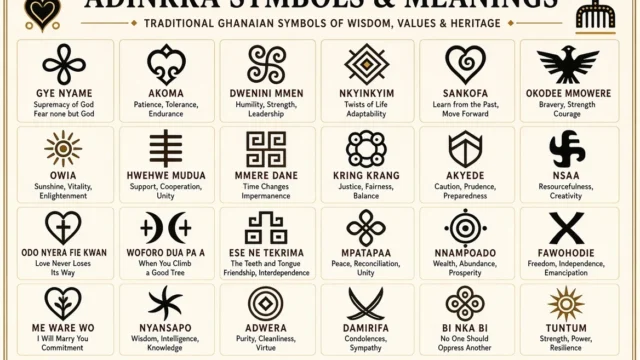
Likewise the word “hieroglyph” may be used loosely to mean a picture-like sign, but Egyptian hieroglyphic writing has its own documented linguistic structure and evolution. Adinkra symbols from Ghana are also a distinct cultural system rather than alternate spellings of Nsibidi. If comparing African graphic traditions in educational content, provide separate geographic contexts, sources and examples. That careful framing makes the comparison useful without flattening different peoples’ histories into a single invented alphabet or superstition chart.
How to verify a Nsibidi image before printing, tattooing or teaching
First identify the image’s claimed source. Does it come from a museum object, published scholarly illustration, documented craft tradition or contemporary artist’s reconstruction? Check whether a reference provides a date or cultural attribution. Compare the shape with at least one independent source, noting if the alleged meaning comes from a community practitioner or from a secondary writer. Do not assume a neat, high-contrast icon is more authentic than a worn design on an older artefact.
Second be clear about your purpose. A classroom sheet may show a group of motifs to introduce students to a historic visual tradition. A tattoo requires much greater confidence in the symbol’s social meaning, direction and any cultural sensitivities. Commercial reuse should not imply endorsement by a community. Avoid tracing an identifiable artist’s new creative rendition without permission, even when the underlying historic tradition is older. A caption such as “modern illustration inspired by documented Nsibidi designs” is accurate when that is what the image really depicts.
Why historical Nsibidi matters beyond decorative patterns
Nsibidi challenges the assumption that all sophisticated communication must look like a familiar Western alphabet. It demonstrates how a system of graphic marks, surfaces, movements and social knowledge can carry information across different settings. A significant scholarly discussion has examined whether motifs on early Calabar-region ceramics relate to a longer history of the system. Such research is important, but archaeological dating of an object and firm decipherment of its markings remain separate tasks.
The Smithsonian’s exhibition on African writing and graphic systems places Nsibidi alongside other African traditions rather than portraying it as a curiosity outside world history. That perspective is valuable for educators: it connects the story of writing with material culture and living communities. Readers can appreciate artistic complexity while accepting that some interpretations cannot be recovered from an icon alone. In search and social media contexts, resisting fabricated “symbol translations” protects the original tradition from misinformation and gives readers more reliable answers.
FAQs about Nsibidi symbols
Is Nsibidi a real writing system?
It is a documented Indigenous system of graphic communication. Describing its forms as a standard English-style phonetic alphabet is inaccurate.
Where is Nsibidi from?
It is closely associated with the Ejagham of the Cross River region of Nigeria and Cameroon, with use in other neighbouring traditions.
Can Nsibidi write an English name letter by letter?
There is no universally authenticated one-to-one English A–Z conversion. Online name translators may invent modern correspondences.
Are all Nsibidi symbols secret?
No. Some are publicly documented, while certain interpretations are associated with specific cultural or society-based knowledge.
Is Nsibidi the same as Ghanaian Adinkra?
No. The two have distinct origins, contexts and meanings despite both being important African visual traditions.
Conclusion: Nsibidi needs historical context
Learning Nsibidi responsibly means looking beyond striking line art. Identify a symbol’s source, cultural setting and level of interpretive certainty; avoid one-click English alphabet claims. Museum and scholarly material helps connect the imagery with its living Cross River traditions and the people who continue to study and interpret them.
Sources and further reading
Smithsonian National Museum of African Art: Inscribing Meaning; Smithsonian Libraries: Nsibidi Update; Scholarly study: Nsibidi and Efik Ukara cloth.





Share Your Opinion
Comments are closed on this post.