 Vista
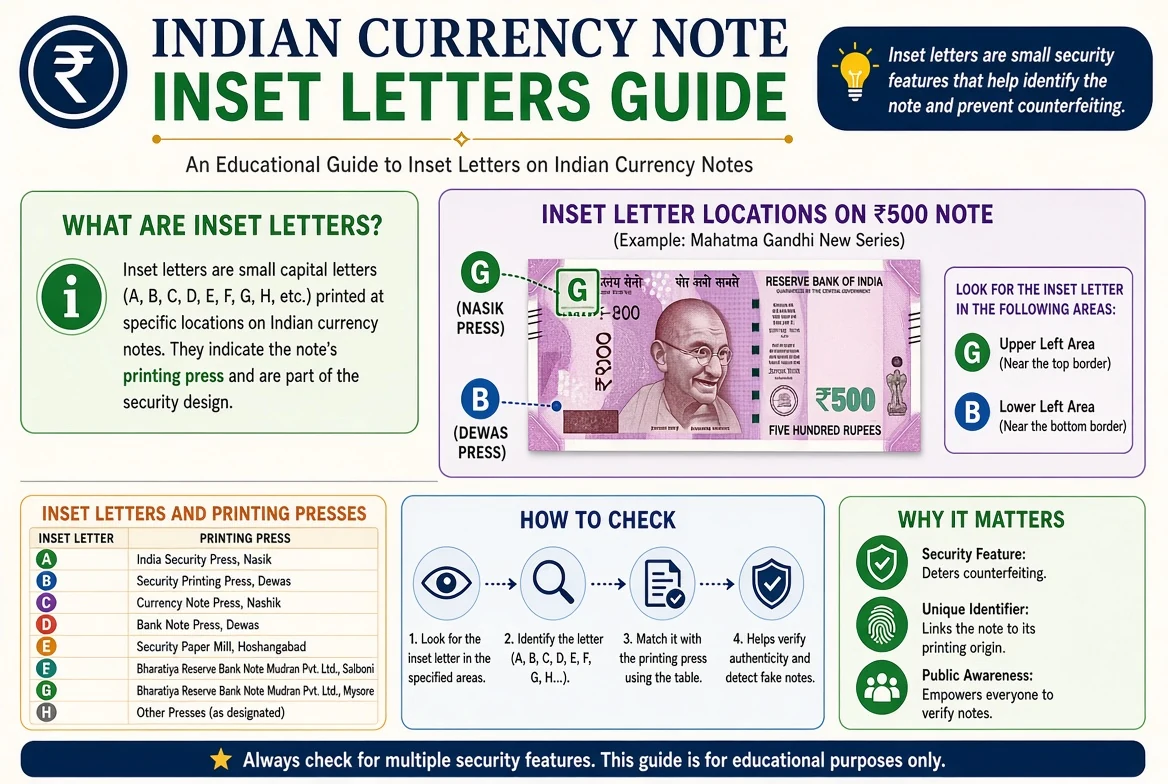
Direct answer: An Indian currency note inset letter is an alphabet in the note’s number panel, according to RBI. It is not the same as the whole serial number or the prefix. Two genuine banknotes can share a serial number if their inset letter, print year or Governor’s signature differs. This guide explains inset letter examples, serial numbers, star notes and when to consult official RBI security features.
Updated 21 November 2026. Illustrated examples are simplified references and not real currency authentication certificates.
Currency note inset letters: three illustrated guides
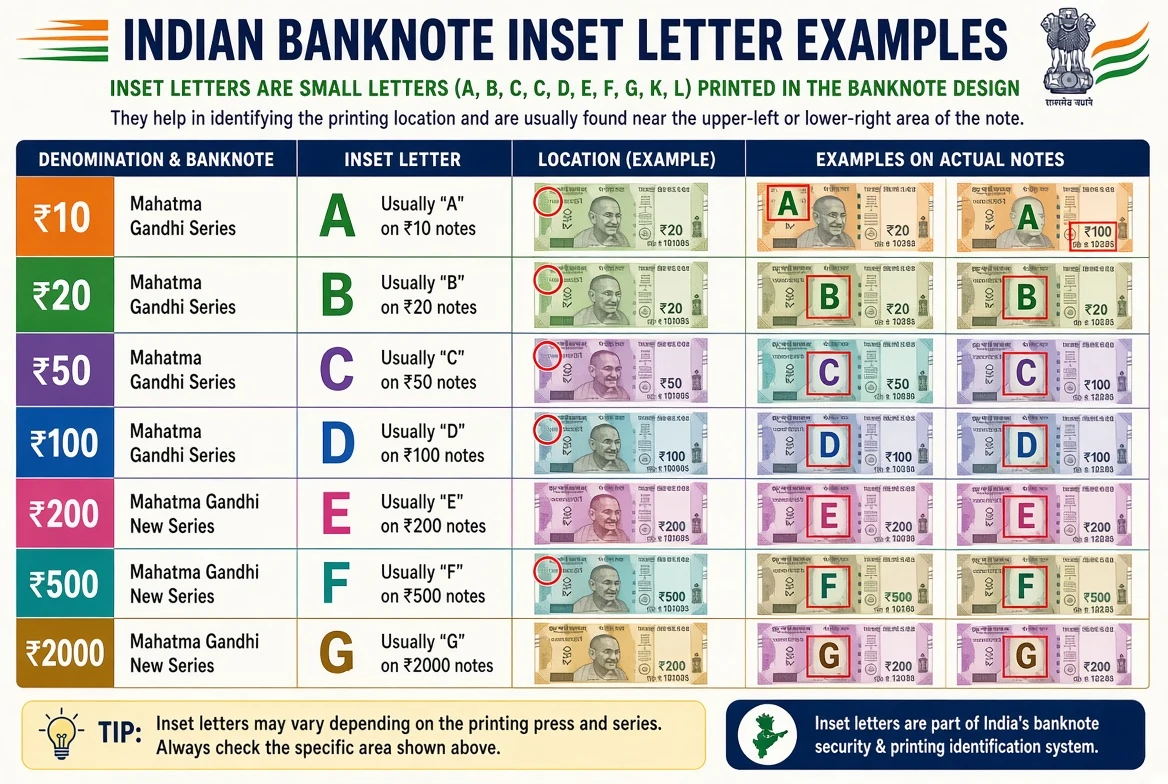
What is an inset letter on an Indian currency note?
An Indian currency note inset letter is an alphabet printed in the banknote’s number panel, according to the Reserve Bank of India’s currency FAQ. It is part of the note’s production and identification conventions and should not be confused with the full serial number or the prefix that may accompany it. On a relevant issue, a small letter such as A or E appears in the serial-number area. RBI announcements sometimes specify that a fresh issue bears a particular inset letter, which helps describe the production series in an official notice.
People often search for “note par inset letter ka matlab” after spotting an isolated letter they had never noticed before. The presence or absence of the inset letter does not automatically establish a banknote’s rarity or value. Different denominations, print years, production batches and series can have different layouts. RBI publishes denomination-specific specifications and security features, so an identification should begin with the note’s year, denomination and issue series rather than relying on a single letter photograph.
Inset letter versus serial number and prefix: the difference
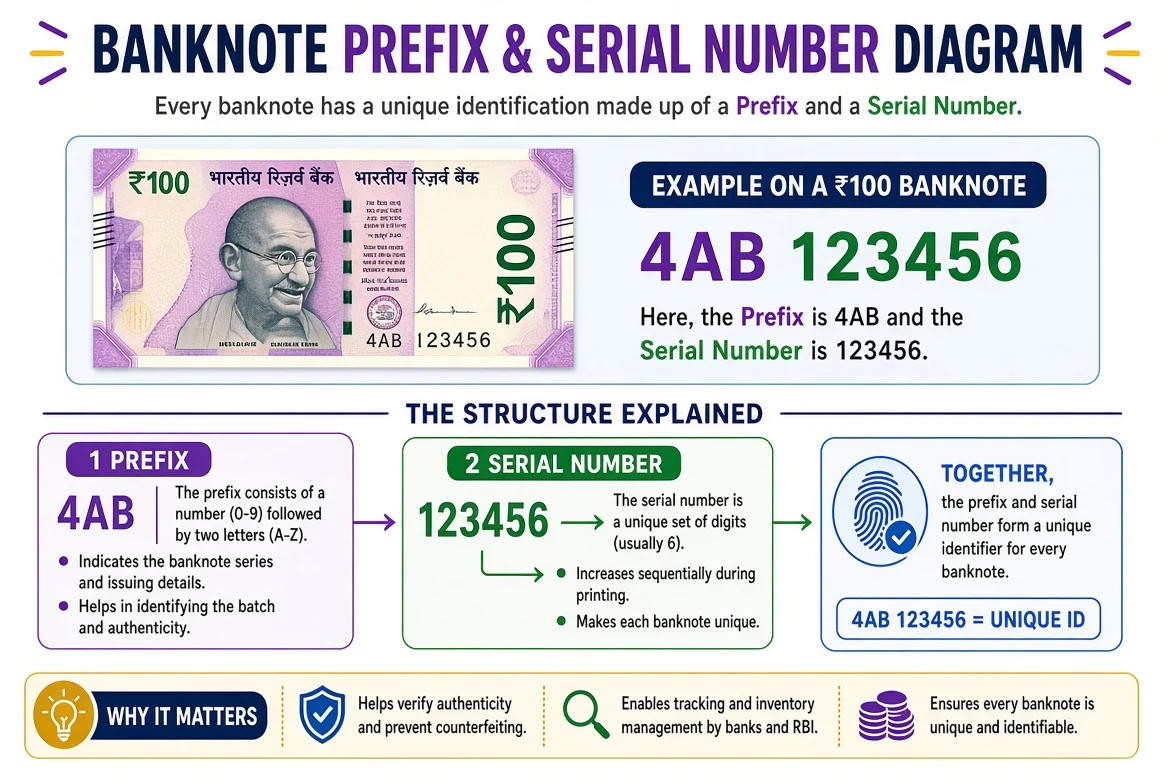
Three terms get mixed up in online explanations. The serial number identifies a note within a numbering arrangement, while the prefix can be an accompanying group of letters or numbers. An inset letter is the letter RBI describes as printed on the number panel. These terms may appear near each other on the banknote, yet they do not necessarily refer to the same component. A separate diagram is useful because visually similar letters may perform different identification roles in official descriptions.
A note’s full identity also depends on its production and issue context. RBI’s FAQ explains that notes can have the same serial number but still be distinguishable by inset letter, year of printing or the signature of a different RBI Governor. This is not permission to ignore suspicious duplication: it simply means a screenshot displaying identical digits is insufficient to prove that one note must be fake. Read all the identifiers and look at the complete security design before reaching a conclusion.
Where is the inset letter printed on a banknote?
Look at the number panel, typically found in designated printed serial-number areas on an RBI note. On many modern Mahatma Gandhi (New) Series notes the numbering has a distinctive ascending-size pattern, with some characters staying the same size. This feature is described in RBI guidance and can help users locate the serial numbers. The inset alphabet, where present for that issue, is not a prominent picture on the reverse and is not the denomination numeral.
Do not photograph banknotes only after cropping away their top or lower margins. The location of the number panel depends on the denomination and design series. To compare with the images here, first locate both number panels, then read the full serial context. If an inset letter is very faint or not present, avoid claiming the note is counterfeit without checking the official specifications for the specific issue. RBI has issued banknotes both with and without inset letters under documented arrangements.
Can two notes have the same serial number? RBI’s answer
Yes, RBI explicitly addresses this question in its FAQ: more than one genuine banknote may show the same serial number if its inset letter, year of printing or RBI Governor signature differs. The key word is may. That statement concerns the design of number allocations across series and years, not the authenticity of any particular pair of notes in someone’s hand. The conclusion from two identical digit strings is therefore “more comparison is needed,” not automatically “rare note” or “counterfeit note.”
To compare two notes, place them side by side and record denomination, design series, year printed, signature and the full number panel including inset letters. Then inspect relevant security features. If the two notes have suspicious printing, torn or modified panels or inconsistent details, seek a bank’s guidance. The RBI’s published number-panel explanation is a better reference than a viral video that declares matching digits impossible under all circumstances.
Is a missing inset letter a fake note or printing error?
A missing or blank inset letter is not a universal fraud indicator. Certain RBI issue announcements explicitly refer to notes issued without inset letters. It would therefore be wrong to demand that every genuine Indian note carry A, B, E or any other letter. A note’s expected details depend on the specific denomination and series. Sometimes a collector observes unusual spacing or weak printing, but only careful comparison with the relevant RBI issue can establish whether it is a variation worth further inspection.
Similarly, a banknote “printing error” should not be diagnosed from one unclear photograph or an extra blot of ink. Banknotes have several coordinated security features. If a design does not match the official layout, check against RBI’s published identification images or ask a bank. Avoid trying to alter the printed serial panel, remove a mark or enhance it with a pen. Genuine variations and damage can be confused easily, and manipulating the note can create legal and financial problems.
Inset letter E, star notes and 2016 RBI announcements
RBI’s archived announcements include examples referring to a specific inset letter E in the number panel. Other notices describe replacement notes carrying a star symbol in the number panel. A star is not simply another alphabetic inset letter. RBI explains the use of star-marked replacement banknotes in particular printing arrangements; these examples illustrate why readers must not collapse all number-panel symbols into one category.
Some old online articles attach enormous collector prices to a note simply because the letter E, a star, or a repeating number is visible. Such statements are not supported by the presence of that character alone. A historically interesting banknote may attract collectors, but valuation requires a specific genuine issue, condition and market evidence. This article is about correctly reading the symbols and RBI vocabulary, not recommending purchases or claiming an instant profit on a common circulation note.
How to check a banknote: a better checklist than looking at letters
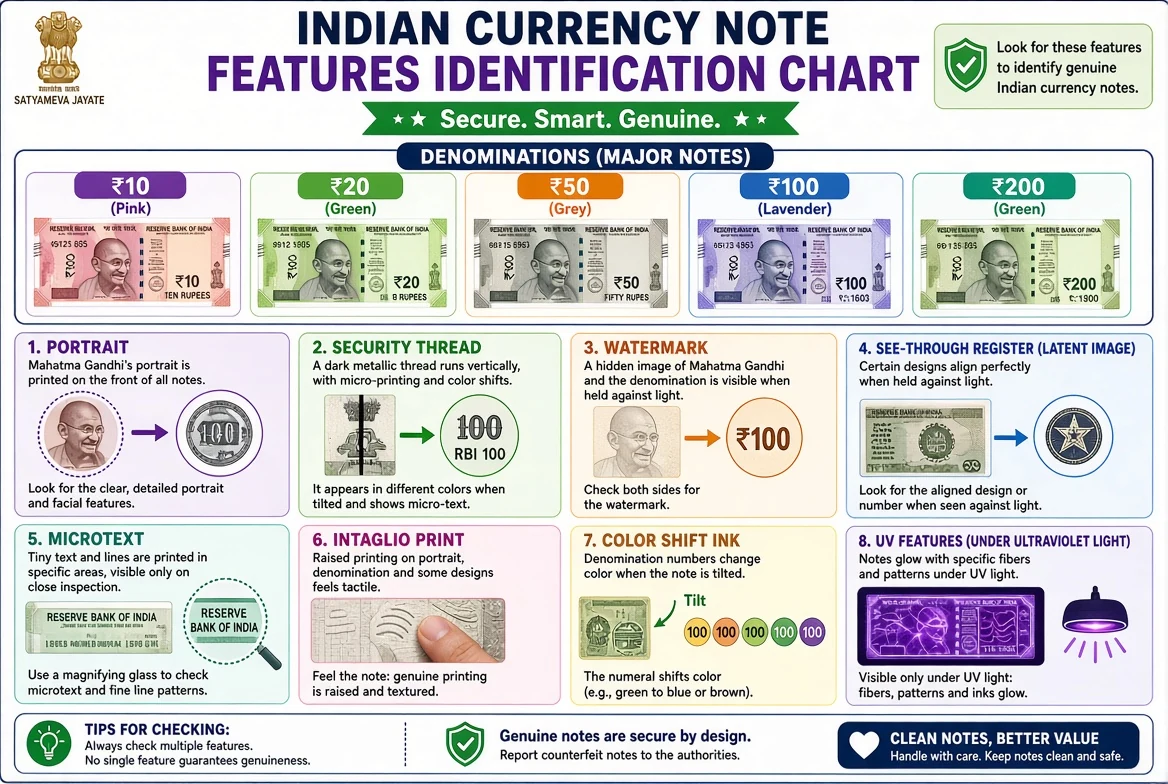
For physical verification, start by matching the note’s denomination and design with RBI’s official security information. Look at the relevant watermark, security thread, microlettering and other published features. Some denominations include tactile identification marks, see-through register or colour-changing elements; the exact features vary. Next examine print sharpness, number-panel alignment and any obvious damage. The inset letter is one small item in that broader examination, not a substitute for security checks.
RBI has public guidance on its currency website and through the awareness initiative “Paisa Bolta Hai”. A guide that promises to prove a note genuine from a single serial letter is overconfident. If you suspect a fake note, avoid passing it on to another person as genuine currency and consult a bank or relevant official process. Do not use household chemical tests or destructive scraping methods. Clear observations and official visual references are safer and more useful than viral DIY authenticity tricks.
Inset letters and banknote collecting: what actually affects value
Collectors may examine prefixes, serial-number patterns, printing dates, signatures, varieties and condition. A letter can help describe a specific recognised variant, but a random inset letter does not itself guarantee rarity. A banknote printed in large numbers is unlikely to become valuable merely because an influencer calls its initial special. Reliable market evidence comes from authenticated examples and completed transactions, not a listing asking an extraordinary amount.
Be alert to fraud involving advance fees to sell notes bearing particular letters or serial digits. No unknown agent should need your bank OTP, remote-access application or payment of “RBI release charges” simply to look at a banknote photograph. RBI is not a public rare-note auction buyer promising huge returns for serial numbers. If you are keeping notes for educational interest, record the denomination, inset, prefix, signature and year accurately. The three charts below can help structure those observations without overstating their value.
Frequently asked questions on inset letters
What does inset letter mean on an Indian note?
RBI defines it as an alphabet printed in the banknote’s number panel.
Can two genuine notes have the same serial number?
Yes, RBI notes they may differ by inset letter, print year or Governor’s signature.
Does every RBI banknote have an inset letter?
No. RBI also issues certain banknotes without inset letters, depending on the issue.
Is the star symbol the same as an inset letter?
No. Star-marked replacement notes are a distinct number-panel convention.
Does inset letter E make a note valuable?
Not by itself. Actual collectability requires issue-specific evidence and market demand.
Conclusion: use the full number-panel context
Inset letters are useful identification clues, but they should always be read with denomination, issue year, signature and security features. A missing letter is not automatically a forgery and a visible letter does not guarantee rarity. RBI’s official issue descriptions remain the proper reference.
Official RBI sources
RBI Currency FAQs: Inset Letter and serial numbers; RBI: Inset letter E press release; RBI banknote security and exchange FAQ.



















Share Your Opinion
Comments are closed on this post.