 Vista

Direct answer: Odissi Chowka is a grounded square-like basic stance; Tribhangi is a graceful three-bend posture creating a curving body line. Both are characteristic of Odisha’s classical dance. These four visual charts compare the postures, explain three bends and show hand-gesture context without reducing safe dance training to a single picture.
Updated 21 November 2026. Educational illustrations; practice under a qualified dance teacher.
Odissi Chowka and Tribhangi: four posture diagrams

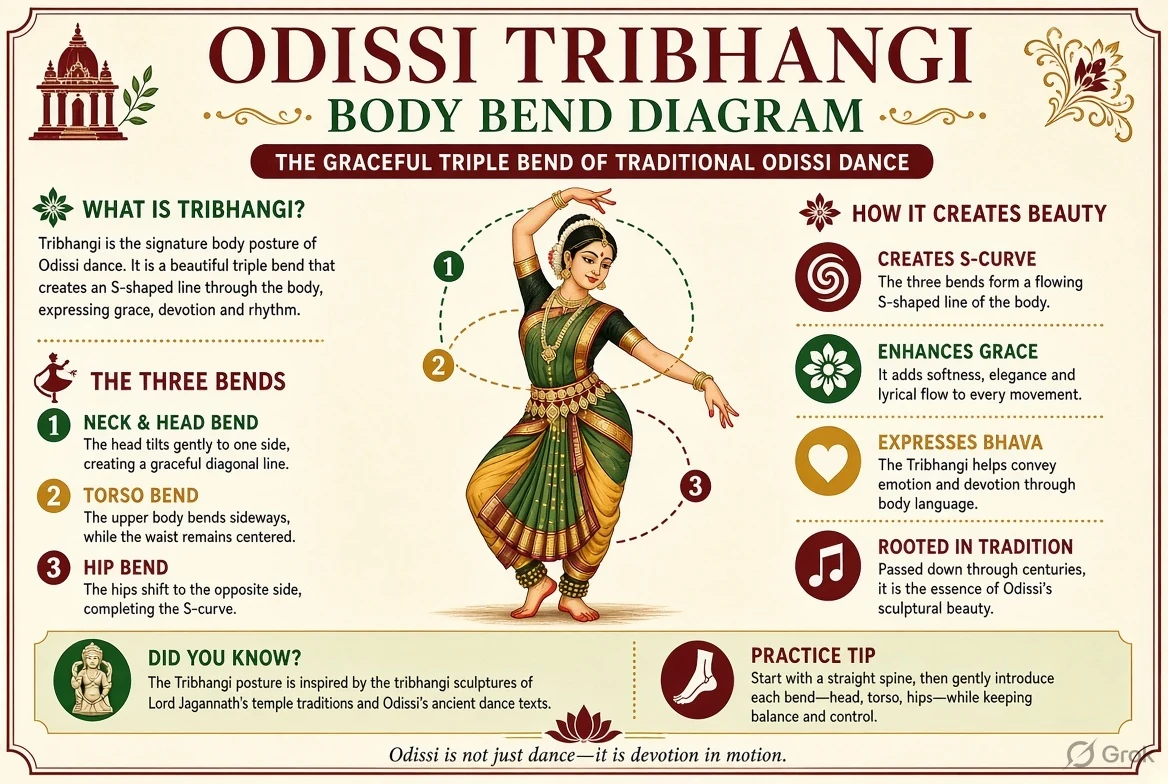


Chowka and Tribhangi: the two characteristic Odissi postures
Odissi, the classical dance tradition of Odisha, is especially recognisable for two contrasting basic bodily positions: Chowka (Chauka or Chauk) and Tribhangi (Tribhanga). Chowka is often described as a stable, square-like stance with bent knees and organised arms. Tribhangi, literally connected with three bends, creates a more curved, asymmetrical bodily line. The Government of India’s CCRT Odissi booklet describes both as fundamental features of the form. They are not merely two costume poses for photographs; they anchor training, movement and expressive choreography.
The two positions are useful visual keywords because students search for their diagrams, differences, meanings and practical technique. Yet a still image cannot tell a beginner exactly how much to bend the knees, how to distribute weight or how to keep the spine comfortable. The four charts introduce the contrasting structure, a three-bend explanation, gestures and a side-by-side comparison. They are educational illustrations, not motion studies of a specific guru’s approved method.
Chowka or Chauka posture: the square stance
The Odissi Chowka stance is generally a grounded, symmetrical position in which the feet are separated, knees bent outward in a controlled manner and the upper body organised with attention to arm placement. The pose is often described visually as “square” because of its structural stability and the geometry of the limbs. Syllabi and practitioners sometimes relate it iconographically to Lord Jagannath, although interpretation and exact phrasing should be understood through the relevant teaching tradition.
From a beginner’s perspective, it is important to understand that the stance requires more than widening the legs. The knees, hips, ankles, torso and gaze work together. Pushing the knees too far outward or dropping the pelvis abruptly can produce strain, especially without warm-up and guidance. Our first diagram indicates broad alignment ideas rather than demanding a universal fixed angle in degrees. The correct depth and arm shape should come from a qualified teacher who can observe the student’s body and adjust the exercise safely.
Tribhangi: why three bends create a sculptural line
Tribhangi or Tribhanga means “three bends” and describes a curved body arrangement often explained through changes around the head or neck, torso or waist, and hip or knee line. The resulting silhouette resembles a gentle S-shaped curve. The point is not to twist three joints independently until a cartoon outline appears. Instead, the dancer organises balance and controlled displacement so the body feels expressive while remaining supported by the legs and feet.
Odissi’s Tribhangi has a strong relationship with sculptural visual language visible in regional temple imagery, and contemporary Odissi performers use it within living choreography. Cultural educators such as Reading Museum have prepared illustrated teaching resources comparing Chowka and Tribhangi, which demonstrates their value for visual explanation. Our second chart isolates the three-bend concept. To practise it, however, a student needs a teacher’s guidance regarding pelvic alignment, knee position, safe range and how to enter and exit the pose smoothly.
Chowka versus Tribhangi: compare geometry and movement
A Chowka vs Tribhangi chart is easiest to read as a contrast between geometries. Chowka emphasises square-like balance, a broad base and controlled symmetry. Tribhangi emphasises asymmetry, curves and the shifting relationship between upper and lower body. Both belong to Odissi, and dancers move between different positions while maintaining musical and expressive continuity. One is not automatically the “masculine pose” and the other the “female pose” in a way that restricts who can learn or perform them.
Practitioners sometimes discuss different qualities or iconographic associations, but the actual choreographic role depends on the piece being performed. A teacher may introduce Chowka to build strength and control before exploring the subtleties of Tribhangi. Neither should be judged solely by how deeply the knees are bent or how dramatic the waist curve looks in a photograph. The fourth comparison visual explains broad structure while leaving detailed alignment and movement transitions to a trained instructor.
Odissi hand gestures: Mudras with posture and expression
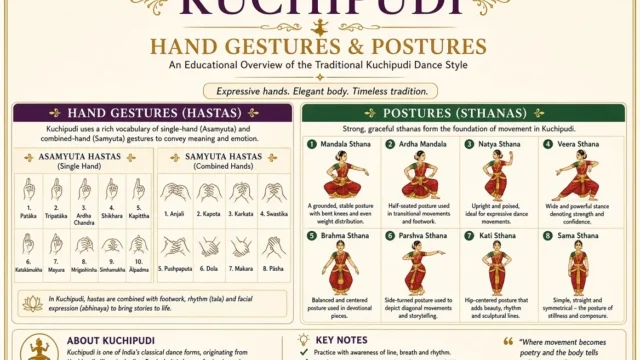
Odissi hand mudras or hastas help portray actions, characters, objects and emotion in conjunction with facial expression, gaze and rhythmic movement. There are connections between gesture vocabularies across Indian classical dance and historical performance treatises. Nonetheless, the context in which a particular hasta is used in Odissi may differ from the way a similar hand shape is taught in Bharatanatyam or Kuchipudi. A drawing of two fingers without the rest of the body does not convey the full meaning of the passage.
The third visual chart introduces hand gestures as one aspect of posture rather than a complete sign-language dictionary. A gesture’s purpose may be rhythmic or narrative, depending on whether the dancer is performing a pure dance sequence or expressive interpretation. If preparing for an exam, consult the names and applications in the student’s school syllabus. Online infographics sometimes mix hand names across traditions; if a visual lacks a credible source, do not assume all labels are correct or universal.
Odissi, sculpture and the visual heritage of Odisha
The sculptural quality of Odissi is often discussed in relation to the region’s historical temple art. Curving Tribhangi figures and strong grounded poses can be seen in artistic traditions associated with the temples of Odisha, though it is important not to suggest that every surviving stone sculpture documents a modern dance movement precisely. Live performance has developed through teachers, ensembles, repertoire and historical change. The imagery is a meaningful reference, not a frozen photograph of how one dancer moved centuries ago.
Odissi performers combine posture with movement of the torso, neck, eyes and hands, creating a distinctive flowing style. The CCRT’s documentation discusses Chowka and Tribhanga along with the performance repertoire. Students may research the relationship between sculptural forms and dance, but should attribute photographs and museum objects correctly. A generic graphic generated for an educational page should not be captioned “ancient Konark dancer, photographed in performance.” Clear separation of historical sculpture and contemporary stage practice strengthens the reader’s understanding.
Odissi repertoire: where these movements appear
Odissi repertoire is often introduced through items such as Mangalacharan, Batu, Pallavi, Abhinaya and Moksha. Cultural institutions and teaching resources discuss these as familiar components of the modern concert format. The physical vocabulary of Chowka, Tribhangi and related movements appears in different ways across pieces. A Pallavi may elaborate rhythmic and melodic movement, while an Abhinaya item focuses more directly on lyrical interpretation. The posture therefore belongs to a wider artistic context and cannot be reduced to a single isolated exercise.
A beginner watching a video can look for moments of grounded square alignment and curved three-bend arrangements, then notice transitions and how hands, face and music change the meaning. Avoid deciding from a still photo alone whether the dancer is in a particular named repertoire item. Costumes and ornaments can look similar across pieces. Use the full programme note or recognised instructor’s explanation when identifying a performance, especially when publishing the image as factual cultural documentation.
Safe ways to learn Chowka and Tribhangi
When learning Odissi basic postures, work with a teacher who can assess hip and knee movement and adjust the depth of positions. Begin with suitable warm-up, balance awareness and gradual repetitions. A wide stance held too low can put unwanted stress on knees, while forcing an exaggerated spinal curve can be uncomfortable. The goal is coordinated control and expression, not reproducing a two-dimensional drawing at any cost.
Practise entering and leaving positions slowly, keeping breathing natural and noticing where weight is supported. Use a stable surface and give yourself enough space. If you have pain, dizziness or limitations in mobility, ask a qualified professional or instructor about appropriate adaptations rather than forcing a textbook pose. A photo comparison can be a useful reminder after class, but it should not become the sole guide for physical technique. Continued training is the safer route to graceful, repeatable movement.
Odissi Chowka and Tribhangi FAQs
What are the two basic Odissi postures?
Chowka or Chauka, a grounded square-like stance, and Tribhangi, an articulated three-bend position.
What does Tribhangi mean?
It refers to three bends that help form the characteristic curved body line.
Is Chowka the same as Tribhangi?
No. Chowka prioritises squarish stability while Tribhangi creates a more asymmetric curving arrangement.
Are Odissi mudras identical to Bharatanatyam mudras?
There is shared vocabulary, but movement context and teaching conventions can differ.
Can beginners learn these poses from images alone?
Images explain the shape, but safe alignment and transitions should be learned with an instructor.
Conclusion: learn the posture in motion
The shapes make sense through movement, balance and music. Use the diagrams to identify Chowka and Tribhangi, but learn safe alignment and expressive transitions from an instructor.
Official and professional sources
CCRT Government of India: Odissi Dance booklet; Reading Museum: Odissi body-position teaching resource; Odissi exponent Sujata Mohapatra: About Odissi; CCRT: Odissi dance demonstrations catalogue.
















Share Your Opinion
Comments are closed on this post.