 Vista

Direct answer: Odisha Pattachitra border patterns use repeated flowers, leaves, vines, carefully drawn outlines, geometric forms and sometimes birds or animals to frame narrative paintings. The tradition is especially associated with Puri’s Raghurajpur Chitrakar artists. These four diagrams explain the visual structure while distinguishing original painted cloth from modern design illustrations.
Updated 21 November 2026. Illustrated reference charts, not authenticated antique Pattachitra photographs.
Odisha Pattachitra border design: four illustrated charts
Odisha Pattachitra painting: why the border matters
Odisha Pattachitra is a living painting tradition historically associated with cloth or prepared canvas and with Chitrakar artisans in the Puri region, especially Raghurajpur. Many works depict stories involving Jagannath, Krishna, Rama and other figures, surrounded by fine ornament and decorative borders. A border is not just an empty frame around the “real picture”: repeated flowers, leaves, curves and geometric linework help organize the scene and establish the painted panel’s rhythm. Some artworks use animals and narrative details within their boundaries too.
Odisha Tourism describes Raghurajpur as a major heritage crafts village known for intricate Pattachitra paintings and natural colours, while Odisha’s Directorate of Handicrafts lists the Raghurajpur-Dandasahi cluster for Pattachitra and palm-leaf engraving. Our four charts teach the visual vocabulary of floral borders, decorative lines, animal motifs and repeating patterns. They are illustrations for recognition and study, not copies of a named artisan’s original Jagannath painting or certification of a specific object.
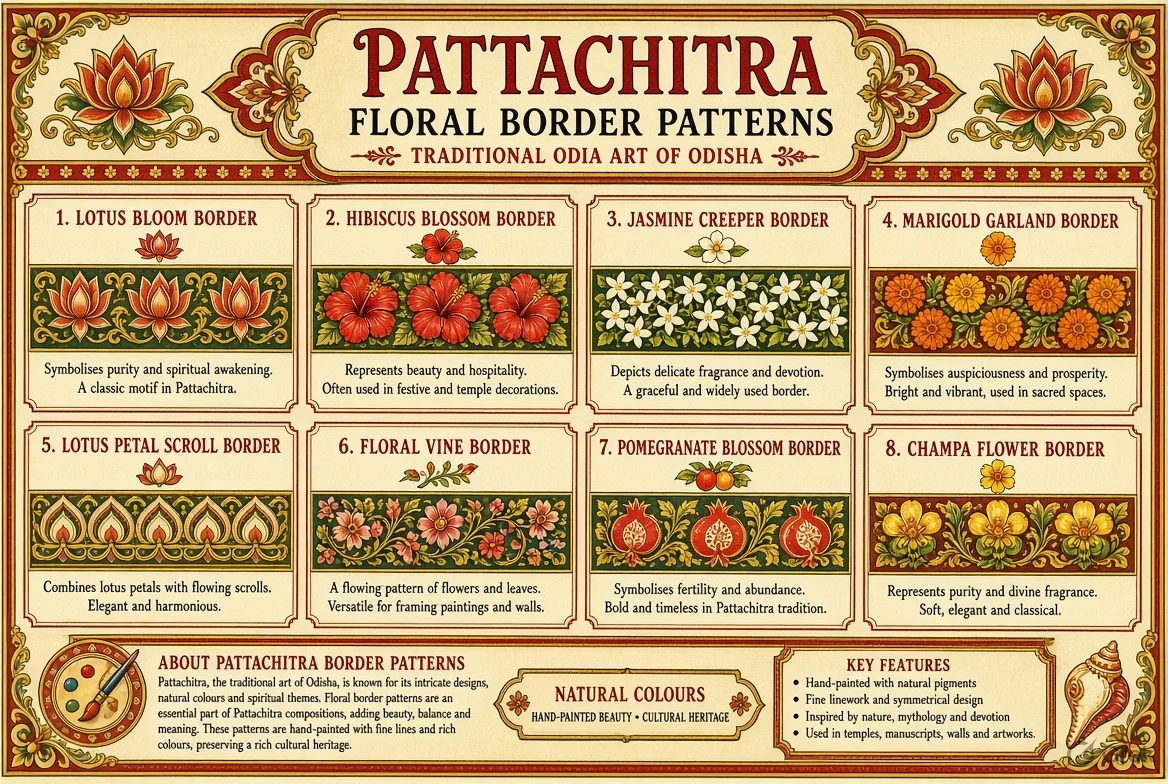
Floral Pattachitra border designs: lotus, leaves and vines
Pattachitra floral borders often rely on rhythmic leaf and vine forms. A climbing creeper can turn continuously along a frame, while individual flowers or lotus-like shapes repeat at measured intervals. These details help hold the viewer’s attention inside the central narrative scene. A very complex painting may use several nested borders, with a fine inner line and a richer outer band. Yet no online chart can declare that every authentic Odisha Pattachitra must contain exactly a certain number of lotus petals.
When reading the first visual chart, identify the main vine, smaller leaves and how the shapes turn at the corners. A flowing border differs from a random assortment of flower stickers because its repeated units establish a clear direction. The same motif can be drawn with different fineness and colour choices by individual artists. If a specific old painting has a documented story behind the flowers, use that source; do not invent promises that every leaf brings a fixed kind of luck or prosperity.
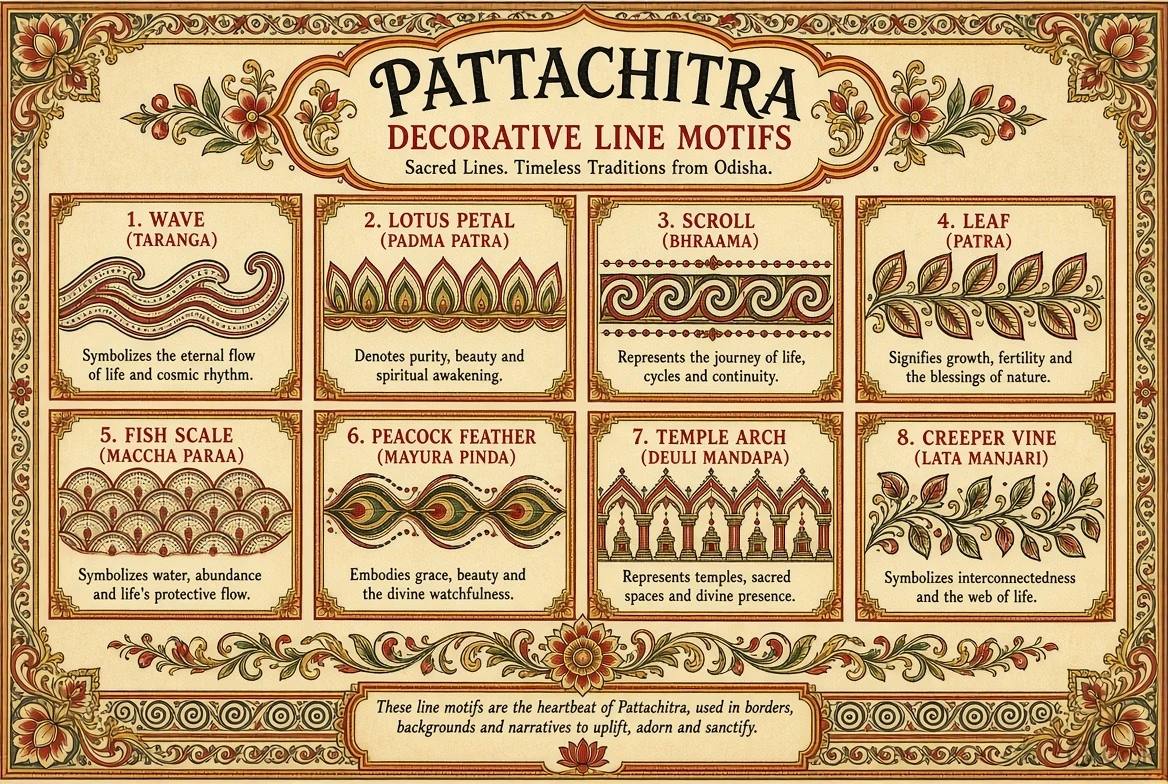
Fine outlines and decorative line motifs in Pattachitra
Odisha Pattachitra linework is recognised for deliberate contours, small decorative details and carefully shaped figures. Fine lines define clothing, ornaments, hair, architecture and surrounding border patterns. The overall style is often presented as highly detailed and full of movement. The borders may use parallel strokes, compact curved elements and repeated fillers. These features are useful for beginner visual identification, but cannot by themselves prove the geographic origin of an unsigned painting.
To practise the technique on paper, start with one broad boundary and add a narrower internal line. Between them place a small repeat unit such as a curling vine or flower. Keep the centre visually separate so the main story remains readable. Do not assume every perfectly smooth digital vector is an authentic historical brush line. A real cloth painting contains choices of material, preparation and a trained hand. The second chart helps identify line density, not certify that the drawing was produced by a professional Chitrakar.
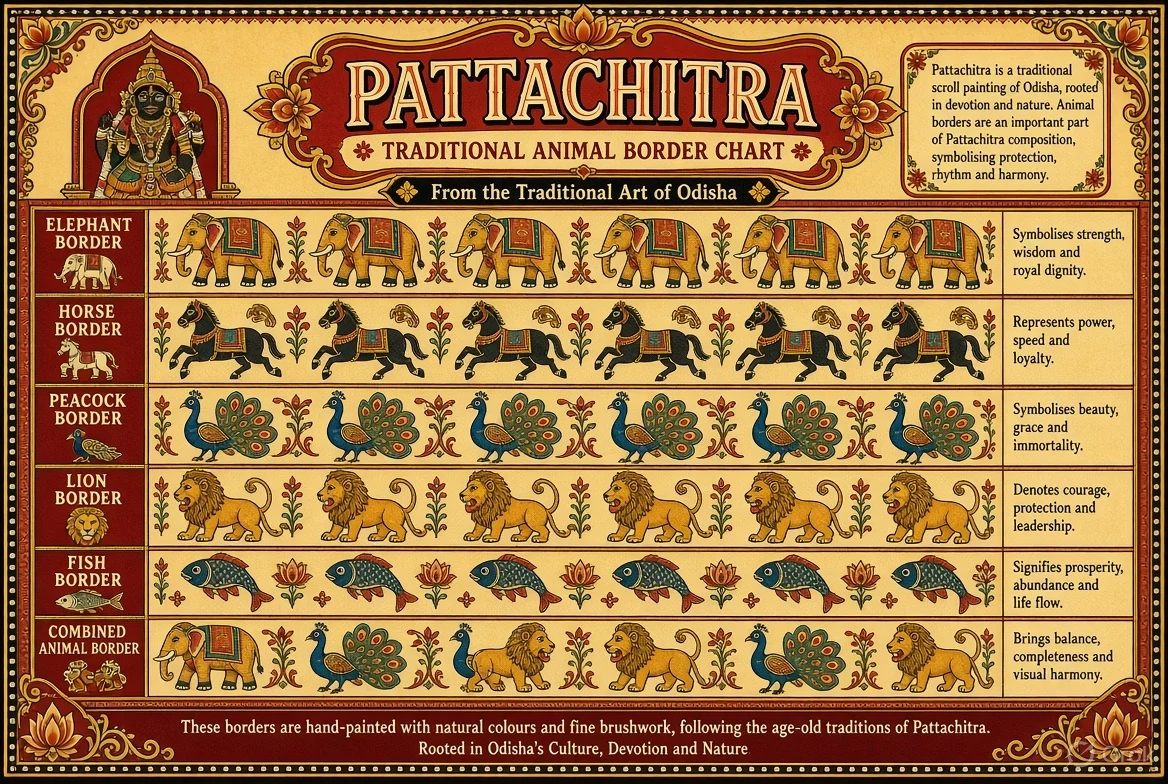
Traditional animal borders: peacock, elephant and other figures
Animals and birds appear in various Pattachitra motifs, sometimes alongside ornamental floral forms and sometimes as active participants in mythological storytelling. Peacocks, elephants, lions and other animals may be placed within or near the border depending on the artist’s composition. Their significance depends on what the overall painting depicts. For example, an animal appearing beside a named deity in one narrative should not automatically be assigned the same role when drawn in a purely decorative frame.
Our animal-border illustration demonstrates how repeating creatures can be balanced with foliage and linework. It is not a catalogue of official sacred animals, nor a guarantee that a particular real Pattachitra uses the same combination. Different artisans can innovate and adapt their style. When a photo is attributed to a named artist, read the source description before claiming a figure represents an episode from a specific epic. Accurate visual captions should identify visible subjects first and interpret cultural meanings only with documentation.
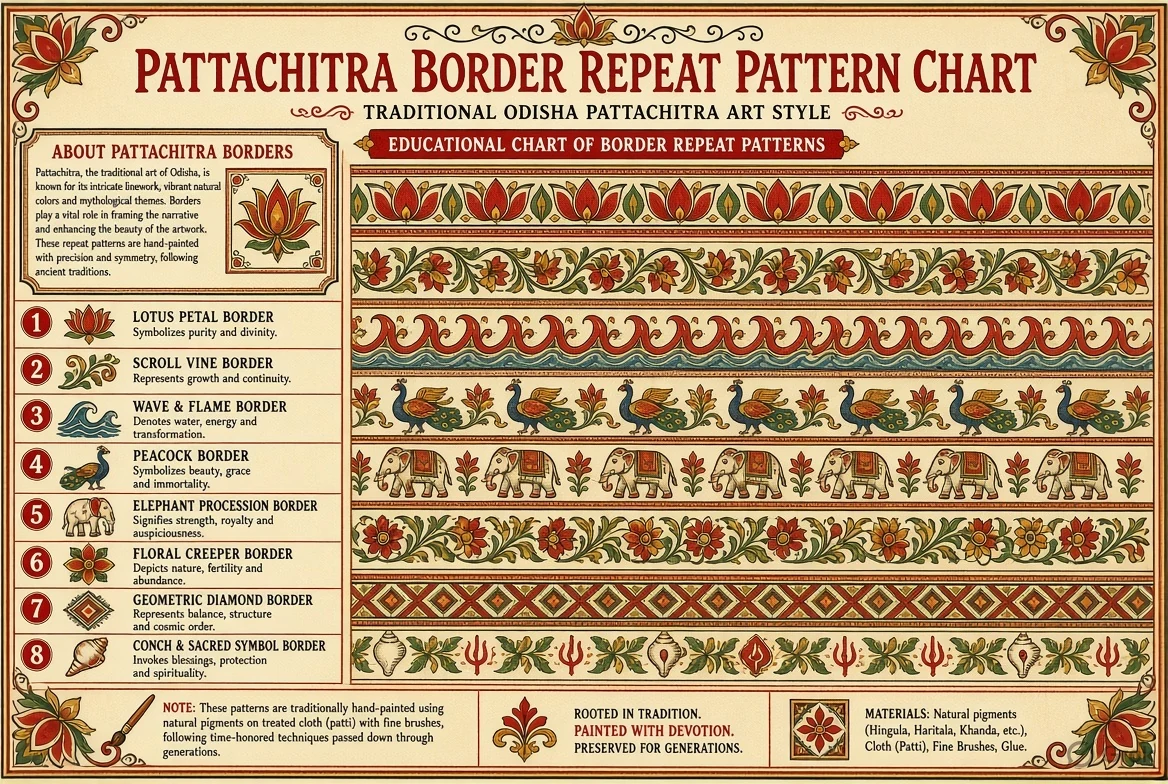
Repeat border patterns: how a complete frame is constructed
A Pattachitra repeating border pattern can be built from a short motif that repeats around the painted area. The artist must consider how the unit fits across each side and what happens at the corners. A double or triple border can produce depth: one outer line, a decorative band and a final inner outline. In a narrative panel, the border can contain the storytelling within a visual boundary, while maintaining an overall sense of harmony.
For a school illustration, sketch the rectangle first, divide each side into repeat units and reserve enough space at the corners. Place one floral or geometric element in each interval and test how the pattern continues around the turn. This teaches composition without copying a living artist’s detailed frame. The image chart is a study exercise rather than a universal “one correct Pattachitra border”. In real works, dimensions and design choices vary with the story, the cloth, the painter and the intended setting.
Cloth preparation, natural pigments and the Chitrakar process
Traditional Odisha Pattachitra is strongly associated with prepared cloth or canvas, often treated and polished to produce a smooth working surface before drawing. Cultural craft references describe mineral and natural pigments, carefully prepared outlines and traditional brushwork. Materials and methods can vary by artisan and time, so a simplified online description should not claim that every historical painting used one exact chemical formula. Palm-leaf engraving and related crafts also exist in the region but are not the same material process as an ordinary cloth Pattachitra.
The detailed linework reflects skilled practice, not merely a black pen filter applied to a picture. If buying an artwork, ask whether it is hand-painted on prepared cloth, a digital print, a palm-leaf work or another product. Photographs of the making process and reliable artist information can be helpful, but one superficial brushstroke difference does not authenticate a valuable painting. Respect conservation: do not scrape or soak an old piece to test its pigments. A specialist can advise on handling and storage.
Jagannath, Raghurajpur and the cultural setting
The Puri region’s Jagannath tradition is an important context for many Odisha Pattachitra themes. Paintings may portray Jagannath, Balabhadra and Subhadra, Krishna-related narratives and other episodes depending on the maker and purpose. Odisha Tourism and the Press Information Bureau describe Raghurajpur as an artisan centre with a rich craft identity. But not every Pattachitra painting shows Jagannath, and a generic graphic of a deity should not be labelled a Raghurajpur original without credible provenance.
The Chitrakar community’s workmanship and artistic continuity deserve recognition. A tourist purchasing art in the village should ask for the maker’s name and the materials used, rather than assuming all products sold near Puri are identical. Modern artists create diverse subjects and sizes, and the setting of an actual artwork can differ from a classroom border study. In website ALT text, including “Odisha Pattachitra Raghurajpur” is appropriate only when the object’s connection to that context is supported, not merely because the style resembles it.
Odisha Pattachitra vs Bengal Patachitra and other arts
Odisha Pattachitra should not be automatically merged with Bengal Patachitra. Both involve painting and storytelling, but Bengal’s traditional scroll narratives, performances and regional artistic lineages form a different cultural practice. Asia InCH maintains separate references for Odisha icon painting and West Bengal scroll painting. Within Odisha, palm-leaf engraving is related to the region’s crafts but uses different material and technique from painting on cloth.
A lotus or bird border also appears in other Indian arts, such as Kalamkari or Madhubani. Simply looking at a floral vine cannot establish the painting tradition. Examine the central composition, outlines, materials, creator and region. For an educational diagram, describe the image as “Odisha Pattachitra-inspired floral border” if it does not reproduce a verified historical object. Better classification gives readers a genuine visual reference and does not erase regional differences to attract search traffic.
FAQs on Odisha Pattachitra border patterns
What is Odisha Pattachitra painting?
A traditional painted-cloth art associated especially with Puri, Raghurajpur and Chitrakar artisans.
What designs appear in Pattachitra borders?
Repeated vines, leaves, flowers, curved lines, geometry and sometimes animals.
Is every Odisha Pattachitra about Lord Jagannath?
No. Jagannath is important, but many other religious and narrative subjects are painted.
Is Odisha Pattachitra the same as Bengal Patachitra?
No. They are distinct regional painting and storytelling traditions.
Can digital print be described as an original handmade Pattachitra?
No. A digital reproduction and an original Chitrakar-made painting should be clearly distinguished.
Conclusion: learn the frame and honour the painter
The Pattachitra border is part of the artistic composition and the painter’s craft. Learn the visual structure of flowers, lines and figures while giving original creators and the region’s history proper recognition.
Official sources and cultural references
Odisha Tourism: Traditional Arts and Pattachitra; Odisha Tourism: Raghurajpur craft village; Odisha Directorate of Handicrafts: Craft clusters; Asia InCH: Odisha Pata Chitra painting; Asia InCH: Distinct Bengal scroll-painting tradition.

















Share Your Opinion
Comments are closed on this post.