 Vista
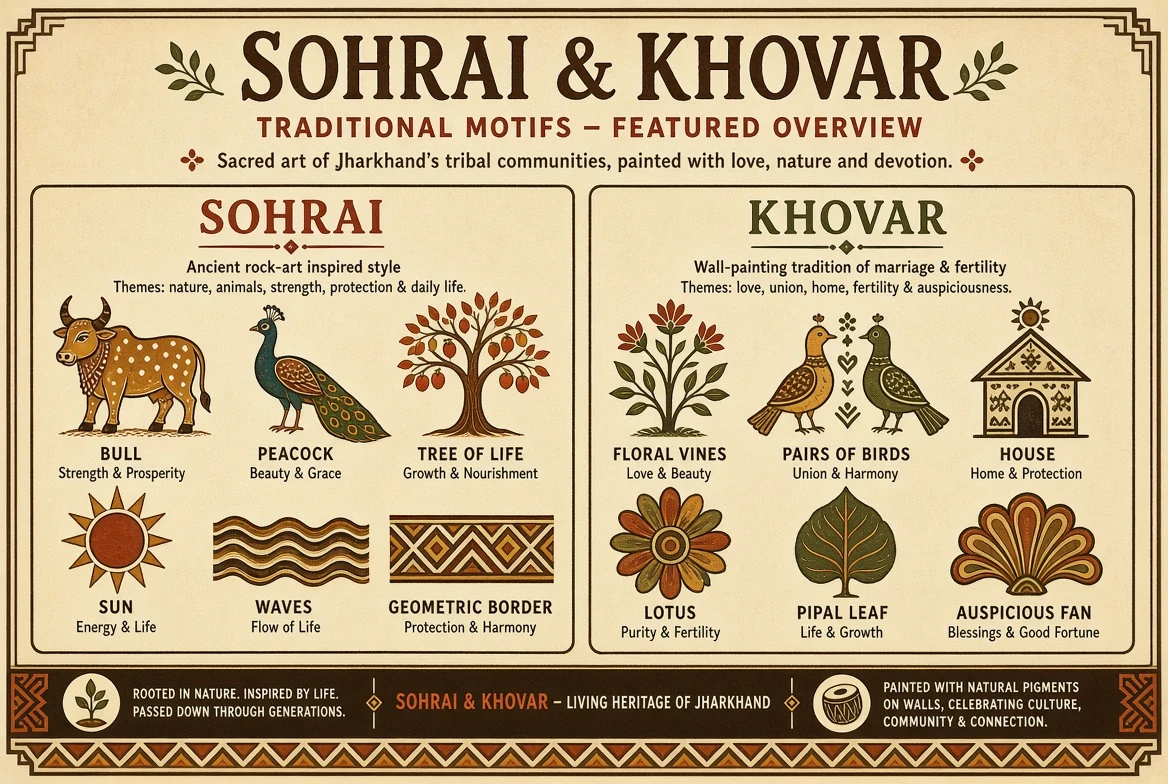
Direct answer: Sohrai and Khovar painting are related wall-art traditions from Jharkhand, especially Hazaribagh. Sohrai centres on harvest-time themes and animals; Khovar is linked to marriage and often uses contrasting clay layers and comb-cut patterns. The combined tradition received GI recognition in 2020. Four charts explain their motifs and differences without presenting modern illustrations as documentary ritual images.
Updated 21 November 2026. Educational artwork and historical guide.
Sohrai and Khovar painting chart: four illustrated references


Sohrai and Khovar painting: two related traditions of Jharkhand
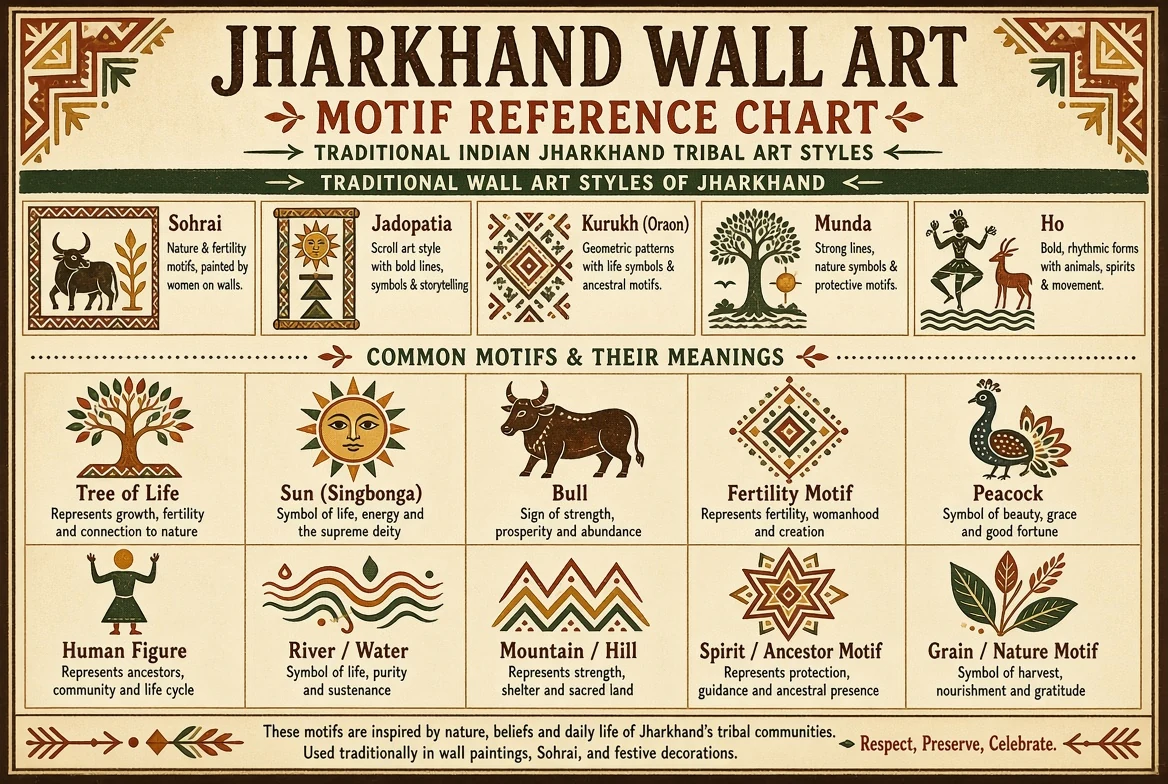
Sohrai and Khovar painting are closely related but distinct traditions of mural painting associated especially with villages in the Hazaribagh region of Jharkhand, India. Many accounts emphasise the contributions of women painters, natural-earth pigments and walls prepared with layers of local clay. Sohrai is connected with the agricultural harvest and the honouring of cattle, while Khovar is associated with marriage and preparation of nuptial spaces. Both can feature flora, fauna, bold linework and visually striking patterns, but their occasions and techniques are not completely interchangeable.
The official Jharkhand tourism website distinguishes comb-cut or finger-painted Khovar from wall-painted Sohrai. The living tradition also appears in galleries, books and portable artworks today. These four educational charts compare motifs, material processes and the relation between celebration and painting. They are not copies of individual women’s original wall murals, and they should not be used as documentary evidence of a specific ritual. A real object’s community, maker and local story remain essential for interpretation.
Sohrai harvest art: cattle, deer, birds and plants
Sohrai art motifs frequently feature cattle, deer, birds, fish, plants and other creatures, often painted in earthy reds, blacks, yellows and white. Those shapes connect visually with agriculture, animal life and the landscape around Hazaribagh. Sohrai painting is strongly associated with the harvest-festival season, including the social importance of cattle in farming households. The images may be lively and expansive, bringing multiple animals and plants into a single wall composition.
It is tempting to assign every bird a fixed “good luck” label or every cow a universal promise of prosperity. Instead, identify the particular scene and the source where a maker or scholar explains its meaning. Individual villages and painters may use forms differently. Our first chart explains what animals and leaves can look like, while the official Jharkhand descriptions provide the broader seasonal setting. A silhouette alone cannot fully decode a mural’s social or spiritual role.
Khovar wedding wall art and the comb-cut technique
Khovar painting is commonly associated with the marriage season and decorated spaces connected with a newly married couple. A prominent technique is comb cutting, also called scraping or sgraffito: painters create contrasting layers on a prepared mud wall, then draw through the upper layer while it is still workable, revealing the underlying colour. A plastic or bamboo comb or fingers may help make parallel grooves, plant shapes and flowing lines. The result can appear strongly black-and-white, although materials and local practices vary.
The technique is not merely a digital scratch filter. Its visual effects arise from actual earth materials and human gestures. Asia InCH and Jharkhand Tourism document the use of natural soils, combs and simple tools; their accounts are more meaningful than a decorative poster that claims all marriage murals always use one precise layer order. When looking at our second chart, think about the difference between painted colour added on the surface and a line revealed by removing a wet upper layer.
Why Sohrai and Khovar look similar but are not the same
Both arts can employ nature subjects, wall surfaces, repeated shapes and community knowledge. Their common regional setting leads some internet searches to combine them into one label. But the Sohrai vs Khovar distinction is primarily about the social season and context—harvest versus marriage—alongside prevalent visual and technical differences. Sohrai is frequently described as vividly painted, while Khovar often highlights comb-cut dark-and-light contrasts. These are tendencies, not an absolute ban on any style overlap.
A painting with deer and leaves could therefore require more context before being assigned one name. Ask where it was made, on what occasion, by whom and with what technique. Some contemporary portable works borrow from both and can be marketed under the paired label. Accurate captions should say “Sohrai-Khovar-inspired pattern study” if the source is a modern infographic, rather than labelling it a photograph of a real harvest ceremony. That detail protects community identity and improves the accuracy of visual search results.
Hazaribagh soils, natural colours and mud-wall preparation
The traditions are known for making effective use of locally available earth pigments. Sources describe red ochre, yellow earth, dark mineral or charred pigments and white clays as part of different painting practices. The prepared mud wall is not only a background: it can form a working layer through which colour is added, smeared or scratched away. The relationship between texture, colour and the physical architecture is central to understanding why a copied digital motif cannot fully reproduce the traditional process.
Different households and villages may prepare walls differently. Some use fingers or twigs for painting, while others employ combs to produce fine parallel marks. A classroom exercise using safe craft materials may illustrate the idea of colour contrast, but it should not be advertised as a ritual formula from all Hazaribagh communities. When recording an authentic mural, include notes on the wall material and any known artist or village information rather than focusing only on the final animal outline.
2020 GI tag: what was actually registered?
Sohrai-Khovar Painting received Geographical Indication recognition in 2020, with the Indian GI Registry recording the associated application as number 658. Government economic-survey reporting also identifies the recognition with Hazaribagh and the wider regional heritage. The registration helps acknowledge a distinctive product associated with its geographical and cultural context. It does not mean every file named “Sohrai wallpaper” is certified artwork or that a mass-produced decorative sticker is automatically an original community-made mural.
For a real artwork, identify its maker, materials and provenance. Where GI details or seller assurances are relevant, verify the specific claims rather than displaying the protected name merely as a marketing badge. Digital drawings can be useful for education when described accurately as inspired or illustrative. An explanatory website should not imply it has GI certification simply because it discusses a GI-recognised tradition. Accurate treatment of heritage claims benefits the artists as well as readers.
The women painters and continuity of cultural knowledge
Jharkhand Tourism and cultural researchers describe the prominent role of women in transmitting and practising these mural traditions. Knowledge is shared through family and community relationships and tied to agricultural or marriage events. This makes the work a living practice rather than an anonymous pattern that simply appeared on old walls. Individual artists may be known by name, and projects documenting their work should give attribution wherever the records allow it.
Modern transitions create both opportunity and concern. Art on paper and canvas can support livelihoods and allow artists to reach wider audiences; changing house materials, village environments and economic pressures can also threaten customary wall-painting contexts. Cultural documentation from IRCI and arts researchers explores these changes. A useful visual guide should help readers appreciate the people making and sustaining the art, not just copy animal silhouettes into uncredited digital clip art.
How to identify Sohrai-Khovar art respectfully
Examine the scene and note its materials, animals, plants and technical marks. Is the line drawn over a wall, or cut through contrasting mud layers? Does the documented occasion concern a harvest celebration or a marriage? Is the painting an original wall mural, an artist-made portable work or a new educational illustration? These questions provide a stronger starting point than searching for one animal symbol in isolation.
If you are making a school poster, explain the contrast between Sohrai’s harvest associations and Khovar’s wedding associations, and use safe illustrative forms instead of presenting a complete ritual as a craft tutorial. If using a real photographer’s image or a named painter’s work, secure rights and include credit. Do not claim that a modern computer-generated wall scene depicts an actual ceremony. That clarity makes history, practical learning and SEO work together without misleading readers.
Sohrai and Khovar painting FAQs
What is the difference between Sohrai and Khovar?
Sohrai is associated mainly with harvest celebrations, while Khovar is linked to marriage-related murals.
Where is Sohrai-Khovar painting practiced?
It is especially associated with the Hazaribagh region of Jharkhand.
What is Khovar comb cutting?
Creating patterns by scratching or cutting through contrasting layers on a prepared wall.
When did Sohrai-Khovar get GI recognition?
It received GI recognition in 2020; India’s registry records application number 658.
Is every animal in Sohrai art a fixed sacred symbol?
No. Interpretation depends on the particular composition, artist and community context.
Conclusion
Sohrai and Khovar share an artistic landscape but have different occasions and sometimes different methods. Look at the maker, wall, harvest or marriage context and genuine provenance rather than assigning fixed meanings to generic silhouettes.
Official and cultural sources
Indian GI Registry: Sohrai-Khovar Painting, Application 658; Jharkhand Tourism: Sohrai and Kohvar wall painting; Sahapedia: Production of Mud Murals; IRCI: Sohrai — Murals of Memory.














Share Your Opinion
Comments are closed on this post.