 Vista

Direct answer: Madhubani or Mithila painting motifs include fish, peacock, lotus, sun, flowering vines and decorative border designs. Kachni generally emphasises intricate lines and hatching; Bharni uses more filled colour. These four illustrated charts explain the visual difference while respecting the fact that motifs gain meaning from particular artists, narratives and cultural settings.
Updated 21 November 2026. Reference illustrations, not copies of named artists’ paintings.
Madhubani painting motifs chart: fish, peacock, lotus and style guide



Madhubani painting motifs: a living Mithila tradition
Madhubani painting, also known as Mithila painting, is closely associated with the Mithila region of Bihar and neighbouring areas of Nepal. It is known for drawn outlines, decorative fills, dense borders and subjects from local life, celebrations, nature and religious storytelling. A single picture might combine fish, peacocks, lotus, sun, people or other figures in a carefully balanced arrangement. Today artists work on handmade paper, cloth and other surfaces in addition to the historical wall and floor traditions.
The Madhubani district administration explains that the traditional practice was strongly shaped by women artists, while contemporary work also involves men and broader commercial and institutional networks. It is therefore not accurate to treat Madhubani art as a frozen prehistoric code in which every fish means exactly one thing. A pattern may have associations with a specific narrative, household context or named maker. The four charts below show visually recognisable features; they are illustrations for learning, not authenticated copies of any artist’s original composition.
Fish and peacock patterns: how to read the motifs
Madhubani fish motifs can be constructed from a clear outline, repeated scales, fins and decorative linework. Peacock motifs offer a similarly recognisable silhouette, with curving necks and patterned tail feathers. In popular guides they are sometimes assigned one-word meanings such as fertility or beauty. These associations may appear in particular traditions, but claims must be tied to documented cultural contexts instead of declared universal for every fish, bird and painter.
Look at how the animal interacts with the surrounding scene. A peacock beside a lotus and geometric border has a different composition from a fish used as one element in a larger narrative. Some contemporary works are intentionally decorative rather than illustrating one ritual story. If a chart merely reproduces a modern designer’s fish pattern, it should be labelled as an educational example. That honesty preserves the difference between learning about a recurring visual subject and interpreting a particular cultural artwork.
Lotus, sun and nature motifs in Mithila painting
The lotus appears in many Indian artistic traditions and can be central in devotional and domestic imagery. The sun may be represented as a round form with radiating marks, sometimes inside a more elaborate composition. Plants, branches, flowering shapes and local animals often occupy areas between major figures. Such motifs allow artists to integrate natural forms with human and religious subjects. The same icon may be drawn differently between workshops and styles, so a few illustrations cannot stand in for an exhaustive historical dictionary.
Readers looking for “Madhubani sun painting meaning” should distinguish the visible subject from the significance assigned by the artist. A sun inside a particular devotional picture may carry a different context than one used to fill a classroom poster. Similarly a lotus drawn in the Bharni style can use large areas of colour, while another artist may emphasise fine black linework. Our second chart makes those shapes easy to identify without inventing claims about universal luck, money or supernatural power.
Kachni vs Bharni: the key difference in painting style
Kachni is a linear Mithila painting approach often associated with intricate hatching and a restricted palette. Bharni is commonly identified through stronger areas of filled colour. Art-historical introductions, including Smarthistory’s discussion of Mithila painting, explain that these visual choices developed in social and artistic contexts and that individual artists adapted them. They are not two computer-generated filters that can be applied indiscriminately to every Madhubani artwork.
A beginner can compare the same fish outline drawn twice. In Kachni-like study work, fill it with parallel or cross-hatched lines; in Bharni-like work, build clearly separated colour areas. This teaches the broad distinction but does not make the exercise an authentic traditional work. Other named strands, including Godna and Kohbar-related work, can introduce further differences in subject and technique. A good article avoids saying there are only two forms of Madhubani art, or that everyone painting in a style belongs to a single fixed social group today.
Madhubani border designs: double lines and filled spaces
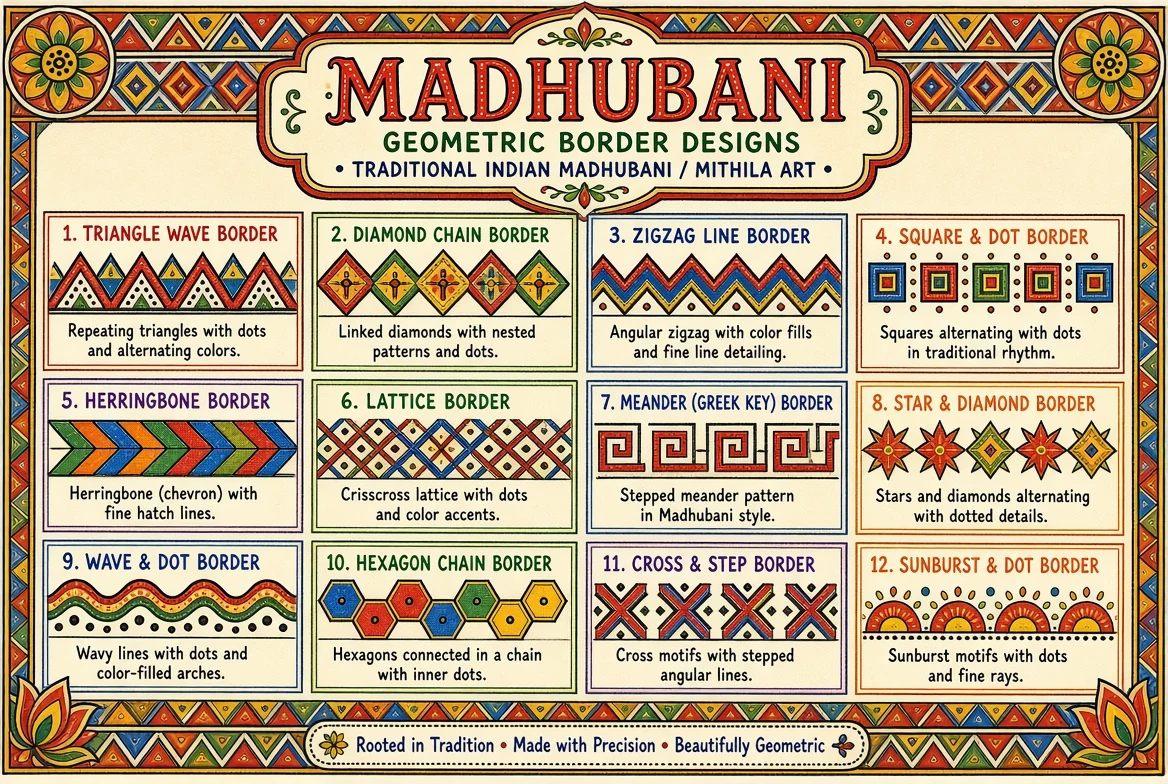
Dense decorative borders are especially useful for identifying many Madhubani painting designs. Repeated triangles, leaves, vines, squares, dots and parallel strokes may frame a central narrative, while smaller patterns fill empty areas within it. Double outlining and carefully organised spaces can create a compact, busy composition that feels coherent. The border is more than an afterthought: it can guide a viewer’s attention back to the main figures.
To draw a practice border, begin with two parallel lines and divide the space between them into equal intervals. Repeat a small leaf, triangle or wave and allow the outer design to connect with the interior. Avoid assuming that any triangle border belongs exclusively to Mithila, because geometric repetition appears across many cultures. The chart provides ideas for studying structure rather than a licence to copy the exact design of a named living artist. For an art-class poster, record whether the work is an inspired exercise or original artisan-made painting.
Women artists, wall paintings and modern paper works
Historically, Mithila’s painted walls and household settings played an important role in the practice. The transition to commercial works on paper made the art more visible beyond villages and offered an additional livelihood to many artists. The Madhubani district administration describes initiatives that encouraged women artists to create work on handmade paper for sale. Modern galleries, government initiatives and online marketplaces have broadened the audience, but this does not mean all village ritual contexts disappeared.
Individual artistic recognition is also essential. Smarthistory discusses artists such as Sita Devi and describes how their work helped bring the tradition to wider audiences. Rather than captioning a painting “anonymous folk art” when its creator is known, include the artist’s name and the documented date or material. Contemporary Mithila artists continue to adapt designs, colours and subjects. Treating every modern painting as an unchanging ancient template undervalues those creative contributions.
Madhubani and GI recognition: what it does and does not prove
Madhubani painting has received recognition in India’s Geographical Indications framework, supporting its relationship with the Mithila region and traditional artistic production. Such recognition can help highlight regional heritage and legitimate artisan practices. It does not mean a random digital picture labelled Madhubani is authentic, licensed by a community or approved for unlimited reproduction. A copy of a famous fish design on a manufactured poster is not automatically an original artisan work merely because a seller adds a GI badge.
When buying actual artwork, ask about the painter, material, place of production and provenance. The state-supported Madhubani art portal presents collections from working artists and can be a useful starting point. A transparent seller should describe whether the item is an original painting, a print or a digitally illustrated design. Likewise bloggers should not imply that their own educational infographic is a traditional hand-painted artifact. The distinction adds credibility and keeps cultural value visible.
Madhubani vs Gond, Warli and Pithora painting
Mithila painting often features dense bordered drawings, patterned surfaces and subjects drawn from its own cultural setting. Modern Gond painting is frequently associated with coloured animals and fine dot-dash textures; Warli painting with geometric human scenes; and Pithora painting with Rathwa ritual murals and mounted horses. These comparisons are useful visual clues but not strict universal rules. Nature scenes, fish, sun and trees can occur across several traditions, and modern artists sometimes experiment beyond familiar forms.
For accurate search labels, use the artist, region and style rather than an all-purpose “Indian tribal art” description. Madhubani is not simply Gond with borders, and Pithora cannot be identified by the presence of any horse. When sourcing images, inspect accompanying museum or artist documentation, not only visual similarity. Correct naming protects distinct community histories and helps readers find the exact design or cultural background they searched for.
Frequently asked questions about Madhubani designs
Are Madhubani and Mithila paintings the same tradition?
The terms are closely related and commonly used for the painting practices of the Mithila region.
What is the difference between Bharni and Kachni?
Bharni commonly emphasises filled colour, while Kachni uses delicate lines and hatching.
Do fish and peacock motifs have one fixed meaning?
No. Associations vary with the painting’s story, artist and social context.
Why do Madhubani paintings have dense borders?
Repeated geometric or natural motifs can frame and visually connect a composition.
Can a printed Madhubani design be called an original painting?
Not without clarity. Original hand-painted artwork and mass-produced prints should be distinguished.
Conclusion: learn the style and credit its artists
Mithila painting is both a regional heritage and a contemporary art practice. Learn the fish, peacock, lotus and border vocabulary, compare Kachni and Bharni honestly, and identify the creator whenever discussing a particular work.
Verified references
Madhubani district administration: Handicraft and Mithila Painting; Smarthistory: Painting in Mithila; Bihar government: Madhubani Artist Collections; PIB: Mithila regional crafts and artists.





















Share Your Opinion
Comments are closed on this post.