 Vista

Direct answer: The most reliable British silver hallmarks identification chart starts with the sponsor’s mark, fineness number and assay office mark. Traditional additions include the lion passant for sterling silver and a date letter, but these two are optional on modern UK hallmarks. Our four diagrams explain the lion, office symbols, date-letter cycles and maker/sponsor marks without falsely identifying every item from one symbol.
Updated 21 November 2026. Historical identification reference, not an official assay certificate or antique valuation.
British silver hallmark identification: four pictured charts


British silver hallmarks identification: begin with the three key marks
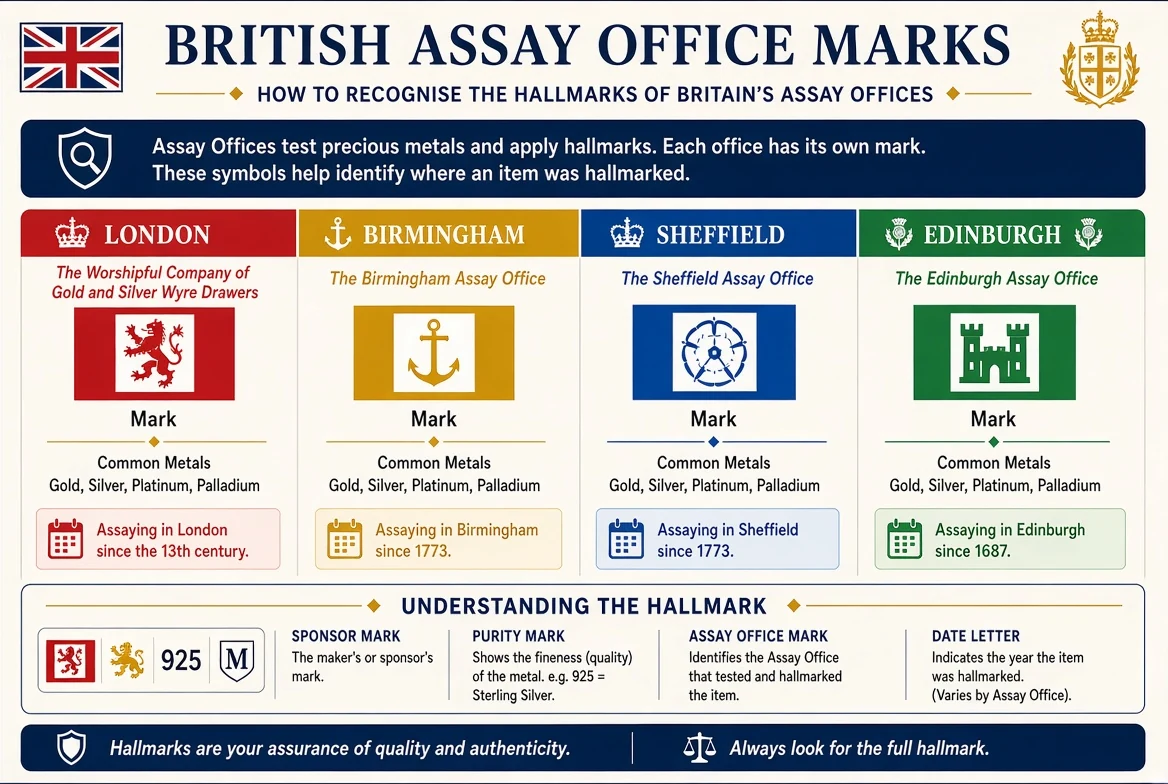
British silver hallmarks are a regulated marking system used to describe the precious-metal fineness of qualifying objects. On a modern UK-hallmarked silver item, the compulsory set comprises the sponsor’s mark, the fineness mark and the assay office mark. The sponsor’s mark identifies the person or business that submitted the piece; it is not always the craftsperson who physically made the item. The fineness mark gives the metal’s silver proportion in parts per thousand, such as 925. The assay-office mark identifies the independent office responsible for the hallmark.
Collectible antique silver often shows additional traditional signs, notably the lion passant and a date letter. They remain valuable visual clues but are no longer universally compulsory on recent articles. Sheffield Assay Office says the lion passant for 925 and date letter are voluntary additions, and the date letter became optional in 1999. This one detail prevents a common error in online charts: a modern genuine 925 silver piece can have the three required elements without displaying the familiar traditional walking lion.
What does a lion passant mean on old silver?
The lion passant is the historical walking-lion figure commonly associated with English sterling silver. “Passant” refers to the animal’s walking posture, not a special level of antique value. Collectors often use a lion hallmark as an initial clue when examining a spoon, tray, teapot or other silver object. Its appearance, shield and combination with other marks must be compared with the relevant period. A vaguely lion-shaped scratch or a manufacturer’s decorative badge is not enough to identify an official hallmark.
A second common confusion is that every silver item has to carry a lion. Modern UK rules allow the traditional lion to be omitted, while Scottish and historical marks may use different pictorial conventions. Britannia silver is traditionally associated with the Britannia figure and a fineness of approximately 958 parts per thousand. The standards should not be merged merely because both are silver. Always record the numeric fineness if available and check the hallmark’s entire group before describing a piece as British sterling.
London leopard, Birmingham anchor, Sheffield rose and Edinburgh castle
The assay office mark often supplies one of the most useful identification clues. The London office has traditionally used the leopard’s head; Birmingham is associated with an anchor; Sheffield uses a rose in current examples, with older history involving a crown; and Edinburgh has a distinctive castle mark. These are office identifiers, not guarantees about the physical location where a jeweller manufactured the item. A silver object could be made elsewhere but submitted to one of these offices for official testing and marking.
Look closely at the symbol’s outline because centuries of design changes can affect appearance. Date-letter cycles, historical office closures and older local practices add complexity to antique attribution. A random “Birmingham anchor means 1850” caption is wrong because the anchor appears over an extended period. Pair the town or assay mark with the actual date-letter style, maker/sponsor registration and item type. Museums, assay offices and specialist hallmark books are better sources than a generic social image of four icons.
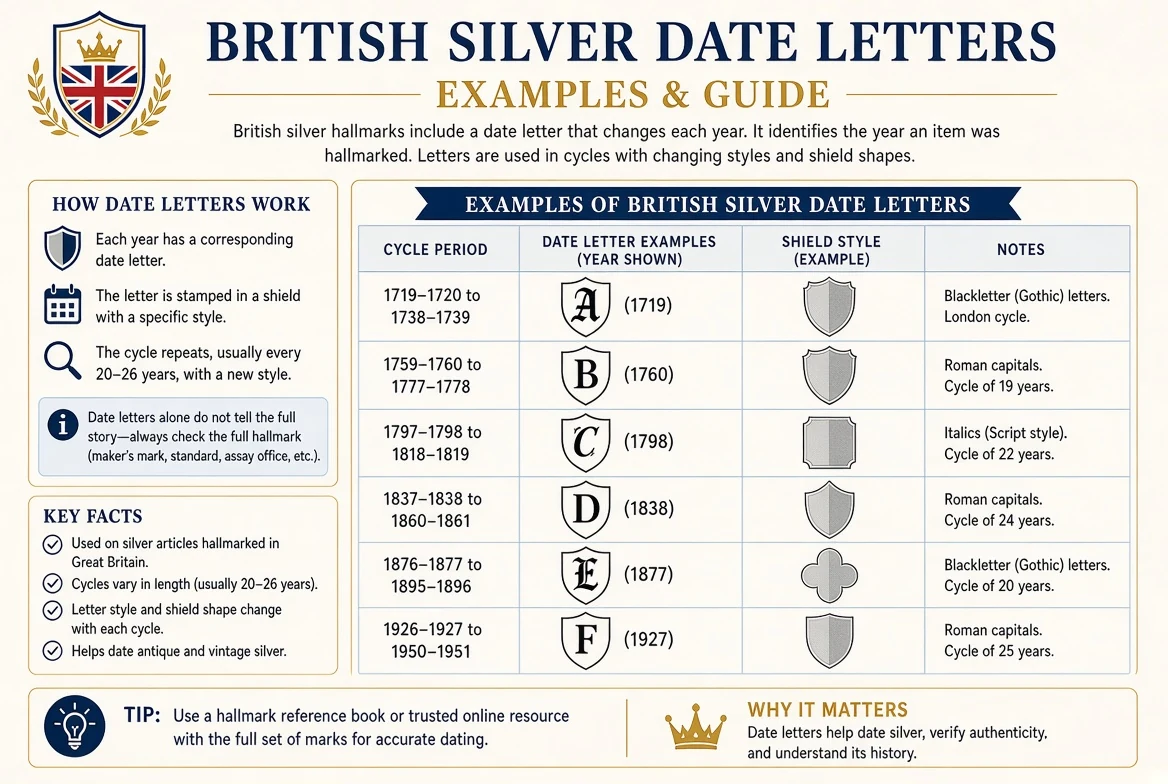
Date letter chart: why one alphabet letter does not equal one year
A British silver date letter can help locate the year of assay, but it must be read within the correct historical cycle. The case of the letter, its typeface and the shape of its surrounding shield or punch can all matter. For example, an A from one alphabet cycle is not interchangeable with an A in a different cycle. Sheffield Assay Office explains that modern date letters change on 1 January and that each new 25-year series uses a new typographic style to distinguish years.
Earlier date-letter changes were not necessarily aligned with calendar January. The official Sheffield account notes that its earlier sequence changed in July in some periods. Since date letters became optional in 1999, their absence on a recent item is not enough to reject it as unhallmarked. For an antique, trace the group of marks in a dated reference chart and compare the shield, case and office. This approach can narrow age without assigning a false specific year to one isolated letter.
Maker’s mark versus sponsor’s mark: a subtle but important distinction
The first initials collectors notice on a silver spoon may be called the maker’s mark, yet UK hallmarking uses the more precise modern term sponsor’s mark. It indicates the party registered to submit the item for hallmarking, not necessarily the designer or physical artisan. Historical makers’ and sponsors’ identities can overlap, but that cannot be assumed from a pair of initials. A registered importer, retailer or company might be responsible for submission rather than handcrafting the silver object.
When a seller claims an item was produced by a famous silversmith, seek a reliable sponsor or maker index for the exact combination of initials, punch shape, office and date. Simple initials such as AB occur across many names and periods. The layout chart in this article helps viewers recognise where the sponsor’s mark sits among other symbols. However, some pieces bear several marks or later repair marks, and the order may differ. The correct identification comes from documented comparisons rather than reading letters in isolation.
Sterling 925, Britannia 958 and other silver purity marks
Silver fineness is normally stated in parts per thousand. 925 sterling silver nominally contains 925 parts of silver in 1,000, while 958 Britannia silver is a higher silver standard in the UK historical tradition. Some silver-looking items are plated base metal, including products described as EPNS (electroplated nickel silver), and should not be treated as solid sterling simply because a decorative mark resembles a lion.
UK hallmark rules apply under specified weight exemptions and other legal provisions. Birmingham Assay Office describes a general hallmarking threshold at 7.78 grams and over for silver articles. Therefore tiny items may not require hallmarking under the same conditions as a large silver teapot. The legal requirement also differs by jurisdiction; an Indian BIS silver HUID is not a replacement for identifying historic British marks. A collector should first determine whether the object is a UK hallmarked item, a foreign import, a plated article or a privately stamped modern design.
How to examine antique British silver without damaging it
Place the silver item on a soft cloth and locate the underside, handle base, rim or other area commonly used for marks. Take one overall photograph, then a close-up showing the full mark group in order. Use side lighting or a loupe; avoid polishing, scratching or acid testing a valuable antique. Note any separate hallmarks on detachable parts, as an antique teapot’s lid may carry different or additional marks from the body.
Record the following evidence together: the likely silver standard, assay office, date letter if present, sponsor’s initials, shape of each punch and general object design. Compare the combination with official assay-office references and specialist catalogues. A genuine-looking mark on an otherwise inconsistent object can still require expert examination. Repairs, replacement parts or counterfeit stamps complicate attribution. Condition, provenance and documented manufacture are separate from the basic meaning of a 925 number.
Are all old British silver hallmarks valuable?
Hallmark interpretation is not an appraisal. A complete set of marks can help date a silver object and identify a sponsor, but resale value also depends on weight, artistry, rarity, maker attribution, condition, provenance and buyer demand. Ordinary well-made sterling utensils can be historically interesting without commanding extraordinary auction premiums. Conversely, unusual makers and documented designs may need specialist assessment. A faded lion or an uncommon date-letter shape is not an automatic guarantee of a valuable rarity.
Online listings sometimes show an asking price but not a completed sale. Treat both sensational figures and unverified claims of royal ownership with caution. If you suspect a rare item, preserve the surface and request professional guidance. Do not accept a valuation from a chatbot or viral image that has seen only one unclear hallmark. An accurate mark identification gives the foundation for valuation, not the valuation itself.
FAQs: lion passant, date letters and UK hallmarks
What are the three compulsory modern UK hallmark marks?
Sponsor’s mark, numeric fineness mark and assay-office mark, on qualifying items.
Is the lion passant mandatory on every UK sterling item?
No. It is a traditional optional silver symbol on modern hallmarks.
What does the anchor hallmark mean?
It identifies the Birmingham Assay Office in the UK hallmark system.
When did UK silver date letters become optional?
They became voluntary in 1999; older date cycles must be checked separately.
Does a maker’s mark prove one named artist made an antique?
No. Sponsor registration, date, office and provenance all require verification.
Conclusion: read the entire hallmark group
Use the assay office, fineness number, sponsor’s mark and—where present—date letter and traditional lion together. A single lion or letter cannot prove a precise year, maker or price. Specialist assay-office references provide the proper comparison for real antiques.
Sources and further reading
Sheffield Assay Office: UK hallmarks and date letters; Birmingham Assay Office: UK legal hallmark elements; Hallmarking Act 1973; Goldsmiths’ Company Assay Office: history.








Share Your Opinion
Comments are closed on this post.