 Vista
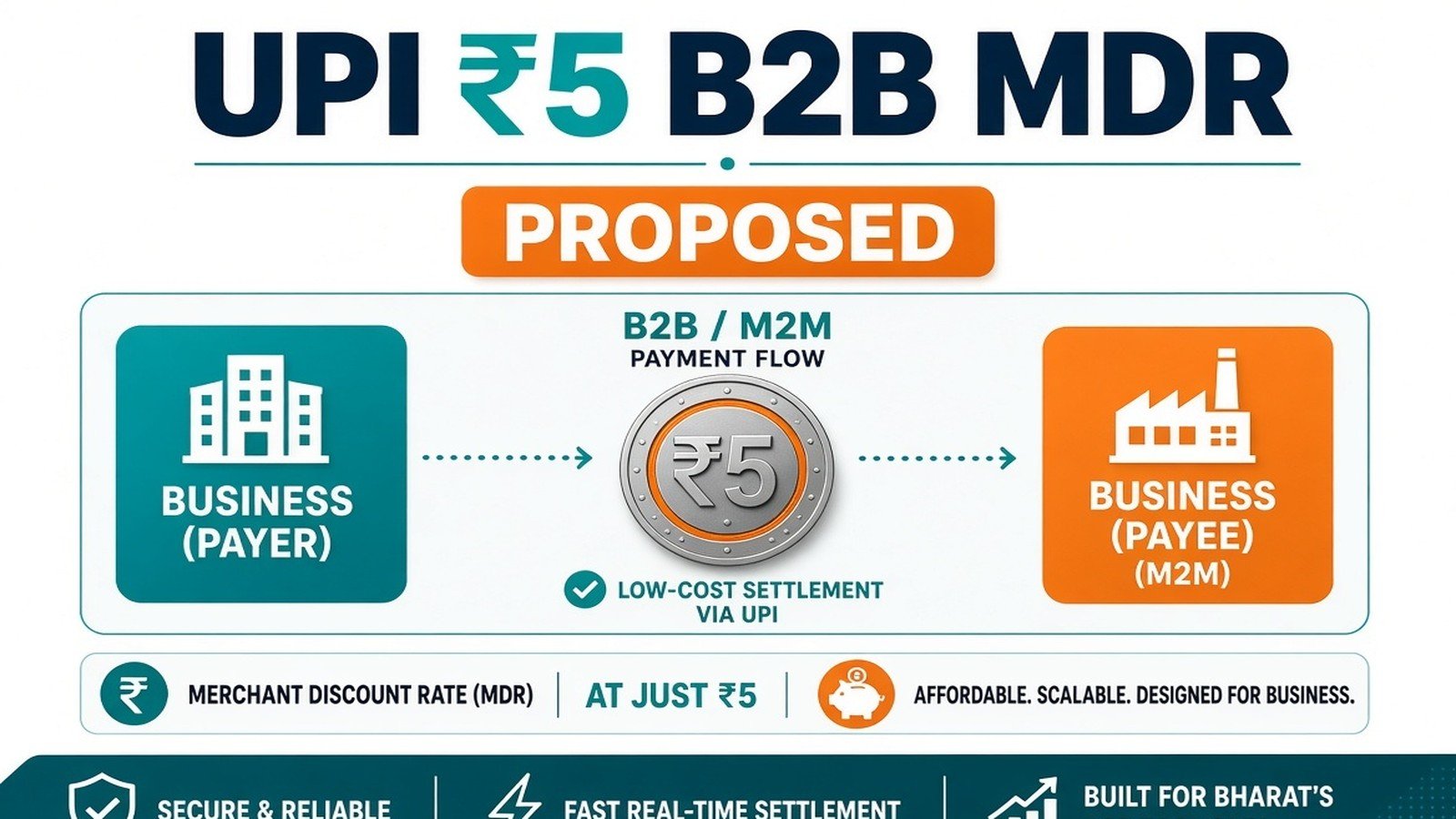
UPI B2B ₹5 MDR, November 2026: recent reporting points to a proposed flat ₹5 fee for merchant-to-merchant transactions, but no official implementation date has been confirmed. Ordinary person-to-person UPI remains free. Here is what traders should know about the M2M proposal, the delayed 0.4% P2M framework, and the difference between a proposal and a live charge.
Status: Reported proposal / implementation date unconfirmed. Distinguish the September announced P2M framework from November reporting about M2M fees.

Checked and updated: 22 November 2026
UPI B2B ₹5 MDR: is the merchant-to-merchant charge live?
No officially confirmed implementation date for a general flat ₹5 B2B UPI MDR was available as of 22 November 2026. Reports published on 19 November, citing people familiar with deliberations, said that the National Payments Corporation of India (NPCI) UPI and Services Steering Committee had favoured a fixed ₹5 Merchant Discount Rate for merchant-to-merchant payments. However, reporting also made clear that the new framework’s rollout date had not been finalised.
That distinction matters. A newspaper’s report about a committee decision does not by itself mean every wholesaler is already paying ₹5 on an ordinary UPI transfer. It also does not mean individuals need to pay ₹5 for scanning a neighbourhood QR code. The proposed business-specific fee must be distinguished from both free person-to-person payments and the already-announced—but delayed—merchant MDR framework.
On 20 November, Business Today described the ₹5 M2M charge as a possibility still being discussed as businesses objected to paying MDR at multiple points in the supply chain. Until the final NPCI or official implementation circular defines merchant types, charging conditions and effective date, traders should not assume the ₹5 fee is universally in force.
What are B2B, M2M, P2M, P2P and P2PM UPI payments?
P2P means person-to-person. A bank-account transfer between two people, for example sending money to family, is a classic case. The Ministry of Finance’s September 2026 clarification states that ordinary P2P UPI transfers remain free for customers, regardless of payment amount within the relevant transaction limits.
P2M means a person paying a registered merchant, such as a shopper paying at a supermarket. P2PM denotes a special small-merchant payment category described in NPCI’s September framework; qualifying small merchants, including many street vendors within prescribed limits, are protected by zero MDR. A QR code by itself does not tell the user all onboarding and category details.
M2M or B2B is a business paying another business: a retail shop pays a distributor, a wholesaler settles with a manufacturer, or a B2B platform collects from merchants. Reporting on the proposed ₹5 charge focuses on those commercial transfers. The distinction is based on the transaction’s merchant classification and payment system rules, not simply whether the payer happens to own a shop.
What NPCI and the government announced in September 2026
On 15 September 2026, the Ministry of Finance published a clarification about a revised UPI MDR framework. It said normal P2P transfers and payments of up to ₹2,000 to merchants would remain outside the new fees. It also described zero MDR for eligible small P2PM merchants, including small vendors receiving up to ₹1 lakh per month through relevant QR onboarding.
For specified P2M payments above ₹2,000, the announced rate was 0.4% with a ₹300 ceiling. For selected essential or thin-margin merchant sectors—such as railways, telecom, insurance, fuel and agricultural inputs—the announced structure included a flat ₹5 rate on transactions above ₹2,000. Capital-market payments had a separate 0.02% rate capped at ₹300.
The original plan pointed to an October 15 rollout, but later reporting from multiple outlets said NPCI postponed that implementation and had not announced a replacement date by 22 November. Therefore the official September framework describes proposed categories and protections, not evidence that every scheduled fee has already gone live on every payment service.
₹5 flat charge for B2B is different from the ₹5 essential-sector MDR
Two different ₹5 discussions have become entangled on social media. The first is the flat ₹5 MDR for select railways, telecom, insurance, fuel and similar merchants on qualifying P2M payments above ₹2,000, documented in the September government and NPCI FAQs. The second is the potential new flat ₹5 rate for general M2M/B2B transfers between wholesalers, retailers, distributors and marketplaces, reported on 19 November.
The first has a published policy explanation identifying specified sectors and a qualifying payment threshold. The second has been discussed in news reporting based on sources familiar with a committee decision, while the public implementation conditions remain unconfirmed. Do not take the first document and claim it is the formal final notification for the second.
A merchant seeking certainty should identify whether a payment is a consumer-to-merchant sale, a designated sector purchase or a merchant-to-merchant supply-chain settlement. The classification can change which rule might become relevant. Likewise, a transaction in a selected category does not automatically mean the same MDR is charged in another business category.
Why traders worried about 0.4% and a ₹300 maximum
Imagine a wholesaler receiving a qualifying UPI payment of ₹50,000 from a retailer. Under the earlier percentage model, 0.4% of ₹50,000 would equal ₹200. At ₹75,000 or more, the announced standard merchant ceiling limits that percentage-based example to ₹300. A business processing many such receipts could find the fees significant if its margins are low.
The reported flat ₹5 M2M idea would make the rate independent of transaction size in qualifying B2B cases. A hypothetical ₹20,000 supplier settlement would then cost ₹5 rather than the ₹80 that 0.4% would produce; a ₹75,000 qualifying settlement would be ₹5 instead of ₹300. These are illustrative comparisons of two frameworks, not a statement of fees currently collected.
However, a fixed ₹5 charge may not always be cheaper on small business transfers. On a hypothetical ₹1,000 settlement, a straight 0.4% calculation is ₹4, lower than ₹5—but the September P2M framework also has a ₹2,000 threshold, so simply using percentages without checking classification is misleading. This is one reason businesses want the final effective rules and any exemption threshold stated explicitly.
Would ordinary UPI users pay ₹5 for payments to shops?
The government clarification says MDR is a charge within the merchant payment ecosystem, not a separate fee charged to individuals who pay through UPI. It prohibits payment apps from adding hidden platform fees to ordinary UPI payments under the described framework and says onboarded merchants cannot directly pass the MDR on to shoppers as an extra UPI charge.
The September statement also says small merchant payments and P2P payments remain outside the new MDR. Consequently, a friend sending ₹10,000 to another friend does not become subject to the reported ₹5 M2M proposal simply because the transfer is above ₹2,000. Likewise, scanning a normal vegetable vendor’s QR code does not automatically make the vendor a large B2B merchant.
Beware headlines claiming ‘UPI is no longer free for everyone’ or that a ₹5 fee is automatically deducted from each customer’s bank account. An ordinary customer should check the official charge description and their bank statement rather than treating viral screenshots as a new mandate.
When could the B2B UPI MDR begin?
The original P2M MDR implementation was expected on 15 October 2026, according to the September announcement, but later deferred. Business reporting around 19–20 November said the implementation timetable remained unsettled and may be delayed further because of opposition from trade organisations. There was no official revised rollout date confirmed in the material verified for this update.
The reported M2M flat-rate idea would require clear operational conditions before businesses can plan: which merchant IDs qualify, what constitutes a B2B payment, whether there is a minimum value, how the transaction charge is collected and how credits or failed transactions are handled. Those details should not be invented from an early committee discussion.
The reliable answer to ‘B2B UPI ₹5 MDR start date’ is therefore that businesses must wait for a final public NPCI, bank or appropriate authority implementation notice. If a bank or PSP displays a new charge, ask for the specific effective rule and category applicable to your transactions.
GST on ₹5 MDR and requests for an exemption
The All India Consumer Products Distributors Federation (AICPDF) wrote to the Finance Minister in November seeking an exemption for merchant-to-merchant UPI transactions, according to reporting that reviewed the letter. Distributors argue that charging a fee when retailers buy stock from wholesalers, again when wholesalers pay suppliers, and elsewhere in the chain could add repeated settlement costs.
The federation also requested clarification of any Goods and Services Tax treatment of MDR. NPCI and RBI are involved in payment rules, but a GST rate or exemption belongs to the appropriate tax-law authorities and GST Council process. A statement that ‘₹5 plus 18% GST is confirmed for every B2B UPI payment’ would go beyond the public facts verified here.
Retailers should also separate GST on the underlying goods or services from any future tax treatment of payment-processing charges. The amount of GST in the commercial invoice is not the same as the fee charged by a payment intermediary. Follow official GST circulars and invoices before adding a separate surcharge to a customer bill.
How the proposed MDR could affect distributors and small retailers
Consider a retailer that settles with five distributors every day. If every qualifying B2B transfer ultimately carried a ₹5 flat fee, that would amount to ₹25 a day for the five settlements, or ₹750 across thirty days. Whether this is small or meaningful depends on margins, transaction count and who the payment service bills. The figure is a hypothetical budget example, not a forecast of guaranteed charges.
Under a variable 0.4% charge, the same retailer could incur very different costs depending on transfer values. Fixed fees are easier to model for large invoices, but they can discourage splitting small settlements into many payments. At the same time, cash collection costs, reconciliations, failed transfers and security risks can also have economic value.
Trade associations want to avoid payment charges cascading across the manufacturer–distributor–retailer chain. The payments industry argues that revenue helps sustain processing networks and fraud protection. The policy balance is still being debated, so the practical task for businesses is to watch final rules and accurately log payment types—not to stop accepting secure digital payments based on unverified rumours.
Practical checklist for businesses preparing for UPI MDR changes
First, export a month of UPI receipts and tag them as individual customer purchases, merchant-to-merchant supplier payments, and other categories. Second, identify which accounts and QR codes are registered as merchants or small P2PM merchants. Third, reconcile high-value receipts against invoices to spot genuinely B2B payments rather than classifying every large transfer as commercial.
Fourth, ask your acquiring bank or payment service provider whether any MDR has actually been activated, on which transactions and from what date. Fifth, read the latest NPCI circular or official government statement; a 19 November media report is useful for tracking proposals, not a substitute for an effective rule. Sixth, if new charges begin, verify merchant statements, invoice reconciliation and relevant tax advice.
Finally, tell staff and customers that the reported ₹5 M2M proposal is not a mandatory user fee. Do not add surprise checkout ‘UPI charges’ based on speculative posts. Keep safe payment alternatives available, avoid unauthorised surcharges and maintain clear records for genuine business expenses.
What to search next: future keywords and verification signals
Searches such as ‘UPI B2B 5 rupees MDR effective date’, ‘NPCI M2M official circular PDF’, ‘₹5 UPI wholesaler payment charges’, ‘MDR GST exemption distributor’, and ‘P2M vs M2M UPI difference’ reflect different questions. They should not be answered with one blanket yes/no. The first two require a dated implementation notice, while the last can be explained from existing categories.
Also watch for ‘₹5 MDR charged by which bank’, ‘UPI ₹2000 limit charges’, ‘is personal UPI free November 2026’ and ‘does merchant pass MDR to customers’. Some may become relevant when actual operational rules are published; they are anticipated search intents, not verified Google Trends volumes.
Whenever a new claim spreads, check the date, the affected transaction type, payer, merchant classification, rate, cap, exclusions and regulator or network circular number. These checks are more useful to a business than copying a sensational statement that all UPI payments are now paid.
UPI B2B ₹5 MDR: FAQs
Has NPCI started charging ₹5 on all B2B UPI transfers?
No official general M2M implementation date was confirmed as of 22 November 2026. The ₹5 rate is a reported proposal; check the final circular.
Will ordinary UPI users pay ₹5?
The September government clarification protects ordinary P2P transfers and says MDR is not a customer-level fee.
Is the ₹5 rule only for transactions above ₹2,000?
The official September selected-sector P2M flat ₹5 rule includes a ₹2,000 threshold. The reported general M2M proposal had no published final threshold verified here.
What is the difference between M2M and P2M?
M2M is merchant paying merchant, such as retailer to wholesaler; P2M is a consumer buying from a merchant.
What was the earlier UPI MDR rate?
The September framework outlined 0.4% for specified P2M transactions above ₹2,000, with a ₹300 cap, plus category exemptions.
Is GST on the new flat ₹5 charge final?
The distributors’ group asked for GST clarification. Do not assume a specific new GST treatment without applicable official guidance.
Conclusion and verification sources
The key missing detail in the reported M2M ₹5 framework is a final implementation notice. Until then, do not present it as a live blanket charge or confuse it with ordinary free P2P transfers.
- Ministry of Finance PIB: UPI P2P remains free (15 September 2026)
- NPCI official FAQs on select UPI merchant MDR
- Business Standard: M2M ₹5 proposal, 19 November 2026
- Business Today: B2B rollout still under discussion, 20 November 2026
- NDTV Profit: distributors seek exemption, 19 November 2026
Disclaimer: Policy and financial information, not individual tax or merchant acquiring advice. Confirm charges against applicable official circulars and your provider’s terms.


















Share Your Opinion
Comments are closed on this post.