 Vista
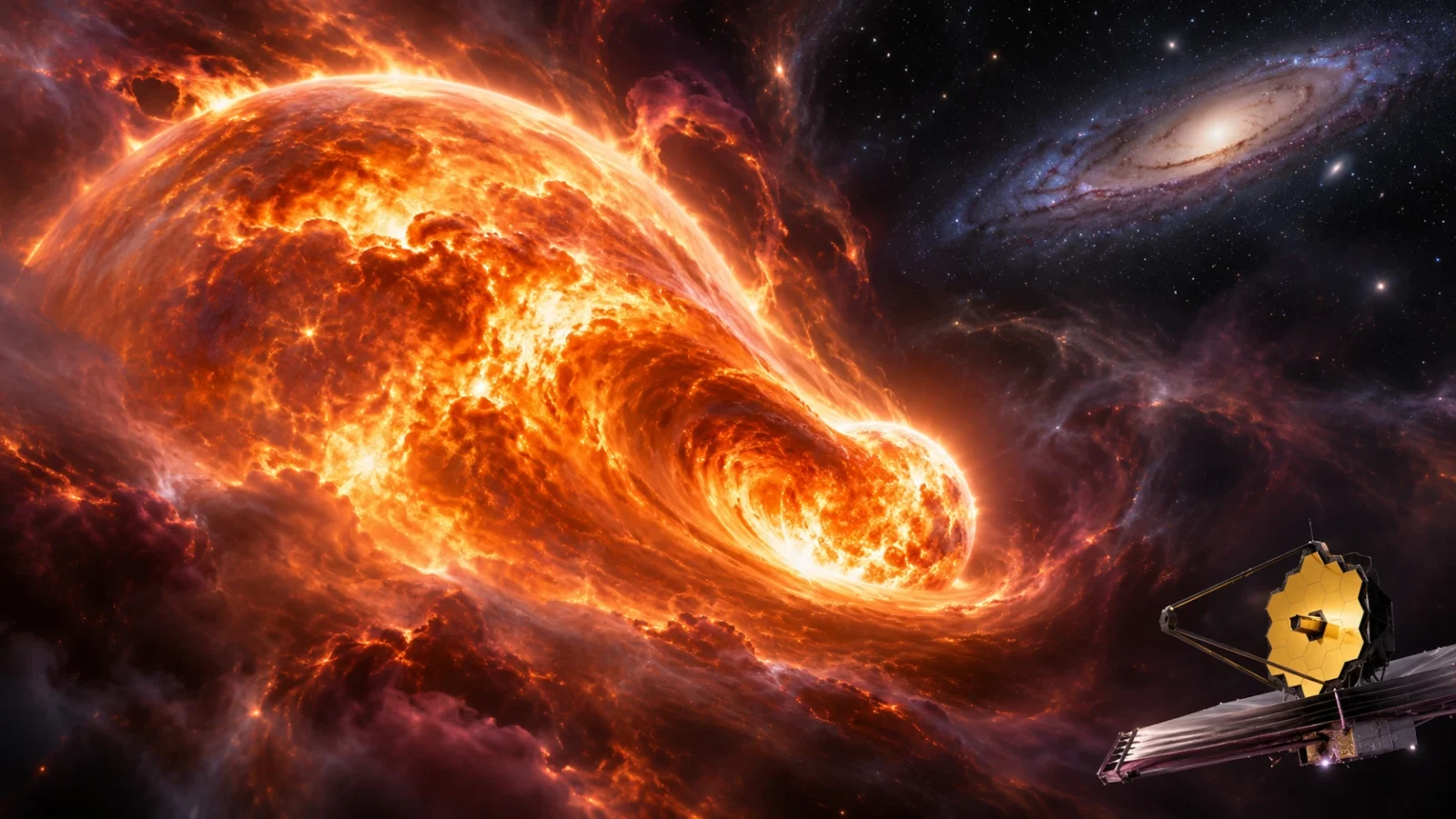
NASA’s 18 November 2026 announcement explains how scientists reconstructed an unusual stellar merger in the Andromeda galaxy using the James Webb Space Telescope (JWST), SPHEREx, NEOWISE, and ground-based observatories. The event, formally AT 2025abao and nicknamed Bao, involved a huge supergiant star swallowing a much smaller companion. Webb did not photograph two stars visibly crashing into each other: its infrared observations on 24 December 2025 provided critical evidence about dust and the aftermath, 47 days after the eruption’s peak. The four-part fiery depiction shared alongside the news is an artist’s illustration, not a direct Webb image.
Updated: 23 November 2026 | NASA release: 18 November 2026 | Webb observation: 24 December 2025
What did NASA actually discover about Bao?
In November 2026 NASA described an analysis that could piece together an uncommon and difficult-to-catch moment of stellar evolution. Astronomers had noticed unusual behaviour in this object years before a 2025 eruption. By combining a long observational timeline with models, they identified a small star spiralling into the bloated envelope of a massive primary star and ultimately merging with it. The nickname Bao refers to the new single stellar object left behind. It does not describe a giant cosmic explosion newly seen in the sky on 18 November 2026. The research release date and the actual physical event are different. Andromeda, also catalogued as Messier 31 or M31, is our neighbouring large galaxy, not part of Earth’s solar system. A useful explanation must separate the evidence captured by different telescopes from the dramatic artwork used to communicate the science.
Bao star merger timeline: 2023, 2024, 2025 and 2026
The research team identified unusual behaviour by examining NEOWISE data in February 2023; before 2018 the star had shown a more consistent brightness. In September 2024, a telescope called WINTER picked up changes, including brightening and signs of dust production. NASA’s SPHEREx mission registered an intriguing combination of fading visible light and increasing infrared light in July 2025. Zwicky Transient Facility detected the eruption on 17 October 2025, then additional observatories—including Swift and Gemini North—followed the object in November. Webb observed Bao on 24 December 2025 through a rapid programme. The research findings were reported publicly on 18 November 2026. These dates matter because a headline reading ‘JWST sees star collision today’ would incorrectly place the merger in November 2026.
How did the smaller star get swallowed?
Scientists describe the process as common-envelope evolution. In an ordinary binary, two stars orbit a common centre. As one of them grows into a large, diffuse giant, its expanded outer envelope can envelop its companion. The smaller star then travels through gas instead of empty space and experiences drag. Orbital energy is transferred into the envelope, changing the orbit and potentially expelling dusty material. The companion may continue spiralling inward rather than staying in a stable orbit. Some common-envelope systems eject the material and survive as two closer objects, but the evidence for Bao supports a merger. The outer layers can be disturbed and shed into the surroundings while the smaller companion ultimately enters the larger star’s interior. This is not the same process as two solid objects physically smashing together at a single visible instant.
Big Bao versus Little Bao: stellar sizes and masses
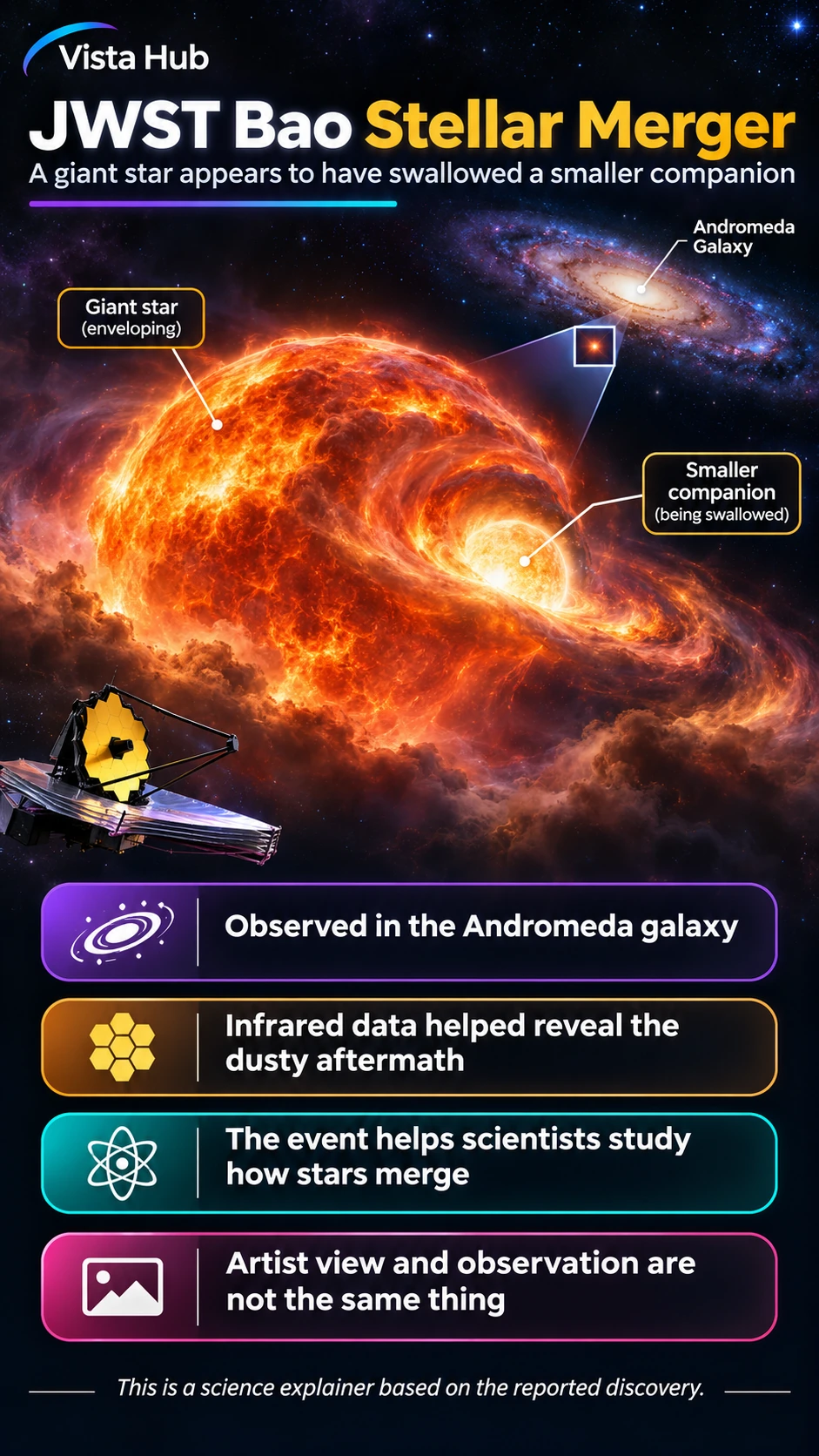
NASA’s model estimates that the larger star before eruption had roughly seven times the mass of our Sun, about 350 times its radius and around 18,000 times its brightness. These are model-derived physical estimates, not quantities directly measured with a measuring tape. The smaller companion is estimated at about 0.7 solar masses, slightly less massive than the Sun. The contrast explains why the large primary overwhelmingly dominated earlier observations. For scale, a star’s radius tells us its size, while mass measures the amount of matter and luminosity refers to emitted energy. A star with hundreds of solar radii does not necessarily have hundreds of times the mass. The larger star’s diffuse outer atmosphere made it possible for its companion to move through a shared envelope.
How Webb confirmed the merger after its peak
The James Webb Space Telescope is unusually sensitive to infrared light. In this investigation, its mid-infrared measurements helped scientists identify dust shed over a long period and constrained models of how the envelope was expelled. Webb’s December 2025 observations were taken after the eruption reached peak brightness, making them a follow-up rather than a real-time image of the first contact between two stars. The researchers combined these data with ultraviolet, visible and near-infrared observations from other telescopes. The result was a more complete reconstruction of the periods before, during and after the event than would be possible from a single snapshot. NASA describes the 47-day follow-up as unusually early for a stellar merger. That early evidence allowed the team to test models while the system’s dust and emissions were still evolving.
Is the viral Bao star merger photo real or an artist’s concept?
NASA makes two different visual resources available. One official composite shows Andromeda and small images of the source across different instruments and phases: NEOWISE, SPHEREx and Webb. These observational pictures depict a distant point-like source and its changing infrared appearance, not two recognisable suns in a fiery embrace. Another official four-panel image visualises the quiet stage, a dusty precursor, the eruption and the later expansion of expelled material. NASA labels this second set ‘Artist’s Concept.’ Our featured OG and informational poster are also educational illustrations, not telescope photographs. This difference should be shown plainly in captions and ALT text. Readers looking for ‘Bao stellar merger real image’ should know what actual data can reveal at the enormous distance to Andromeda.
Is Bao a supernova, a black hole or a new planet?
None of those descriptions accurately captures the reported event. A supernova commonly involves a different catastrophic stellar process, while this study interprets Bao as a merger of two stars following common-envelope evolution. A black hole is not claimed as the direct observed product, and no planet is being discovered. Some other compact-star binary systems can lead to dramatic outcomes such as gravitational waves, neutron-star combinations or later explosions, but those possibilities provide background context rather than evidence of what happened in Bao. NASA describes the remaining object as possibly rejuvenated, a tentative term because additional observations are needed to learn its final characteristics. ‘The star swallowed a companion’ is a compact popular-science explanation, not a sign that something dangerous has approached Earth.
Why this finding matters to gravitational-wave astronomy
Common-envelope evolution is a challenging stage in stellar-evolution calculations because gas dynamics, energy transfer and mass loss interact in complicated ways. In many systems astronomers only observe the end state and must infer what occurred long ago. Bao offered an unusually detailed observation trail and a model fitting the infrared dust signature, creating a way to test how effectively orbital energy ejects material. A different binary system might survive as two closer stars, later evolving into compact objects that produce gravitational waves when they interact. Bao itself is not reported as a gravitational-wave detection. Its broader value is helping researchers understand a process that influences which stellar pairs remain bound, merge, or eventually form extreme objects. More surveys could uncover similar cases.
How to find original images and avoid misleading claims
The NASA Science story links an ‘AT 2025abao in the Andromeda Galaxy’ observing montage and a separately labelled ‘Andromeda Star Merger (Artist’s Concept).’ Compare both before reposting a dramatic thumbnail. A realistic depiction can make the story accessible, but it must not be described as a Webb photograph if NASA labels it an illustration. For a classroom explanation, use the official source to show a timeline with the instrument and date next to each observation. Avoid claims that scientists watched the crash in a live high-resolution video; the finding involves detecting changes in light and reconstructing them with models. Readers who want the technical research should follow the Nature study linked from NASA and check any future observing announcements.
Frequently asked questions
What is Bao or AT 2025abao?
A stellar merger in the Andromeda galaxy reconstructed from data gathered by multiple telescopes.
When did Webb observe Bao?
24 December 2025, 47 days after the eruption’s peak, according to NASA.
Was the merger discovered on 18 November 2026?
That was the NASA public research announcement, not the date the stars first merged.
How big was the larger star?
Models estimate about seven solar masses, 350 solar radii and 18,000 solar luminosities.
Are photos of two colliding bright stars actual JWST images?
No. NASA’s dramatic multi-stage collision imagery is an artist’s concept; observations show a distant point-like source.
Did the event create a black hole or threaten Earth?
NASA does not present either claim as a result of this study.
Conclusion
The scientific breakthrough is the reconstruction from a multi-year observation trail, not a close-up camera movie of two stars colliding. Read observational images and illustrations with the correct labels.
Official sources
- NASA Science: Bao stellar merger research, November 2026
- NASA observational montage: AT 2025abao
- NASA: Four-stage artist’s concept
Stellar parameters are scientific estimates subject to future research.

















Share Your Opinion
Comments are closed on this post.