 Vista

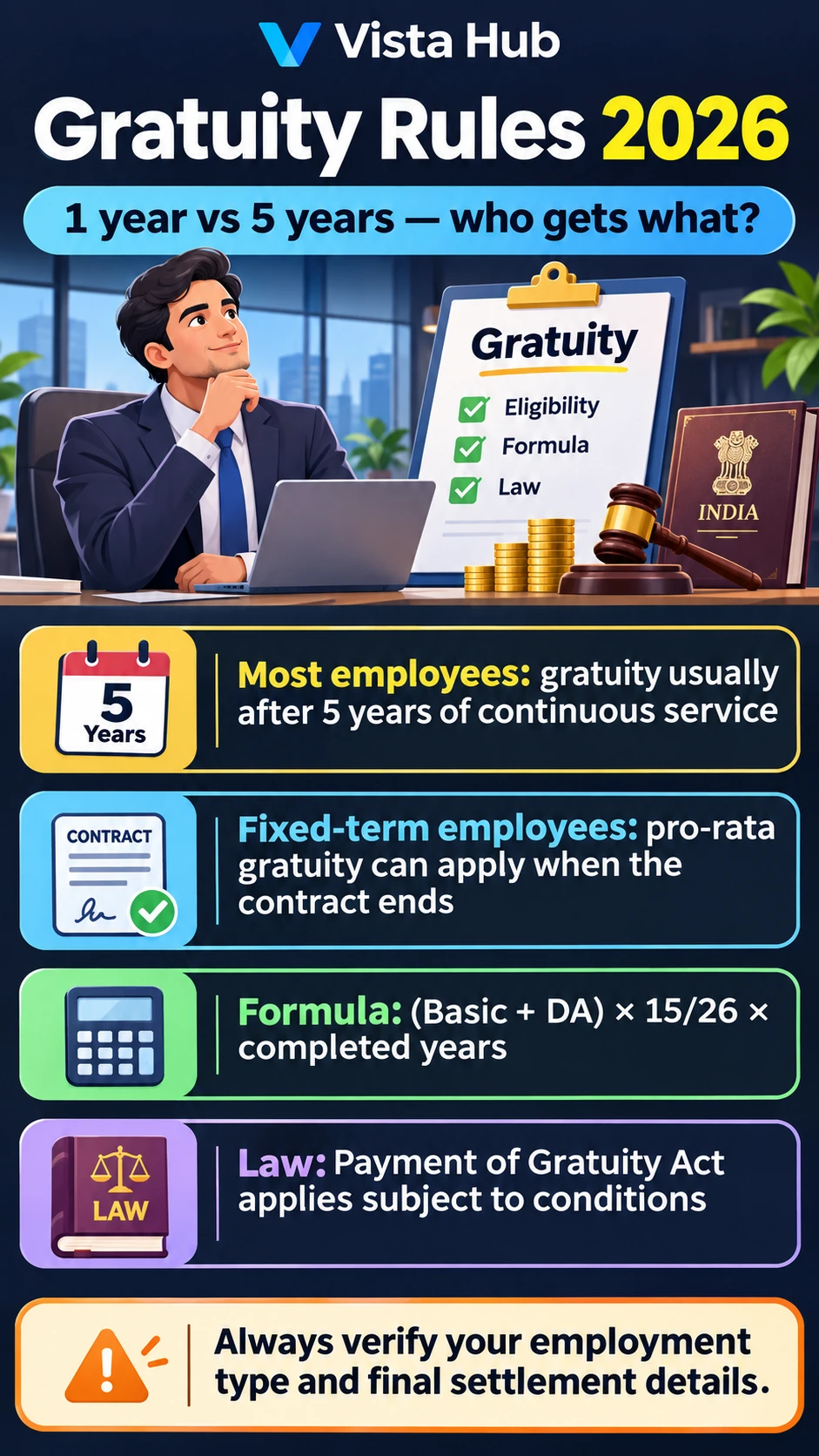
Does everyone in India qualify for gratuity after only one year of employment in 2026? No. Under the labour-code framework, the government explains that eligible fixed-term employees can receive proportionate gratuity on completing one year of continuous service. Regular employees generally remain subject to the ordinary five-year service condition, with important exceptions. The four labour codes were made effective on 21 November 2025, so the present debate is about applying an existing reform, not a new rule announced today.
Updated: 23 November 2026 | Labour Codes effective: 21 November 2025
What actually changed in India’s gratuity rules?
Gratuity is a statutory benefit connected with the end of qualifying employment. It is not the same as provident fund savings, annual performance bonus, unpaid wages or leave encashment. Several items may appear together in a full-and-final settlement, but each has a different calculation and legal foundation. The Code on Social Security, 2020 brought social-security provisions together, and Section 53 is central to the discussion of fixed-term employees. The important change is the reduced service requirement for a particular qualifying category. It does not erase every other condition and does not automatically turn every contractor into a fixed-term employee. Readers should first distinguish statutory eligibility from online headlines.
One year or five years: which worker qualifies?
A genuine fixed-term employee engaged for a defined period under an applicable employment arrangement may qualify for proportionate gratuity after one year of continuous service. A freelancer, platform worker or person assigned through a third-party manpower company is not necessarily in that category simply because the engagement has an end date. Regular and permanent employees generally look to the five-year continuous-service benchmark for ordinary qualifying separation. Death and disablement deserve separate consideration because the statutory framework contains exceptions to the normal service period. Confirm the actual legal employer, appointment letters, renewals and exit circumstances before telling someone their entitlement has been accepted or rejected.
Gratuity formula and a worked salary example
A commonly used estimate for monthly-rated employees is qualifying last-drawn wages multiplied by 15 divided by 26 and then by the number of service years counted under applicable rules. This is not a formula based automatically on CTC or take-home salary. Take an illustrative qualifying wage of ₹30,000 and six counted years. The familiar calculation ₹30,000 × 15 ÷ 26 × 6 yields approximately ₹1,03,846, subject to the statutory ceiling and relevant provisions. A different wage base or service period changes that estimate. Fixed-term service eligible for proportionate payment requires its own careful calculation; blindly entering a single year for every temporary worker is not a legally reliable method.
Basic pay, DA and the wage-definition question
Payslips commonly include basic pay, dearness allowance, house-rent allowance, special allowance, incentives and provident-fund deductions. The statutory definition of wages is not identical to either gross CTC or in-hand salary. Government material on the Code includes basic pay, DA and retaining allowance where relevant. It also describes an add-back rule where certain excluded payments exceed half of total remuneration. That is why an online chart saying that only basic salary can ever matter may be incomplete. Ask payroll which exact wage figure it used and why. A yearly gratuity provision appearing inside your compensation package is an employer-side accounting item, not by itself proof of immediate entitlement on resignation.
Resignation, expiry of a fixed-term contract and exceptions
When a regular employee resigns, continuous service and the ordinary threshold are significant. When an eligible fixed-term appointment runs its agreed course after the qualifying period, proportionate entitlement needs examination under the relevant rule. A dismissal with an allegation of misconduct raises a separate question about legally permitted forfeiture and cannot be treated as an automatic cancellation of gratuity. Death and disablement can bring exceptions to the typical threshold; families and nominees may need documentary support. Complex employment histories involving transfer, restructuring, contract renewal or an agency can require examination beyond the latest joining date. Preserve old letters and correspondence instead of relying only on a recent payslip.
Seven documents and checks for an accurate claim
Record your original joining date, last working day and significant interruptions in service. Identify whether you are regular, fixed-term, agency-employed or a consultant. Save appointment letters, renewals and transfer orders. Check payslips for qualifying wage components and retain full-and-final correspondence. Ask HR for an itemised gratuity calculation showing the category considered, counted years, statutory wage figure and any ceiling. Compare that working with official material rather than a viral calculator screenshot. If HR refuses a one-year claim, specifically ask whether the fixed-term provision was considered. Do not give personal banking information to unofficial social-media claim handlers or pay a stranger a processing fee.
Common myths about gratuity in 2026
Myth one: every person employed for twelve months receives gratuity. Reality: the one-year change is targeted at eligible fixed-term employment. Myth two: every short project contract is a fixed-term employment contract. Reality: the employment relationship and responsible employer must be established. Myth three: gratuity equals a year’s basic salary or the number printed next to gratuity in CTC. Reality: statute-based wage and service calculations control the amount. Myth four: private employers never pay gratuity. Reality: covered private establishments are within the statutory framework. Myth five: a single online number decides every disputed entitlement. Reality: separation reasons, exceptions and evidence can change the assessment.
What if the employer does not pay gratuity?
Begin with a written request to HR stating the employment category, joining and exit dates, and the basis of your understanding. Ask the company to provide a reasoned calculation, not merely an oral denial. Identify whether the disagreement concerns continuous service, fixed-term classification, wage components or alleged forfeiture; different issues need different evidence. Keep copies of all replies and original employment records. If the problem cannot be resolved internally, seek the appropriate labour authority or qualified legal advice. Do not assume an employer is dishonest only because its first estimate differs from yours, but equally do not accept an unsupported statement that all one-year claims are impossible. The correct answer depends on the law and facts together.
Checking the employment letter before trusting a gratuity calculator
Two workers can sit at adjacent desks and still have different statutory entitlements because one is directly engaged on a qualifying fixed-term arrangement while the other is hired by a separate service provider. Read the actual employer name, the contract duration, extension letters and the reason the appointment is ending. Keep a copy of the wage statement used for the estimate. If payroll and the employee disagree, request a line-by-line written explanation rather than applying an online formula to gross CTC. This practical check is more important than a viral comparison showing ‘1 year’ on one side and ‘5 years’ on the other without describing who qualifies.
FAQs — Gratuity Rules 2026
Do all employees get gratuity after one year?
No. The one-year provision is for eligible fixed-term employees, not every worker.
When did the labour-code change take effect?
The four labour codes were made effective on 21 November 2025.
What is the usual regular-employee service requirement?
Generally five years of continuous service, subject to statutory exceptions.
What is a basic gratuity estimate?
Qualifying wages × 15/26 × counted service years, subject to actual law and limits.
Is every contractor a fixed-term employee?
No. The employer and applicable employment contract determine the category.
Can gratuity be claimed from a CTC line item alone?
No. Actual statutory eligibility and the payable calculation must be checked.
Final takeaway
The crucial distinction is your employment category. Verify the appointment type, wage base and counted service before relying on a headline or calculator.
Related: Termination compensation and gratuity
Official sources
- PIB: Code on Social Security, 2020; fixed-term gratuity
- PIB: Four Labour Codes effective 21 November 2025
General information, not legal advice for any individual.






















Share Your Opinion
Comments are closed on this post.