 Vista
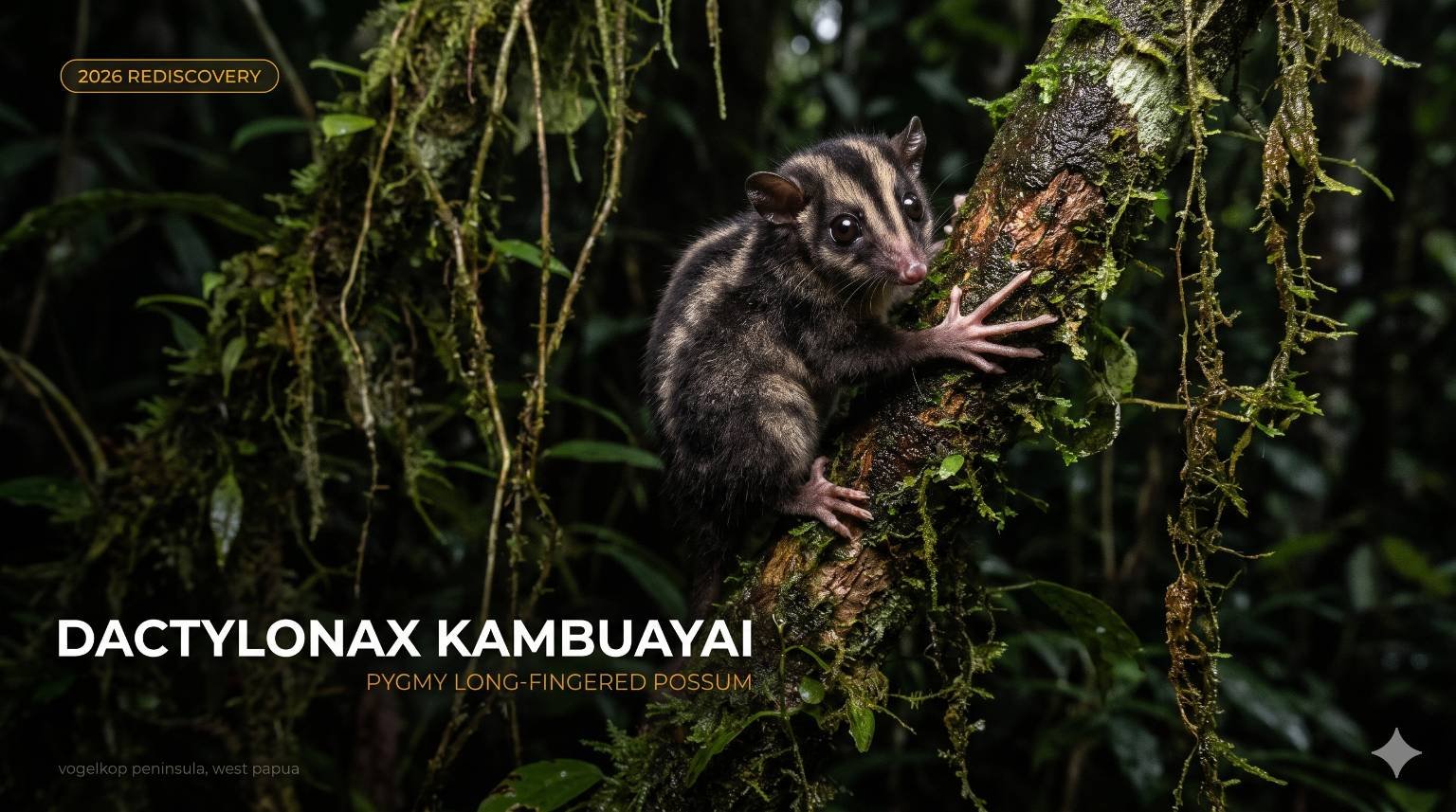
Dactylonax kambuayai, the pygmy long-fingered possum, is a striped rainforest marsupial confirmed alive in modern records described in March 2026. It was previously documented chiefly from older fossils and has an unusually long fourth finger. Here are the rediscovery facts, pictures, anatomy and the real meaning of the “found alive after 6,000 years” headline.
What is Dactylonax kambuayai?
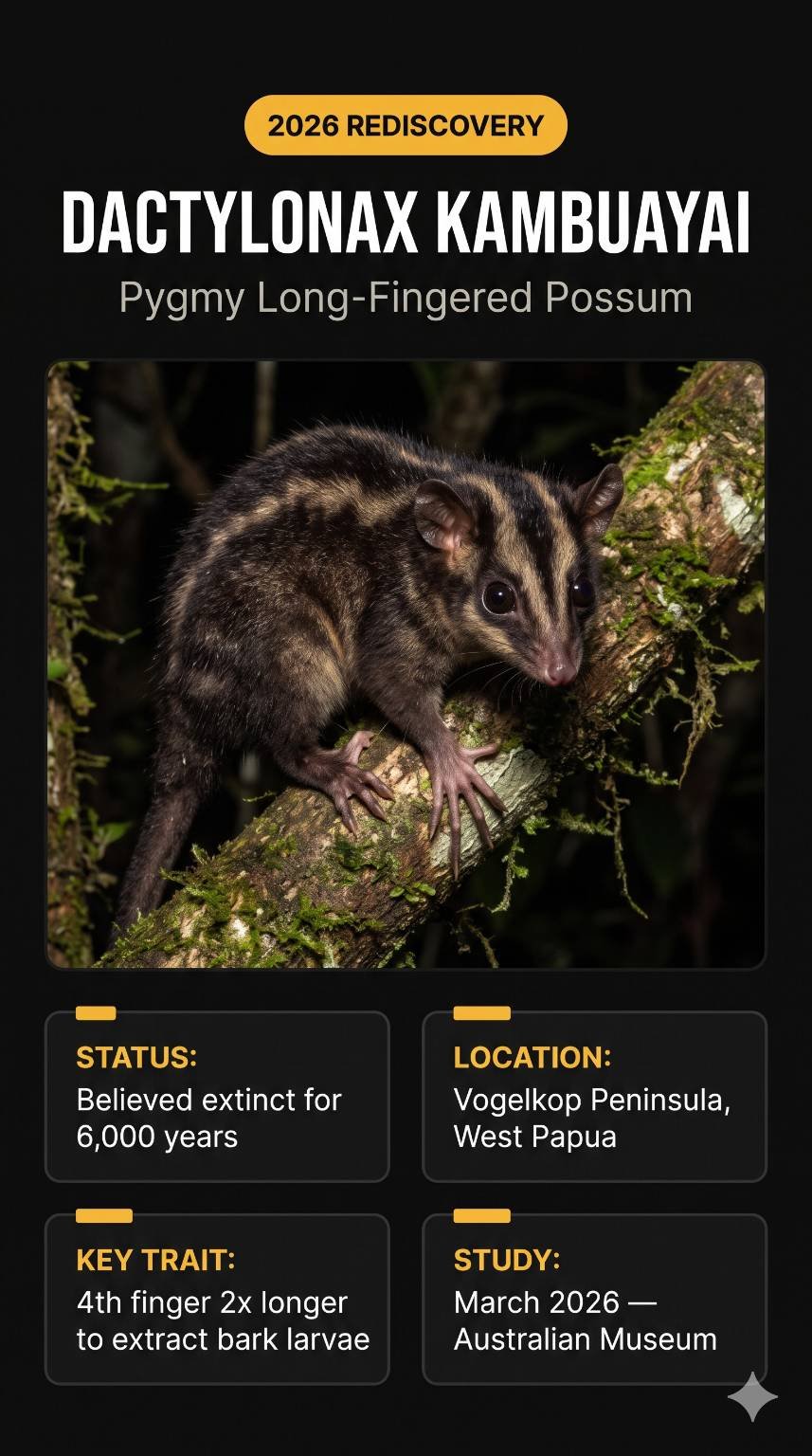
Dactylonax kambuayai is a very small, boldly striped marsupial from the rainforests of western New Guinea, within Indonesian territory. Its common English name is the pygmy long-fingered possum. The animal belongs to a distinctive group of striped possums with specialised hands and ecological adaptations. In March 2026 scientists published modern evidence of a living species that had previously been documented mainly from fossil material. That is why headlines called it an animal found alive after thousands of years. The accurate interpretation is not that the species physically came back from extinction. Rather, zoologists finally linked living observations and museum material to a taxon that had remained effectively hidden in the modern scientific record. This is one of the most interesting examples of how a species can be familiar in a region yet scientifically overlooked under a different name or classification.
Where was the pygmy long-fingered possum found?
The species is associated with the Vogelkop, also called Bird’s Head, Peninsula in the western part of New Guinea. Importantly, this is in Indonesian Papua; it should not be casually reported as a discovery in the independent country of Papua New Guinea. The landscape includes tropical rainforests across low- and middle-elevation sites. The scientific article describes localities connected to an old Holocene fossil deposit and to modern records in the peninsula. These remote forests have a complicated geological and biogeographical history, with different plants and mammals across elevation zones. The fact that researchers uncovered modern records does not establish that the species is widespread or abundant. A few observations are valuable evidence of survival, but they are not a population census. When looking at Dactylonax kambuayai pictures, habitat and locality documentation help distinguish useful research records from generic forest mammal imagery.
What does ‘rediscovered after 6,000 years’ really mean?
The phrase refers to a gap between fossil evidence and the modern scientific recognition of living animals. Fossil remains associated with the species were known from Holocene deposits, and for a long time researchers lacked widely accepted modern evidence matching that taxon. In 2026 a detailed taxonomic paper linked museum specimens, photographs and observations with the previously described fossil material. A person may understandably picture an animal returning from the dead, but that is not how the discovery happened. The possum’s ancestors and later populations could have survived continuously in rainforest habitat while escaping formal recognition. Palaeontologists sometimes use the term Lazarus taxon for a lineage apparently absent from records during a long interval before it reappears in evidence. Here the term describes our incomplete knowledge, not a literal resurrection.
How the remarkable fourth finger works
One of the most memorable features of long-fingered possums is a specially elongated fourth digit. The Australian Museum describes one digit on each hand in D. kambuayai as about twice the length of the next longest finger. This unusual proportion is related to the feeding adaptations of its broader group. Dactylonax possums have anatomical specialisations involving the hand and skull that are associated with finding wood-boring insect larvae beneath bark or inside timber. Rather than relying only on sharp teeth, a possum may probe crevices with its finger to reach hidden food. The feature invites comparison with the aye-aye, a lemur of Madagascar with a different lineage but a superficially similar foraging strategy. Such similarities are examples of functional adaptation, not evidence that possums and lemurs are close relatives. For pictures, the hands and fingers are more informative than a cute facial portrait alone.
Dactylonax kambuayai versus other long-fingered possums
The 2026 paper revisited the relationships and distributions of the Dactylonax group. It distinguished the pygmy lowland form D. kambuayai from the larger D. palpator in the Arfak Mountains and D. ernstmayri from other parts of New Guinea’s mountains. Their geographical and elevational distributions differ. According to the study, D. palpator is associated with montane environments on the Vogelkop, while D. ernstmayri is more widely found along New Guinea’s central mountains and the Huon Peninsula. The authors also described some overlap or replacement along elevation bands. A comparison should therefore avoid treating all striped possums with long fingers as one species. Size, skull characteristics, finger proportions, locality and taxonomy all matter. When old sources use the name Dactylopsila kambuayai, readers should know that later taxonomic work treats Dactylonax as the relevant genus.
The detective story behind the modern evidence
Scientists pieced together several kinds of evidence rather than relying on a single new photograph. The Australian Museum says that a specimen gathered in 1992 and initially misidentified, field photographs, recent observations and older fossil fragments all contributed to the recognition. The research drew on museum expertise, independent wildlife observers and local knowledge. That combination is important because rare forest animals can be difficult to find during brief scientific trips. Local residents may know which animals occur in an area even when the international literature has gaps. Modern databases, better anatomical study and renewed attention to old collections can connect these scattered records. The paper was published in Records of the Australian Museum on 6 March 2026, after the evidence had been collected and evaluated. Thus, March 2026 is the publication milestone, not necessarily the date any one animal was first photographed.
Why the forest and local communities matter
The Vogelkop rainforests include species with highly distinctive natural histories. Researchers emphasised that collaboration with Papuan researchers and Indigenous communities was crucial for documenting the rediscovered marsupials. Traditional ecological knowledge can provide names, locations and long-term observations that are missing from outside collections. Protecting forest habitat is especially important for species that are rarely recorded and may depend on particular vegetation or elevation zones. Logging, road construction and habitat fragmentation can make further surveys more difficult, although a species-specific population trend must not be invented without evidence. Rather than presenting the possum only as an extraordinary curiosity, a useful article asks what it reveals about rainforest conservation and how future surveys could establish its range and abundance. Community partnerships are part of the scientific method in this case, not an incidental footnote.
How is it different from the ring-tailed glider?
The pygmy long-fingered possum and Tous ayamaruensis, a ring-tailed glider, received attention together in March 2026. Both are marsupials linked to the Vogelkop region and both were associated with old fossil evidence before modern confirmation. However, they are not two names for the same animal. Dactylonax kambuayai is particularly notable for a striped body and an exceptionally long fourth finger. The ring-tailed glider belongs to a separate possum lineage, is related to Australia’s greater gliders, and is discussed for its gliding adaptations and powerful prehensile tail. A poster that combines the two as a single species or labels one photograph with the other’s name would be misleading. Their discovery stories overlap, but their anatomy, taxonomy and ecological roles warrant separate articles. Readers can compare them by scientific name, anatomy and the types of records used in the research.
Dactylonax kambuayai pictures: what the images can show
A suitable picture gallery should help readers recognise a small striped mammal, see the structure of its unusually long fingers and understand the forest context. A front-view portrait may highlight facial stripes, while a full-body image can show proportions and tail. A hand close-up or scientific plate is essential for the species’ most distinctive adaptation. The posters uploaded to Vista Hub provide a visual introduction, but they should not be used to certify an individual field specimen. For that, refer to the primary paper and images whose specimen identity has been checked by the researchers. Viewers should resist the temptation to label any striped possum as D. kambuayai. In a region with several related mammals, accurate locality information and anatomical features are vital. Search queries such as “pygmy long fingered possum pictures” are best answered with explanatory captions, rather than an unlabelled collection of attractive mammals.
What further research is needed?
Modern recognition opens more questions than it closes. Researchers need a better picture of the possum’s distribution, diet in different forest types, seasonal behaviour, reproduction, population trends and habitat threats. Field surveys at different elevations can test where D. kambuayai overlaps with or is replaced by related Dactylonax species. Carefully collected photographs, genetic samples when ethically and legally obtained, and museum documentation can all contribute. The public should not infer that rediscovery means the species is now safe, or conversely that its population is definitely on the verge of extinction. A credible conservation status requires systematic assessment. Above all, this case shows why a geographic region can hold significant biological surprises even in the era of satellites and digital cameras: many mammals live in habitats where repeated close-range surveys remain challenging.
Frequently asked questions
Was Dactylonax kambuayai truly extinct?
Modern evidence had been missing from its documented scientific record; the 2026 research established that it is living. No animal was resurrected.
Where does this possum live?
Its documented modern records are from the Vogelkop Peninsula of Indonesian West Papua.
Why is its fourth finger so long?
The elongated digit belongs to a feeding adaptation associated with probing wood for insect larvae.
What does the six-thousand-year figure describe?
It refers to the age and apparent gap between old fossil evidence and modern scientific confirmation.
Is it the same as Tous ayamaruensis?
No. The two are distinct marsupials with different anatomy and scientific classification.
Conclusion and research sources
The pygmy long-fingered possum illustrates how museum collections, local knowledge and new field evidence can reveal living members of lineages previously known mostly from fossils. Updated 23 November 2026.
Sources: Flannery et al., Records of the Australian Museum, 6 March 2026; Australian Museum research announcement; Bishop Museum announcement.
Related science reading
- Indian Bramble Shark (Echinorhinus roinee): New Kerala Deep-Sea Species, Photos & Facts
- India Deep Ocean Mission Discoveries 2026: New Sharks, MATSYA-6000 & 2028 Dive Target

























Share Your Opinion
Comments are closed on this post.