 Vista
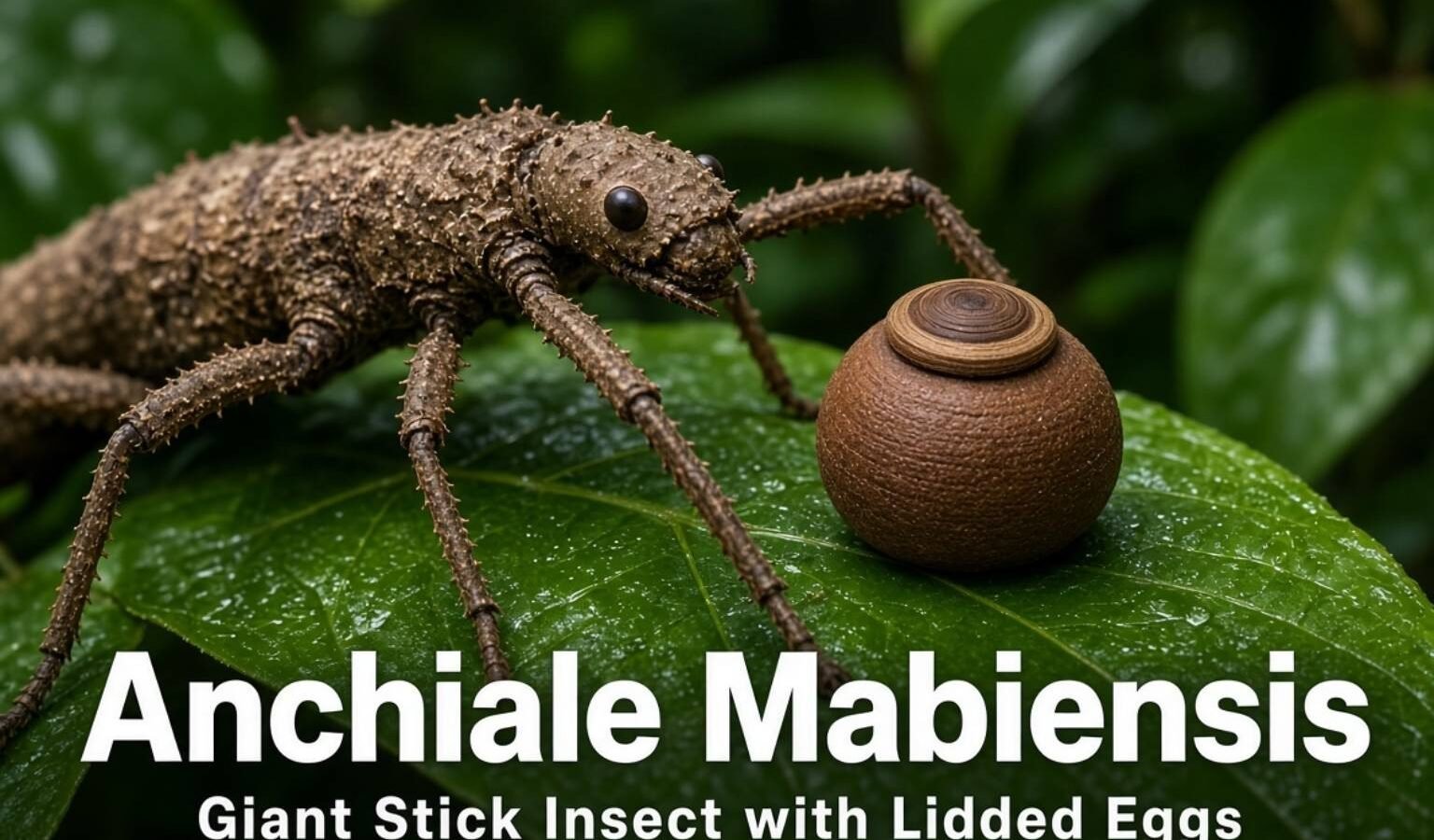
Anchiale mabiensis is a stick insect scientifically described in September 2026 from Queensland, Australia. Its small eggs have an unusual operculum, or lid, with inner rings that researchers identified as a distinctive feature. Explore its pictures, Mabi forest habitat, egg details, size and scientific identification below.
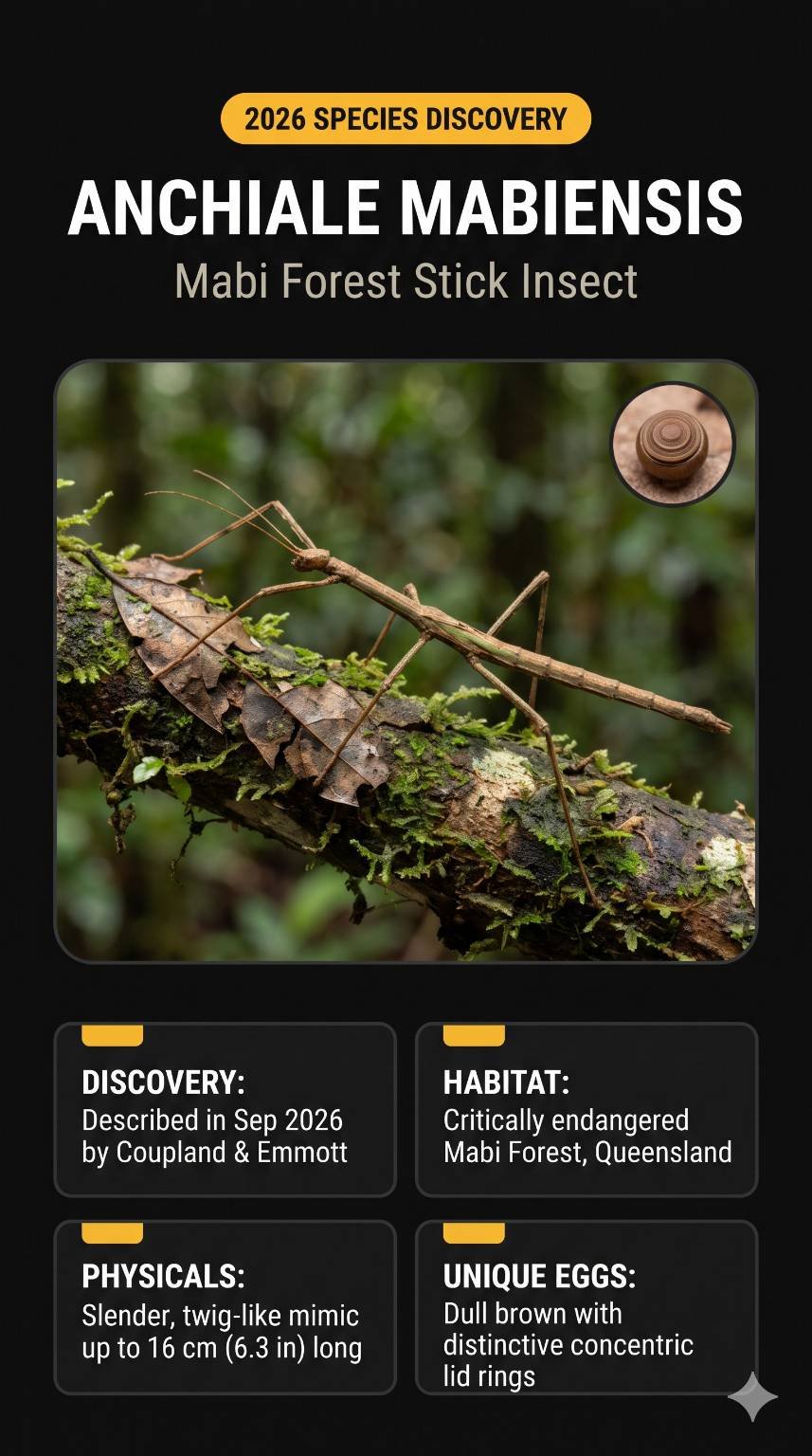
What is Anchiale mabiensis?
Anchiale mabiensis is a stick-insect species formally described in September 2026 during a scientific revision of the Australian genus Anchiale. The name refers to the Mabi rainforest of Queensland, a distinctive forest ecosystem in the Atherton Tablelands region. Stick insects are masters of camouflage: their long bodies, legs and colours can resemble twigs, leaves and the surrounding vegetation. The significance of Anchiale mabiensis, however, is not simply that it looks strange. Researchers found distinctive anatomical features and a remarkable egg structure that helped separate it from other Anchiale species. Readers searching for Anchiale mabiensis pictures often see a generic stick insect or a striking round egg. Those visuals may communicate the general idea, but correct species identification depends on the scientific diagnostic characters and the actual specimen record. The 2026 research offers a useful lesson in why taxonomy needs more than a good photograph.
Where was the Mabi stick insect discovered?
The formal type material is associated with the Malanda area of the Atherton Tablelands in Far North Queensland, Australia. Researchers describe the species as predominantly known from Mabi forest, a complex mesophyll vine forest community on basalt soils, and also record it from lowland riparian rainforest near Babinda. Thus the shorthand “Mabi Forest stick insect” is meaningful, but the species should not be described as necessarily limited to a single tree or one tiny forest patch. This habitat receives considerable rain and supports a lush vegetation structure in which plant-mimicking insects can be hard to notice. The paper records observations on Grey Sassafras, Doryphora aromatica, as a foodplant. Habitat details are important in conservation discussions and in image captions, but a rainforest background alone cannot authenticate any specimen’s identity. A reliable field record also needs a date, locality and suitable taxonomic evidence.
Why the lidded eggs attracted scientists’ attention
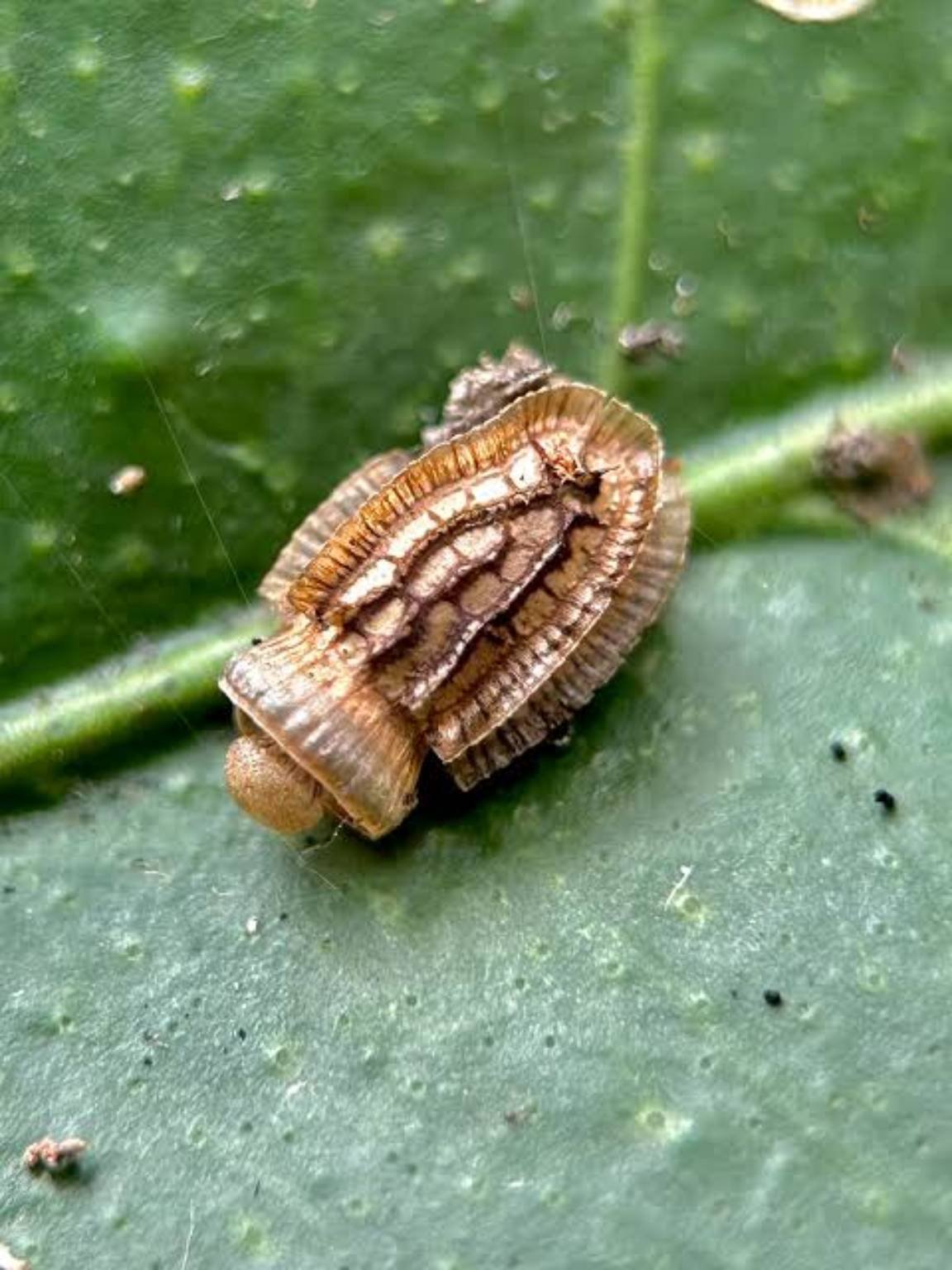
The egg has a capsule and a lid technically called an operculum. In the genus Anchiale, the operculum can have a raised central structure, while the capsule carries distinctive surface characteristics. The 2026 revision found an especially unusual arrangement in A. mabiensis: two or three inner rings on the operculum, not recorded in the other Anchiale species studied and reported as a first among phasmids in this context. The original study describes the egg capsule as black, oval, glossy and heavily sculptured with ridges. An enlarged circular depiction can help a reader understand the concept, but a simple smooth brown ball does not reproduce every measured specimen feature. The paper provides egg dimensions of approximately 2.7 millimetres in capsule length, 2.1 millimetres in height and 1.8 millimetres in width. These small features show why close examination is essential for insect classification.
How big is Anchiale mabiensis?
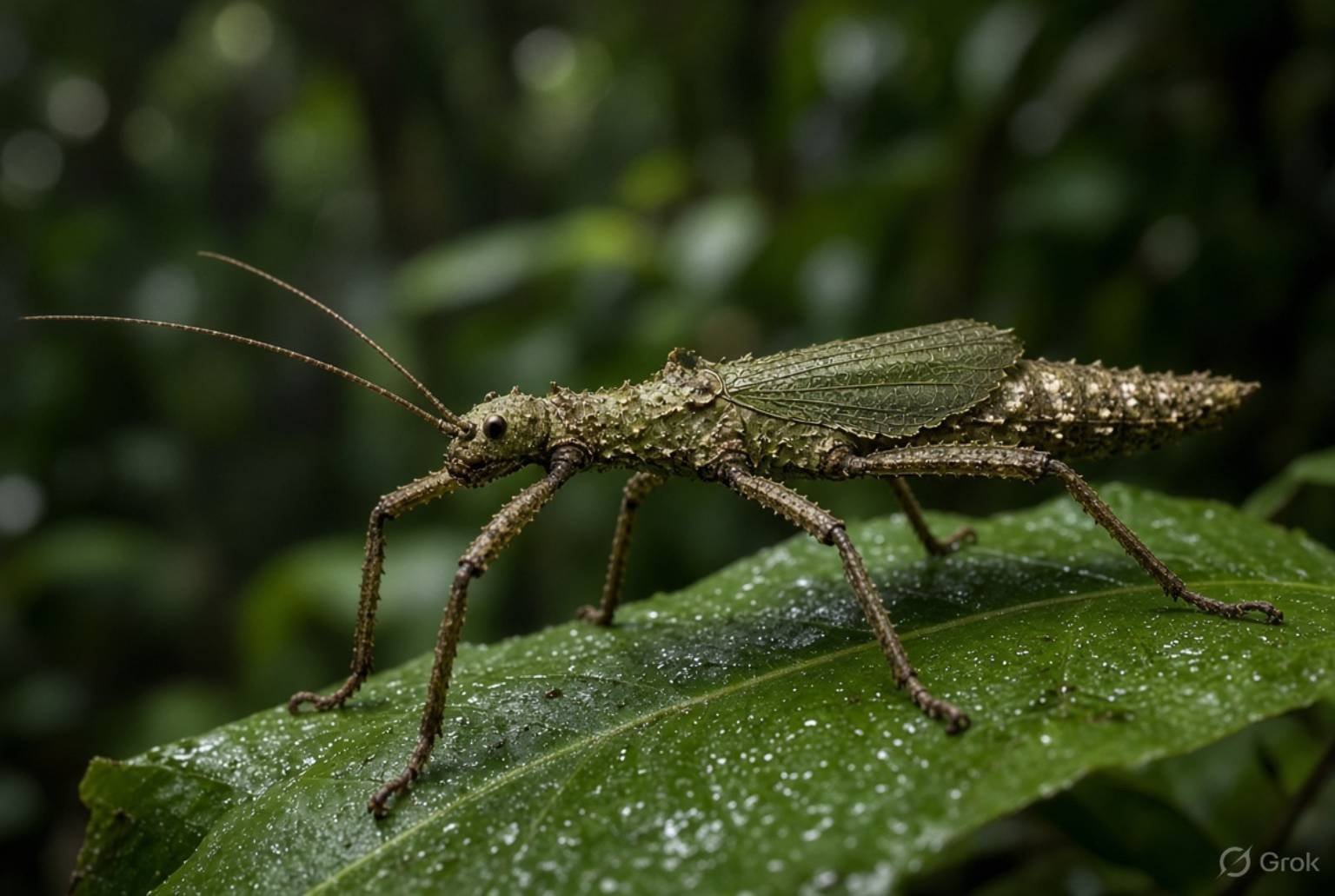
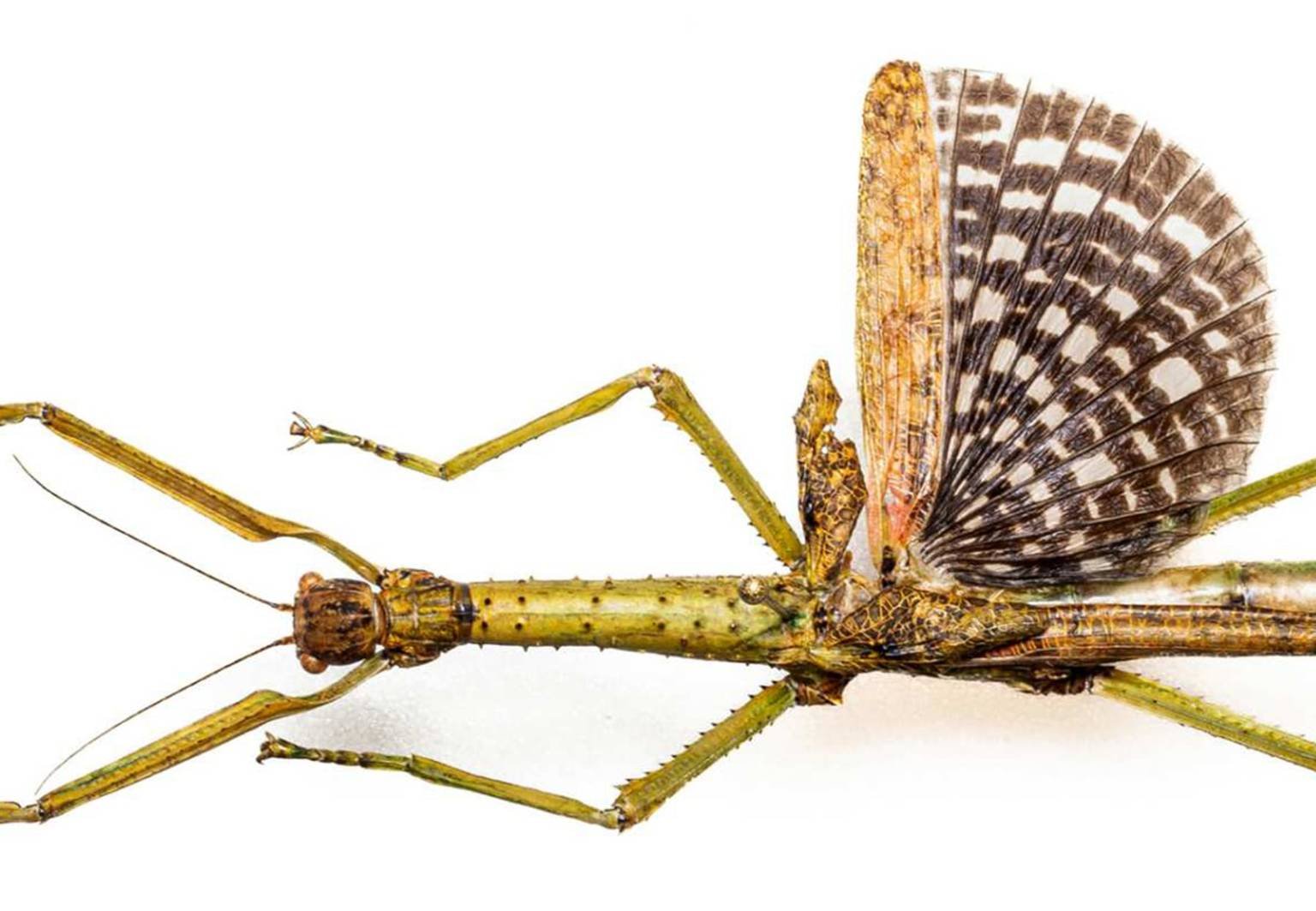
The body length of the female holotype was recorded as 115.4 millimetres, while a male paratype measured 82 millimetres. A University of Sydney illustration describes a stretched female reaching 16.3 centimetres in total length, a different way of measuring a long-bodied insect including extended parts. The numbers should therefore not be treated as interchangeable body-length measurements. The species is smaller and more slender than Anchiale robusta, another species treated in the same 2026 revision. Adult females appear mainly leaf green with brown markings, while males may differ in wing proportions and colour. Wings, segments, legs and the rear of the abdomen all supply useful identification characters. Females of A. mabiensis have short cerci compared with some relatives. A scientific image gallery is most useful when a figure shows the body from above, the side and behind rather than offering only one dramatic perspective.
Anchiale mabiensis versus Anchiale robusta
The revision disentangled a number of Australian Anchiale lineages and described two new species, including A. robusta and A. mabiensis. These species may occur in overlapping parts of Queensland, but their size, proportions, hindwing reach, abdominal structures and eggs differ. The female A. mabiensis is shorter and more slender than the A. robusta female described in the study. A. mabiensis also differs from A. briareus in details of the sixth abdominal segment, and it can be separated from A. albopunctata by its distinctive egg morphology and short cerci. It would be misleading to promise that every casual observer can reliably identify one from a single mobile photograph. Expert inspection of anatomical characters remains the appropriate standard, with field location contributing supporting context. This comparison is more useful for students than a generic “biggest stick insect in Australia” claim, which is not what the study established.
Are the insects or their forest critically endangered?
The University of Sydney explicitly describes the Mabi rainforest ecological community as critically endangered. That does not automatically establish a matching IUCN category for Anchiale mabiensis itself. The new insect’s population size, rate of decline and complete distribution are not established simply by describing its forest. Readers should keep the status of an ecosystem separate from a formal species-level Red List assessment. Nevertheless, restricted known localities and an endangered forest type make careful habitat research and biodiversity monitoring important. Forest clearing, fragmentation and changes in environmental conditions can alter the places insects depend on, but the particular threats and population trends for this species require direct study. Avoid sharing a poster that labels A. mabiensis “critically endangered” without a citation to an actual species assessment. Precision protects the credibility of conservation reporting.
What the new species tells us about biodiversity
Stick insects are easy to overlook even in regions repeatedly visited by naturalists. Researchers used museum specimens, taxonomy, field surveys, observations and molecular evidence to revisit the genus Anchiale, concluding that what had looked like two familiar species actually included five Australian species-level groups in their revised treatment. A different species, A. robusta, had long been misidentified in earlier records. The revision also hints that additional species may still await description. This illustrates a broad ecological point: the act of naming biodiversity is an ongoing research process, not a completed catalogue. When a new species is described, it can refine older reports, improve the interpretation of citizen-science records and support the protection of specialised habitats. The curious egg of Anchiale mabiensis is not merely a novelty; its structure is evidence that helps researchers work out which organisms belong to which lineage.
How to interpret pictures of the insect and its egg
A useful image set includes a full-body view to explain the stick-like form, a closer view of wing proportions and body segments, and an enlarged egg detail that makes the operculum visible. The magnified object should be labelled with the appropriate scale; an egg only a few millimetres long can look huge on a poster. The uploaded visuals on this page are intended to organise these questions, while the diagnostic illustrations in the published study remain the scientific basis for identification. Do not assume the pictured insect and egg belong to the same specimen unless a source makes that connection. An accurate caption explains what the reader should notice—twigs-like body, short cerci, wing pattern or concentric opercular rings—without claiming more than the source supports. This distinction also makes the content valuable to classroom readers using Google Images for biology diagrams.
Research timeline and practical reading guide
The taxonomic revision was first published on 21 September 2026 in Austral Entomology, followed by a University of Sydney research announcement on 22 September. The study is titled “A revision of Australian Anchiale Stål, 1875 (Phasmida: Phasmatidae: Phasmatinae: Phasmatini), with the description of two new species”. Search the DOI rather than relying on copied captions. The original paper lists a female holotype collected on 2 February 2023 from the Malanda area and provides measurements, material examined, descriptions of habitat and detailed figure sets. That means the species was not created in September 2026, nor first observed by humanity on that day. It was scientifically described after analysing evidence gathered earlier. For anyone attempting to verify a colourful social-media fact card, the paper’s species section is the most reliable starting point.
Frequently asked questions
Is Anchiale mabiensis a newly discovered species?
It was formally described in the 2026 revision of Australian Anchiale; the specimens and observations include older collection dates.
Where does it live?
It is known from Queensland, especially the Mabi rainforest of the Atherton Tablelands, with a record from Babinda.
What is special about its eggs?
Scientists reported unusual concentric inner rings on the egg operculum, or lid.
How long is it?
The measured female holotype body is approximately 115.4 mm; extended overall length can be recorded differently.
Is it officially critically endangered?
The Mabi forest ecological community is critically endangered; do not confuse that with an unverified species-level IUCN listing.
Conclusion and references
Anchiale mabiensis demonstrates how careful taxonomy can reveal overlooked biodiversity and how tiny eggs can help distinguish similar insects. Updated 23 November 2026. Sources: Austral Entomology revision, 2026; University of Sydney research release.
Related science reading
- Indian Bramble Shark (Echinorhinus roinee): New Kerala Deep-Sea Species, Photos & Facts
- India Deep Ocean Mission Discoveries 2026: New Sharks, MATSYA-6000 & 2028 Dive Target

























Share Your Opinion
Comments are closed on this post.