 Vista
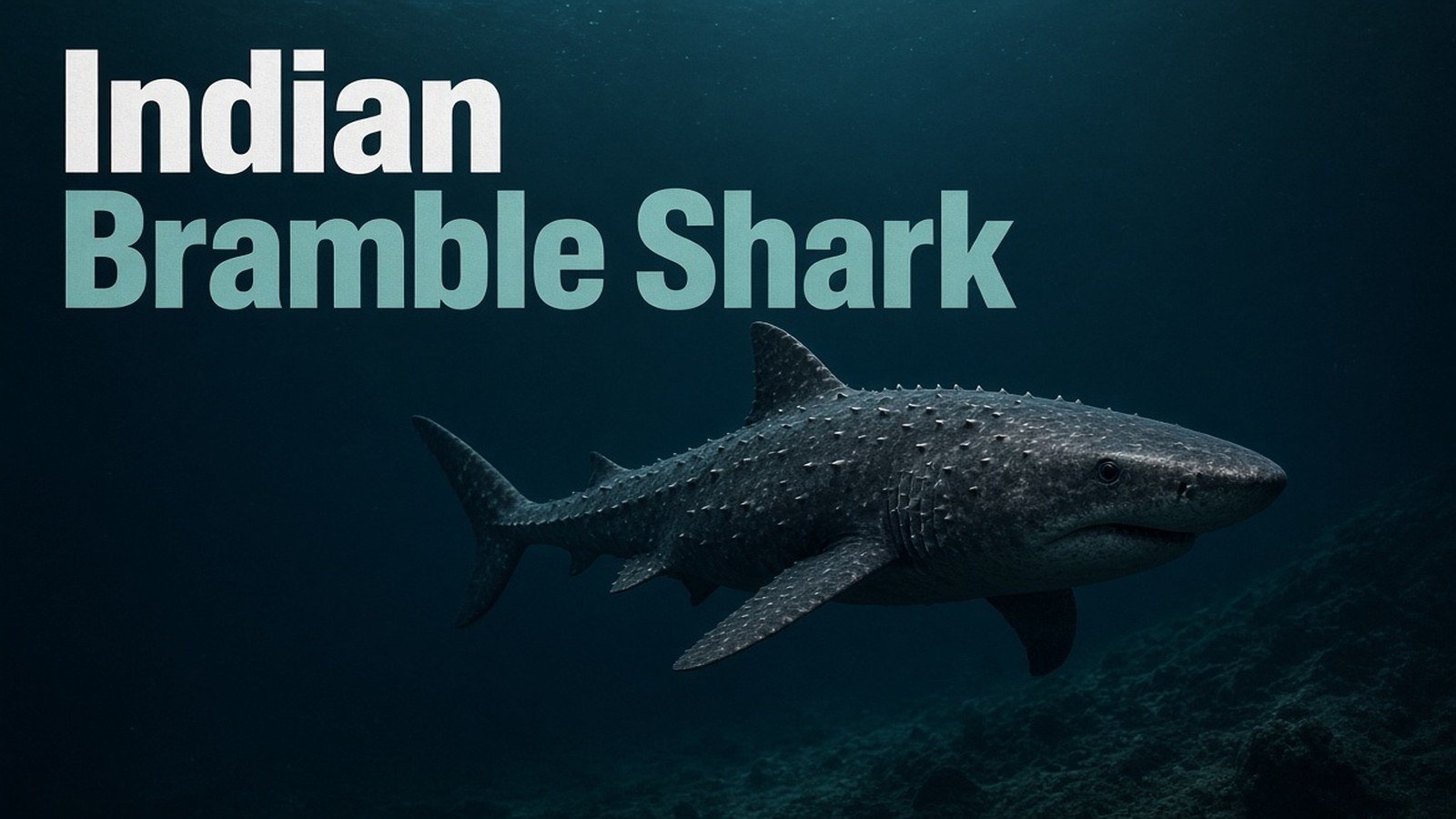
Indian Bramble Shark 2026: researchers in India identified Echinorhinus roinee as a distinct deep-sea shark from Kerala specimens previously labelled Atlantic bramble sharks. Learn what the evidence says about its size, 350–450 metre habitat, skin, DNA and conservation.
Updated: 22 November 2026 | Official discovery announcement: 11 November 2026
Indian Bramble Shark discovery 2026: what exactly happened?
On 11 November 2026, India’s Zoological Survey of India (ZSI) announced that a deep-sea shark long recorded as the Atlantic bramble shark in Indian Ocean waters is actually a distinct species. Researchers working with ICAR–Central Marine Fisheries Research Institute (CMFRI) described it as Echinorhinus roinee, commonly called the Indian Bramble Shark. The formal species description appears in Records of the Zoological Survey of India, volume 126, special issue 1, 2026.
This is a discovery in scientific identification, not a claim that a never-before-seen monster suddenly appeared near a tourist beach. Animals had been caught and recorded along the southwestern Indian coast over many years, but they carried a different species label. By combining precise body measurements with DNA barcoding, scientists found that the population differs from related sharks known in the Atlantic and Pacific Oceans. The distinction improves the reliability of marine biodiversity and fisheries records.
Where was Echinorhinus roinee found in Kerala?
The research material was collected from Sakthikulangara Fishing Harbour in Kollam district, Kerala. The sharks were landed there as bycatch of deep-sea shrimp trawlers. Bycatch means an animal is captured while a fishing operation is targeting a different species. In this case the fishers were not undertaking a dedicated shark-discovery expedition. The harbour was the landing and specimen-collection location, rather than proof that the species lives only inside Kollam harbour.
The government release describes the shark as inhabiting continental-slope waters roughly 350–450 metres deep. A continental slope is the underwater terrain beyond the shallower continental shelf, where the sea floor descends toward the deep ocean. The number is a reported habitat-depth range for the new description; it should not be converted into a universal maximum depth or a claim that the fish swims near every Kerala beach.
Indian Bramble Shark appearance: size, skin and identification chart
The species can grow to approximately three metres, or close to ten feet, and its body ranges from dark brown to blackish. The most distinctive visible feature is a covering of thorn-like dermal denticles—tooth-like structures in the skin. In older individuals, some denticles fuse into prominent plates with several points. The rough surface explains the common word “bramble”, referring to thorny growth rather than to leaves or plants.
Scientists identified anatomical differences including relatively larger eyes, larger pelvic fins and a longer region from snout to gill openings compared with close relatives. A photograph of a large dark shark alone cannot establish species identification. Specimen-based measurements, comparative anatomical features and genetic evidence are especially valuable because deep-sea animals may look similar and photographs may miss important diagnostic details.
Echinorhinus roinee vs Echinorhinus brucus vs Echinorhinus cookei
The Atlantic bramble shark, Echinorhinus brucus, was the name applied to many historical Indian records. The Pacific prickly shark, Echinorhinus cookei, is another member of the same group. The 2026 study shows that the Indian Ocean lineage differs from those two rather than representing one globally identical species.
The classification matters for more than naming. If fisheries reports from distant oceans all use a single name for different animals, estimates of population size, geographical range and conservation risk become unreliable. Splitting a misidentified population into its correct species can change how old specimens and bycatch observations should be interpreted. It does not automatically mean every older mention of E. brucus is incorrect; researchers must evaluate the original locality, voucher and evidence.
How mitochondrial DNA confirmed a distinct Indian Ocean lineage
DNA barcoding compares selected short regions of genetic material that are useful for distinguishing organisms. The ZSI announcement says mitochondrial barcode genes placed the Indian specimens in a genetically distinct lineage from both the Atlantic bramble shark and the Pacific prickly shark. Genetic evidence supported the morphological differences observed by the team.
This does not mean researchers changed the shark’s DNA or created a new animal in a laboratory. They sampled natural biological material, sequenced the relevant genes and examined how closely the patterns matched known species. A single social-media photo cannot replace that work. DNA-based identification is powerful when it agrees with anatomy and collection records; it is not an excuse to declare every unusual-looking fish a completely new species.
Who discovered the shark, and why is the name roinee used?
The announced study team included Praveen Rozario, Bineesh K. K., Sweta Beura, Anil Kasinath and Dhriti Banerjee from the Zoological Survey of India, together with Akhilesh K. V. from ICAR-CMFRI. The scientific material is associated with the Marine Biology Regional Centre of ZSI, Chennai. The government’s press note says the type specimens are preserved in the National Zoological Collections there.
The specific name roinee honours Roinee, the daughter of ZSI director Dr Dhriti Banerjee. This is the stated origin of the scientific epithet, not the name of a fishing village, a geographic river or a newly invented local shark category. The preserved type specimens matter because they give future researchers a physical reference for checking species identity as more records emerge.
Does the shark live only in India? What about Oman, Sri Lanka and Thailand?
The best-supported specimen locality in the announcement is the Kerala southwest coast. However, the ZSI statement notes genetically similar records suggesting that the Indian Bramble Shark’s range may extend to waters around Oman, Sri Lanka and Thailand. The word “may” is important. Those are potential broader-range clues, not a complete survey documenting the population everywhere between those countries.
Scientists may need to re-examine older collections, fisheries bycatch databases and genetic sequences originally assigned to other Echinorhinus species. That work could clarify where the species breeds, how it moves between habitats and how abundant it is. Until such studies are done, readers should avoid viral maps showing a certain global range or claiming the shark has been sighted at a specific tourist destination.
Is Echinorhinus roinee dangerous to swimmers or humans?
The available research describes a deep-sea shark inhabiting continental-slope habitat hundreds of metres below the surface. It does not establish the animal as a routine nearshore swimmer or a species involved in attacks on beachgoers. A three-metre length can sound frightening, but size alone cannot establish aggression or real-world human risk.
For ocean users, the sensible response to the news is understanding biodiversity, not panic. Avoid touching, transporting or disturbing wild sharks and follow coastal safety guidance issued by local authorities. Claims that “a newly discovered ten-foot killer shark is hunting people in Kerala” are not supported by the official scientific description. Likewise, it would be careless to promise that a wild shark could never hurt anyone under any circumstances.
Why bycatch and species identification matter for conservation
Deep-sea shrimp trawling can bring up non-target sharks along with commercially desired shrimp. The ZSI statement points out that bramble sharks appear in trawl and longline bycatch off India’s southwest coast. If the catch is logged under the wrong species, managers cannot reliably assess how frequently the true Indian species is captured or how its population changes.
New taxonomy therefore changes the questions researchers need to ask: what fishing depths overlap the shark’s habitat, how many specimens are encountered, whether juveniles and breeding individuals are caught, and whether conservation measures need adjustment. A new name by itself is not an IUCN Red List assessment. Readers should not transfer the endangered status attached to a different shark species to E. roinee without a species-specific assessment.
How India’s Deep Ocean Mission connects to this discovery
The 2026 research received financial support from India’s Ministry of Earth Sciences under the Deep Ocean Mission, according to the government announcement. The connection illustrates why studies of preserved specimens, genetic sequences and commercial fishing landings belong alongside technology-heavy deep-sea exploration projects.
Deep-ocean research is sometimes pictured only as manned submarines and robots working at extreme depths. In reality, taxonomy and fisheries science are also essential for understanding ocean ecosystems. A shark found in an existing sample collection may answer a scientifically important question even without a dramatic live underwater video. This research should not be confused with an announcement that the Samudrayaan submersible photographed the shark in the wild.
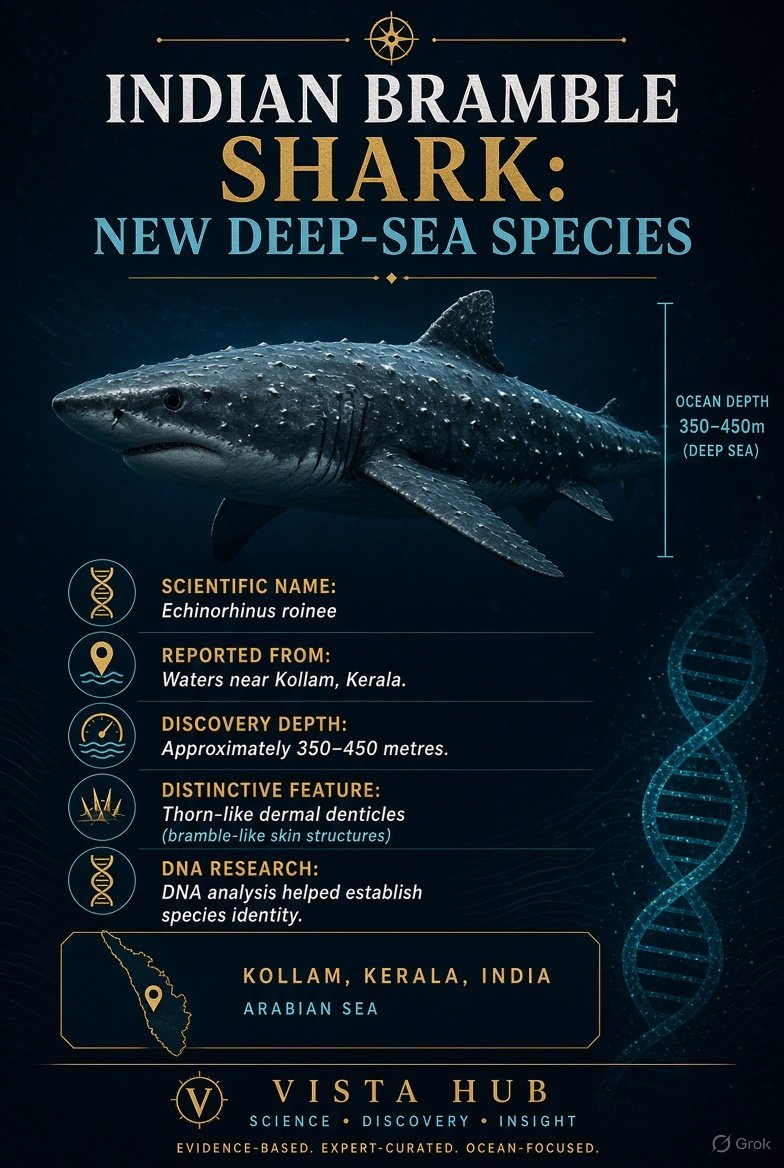
Indian Bramble Shark photo and diagram: what the visuals can and cannot show
The accompanying infographic is an illustrative identification guide, not a diagnostic specimen photograph. It highlights the reported dark body, large shark size, thorny denticles and continental-slope setting. These are useful visual cues, but the exact arrangement of denticles, fin measurements and genetic details must come from the published research.
For trustworthy real-world reference images, readers should inspect the ZSI release and published taxonomic plates when accessible. Before reusing a photo labelled simply ‘bramble shark’, confirm its species: older captions may depict E. brucus or another member of the genus. Labelling an unrelated shark image as the exact new Kerala species can create misinformation and confound visual searches.
What to remember for GK, UPSC and future research questions
For a concise 2026 current-affairs answer: the scientific name is Echinorhinus roinee; common name Indian Bramble Shark; announcement November 11, 2026; institutions ZSI and ICAR-CMFRI; collection point Sakthikulangara Fishing Harbour, Kollam; habitat approximately 350–450 metres; size up to three metres; and key evidence anatomy plus mitochondrial DNA.
A stronger explanation adds why the species was overlooked: specimens were historically associated with Atlantic E. brucus. It also notes that potentially similar lineages in Oman, Sri Lanka and Thailand require verification and that the study supports better bycatch monitoring. Future useful searches may include ‘Echinorhinus roinee scientific paper PDF’, ‘Indian Bramble Shark vs Atlantic Bramble Shark’, ‘Kerala deep sea shark real photo’ and ‘Echinorhinus roinee conservation status’. These are search ideas, not measured trend volumes.
Indian Bramble Shark FAQs
Is Echinorhinus roinee really a new shark species?
Yes. ZSI and ICAR-CMFRI described a distinct Indian Ocean species in a 2026 taxonomic paper, announced on 11 November 2026.
Where was the Indian Bramble Shark found?
The specimens were landed as deep-sea shrimp-trawler bycatch at Sakthikulangara Fishing Harbour, Kollam, Kerala.
How big and how deep does it live?
The government reports up to about three metres long and a continental-slope habitat roughly 350–450 metres deep.
Is the Kerala shark the Atlantic bramble shark?
No. It was historically misidentified as Echinorhinus brucus; morphology and DNA support the separate name Echinorhinus roinee.
Is the infographic a real shark photograph?
No. It is a topic-specific explanatory illustration, not the original type-specimen image from the scientific paper.
Is it proven dangerous to beach visitors?
The scientific announcement does not report beach attacks. It describes a deep-water species and should not be turned into a coastal panic story.
Conclusion and original research sources
The finding improves species identification and conservation evidence; it is not evidence of a new threat to swimmers. Verify exact photographs and biological claims against the original sources.
- Government of India / PIB: New Deep-Sea Shark Species (11 November 2026)
- Records of ZSI (2026): Echinorhinus roinee original taxonomic research (DOI)
Image note: Featured illustration and poster are not certified specimen photographs.




















Share Your Opinion
Comments are closed on this post.