 Vista
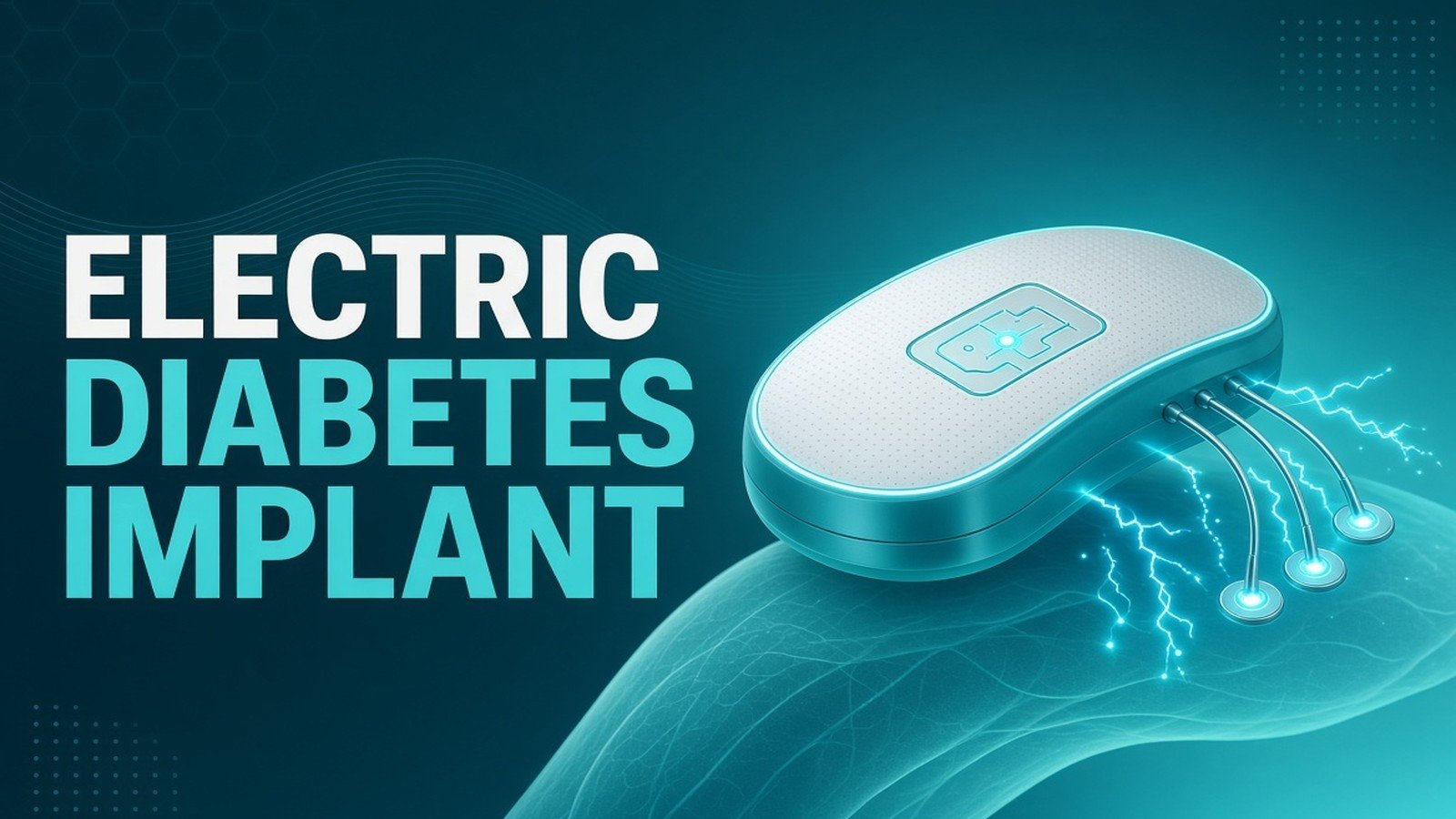
Electric diabetes implant 2026: ETH Zurich’s ECHO device uses a wireless electrical catalyst to convert excess glucose to gluconate. It controlled blood sugar in type 2 diabetic mice, but has not been tested in humans and is not a cure or approved replacement for insulin or diabetes medicines.
SAFETY FACT CHECK: Mouse-only research; do not stop prescribed medicine or insulin. ECHO uses electrocatalysis, not nerve stimulation.
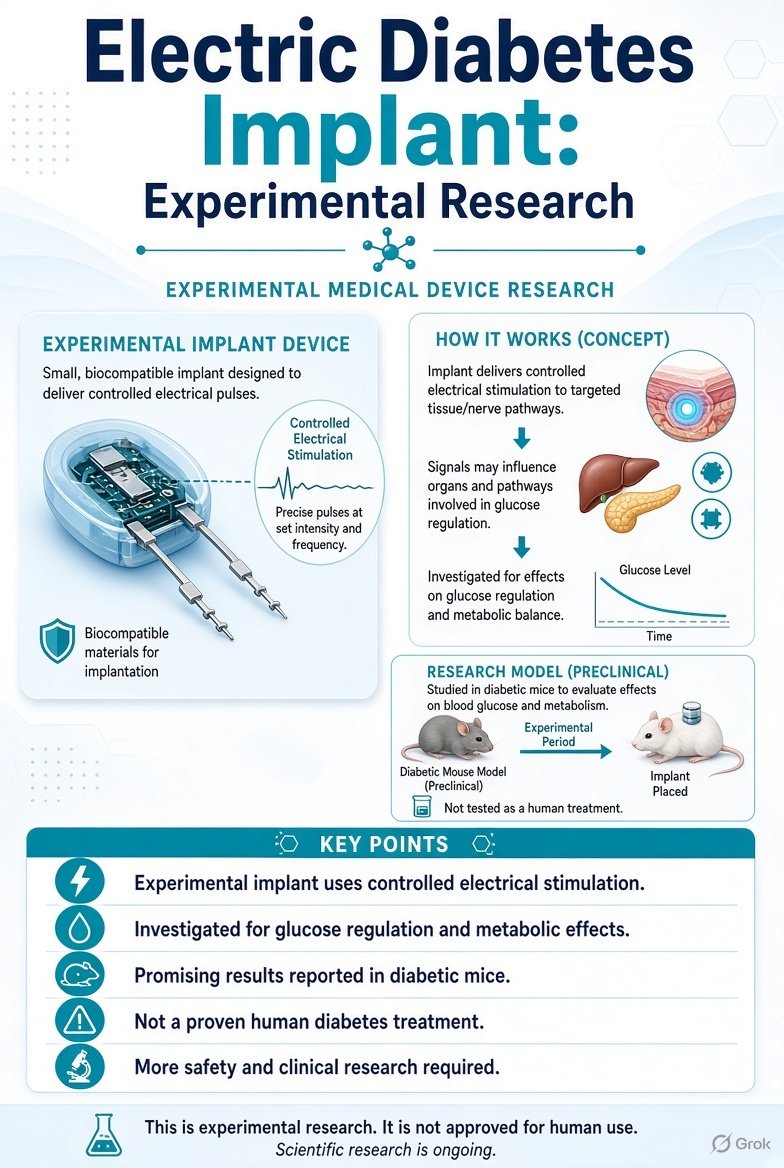
Reviewed 22 November 2026 | Science paper: 22 October 2026
Electric diabetes implant 2026: did scientists cure diabetes without insulin?
Researchers at ETH Zurich and collaborators reported a proof-of-concept electrically controlled implant that reduced high blood glucose in laboratory mice with type 2 diabetes and obesity. Published in Science on 22 October 2026, the study used a tiny inorganic catalyst to turn some circulating glucose into gluconate, which can then be cleared through the kidneys. The design is called an electrocatalytic closed-loop health optimization (ECHO) device.
The headline ‘diabetes cured with electricity’ is not supported by these findings. The team has not tested ECHO in people, and no human treatment approval, hospital rollout or Indian availability was announced. In experiments, the device brought blood glucose back toward the normal range within about one hour in the tested diabetic mice and functioned during a six-week observation period. Those results are promising for medical-device research but cannot predict how well a similar implant would work in a person over many years.
Importantly, this particular implant is not a tiny insulin pump and does not directly use electricity to stimulate the vagus nerve. Its working principle is electrochemistry: electronically controlled conversion of glucose. That distinction matters because there are other, separate bioelectronic diabetes devices in the news.
What is the ECHO implant? Name, team and original paper
ECHO stands for electrocatalytic closed-loop health optimization. The device integrates a catalytic surface, a wireless power and electronic-control component, and signals from a continuous glucose monitor (CGM). The original Science study is titled Wireless electrocatalytic closed-loop system for drug-free management of diabesity, DOI 10.1126/science.ady8560.
Authors included Debasis Maity, Preetam Guha Ray, Peter Buchmann, Ghislaine Charpin-El Hamri and Martin Fussenegger, with affiliations including ETH Zurich, the University of Basel and the University of Lyon. The lead research programme was directed by Professor Martin Fussenegger. The university announcement appeared on the same date as the paper, October 22, while broader articles followed later in October and early November.
‘Diabesity’ is a research term combining diabetes and obesity. It describes interacting metabolic problems, not a completely different official disease that every person with diabetes necessarily has. In the experiment, researchers used mice with type 2 diabetes and obesity-like metabolic features rather than enrolling human patients from the general population.
How the implant converts glucose into gluconate
The key process is an electrocatalytic oxidation reaction. A specially designed catalyst on an electrode helps transform a portion of blood glucose into gluconate when a very small electrical current is applied. The paper reports that the reaction product can be cleared through the kidneys and urine. By converting some excess glucose directly, the researchers aimed to reduce the fuel that might otherwise be metabolized or stored.
This is different from ordinary insulin action. Insulin is a hormone that helps cells take up glucose and regulates how the body processes energy; insulin therapy is essential for many patients and especially for people with type 1 diabetes. The ECHO system instead aims to remove a portion of excess glucose by chemistry, without releasing insulin or a glucose-lowering drug from the device in these mouse experiments.
The device does not make glucose disappear in an unexplained flash or ‘burn sugar with electricity’ inside every body cell. The chemical transformation occurs at a designed material surface, and its byproduct must be processed and eliminated. The kidney dependence is one reason researchers must study the approach carefully in humans, particularly in people whose kidney function is already reduced.
What’s inside it? Graphite felt, gold and platinum nanostructures
ETH Zurich describes the catalyst as graphite felt decorated with gold nanoclusters, whose surfaces carry still smaller platinum particles. These materials create an electrochemically active surface on which glucose can be converted selectively. Because the system uses inorganic components rather than living engineered cells or enzymes, the investigators hope some manufacturing and stability challenges might be easier to address.
The implant also contains a control unit in a small 3D-printed housing, along with elements to receive wireless power. ETH Zurich identifies a 13.56 MHz wireless power frequency used in the research setting. The paper’s experimental activation condition involved roughly 0.75 volts and 10 milliamperes. These are technical laboratory parameters, not settings that a patient should attempt to reproduce with a consumer electronic product.
Gold and platinum are not evidence that the device makes the body ‘drink metal particles’. The research centres on engineered surfaces and their biocompatibility under specific experimental conditions. Long-term material stability, migration of components, infection risk and tissue responses would still need to be studied before any human use.
How the CGM, phone and wireless power create a closed loop
A continuous glucose monitor (CGM) measures glucose trends in tissue fluid and produces frequent readings. In the proposed ECHO system, sensor data inform an electronic controller; when glucose rises above the chosen threshold, the controller activates the catalyst through wireless power. When glucose reaches the target range, the device can be turned off again. This feedback arrangement is called a closed loop.
The university describes using a Bluetooth link and a smartphone or smartwatch to help manage this process. In the mouse studies, the combination of established glucose-monitoring hardware and a smartphone-controlled catalyst created an automated research setup. A closed-loop system is not the same as a fully autonomous, failure-proof medical product ready to be worn at home.
Real-world use would require robust sensor accuracy, protection against device faults, reliable power delivery, safe default behaviour, cybersecurity and medical oversight. If a glucose sensor reads incorrectly or a connection fails, treatment could be inappropriate. The 2026 mouse results cannot by themselves establish that those problems have been solved for long-term human implantation.
Results in diabetic mice: glucose control within one hour
The abstract published in Science reports that low-power activation in the tested type 2 diabetic mice restored glucose homeostasis within one hour. That means measured glucose regulation improved in this specific experimental model. It does not mean a person’s blood glucose would always become normal exactly sixty minutes after receiving an implant.
Experiments also found changes in metabolic fuel use: the animals shifted away from reliance on glucose toward greater use of lipids. The team recorded lower body weight and triglycerides, alongside higher circulating free fatty acids and ketone bodies. These biochemical measurements help build a mechanistic picture; they are not evidence that the device is already a proven obesity treatment for patients.
An important detail in ETH Zurich’s research summary is the separate test using a reservoir holding five litres of glucose-containing solution, roughly the total blood volume of an average adult. That was a laboratory conversion test, not a clinical trial conducted in five litres of human blood inside a person. The animal experiments were separate and remain the relevant in-vivo evidence.
Six-week observations and the 12-day automated-system limitation
The researchers monitored the implant in the mouse experiments over approximately six weeks. They reported no detected tissue damage attributable to the electrical or thermal effects and no observed serious physiological, inflammatory or behavioural problems in the tested animals under the study conditions. The primary paper also reported no detected hypoglycemia during the evaluated intervention.
Independent experts quoted by Science Media Centre Spain welcomed the proof of concept but explained that the fully automated configuration was assessed for a shorter period, around twelve days, and that experimental groups were small. This is a valuable distinction: long-term device tolerability in a six-week study is not the same as verifying every automated component for six full weeks under all possible conditions.
‘No observed adverse effects’ does not mean the product has been proven permanently safe. Humans live much longer, have varied kidney function and multiple illnesses, may take other medicines and face a different magnitude of glucose fluctuations. Large-animal studies and clinical trials would be needed before estimating adverse-event rates in people.
Why the kidneys matter: gluconate and long-term safety questions
ECHO depends on the body being able to eliminate the glucose-derived product gluconate through urine. People with diabetes may have existing kidney disease, and kidney function can vary widely across patients. Experts therefore want detailed investigation into how the byproduct behaves over long periods and what might happen if renal clearance is impaired.
Other open questions include whether the implant retains catalytic efficiency after months or years, whether surrounding tissue forms a layer that reduces performance, how reliably it can be powered wirelessly and what happens if the sensor or controller fails. Infection, inflammation, metal-particle stability, surgery-related risks and practical replacement procedures are also important in moving from a mouse model to a human device.
The experiment provides a reason to study those questions, not evidence that they have already been resolved. A small controlled preclinical study cannot establish safety in pregnant patients, older adults, children or people with advanced diabetes complications.
Is this a treatment for type 1 or type 2 diabetes?
The experiments concerned type 2 diabetic mice with obesity-related metabolic abnormalities. Type 2 diabetes commonly involves insulin resistance and sometimes insufficient insulin production. Type 1 diabetes typically involves autoimmune destruction of insulin-producing pancreatic cells and requires insulin replacement. It is particularly dangerous to suggest that an experimental glucose-oxidizing implant removes the need for prescribed insulin in type 1 diabetes.
The paper’s phrase ‘drug-free management’ describes the experimental device mechanism, not a medical recommendation to stop pills, injections or monitoring. Even among people with type 2 diabetes, treatment depends on blood-glucose patterns, cardiovascular or kidney conditions, individual goals and clinician guidance.
At the time of this report, the established tools available to patients remain dietary and activity support, clinically appropriate medication, insulin when needed and glucose monitoring. The ECHO implant is not part of routine diabetes care and has not been shown to improve long-term outcomes such as preventing heart attacks, kidney failure or vision loss in humans.
ECHO vs insulin pump vs a separate nerve-stimulation implant
An insulin pump or an automated insulin delivery system uses a glucose sensor and a pump to deliver the hormone insulin. The FDA explains these ‘artificial pancreas’ systems as a combination of monitoring, algorithms and insulin infusion. ECHO also uses glucose readings and feedback, but its intended action is electrocatalytic chemical conversion, not injecting insulin.
Another 2026 bioelectronics story, discussed in Nature on 18 November, described a different glucose-powered implant called NeuroAxis that stimulates the vagus nerve in rat models of diabetes. That is a separate experimental approach with different animals, engineering and mechanisms. Mixing its description with ETH Zurich’s ECHO mouse study produces a false story even though both involve electronic diabetes devices.
A useful visual comparison is: insulin pump → sensor-adjusted delivery of insulin; ECHO → sensor-adjusted electricity to a glucose-oxidizing catalyst; NeuroAxis → device-driven neural stimulation in rats. The third approach is mentioned to prevent confusion, not to claim one has been proven better than the others.
Can people buy the electric diabetes implant in India in 2026?
No clinically available ECHO implant has been established by the October 2026 research. ETH Zurich explicitly states the team had not tested it in humans. The study therefore does not supply an Indian price, surgery package, regulatory approval number, waiting list, hospital network or pharmacy ordering route. Online claims offering a guaranteed implant appointment based solely on this study should be treated cautiously.
Turning a prototype into an approved medical device generally requires engineering verification, biocompatibility testing, larger animal studies as appropriate, ethical human studies, manufacturing standards, regulatory review and post-market monitoring. The order and details depend on the jurisdiction and device classification. Researchers cannot responsibly forecast the market launch year from one mouse experiment.
People who encounter ‘book diabetic implant without insulin’ advertisements should verify the institution and regulatory status and consult qualified clinicians. Sharing medical records or paying a deposit to an unauthorised seller for an unapproved treatment can be risky.
What should someone with diabetes do now?
Do not stop insulin, metformin or other prescribed medicines because of a successful animal experiment. Continue individual management plans agreed with your healthcare professional, including glucose checks, nutrition, activity, foot and eye care, kidney monitoring and follow-up appointments where relevant. The US National Institute of Diabetes and Digestive and Kidney Diseases (NIDDK) notes that medications and targets must be tailored to the patient’s condition.
Seek urgent medical advice for severe symptoms of very high or very low blood glucose. An implanted experimental device cannot be substituted by applying a household electrical current, placing an electrode on the skin or following instructions from an unofficial video. Medical electrical devices need controlled engineering and professional supervision.
The useful future reader questions are ‘ECHO diabetes implant human trials’, ‘ETH Zurich glucose to gluconate device’, ‘Science 2026 electrocatalytic diabesity’, ‘electronic implant vs insulin pump’, ‘ECHO implant India availability’, and ‘how kidneys excrete gluconate’. These are anticipated search intents rather than claims of measured Google search volume.
Electric Diabetes Implant: FAQs
Can an electric implant cure type 2 diabetes in humans?
No. The ECHO electrocatalytic device has been tested in diabetic mice, not humans. It is not an approved treatment.
What does ECHO stand for?
Electrocatalytic closed-loop health optimization, the experimental system described in the October 22, 2026 Science paper.
Does ECHO deliver insulin or electrically stimulate nerves?
Neither in this study. A catalyst uses a small electric current to oxidize some glucose to gluconate; this differs from insulin delivery and nerve stimulation.
How quickly did it work in mice?
The study reported glucose regulation returning toward normal within about one hour under its experimental mouse conditions.
Was the six-week mouse experiment proof of long-term human safety?
No. The animals were monitored for six weeks, but people require separate clinical testing, including assessment of kidney function and device durability.
Is the ECHO diabetes implant available in India in 2026?
No verified approved consumer or hospital availability was established by the original research. Human testing had not yet occurred.
Conclusion, original research and medical disclaimer
The mouse proof of concept is promising, but it establishes neither human safety nor effectiveness. Patients should continue established care and discuss treatment questions with their clinicians.
- ETH Zurich, 22 October 2026: Tackling diabetes with an electronic implant
- Science (22 October 2026): Wireless electrocatalytic closed-loop system for drug-free management of diabesity
- PubMed: ECHO electrocatalytic implant mouse research and abstract
- Science Media Centre Spain: independent experts on the mouse proof-of-concept
- FDA: What is an artificial pancreas / automated insulin delivery?
- NIDDK: Managing diabetes — established care options
- Nature (18 November 2026): a different glucose-powered nerve-stimulation implant studied in rats
Medical disclaimer: General science education, not personalised medical advice. Do not change prescribed treatment without a qualified clinician. Images are educational illustrations.



























Share Your Opinion
Comments are closed on this post.