 Vista
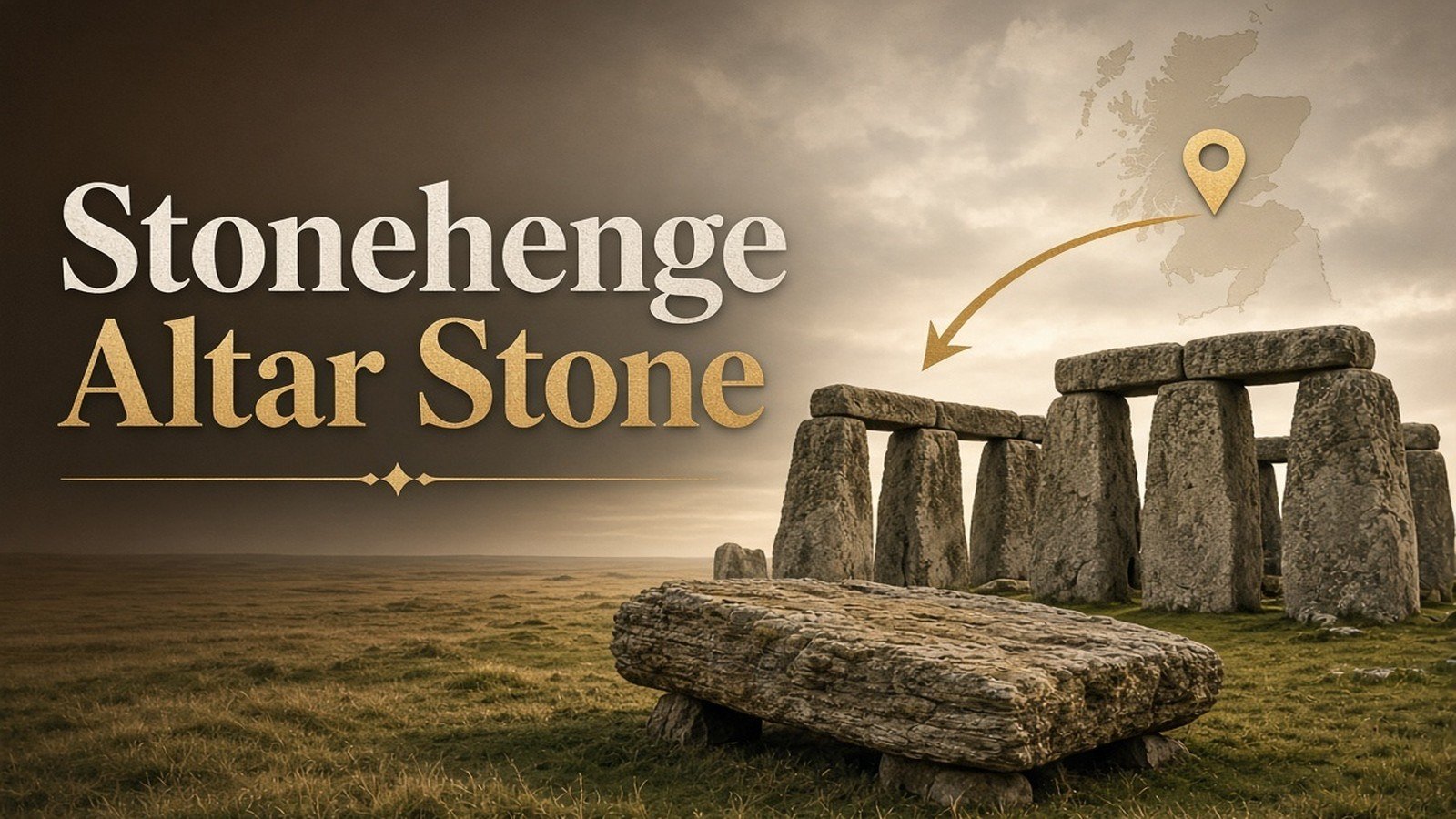
Stonehenge Altar Stone source mystery, November 2026: the six-tonne Stone 80 still lacks a confirmed quarry. A 2024 mineral-age study supported northeast Scotland, but new multi-proxy research excluded several tested candidate outcrops. The Scottish hypothesis remains possible; exact origin and transport route are unknown.
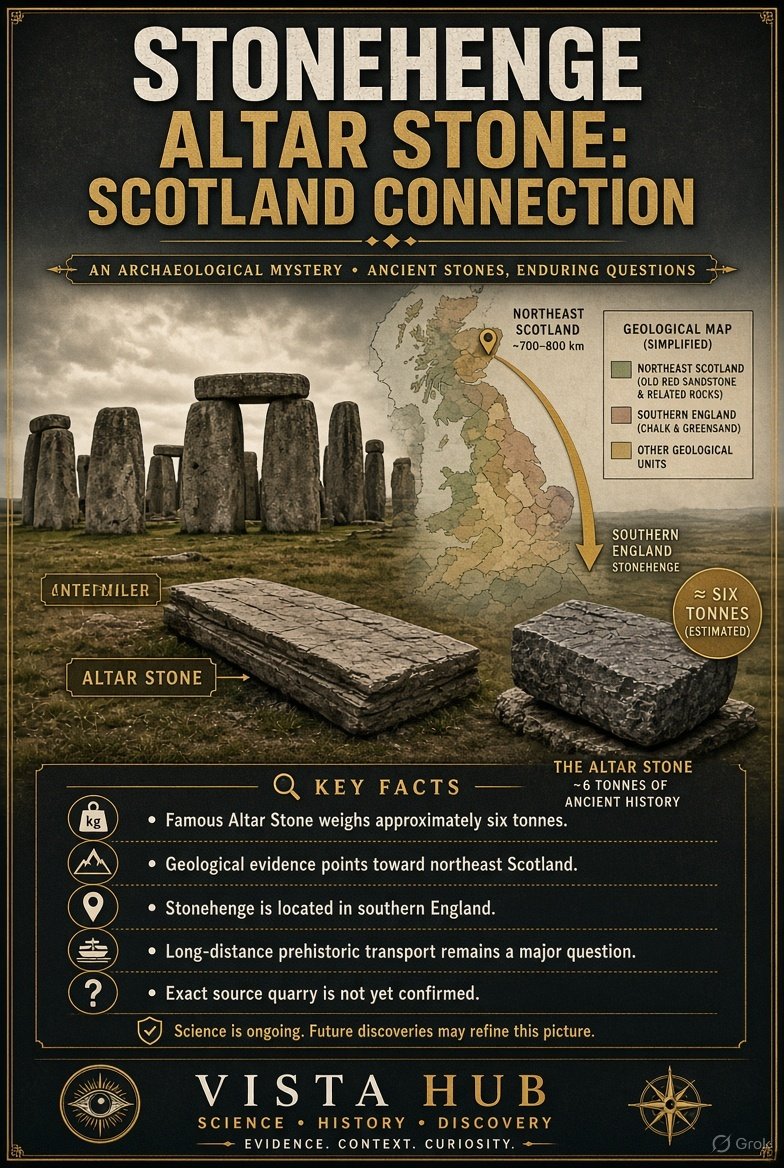
Important update: a 2026 geological study ruled out several proposed outcrops, and the graphic is not proof of a Scottish quarry.
Updated: 22 November 2026 | Latest geological study: November 2026
Stonehenge Altar Stone 2026: is its Scottish origin confirmed?
The source of Stonehenge’s six-tonne Altar Stone remains an open geological question. A high-profile 2024 study used the ages of microscopic mineral grains to suggest that the sandstone block originated in northeastern Scotland, perhaps the Orcadian Basin, rather than Wales. However, a detailed November 2026 investigation tested candidate sandstone outcrops against the Altar Stone’s broader geological fingerprint and found no exact match among the investigated sites.
This is not the same as conclusively proving a non-Scottish source. Aberystwyth University’s official summary dated 5 November 2026 says the new analysis eliminates several promising locations but leaves the precise quarry unknown. Researchers are refining where to search, and Scotland remains part of the discussion. The correct updated headline is therefore ‘Stonehenge Altar Stone’s Scottish origin questioned as exact source remains unknown’, not ‘scientists confirm a Scottish quarry’ or ‘scientists have finally proved Scotland impossible’.
The latest paper in the Journal of the Geological Society matters precisely because older age-based evidence and new whole-rock measurements do not currently lead to one agreed outcrop. Readers deserve to see what each technique establishes and where uncertainty persists.
What is the Altar Stone? Size, weight and Stone 80
The Altar Stone is a large, horizontally lying sandstone slab identified by archaeologists as Stone 80 in the central part of Stonehenge on Salisbury Plain, Wiltshire, England. It is approximately 4.9 metres long, with commonly cited dimensions around one metre wide and half a metre thick. Estimates put its weight around six metric tonnes. Parts of it lie sunk into the ground beneath the fallen remains of the Great Trilithon.
It is not the same as the huge upright sarsen stones that form Stonehenge’s most recognisable outer structures. It also differs in composition and geological history from many of the smaller bluestones, whose known source areas include west Wales. Stonehenge was assembled and modified over many centuries, broadly between about 3000 and 1600 BC. Not every stone in the monument came from one location or was transported by the same method.
The name ‘Altar Stone’ is a later descriptive label. It does not, by itself, prove that the prehistoric builders used this particular slab for sacrifice or any precise ceremony. Its original placement, movement and significance are subjects for archaeological interpretation.
The older Wales explanation: why geologists changed direction
For much of the twentieth century, many scholars considered west Wales or nearby Welsh-border sandstone units promising sources for Stonehenge’s Altar Stone. That belief partly reflected the verified Welsh origins of other bluestones. Yet similarities between large rock units are not enough to identify a source confidently, particularly when sediments of similar age and composition occur in several regions.
More detailed petrography and isotopic research challenged the familiar Anglo-Welsh Basin explanation. The question became whether the Altar Stone’s specific sandstone components came from a geological system much farther north. Researchers also had to distinguish the origin of the individual mineral grains within the sandstone from the later location where the whole sandstone rock formed.
That is why the modern story is a series of revised hypotheses, rather than a simple ‘Wales was wrong, Scotland is unquestionably right’ switch. In geology, ruling out one quarry area can be meaningful even when the eventual correct answer has not yet been found.
The 2024 Nature study: why northeast Scotland became the leading theory
A Nature paper published on 14 August 2024, titled A Scottish provenance for the Altar Stone of Stonehenge, compared the ages of detrital zircon, rutile and apatite grains in the Altar Stone with regional sedimentary records. The combinations of ages were strikingly compatible with geological histories associated with northeast Scotland’s Orcadian Basin.
The researchers reasoned that a block originating around that region would have made a journey of roughly 700–750 kilometres to Salisbury Plain, depending on route assumptions. The result drew international attention because prehistoric communities could have had networks or transport capabilities across much greater distances than some popular accounts imagined.
However, a mineral-age match is not identical to finding an exact quarry. Detrital grains may have had earlier geological origins and been transported naturally through ancient river and sediment systems before becoming part of a new sandstone. The 2024 research proposed a compelling regional provenance; it did not discover a marked extraction pit that conclusively matched the Altar Stone.
What changed in November 2026? The new geological fingerprint
The 2026 paper, Searching for the origin of the Stonehenge Altar Stone: new sedimentological, petrographical, mineralogical, geochemical and isotopic constraints, was published in the Journal of the Geological Society, volume 183, issue 6. The research team, led by Duncan Pirrie and including Richard Bevins, Rob Ixer and Nick Pearce, examined the rock through a wider range of techniques than simply dating a few types of minerals.
Researchers used observations from the Altar Stone itself alongside confidently attributed fragments in museum collections. The study compared sandstone texture, mineral types, clay components, chemical composition and isotopic properties with possible sources. According to the institutional summary, several examined locations within northeast Scotland’s Orcadian Basin failed to reproduce the complete combination of characteristics.
The important finding is no sampled candidate outcrop yet matches the entire suite of evidence. In academic language, the new geological fingerprint constrains possible sources more tightly. It does not certify that every Scottish rock formation has been sampled, nor prove that the Altar Stone must come from a completely different country.
Zircon, rutile and apatite: why tiny grains can reveal a rock’s past
Sandstone consists of particles that were eroded from older rocks, transported by natural processes, deposited and cemented over time. Some grains preserve clues about where those older source rocks formed. Zircon is especially useful because it can retain uranium-lead age information. Rutile and apatite can provide additional age and geochemical constraints.
A scientist may compare hundreds of grain ages in a stone to corresponding distributions in sandstone basins elsewhere. If two populations have a similar pattern, they may share a broader geological history or sediment source. But different sedimentary basins can acquire grains from overlapping ancient terrains, so a matching mineral-age distribution may not determine a unique modern quarry location.
The 2026 study adds evidence from the whole rock, including its mineral assemblage and chemistry. Think of an individual grain age as one feature in a fingerprint: useful, but insufficient alone. Multiple independent properties are needed before claiming that a six-tonne slab came from a particular rock exposure.
Why some Old Red Sandstone outcrops do not fit
The Orcadian Basin contains large areas of Old Red Sandstone and related geological formations. Researchers had considered it an attractive candidate after comparing the Altar Stone’s mineral ages with Scottish materials. However, detailed examinations found mismatches in several tested rocks’ mineralogy, especially when texture, heavy minerals, clay minerals and geochemistry were evaluated together.
The peer-reviewed 2026 abstract states that many studied Old Red Sandstone outcrops in the Orcadian Basin could not have been the exact source. It also says none of the sampled UK Old Red Sandstone outcrops then examined showed the entire matching set of characteristics. That is a substantial narrowing of possibilities, not a random contradiction to be ignored.
One limitation is sampling. Geologists have not tested every outcrop, buried layer, eroded former exposure or transported block in Britain. A potential match might be found in a currently unexamined area or as researchers develop more precise reference collections. Hence the phrase ‘source remains unknown’ is a more defensible conclusion than confidently declaring one modern quarry.
Was the Altar Stone carried by people or moved by glaciers?
Two broad transport ideas are discussed: deliberate human movement over water and land, and some degree of glacial transport before later human movement. The June 2026 Journal of Quaternary Science paper, summarised by Sheffield Hallam University, modelled ice-sheet pathways from northeastern Scotland. It proposed that glaciers could conceivably have shifted relevant rock as far south as the Dogger Bank area of the North Sea.
Those models did not show a direct viable glacier path all the way to Stonehenge. Under a partial-glacial scenario, people would still need to transport a huge stone a considerable additional distance. Other researchers favour deliberate long-distance Neolithic movement from the source. Without knowing where the slab was originally extracted or collected, neither complete itinerary is proven.
Doggerland, a former low-lying landscape now submerged beneath parts of the North Sea, appears in some theoretical reconstructions. These should be labelled as hypotheses, not as a documented prehistoric shipping manifest. The Altar Stone’s precise journey cannot be reconstructed simply by drawing a straight line between northeast Scotland and Wiltshire.
What would a 700-kilometre Neolithic journey mean?
If geological work ultimately confirms a distant Scottish origin, the stone’s relocation would imply exceptional planning, social organisation and communication across prehistoric Britain. A six-tonne slab cannot be casually carried by a small family. Moving it could involve large groups, carefully chosen routes, sledges or rollers, waterways and repeated stages of handling, depending on the environment and available technology.
Yet it is important to separate a conditional archaeological implication from observed fact. No 2026 paper documents a particular crew, exact travel date, boat type or completed route. Similarly, evidence of long-distance movement does not prove that the same group built every part of Stonehenge or that a single great journey explains the entire monument.
Trade networks, social gatherings, ceremonies and symbolic meanings are possible explanations for why remote stones might have been valued. Archaeologists test such possibilities against dated sites, material distributions and landscape context rather than presenting a romantic reconstruction as historical video footage.
How was the stone studied without removing a large new sample?
Stonehenge is a protected archaeological monument, so destructive extraction of material from its stones is heavily restricted. The November 2026 research drew on in-situ observations and previously collected fragments preserved in museum collections that could be attributed reliably to the Altar Stone. Such sample histories are important; a stray chip without good provenance could lead to a false chemical comparison.
Modern geology offers methods that examine mineral compositions, rock textures and isotope signals in very small quantities of material. Together these analyses help scientists compare a stone with source regions without sawing large slabs from a national monument. Different tests do not all answer the same question: some identify minerals, others reconstruct formation histories or indicate chemical relationships.
The quality of a source claim thus depends on both laboratory measurements and the reliability of the comparison sample. A viral photograph of a similar-looking Scottish rock is not enough to demonstrate matching geological history.
Stonehenge vs Scotland images: do posters prove an origin?
The attached infographic shows the leading historical hypothesis linking Stonehenge and northeast Scotland. Its simple arrow or route illustration should be read as a research hypothesis, not a verified quarry-to-monument GPS track. After the November 2026 study, the exact source remains unknown, and the 2024 Scottish connection is under closer geological testing.
The featured image is educational artwork; it should not be mistaken for a live photograph of workers moving the Altar Stone in the Neolithic period. Actual photos of Stone 80 show it lying low at Stonehenge, partly covered by fallen sarsen stones. Institutional photographs and the original paper are better sources for studying the stone’s real geometry and surface texture.
Responsible visual captions clearly distinguish the fact of a six-tonne Altar Stone from the uncertain source location and transport route. A polished map does not transform an uncertain hypothesis into scientific certainty.
Who conducted the 2026 research, and where can it be read?
The November geological investigation included researchers from the University of South Wales, Aberystwyth University and other British and international institutions. Duncan Pirrie led the study, with colleagues including Richard E. Bevins, Rob A. Ixer and Nick J. G. Pearce. Its title begins Searching for the origin of the Stonehenge Altar Stone, and the journal DOI is 10.1144/jgs2026-090.
The earlier 2024 Scottish-provenance study appeared in Nature, while a separate June 2026 analysis examined possible glacial transport routes in the Journal of Quaternary Science. These publications address related but different questions: where the source might be, which rock matches, and how a huge block might have travelled.
The strongest journalism explains the sequence, publication dates and methods without making one study disappear when the next paper arrives. Science progresses through better constraints and sometimes competing interpretations; uncertainty is a useful result when it keeps unsupported claims from becoming settled history.
What readers may search next: Stonehenge 2026 facts and myths
Likely follow-up questions include ‘Stonehenge Altar Stone Scotland origin disproved 2026’, ‘Altar Stone exact quarry found?’, ‘Orcadian Basin sandstone comparison’, ‘Stonehenge Altar Stone six tonnes size’, ‘glacier versus human transport’, ‘Doggerland Altar Stone theory’, and ‘Journal of the Geological Society 2026 Stone 80 PDF’. These are predicted search intents, not measured Google Trends volumes.
The reliable short answer as of 22 November 2026 is: the Altar Stone is a six-tonne sandstone block; Scottish provenance was proposed in 2024; a 2026 multi-proxy study found no exact matching source among tested candidate outcrops; and its specific origin and journey remain unresolved.
Readers should check future journal articles before treating any announced quarry, glacier route or reconstructed Neolithic procession as established. Geological dating, outcrop chemistry and archaeological transport evidence must ultimately agree for a strong source story.
Stonehenge Altar Stone: FAQs
Did scientists confirm Scotland as the Altar Stone’s source?
No precise source quarry has been confirmed. A 2024 paper supported a northeast-Scotland hypothesis, but November 2026 testing eliminated several candidate outcrops.
Did the latest study prove that the stone cannot come from Scotland?
No. The wider Scottish possibility is not conclusively disproved, though numerous examined Old Red Sandstone exposures were found not to match.
How heavy is the Stonehenge Altar Stone?
Approximately six metric tonnes; its length is about 4.9 metres and it is known as Stone 80.
When was the new geological study released?
The Journal of the Geological Society article is in its November 2026 issue; Aberystwyth University announced the findings on 5 November.
Were glaciers responsible for moving the stone?
Some June 2026 modelling proposed possible partial glacial transport toward Dogger Bank, but no complete glacier route to Stonehenge was established.
Is the Altar Stone the same as Stonehenge’s bluestones?
No. It is a distinctive central sandstone slab; smaller bluestones have their own established geological-source evidence.
Conclusion and primary research sources
The exact source remains unresolved. The 2026 geological tests refine earlier Scottish-provenance claims; future comparisons may identify a quarry and better constrain the transport history.
- Aberystwyth University (5 Nov 2026): latest research narrows the Altar Stone’s source search
- Journal of the Geological Society (2026): multi-proxy geological study of the Altar Stone
- Nature (14 Aug 2024): A Scottish provenance for the Altar Stone of Stonehenge
- Sheffield Hallam University (4 June 2026): possible partial glacial transport route
- Journal of Quaternary Science (2026): From Highlands to Henge
Visual disclaimer: OG and informational poster are educational illustrations. Depicted origins and journeys are hypothetical, not confirmed routes.






















Share Your Opinion
Comments are closed on this post.