 Vista
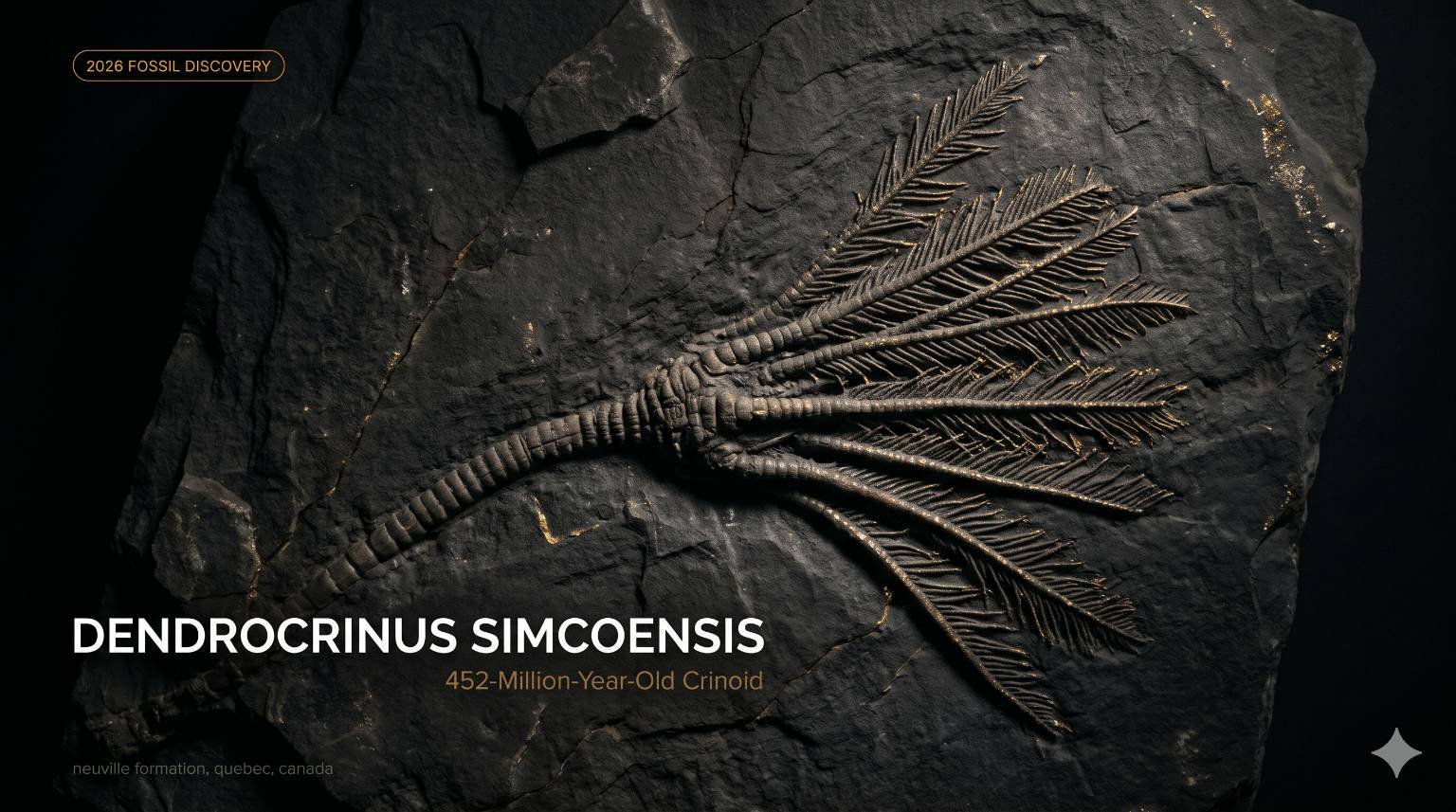
Dendrocrinus simcoensis is an ancient crinoid whose roughly 452-million-year-old fossil preserves some of the oldest-known evidence of delicate feeding structures called tube feet. Researchers described the extraordinary soft-tissue preservation in 2026, revealing new details about life in Ordovician seas. Here are the fossil pictures, anatomy, location and evidence explained.
What is Dendrocrinus simcoensis?
Dendrocrinus simcoensis is an ancient crinoid, a marine animal belonging to the echinoderm group that also includes sea stars and sea urchins. It lived during the Late Ordovician, more than 450 million years ago, long before the earliest dinosaurs. Crinoids are often called sea lilies because their branching arms can look like flowers, but they are animals rather than plants. The research that drew new attention to Dendrocrinus simcoensis in 2026 was not the sudden naming of an entirely new animal. The breakthrough was a remarkable fossil preserving delicate structures called tube feet. These tiny extensions are important for feeding and interacting with moving water. Fossils generally preserve harder skeletal plates, so finding traces of such soft tissue is exceptionally unusual. People searching for Dendrocrinus simcoensis pictures should therefore focus on the preserved anatomical detail and its scientific significance, not simply the beautiful branching outline of a crinoid fossil. The new evidence provides a rare window into a very old ocean ecosystem.
Where was the 452-million-year-old crinoid fossil found?
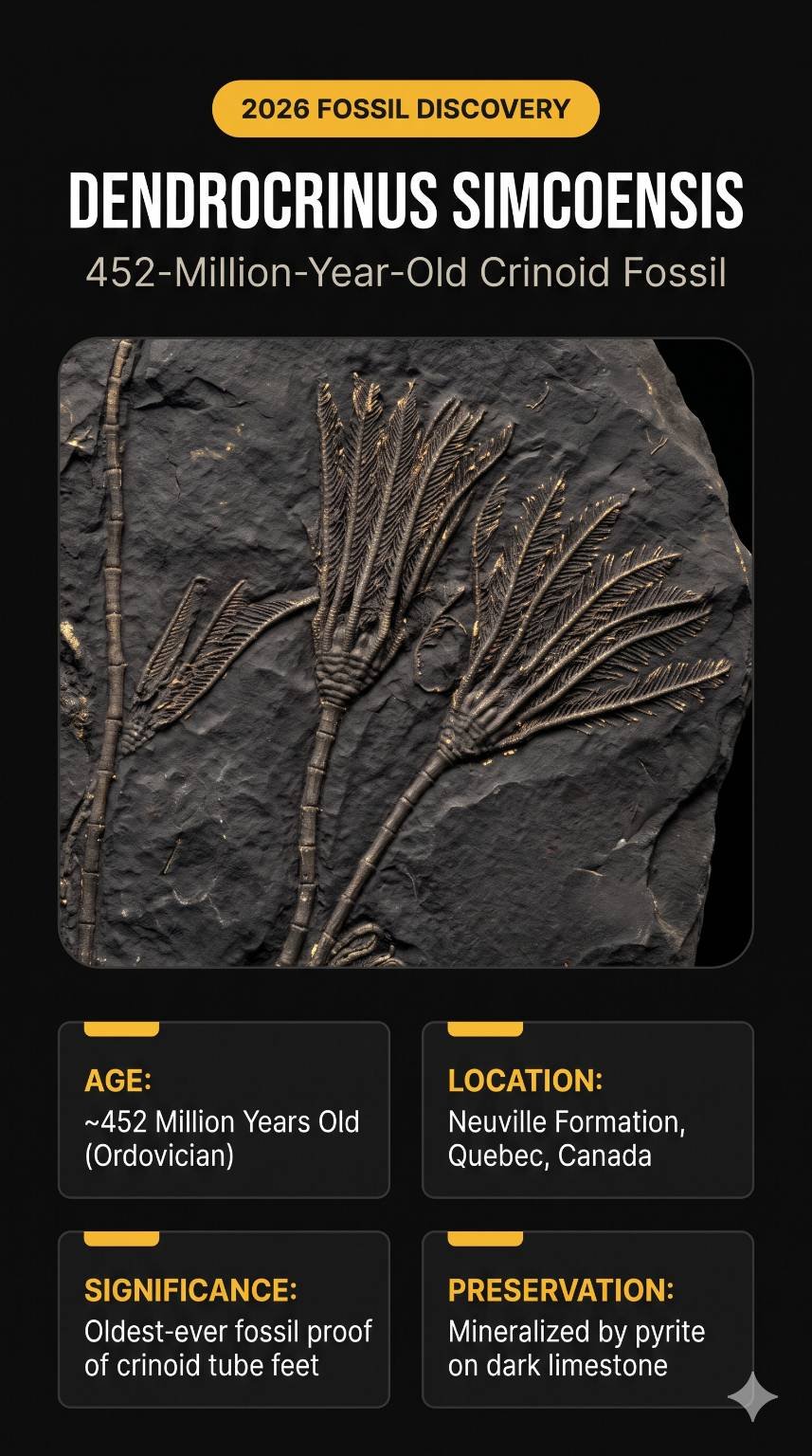
The specimen comes from the Neuville Lagerstätte of Québec, Canada, a fossil locality associated with Late Ordovician marine deposits. A Lagerstätte is a fossil site known for unusually informative preservation, sometimes including structures that would normally decay too quickly to be fossilised. The reported age is about 452 million years, within the period when marine life was undergoing major changes in Earth’s ancient seas. The specimen was not excavated in July 2026 merely because that is when news outlets reported the research. It had been preserved for years at Montréal’s Musée de paléontologie et de l’évolution, where researchers later recognised the significance of the soft-tissue remains. An accurate map should show modern Québec only as a geographical reference. At the time the animal lived, continental positions and ocean environments were very different. Avoid drawing a modern Canadian forest or coastline around the living crinoid and calling it a reconstruction of the Ordovician seafloor.
What are tube feet and why do they matter?
Tube feet are extensions of an echinoderm’s water vascular system. On living crinoids, they are involved in feeding and other interactions with the surrounding water. Unlike human feet, these are not paired bones designed for walking on dry land. They are small soft structures arranged along the animal’s arms. Water moving around the arms can carry food particles, which crinoids capture and transport using specialised tissues. The exact arrangements of tube feet differ across related species and can reveal how a crinoid positioned its arms in currents. The University of Oklahoma team emphasized that size, spacing and arrangement of these structures are informative about ecological role. Most fossils show a crinoid’s mineralised plates and arm branches, not the tiny feeding structures. That is why the discovery is so useful: it connects the elegant fossil skeleton to functional behaviour in the living animal. In an anatomical diagram, label the stalk, cup, arms and tube feet separately.
Why is soft-tissue preservation so rare?
After an animal dies, microorganisms and chemical processes typically break down soft tissues long before a fossil forms. Hard shells, mineralised plates and teeth have a better chance of surviving burial and geological alteration. Exceptional circumstances can slow decay or replace some tissues with minerals before they disappear. The 2026 study reports tube feet preserved as thin pyrite films. Pyrite is an iron-sulfur mineral often nicknamed fool’s gold because of its metallic appearance. Mineralisation can retain a remarkably detailed outline of a structure even though the original soft material is no longer present as living tissue. This is different from finding fresh, flexible tissue inside an ancient rock. Dendrocrinus simcoensis is now reported as the oldest-known example of preserved crinoid tube feet and one of only two documented cases of soft-tissue preservation in crinoids discussed by the authors. This makes the fossil scientifically rare without requiring fantastical claims that its cells are still alive.
How scientists recognised the microscopic fossil structures
Researchers Selina R. Cole, David F. Wright, William I. Ausich and Mario E. Cournoyer studied the specimen and recognised structures associated with the ambulacral feeding system. Their paper appeared in Royal Society Open Science in June 2026, followed by a University of Oklahoma research announcement in July. The study compares the fossil tube feet with the anatomy of living crinoids and the positions of hard skeletal cover plates in other fossil species. Because fossilised soft tissues can be difficult to interpret, anatomical comparisons are essential: a thin mineral trace needs a plausible shape and position within the overall body plan. The authors found that tube-foot spacing showed patterns related to evolutionary relationships and inferred feeding ecology. The discovery was possible because the specimen was already in a curated museum collection, where experts could revisit it with new questions. It is a strong example of why preserving apparently ordinary-looking specimens and maintaining detailed collection records matters.
What did this crinoid look like in life?
A living Dendrocrinus simcoensis likely had a stalk supporting a cup-shaped body and branching arms that could be raised into the current for feeding. Crinoids often resemble delicate underwater plants, but their anatomy is that of a marine invertebrate. The fossil shows a combination of mineralised skeletal structures and unusually informative soft-tissue traces. A reconstruction can show the stalk, arms and the position of feeding structures, yet exact colour, movement speed and surrounding organisms should not be invented. The 2026 research suggests that the distinctive length and spacing of tube feet may be associated with a multidirectional or conical positioning of the arms, differing from some familiar living stalked crinoids. This is an inference grounded in comparative anatomy rather than a filmed observation of a 452-million-year-old creature. The main visual on this page is useful for understanding the overall form; the scientific paper provides the detailed evidence needed to evaluate the soft-tissue interpretation.
Dendrocrinus simcoensis vs modern crinoids
Crinoids are not merely extinct curiosities. Living feather stars and stalked sea lilies still inhabit the oceans, providing researchers with a way to interpret fossil anatomy. Modern crinoids have feeding arms and tube feet, but the arrangement of those structures can differ markedly among lineages. The 2026 paper found that Dendrocrinus simcoensis had a combination of tube-foot lengths and spacing unlike those documented in the modern species used for comparison. That suggests the ancient animal may have exploited water currents in a distinctive way. The authors also related spacing to the shape and arrangement of ambulacral cover plates, which are hard elements more commonly preserved in fossils. Comparing these features can help palaeontologists infer aspects of feeding for species where soft tissue is absent. A responsible side-by-side educational chart labels what is directly preserved, what is observed in living relatives and what is an inference. It should not suggest that the ancient animal was a plant evolving into today’s sea lilies.
What does the fossil teach us about ancient oceans?
The Ordovician was a time when the diversity of marine animals was expanding across many ecological niches. Crinoids became important parts of sea-floor communities, sometimes living among reefs and other benthic organisms. Their arms and feeding structures interacted with currents that carried suspended food. If the configuration of tube feet varied between groups, those differences may record how animals partitioned food resources or adapted to different flow conditions. The Dendrocrinus simcoensis fossil gives researchers an unusually direct anatomical clue instead of relying entirely on skeletal arrangements. This can improve models of early echinoderm ecology and the evolution of feeding adaptations over hundreds of millions of years. However, one specimen does not reveal the exact temperature, salinity or species composition of the entire ocean. Such environmental conclusions require broader geological and palaeontological evidence. Its greatest value is precisely what it preserves: a small but critical part of the animal’s functional biology.
How to interpret crinoid fossil pictures
A good crinoid fossil image shows the stalk, cup and arms clearly, but only a highly informative specimen or close-up will show the exceptionally preserved tube feet. When a picture depicts a branching, fern-like imprint, do not assume every visible branch is soft tissue. Crinoid arms contain mineralised skeletal elements that commonly fossilise; tube feet are much more delicate. The informative poster below the title highlights the scientific story and should be read alongside the original study. Readers can compare published photographs, scale bars and anatomical labels to understand the precise location of the pyrite films. If a gallery shows a decorative fossil from another crinoid species, it can help explain general shape but cannot serve as direct evidence for Dendrocrinus simcoensis. Careful image captions protect the difference between broad educational visuals and the specific fossil specimen that supports the 2026 discovery.
Fact check: was a living 452-million-year-old organism discovered?
No. The fossil records a crinoid that lived more than 450 million years ago. Researchers did not find a living animal of that age, revive a prehistoric creature or recover a functioning set of ancient cells. The scientific term soft-tissue preservation refers to preserved shapes and mineral-replacement traces of structures that would normally rot away. In this case the tube feet are represented by pyrite films rather than fresh tissue. Another misconception is that “sea lily” means a flowering plant; crinoids are echinoderm animals. A third confusion is that the fossil was found for the first time in the 2026 news announcement. The specimen had already been held in a museum, and its special significance emerged through careful expert analysis. A fourth error is to treat all crinoid fossils as identical. Tube-foot spacing varies and may have ecological meaning. Each correction helps readers understand why such an apparently small anatomical discovery attracts scientific attention.
Dendrocrinus simcoensis frequently asked questions
How old is Dendrocrinus simcoensis?
The studied fossil is from the Late Ordovician, approximately 452 million years old.
Where did the fossil come from?
The Neuville Lagerstätte in Québec, Canada, with the specimen held in a Montréal museum collection.
What makes this fossil exceptional?
It preserves traces of tube feet, extremely rare soft structures involved in crinoid feeding.
Is the preserved tissue still fresh?
No. The study describes mineralised pyrite films preserving the structures’ outlines.
Is a crinoid a plant?
No. Sea lilies are marine animals in the echinoderm group.
When was the study published?
The research appeared in Royal Society Open Science in June 2026; University of Oklahoma publicised it in July.
Conclusion and original scientific sources
This fossil is a reminder that museum specimens can preserve astonishing details of ancient anatomy. The scientific value lies in mineralised traces of tube feet and the insights they give into feeding ecology, not in a sensational claim that an ancient animal survived to the present. Updated: 23 November 2026.
Sources: Cole et al., Royal Society Open Science (2026): Exceptional soft-tissue preservation reveals the oldest evidence for tube feet; University of Oklahoma original research announcement, 2 July 2026.
Related science reading
- Indian Bramble Shark (Echinorhinus roinee): New Kerala Deep-Sea Species, Photos & Facts
- India Deep Ocean Mission Discoveries 2026: New Sharks, MATSYA-6000 & 2028 Dive Target






















Share Your Opinion
Comments are closed on this post.