 Vista
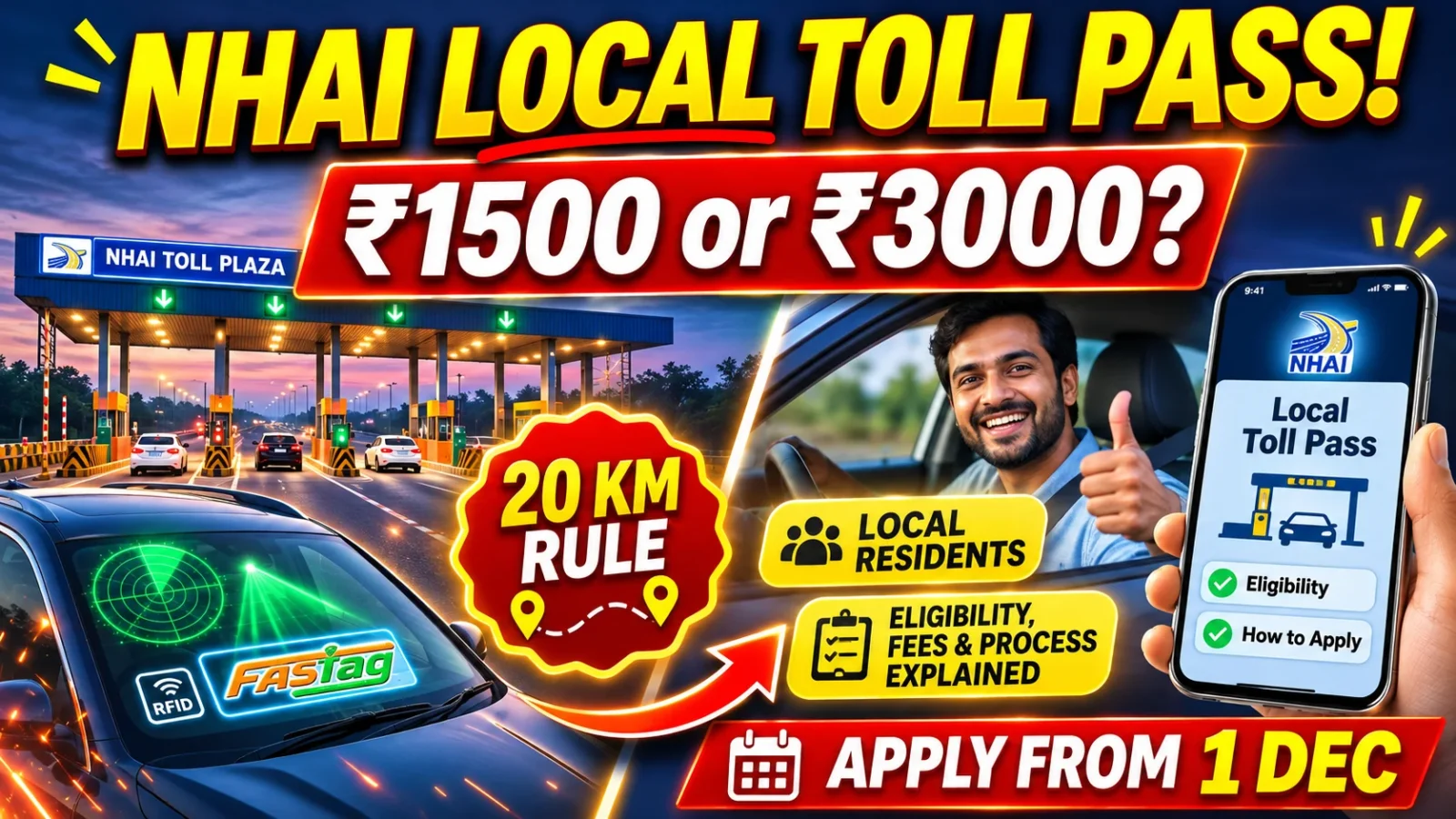
NHAI’s concessional local annual toll pass is now available at eligible National Highway fee plazas for qualifying non-commercial vehicle owners living within a 20 km radius. Under the rules effective 1 November 2026, the annual charge is ₹1,500 at toll plazas outside municipal or local town limits and ₹3,000 at toll plazas within those limits. The distinction is the location of the toll plaza, not whether an applicant happens to live inside a town. A valid, functioning FASTag is required; approval applies to a single eligible fee plaza, not every highway in India. Online application via the official Rajmargyatra app is scheduled to become available from 1 December 2026.
Updated: 22 November 2026. This article explains the NHAI 20 km rule, ₹1,500 versus ₹3,000 criteria, current toll-plaza route, upcoming app application, documents to prepare, real savings calculations and common reasons an application may be refused. It is based on the Ministry of Road Transport and Highways announcement dated 27 October 2026, not an unverified viral message promising a universal ₹1,500 pass.
What is the NHAI Local Annual Toll Pass under the 20 km rule?
The concessional local pass is a targeted toll facility for people who regularly travel through a specific National Highway fee plaza close to their home. NHAI’s earlier local travel arrangements have included monthly passes; the November 2026 amendment adds an annual concession for eligible owners of non-commercial vehicles living within 20 km of a toll plaza. It is intended to reduce repeated toll expenses for qualifying residents, while retaining checks designed to prevent the pass being used for unrelated journeys or commercial fleets.
The legal basis is the National Highways Fee (Determination of Rates and Collection) (Fifth Amendment) Rules, 2026. The Ministry’s 27 October release says the rule takes effect from 1 November 2026. The fee may be revised annually by the Central Government, with revisions taking effect from 1 April. These are rules tied to National Highway fee plazas and should not be presumed to cover every state-road, municipal or private toll booth.
Unlike a nationwide FASTag subscription, a local pass is plaza-specific. If you travel through an entirely different fee plaza, the same concession is not transferable to that location. The announced annual fee is also distinct from a general national annual-pass offer: separate products can have different eligibility, journey limits and validity conditions.
₹1,500 vs ₹3,000 annual toll pass: which fee applies to you?
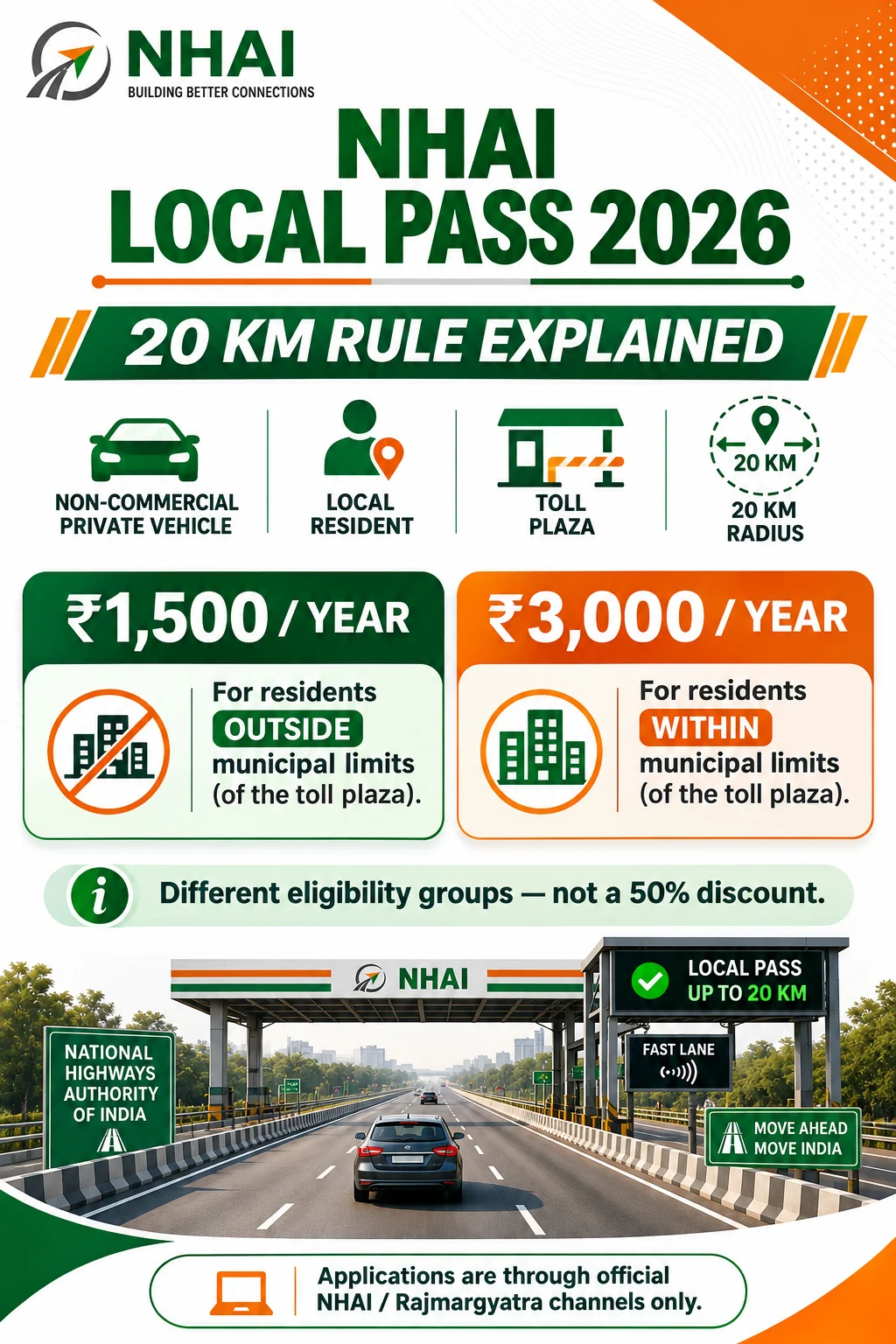
The most misunderstood point is the rate split. The official statement says ₹1,500 per annum where the fee plaza is outside the municipal or local town area and ₹3,000 per annum where the toll plaza is within those limits. Both categories also require an eligible local non-commercial vehicle owner living within 20 km. A rural resident does not automatically qualify for ₹1,500 if their relevant toll plaza is located inside the stipulated urban boundary. Similarly, someone living in town can potentially fall under the outside-plaza category if the specific fee plaza is located beyond the municipal limit and all other conditions are met.
| Condition | ₹1,500/year | ₹3,000/year |
|---|---|---|
| Toll plaza location | Outside municipal/local town limits | Within municipal/local town limits |
| Applicant residence | Within 20 km of that fee plaza | Within 20 km of that fee plaza |
| Vehicle | Eligible non-commercial vehicle with active FASTag | Eligible non-commercial vehicle with active FASTag |
| Pass coverage | Only the approved specific fee plaza | Only the approved specific fee plaza |
| Online facility | Rajmargyatra scheduled from 1 December | Rajmargyatra scheduled from 1 December |
Important: These are separate fee categories, not a discount code converting a ₹3,000 pass to ₹1,500. Avoid paying an agent who says a different address entry will automatically produce the cheaper price; eligibility must follow the official records and location of the relevant plaza.
NHAI Local Pass eligibility: who qualifies and who is excluded?
According to the Ministry, the scheme is for owners of non-commercial vehicles who are residents within 20 kilometres of an eligible toll plaza and have a valid and functional FASTag. The concession is tied to travel through that specific plaza. It is not permission for every family car, taxi or truck to use the same pass freely. Eligibility has to be assessed against the applicant, the vehicle and the plaza rather than a broad regional claim.
Two exclusions are explicit in the official announcement. First, the concession is unavailable on National Highways and Expressways that use a closed user-fee collection system, where fee calculation is linked to a closed, typically distance-based network. Second, the scheme is not to be issued where a service road or an alternative road is available for use by commuters. These are crucial limitations: living nearby and holding a FASTag may not be enough if your plaza is excluded by road design or fee system.
If an address appears to be just outside the 20 km radius or the toll plaza is near a municipality boundary, do not decide eligibility from a simple Google Maps driving route alone. The authority needs to apply its prescribed verification criteria. If refused, ask the plaza office for the reason and whether any record or document can be corrected, rather than assuming a national entitlement that overrides the site rules.
How to apply for a FASTag annual local pass: toll plaza now, Rajmargyatra app from December
As of 22 November 2026, the Ministry says the annual local pass has been available at eligible toll plazas since 1 November. It separately says the annual local pass will be available through Rajmargyatra from 1 December 2026. Do not confuse the effective date of the rule with the digital application launch. If you need the pass before December, the official path is the relevant eligible toll plaza, subject to local verification procedures.
- Identify the specific fee plaza. Check its official name and location and confirm that it is among the eligible National Highway fee plazas.
- Verify whether the plaza lies inside or outside municipal limits. This determines which announced annual fee category is relevant.
- Confirm residence within the prescribed 20 km range. Ask the plaza or relevant official channel how the residence is verified for that location.
- Check the FASTag. It should be valid, correctly associated with the vehicle and functional rather than blacklisted or inactive.
- Contact the eligible toll plaza for the current application process. Present the required ownership and address evidence requested under the official verification process.
- From 1 December, check Rajmargyatra. When the feature becomes available, follow its actual screens to apply or renew. Do not invent an activation sequence before the official rollout.
- Retain confirmation and verify plaza-specific activation. Ask how the concession is recognized through FASTag before relying on it during a trip.
Existing digital local-pass services were available at many plazas before this amendment, but app support for the specific new annual concessional pass is scheduled separately. Use official channels only; neither a WhatsApp forward nor a third-party form promising instant approval is proof of eligibility.
Which documents are needed for the 20 km FASTag Local Pass?
The Ministry’s short press release sets out the resident-distance, vehicle-category and FASTag requirements; it does not publish one universal nationwide checklist of every accepted proof for every applicant. In practice, be ready to show a reliable address document establishing the claimed residence, the vehicle registration certificate or ownership evidence, and the active FASTag/vehicle details. An office may request additional records, identity verification or details of the relevant residence; the definitive list should come from the toll operator or official Rajmargyatra instructions when available.
Prepare clear copies or originals as directed; do not submit Aadhaar scans, OTPs, bank credentials or FASTag login passwords to social-media accounts. A vehicle registered elsewhere is not automatic proof of eligibility or ineligibility; the prescribed residence and ownership checks matter. If the FASTag details do not match the vehicle registration, resolve that with the authorized FASTag issuer before paying for a pass. Charges should be made only through authorized channels with a receipt.
₹1,500 vs ₹3,000 Local Pass savings calculator: annual versus monthly
The financially correct comparison is between the actual current monthly local pass price at your specific plaza and the annual option for the same eligible applicant. ₹360/month is only an illustration, not the officially announced monthly price for every plaza. The basic formula is annualized monthly cost = monthly rate × 12; annual saving = annualized monthly cost − applicable annual local-pass fee. The result could be negative if the monthly tariff is sufficiently low or if the owner does not need passage all year.
| Illustrative monthly rate | 12 months | Saving with ₹1,500/year | Saving with ₹3,000/year |
|---|---|---|---|
| ₹300 | ₹3,600 | ₹2,100 | ₹600 |
| ₹360 | ₹4,320 | ₹2,820 | ₹1,320 |
| ₹400 | ₹4,800 | ₹3,300 | ₹1,800 |
| ₹250 | ₹3,000 | ₹1,500 | ₹0 |
These examples illustrate arithmetic, not quoted rates at any named plaza. There is no legitimate choice between the ₹1,500 and ₹3,000 categories merely to maximize savings—the appropriate rate follows the eligible plaza’s municipal classification. If you visit the plaza only for two months each year, comparing a whole-year purchase with your actual travel pattern may yield a different recommendation. Some users may find the existing monthly arrangement more suitable.
Local Pass versus other FASTag annual passes: avoid mixing up schemes
A local resident concession is not the same thing as every product called a FASTag annual pass. Other passes may be designed for wider networks, personal non-commercial vehicles, limited numbers of trips or a fixed validity period. The new NHAI 20 km local annual pass is narrower: eligibility hinges on proximity and the specific eligible fee plaza, and it is not transferable to another toll booth. Readers should always compare who can apply, where it works, what fee applies and whether that pass replaces or supplements an existing arrangement.
If a highway route has multiple fee plazas, do not presume one local pass covers them all. If you move home, replace the car, change your FASTag, or move from a personal vehicle to a commercial vehicle, seek clarification from the issuing authority on whether continued validity or a new application is needed. The rules exist for qualifying residents, not unrestricted interstate travel.
NHAI 20 km Local Toll Pass FAQs
1. Is the ₹1,500 annual local pass available from November 2026?
Yes, at eligible National Highway fee plazas from 1 November 2026, according to the Ministry. The mobile-app availability date is separately scheduled for 1 December.
2. Can I apply through the Rajmargyatra app today?
On 22 November 2026, the government says the particular annual concessional pass will be available in Rajmargyatra from 1 December 2026. Until then, check with your eligible toll plaza.
3. Is everyone living within 20 km eligible?
No. You must satisfy the non-commercial vehicle and valid FASTag conditions, and the relevant plaza must not fall under an exclusion such as a closed fee system or an available alternative road.
4. Do city residents pay ₹3,000 and village residents ₹1,500?
Not necessarily. The distinction in the release concerns whether the toll plaza is inside or outside municipal/local town limits, in addition to the applicant’s 20 km residence requirement.
5. Is the concession valid at every toll plaza?
No. The annual local pass applies only to the specific fee plaza for which it is issued and cannot be transferred to other toll plazas.
6. Can a commercial taxi or goods vehicle get this pass?
The announced scheme is for eligible non-commercial vehicle owners; a commercial vehicle is not covered by the stated eligibility.
Official source, update date and bottom line
See the Ministry of Road Transport and Highways / PIB announcement dated 27 October 2026 for the rates, limitations, dates and legal basis. NHAI also publishes public guidance at nhai.gov.in. Check the official Rajmargyatra service for app updates and avoid unofficial collection links.
Bottom line: For a qualifying owner of a non-commercial vehicle living within 20 km of an eligible toll plaza, the annual local pass costs ₹1,500 or ₹3,000 depending on the plaza’s municipal classification. The concession has been available at eligible toll plazas since 1 November 2026; Rajmargyatra access is scheduled for 1 December 2026. Compare your actual monthly cost before applying and keep the official confirmation. Conditions, documents and rate revisions should always be verified for your specific fee plaza.




















Share Your Opinion
Comments are closed on this post.