 Vista
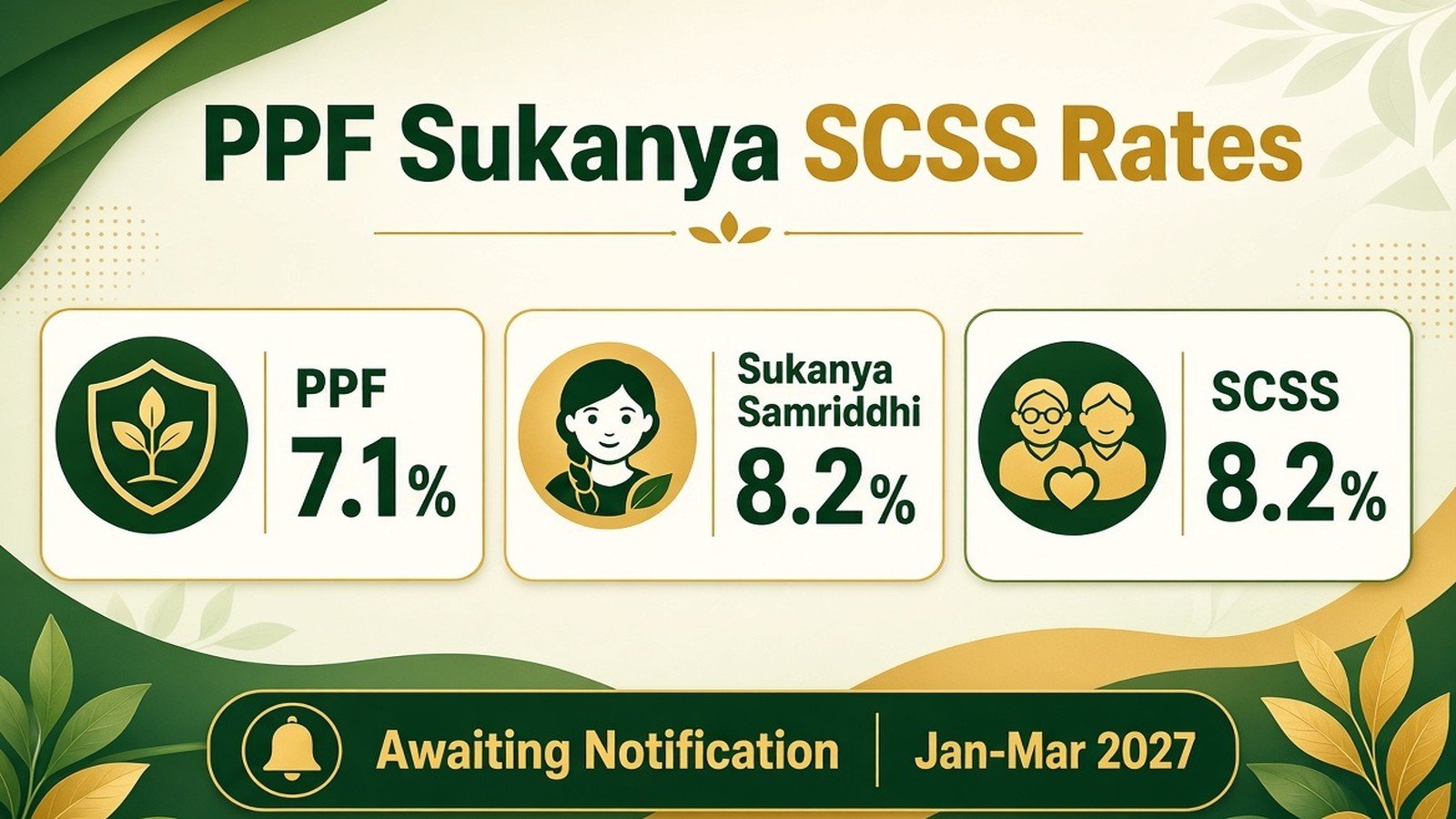
Small Savings Rates January–March 2027: the Finance Ministry has not yet notified the next quarter’s rates. The latest confirmed October–December 2026 figures are PPF 7.10%, Sukanya Samriddhi 8.20% and SCSS 8.20%; they must not be passed off as final January 2027 rates.
NOTICE: January 2027 rates are PENDING; figures below are confirmed only for October–December 2026.

Updated: 22 November 2026 | Next quarter: 1 January–31 March 2027
PPF, Sukanya and SCSS rates for January–March 2027: the direct answer
As of 22 November 2026, the Government of India has not yet announced the interest rates for the January–March 2027 quarter of its small-savings schemes. The latest confirmed schedule covers 1 October to 31 December 2026: Public Provident Fund (PPF) earns 7.10% per annum, Sukanya Samriddhi Account (SSY/SSA) earns 8.20%, and Senior Citizens’ Savings Scheme (SCSS) earns 8.20%. All three were unchanged from July–September 2026.
These are not rates formally approved for the next quarter. The Ministry of Finance reviews small-savings scheme rates on a quarterly schedule and ordinarily announces a new quarter’s decision towards the end of the preceding quarter. A headline promising that the January 2027 PPF rate has already been increased to 7.5%, or guaranteed to remain at 7.1%, would be speculation until the Department of Economic Affairs issues its notification.
This guide tells savers which numbers are real today, which scheme is intended for whom, how rate changes affect old versus new deposits, and where to verify the next government memorandum before making an investment.
Current verified Oct–Dec 2026 interest rate table
The central government office memorandum F.No.1/4/2019-NS dated 30 September 2026 continued the July–September interest schedule for the October–December quarter. An official small-savings distribution page maintained by Indian Bank confirms the scheme-by-scheme rates. The key current figures are PPF 7.10%, SSA 8.20%, SCSS 8.20%, National Savings Certificate (NSC) 7.70%, Kisan Vikas Patra (KVP) 7.50%, Post Office Monthly Income Scheme (MIS) 7.40%.
Other published rates include one-year Time Deposit 6.90%, two-year deposit 7.00%, three-year deposit 7.10% and five-year deposit 7.50%, along with the separately governed recurring-deposit account. The precise compounding or payout method differs: PPF and SSA credit interest annually, SCSS pays interest quarterly, and MIS provides a monthly payout rather than annual compounding of that payout.
The bank explicitly notes that rates for SCSS, KVP, NSC, Time Deposits and MIS apply to accounts opened in the specified quarter. Treating every historical fixed-rate deposit as if it automatically reprices each quarter would be incorrect. The next quarter requires its own government-issued notice.
When will the January–March 2027 rates be announced?
Government small-savings rate changes are normally notified on a quarterly basis. The January–March 2027 quarter begins 1 January 2027 and ends 31 March 2027; an announcement would ordinarily be expected towards the end of December 2026, based on the established release pattern. The exact official notification date and decision are not confirmed as of this article’s update.
To check the decision, look for a Department of Economic Affairs memorandum titled along the lines of ‘Revision of interest rates for Small Savings Schemes for Q4 of FY 2026–27’. An India Post circular or an authorised bank rate table may also reproduce the central government’s decision. The document should state the effective quarter and which schemes have changed or remained unchanged.
A search result headed ‘PPF 2027 new interest rate’ may show the current October–December numbers because the following quarter has not yet started. Always find the effective-from date and issuing authority rather than assuming the publication year in a headline is the effective year of the rate.
How do government small-savings rates get reviewed?
The Finance Ministry periodically reviews the administered interest rates of several small-savings instruments. The framework has historical links to government-security yields and scheme-specific spreads, although actual quarterly outcomes depend on government decisions. Therefore no simple calculator or media prediction can guarantee the next rate from today’s bond yield alone.
Rate reviews provide a mechanism for government-supported savings products to respond to changing financial-market conditions, but they do not necessarily produce adjustments every three months. In fact, the September 30, 2026 memorandum explicitly kept all listed rates unchanged from the immediately preceding quarter. A series of unchanged decisions is not proof that rates will never change.
A rise in RBI repo rate or bank FD rates can influence public expectations, yet it does not automatically amend PPF, SSY or SCSS. The relevant legal notification comes from the central government, not the Reserve Bank’s ordinary bank lending-rate press release.
PPF interest rate: 7.1%, eligibility and long-term rules
The Public Provident Fund is a government-backed long-term savings account available through designated banks and post offices. The current annual rate is 7.1% for October–December 2026. PPF generally involves a 15-year maturity framework with extension options in blocks of five years. The usual minimum annual contribution is ₹500 and the combined annual upper limit is ₹1.5 lakh, subject to applicable scheme rules.
PPF interest is calculated according to the scheme’s monthly balance rule and is credited annually. Deposits made early enough in a month can affect the eligible balance used for that month’s interest computation. Savers commonly use the first five days of the month as an important timing reference, but account-specific records and the PPF Scheme should determine the exact interest calculation.
Unlike a fixed five-year bank deposit, PPF interest can reflect government-notified rates during the ongoing tenure. A person who opened a PPF many years ago should therefore not assume that the rate printed at opening is locked for the entire 15 years. The future January–March rate may affect its next accrual period, but the government has not yet set it.
Sukanya Samriddhi: 8.2% and the girl-child savings account
The Sukanya Samriddhi Account (SSA or SSY) is a government-supported long-term savings scheme for eligible girl children. Under the scheme, an account may generally be opened by a guardian for a girl who has not attained age ten, subject to rules about number of accounts and family circumstances. The minimum annual deposit is ₹250, and deposits can total up to ₹1.5 lakh per financial year.
The scheme’s maturity is normally 21 years from the opening date. Deposits are generally made for the first 15 years from opening, and specified withdrawals for education and early closure for marriage have conditions. The presently notified annual interest rate is 8.20%, credited as prescribed by the scheme. It is not a fixed 8.2% contractual rate for every remaining year until maturity.
Tax benefits are often discussed under Section 80C and related exemptions; actual deduction eligibility depends on the applicable tax regime and statutory rules. Parents should compare the long lock-in, deposit ceiling, girl child’s age, future education needs and emergency liquidity rather than simply ranking schemes by current advertised rate.
Senior Citizens’ Savings Scheme: 8.2% and quarterly payout
The Senior Citizens’ Savings Scheme (SCSS) generally serves eligible senior citizens aged 60 or above, with certain retirement-related exceptions for eligible younger applicants. It has a typical five-year term, with eligible extension choices, and an overall deposit ceiling of ₹30 lakh under the applicable scheme rules. The current rate on qualifying fresh deposits opened in October–December 2026 is 8.20% per annum.
SCSS differs sharply from PPF and SSY because its interest is generally paid quarterly. It is designed to support regular cash flow rather than letting the interest automatically accumulate in the same account to maturity. For an illustrative deposit of ₹10 lakh at 8.2%, simple annual interest is ₹82,000, and four equal quarter payments would be approximately ₹20,500 each before any applicable tax or TDS. Actual scheduled payment dates follow the scheme rules.
The rate applicable to a new SCSS deposit is generally fixed for that deposit’s original term; a subsequent quarterly rate change does not reset every existing SCSS account. Renewals and new deposits may follow rates effective when the relevant action occurs. The details should be checked against the bank or post office’s official account documents.
PPF vs SSY vs SCSS: which one suits which objective?
These schemes have different eligibility rules and payment patterns. PPF is mainly an individual long-term savings and tax-planning instrument; it accepts smaller yearly deposits and normally has limited early access. SSY is a girl-child savings framework with a long maturation period and a specific deposit window. SCSS targets eligible seniors who want recurring quarterly interest payouts over a shorter specified term.
Comparing only 7.1% versus 8.2% without considering tax, liquidity or payout method is misleading. A scheme giving 8.2% with quarterly taxable payouts is not economically identical to another scheme crediting 8.2% annually under its tax rules. The intended beneficiary, deposit ceiling and permitted withdrawals may matter more than a 1.1 percentage-point headline difference.
No single scheme is the best for all households. Someone prioritising money for education in two years should examine liquidity closely before locking funds away; a senior needing quarterly income may find cash flow more relevant than annual compounding. Individual circumstances, emergency savings and diversification matter.
Illustrative interest examples: ₹1 lakh for one year
At a simple annual comparison level, ₹1,00,000 × 7.10% = ₹7,100 of one-year interest at the currently notified PPF rate, while ₹1,00,000 × 8.20% = ₹8,200 at the currently notified SSY or SCSS rate. The arithmetic difference is ₹1,100 per ₹1 lakh for one year. These figures assume the full capital remains eligible for an entire year at that unchanged rate.
Actual PPF and Sukanya crediting follows statutory balance and timing rules, and rates can be revised during a longer saving period. SCSS pays its interest quarterly, so the timing and reinvestment, if any, differ. Consequently a simplistic one-year comparison should not be used as a promised maturity value for any of these products.
An important future scenario is a hypothetical PPF increase from 7.1% to 7.3%: on a ₹1 lakh constant eligible balance, that would be an extra ₹200 per year before considering the scheme’s timing rules. This is only a mathematical scenario; no such January 2027 rate has been notified.
Will a January 2027 rate change affect existing accounts?
Under PPF and SSY, the ongoing interest accrual generally reflects successive notified government rates during the account’s life. A future quarter’s revision can affect interest calculations for existing accounts, so their published rate is not permanently locked from the day they were opened. The exact monthly balance and crediting rules still matter.
For SCSS, NSC, time deposits and similar fixed-rate certificates, the rate accepted on opening is generally applicable to that deposit’s fixed term; rate revisions mainly affect fresh eligible deposits or renewals in the new quarter. The official bank rate table explicitly identifies which product rates relate to accounts opened within the specific October–December quarter.
The distinction is important for a saver who already owns an SCSS account at 8.2%. A hypothetical government change in January would not necessarily alter that account’s quarterly payment; however, it could affect the rate offered on an entirely new SCSS deposit. Contact the issuing post office or bank if a particular account has unusual extension terms.
What are the income-tax rules for interest and investment?
Tax treatment differs substantially. PPF and qualifying Sukanya accounts generally offer tax advantages under their governing statutes, and contributions may have Section 80C implications for taxpayers entitled to those deductions. However, deductions may not be available under the default new income-tax regime, so ‘every saver gets ₹1.5 lakh tax deduction’ is not a correct blanket claim.
SCSS interest is generally taxable according to the account holder’s tax situation, and TDS rules may apply above relevant thresholds. The fact that an SCSS investment can qualify for Section 80C under the relevant regime does not automatically make the quarterly interest tax-free. A post office or bank may require PAN and appropriate declarations depending on applicable rules.
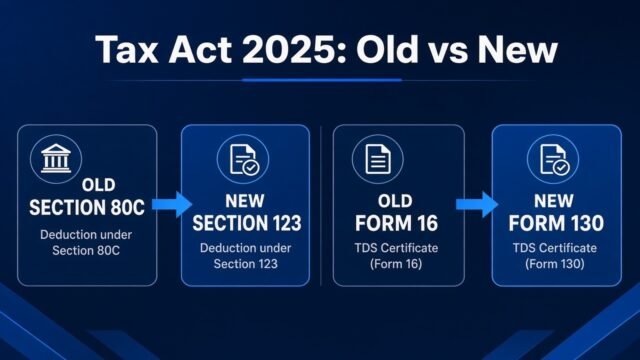
Tax Year 2026–27 is governed by the new Income-tax Act, 2025; transitional section numbers and tax-regime provisions should be checked using updated official guidance. A rate comparison is not a complete after-tax return comparison without the investor’s personal tax bracket and eligibility.
How to check official January–March 2027 interest-rate notification
Start with the Department of Economic Affairs (DEA) on the Ministry of Finance website. Look for an office memorandum on ‘Revision of interest rates for Small Savings Schemes’, carrying an issue date in late December 2026 and an effective period from 1 January to 31 March 2027. The correct notice is normally marked with the relevant financial-year quarter.
Cross-check the India Post savings section or your authorised bank’s small-savings interest page. A real notification will specify rates or explicitly say they remain unchanged. Posts dated in November 2026 that claim a confirmed January hike without an associated document should not be treated as proof. Screenshots cropped to hide the quarter can create especially convincing confusion.
Before opening an SCSS or time-deposit account, ask which government-notified rate applies on the actual opening date. For ongoing PPF and Sukanya accounts, check the new quarterly rate and the specific crediting rules. Retain a statement or official confirmation rather than relying on an unofficial WhatsApp chart.
Common myths, future searches and planning checklist
Myth one: 8.2% on SCSS and Sukanya means the account structures are identical. They are not: payout schedules, eligibility, taxes and access differ. Myth two: every small-savings scheme reprices existing balances quarterly. That depends on the instrument. Myth three: government-linked means the future interest rate can never fall. Rates are reviewed and may change under the notified framework.
Likely reader questions include ‘PPF interest rate January 2027 confirmed?’, ‘Sukanya Samriddhi January March 2027 government notification’, ‘SCSS existing account rate change’, ‘PPF versus SCSS tax and interest’, ‘post office FD rates January 2027’, and ‘small savings Q4 2026–27 notification PDF’. These are anticipated searches, not measured keyword volumes.
The key planning habit is to separate current confirmed rates, next-quarter forecasts and account-specific contractual rules. A reliable financial decision can be based on all three, but a future forecast should never be presented as a government notice already in force.
PPF, Sukanya and SCSS 2027: FAQs
What is the PPF interest rate for January to March 2027?
Not yet announced as of November 22, 2026. The current confirmed October–December PPF rate is 7.10% per annum.
What is the Sukanya Samriddhi interest rate in 2027?
The January–March 2027 rate is pending. The last confirmed October–December 2026 rate is 8.20%.
What is the SCSS rate for January 2027?
No Q4 2026–27 notification has been announced yet. The October–December rate for eligible new SCSS accounts is 8.20%.
Will a new PPF rate affect my old PPF account?
Generally, PPF interest reflects government rates notified during the tenure; it is not locked for all fifteen years at account opening.
Will an existing SCSS account earn the new rate?
Existing SCSS deposits generally retain the rate established at opening for their original term; new deposits may use the rate applicable when opened.
When can I verify the official new small-savings rates?
Look for the Ministry of Finance/Department of Economic Affairs Q4 FY2026–27 office memorandum, normally expected towards late December 2026.
Conclusion and government source links
The Government of India’s next office memorandum, not a forecast, will establish January–March 2027 rates. Existing scheme eligibility, deposit and payout rules remain key to personal planning.
- Department of Economic Affairs – small-savings interest rate notifications
- Department of Economic Affairs – interest-rate notices index
- Indian Bank – October to December 2026 small-savings interest rate table (government OM 30 September 2026)
- India Post – Official Post Office Saving Schemes and account information
- India Post – official Sukanya Samriddhi scheme document
- Department of Economic Affairs – rules governing PPF, SSY, SCSS and other schemes
Financial disclaimer: Educational information only, not personal investment advice. Future rates are not confirmed; verify the issuing bank/post office and government notification.





















Share Your Opinion
Comments are closed on this post.