 Vista
UPI rules in November 2026 need one major clarification: the proposed 0.4% Merchant Discount Rate (MDR) on select person-to-merchant transactions above ₹2,000 has not started on its original 15 October 2026 date. NPCI deferred the rollout on 13 October, and, as of the latest reporting checked on 22 November 2026, a replacement implementation date had not been officially announced. Ordinary person-to-person UPI transfers remain free for users. Separately, a 50 balance-enquiry / 25 linked-account-list limit already existed under an NPCI circular dated 21 May 2025, and IndusInd Bank introduced certain ₹25 failed POS/ATM fees from 1 November 2026. These are three different policies, not a universal new charge on every UPI payment.
Updated 22 November 2026. Quick answer: sending ₹5,000 to a friend by regular bank-account UPI is not subject to the announced 0.4% merchant fee. When the delayed framework is implemented, the 0.4% MDR is aimed at specified eligible merchant-side transactions, and small merchants in qualifying P2PM tiers are exempt. NPCI’s 50-balance-check rule limits repetitive app balance enquiries, not your daily UPI transfers. The ₹25 IndusInd fee concerns selected failed card/POS and on-us ATM events on applicable bank account variants, not every failed UPI transaction.
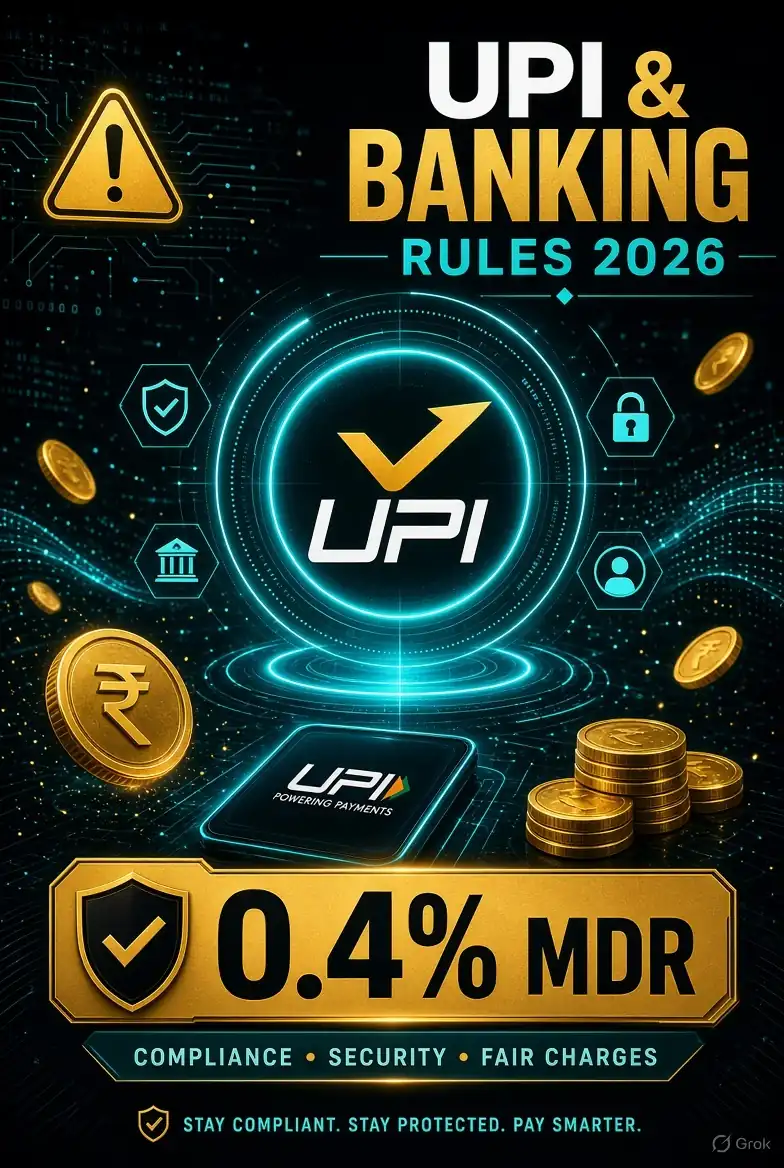
UPI 0.4% MDR 2026: announced in September, delayed in October, still pending in November
The Ministry of Finance and NPCI described a new Merchant Discount Rate framework on 15 September 2026, initially planned for 15 October. Under that framework, eligible bank-account-funded Person-to-Merchant (P2M) UPI payments above ₹2,000 would carry a 0.4% MDR, capped at ₹300 for payments of ₹75,000 and above. The charge would go to participants providing payment infrastructure rather than being a government tax. However, NPCI’s steering committee subsequently postponed the launch because of merchant concerns during the festive season.
On 13 October, NPCI stated that the rollout would take place after Diwali at a date to be notified separately. Coverage from 19 November 2026 continued to report no new date, citing discussions with merchants and policymakers. Therefore a headline declaring that every merchant started paying the 0.4% charge on October 15 would be inaccurate as of this update. Some earlier notices, FAQs and infographics still carry the original schedule, so read them alongside the later deferral announcement. Reports forecasting January 2027 or after elections are predictions, not an official notified date.
Why publish an explainer now? UPI customers want to know whether they owe anything; merchants need to understand the proposed categories and costs; and app users are separately seeing balance enquiry limits. A date-sensitive explanation avoids blending regulations that were announced on different days and affect different people.
P2P vs P2M vs P2PM: who would actually pay UPI MDR?
P2P (person to person) is a normal bank-to-bank transfer between individuals, such as sending money to a family member or splitting a bill with a friend. The announced merchant MDR framework does not cover these transfers. P2M (person to merchant) refers to payments to businesses classified as merchant accounts. The announced 0.4% MDR targets select transactions in this category above ₹2,000 once implemented. P2PM (person-to-person-merchant) is a specially classified small-merchant arrangement. Under the September rules, qualifying merchants receiving up to ₹1 lakh per month through UPI QR in that category stay at zero MDR.
| Payment type | Example | September 2026 MDR framework |
|---|---|---|
| P2P | ₹8,000 to a relative | No announced merchant MDR; customer remains free |
| P2M up to ₹2,000 | ₹1,500 to an eligible merchant | No 0.4% MDR under threshold |
| P2M above ₹2,000 | ₹5,000 to an eligible large merchant | Proposed 0.4% merchant-side MDR when implemented |
| P2PM qualifying small merchant | ₹3,000 to a qualifying small QR merchant | Exempt under applicable category/receipt ceiling |
A shop’s QR code alone does not reveal its precise classification to a shopper. Neither an individual payment crossing ₹2,000 nor a handwritten bill proves that a merchant is in the chargeable tier. Classification and bank/payment-provider settlement arrangements decide applicability. For shoppers, the central consumer protection point remains: the announced 0.4% is not a customer transaction charge.
UPI MDR calculation examples: 0.4%, ₹300 cap and ₹5 essential sectors
The September framework sets a proposed base rate of 0.4% for eligible merchant payments above ₹2,000, capped at ₹300 for qualifying payments of ₹75,000 or higher. The Ministry also specified a flat ₹5 merchant MDR on transactions above ₹2,000 in sectors including railways, telecommunications, insurance, fuel and agricultural inputs, and a separate 0.02% capped at ₹300 framework for certain capital-market transactions. These are special categories, not an added ₹5 tax to consumers. The effective rollout remains deferred as of this article.
| Illustration | Proposed merchant MDR | What customer pays as the announced UPI fee |
|---|---|---|
| ₹1,500 standard eligible P2M | ₹0 (below threshold) | ₹0 |
| ₹2,500 eligible P2M | ₹10 (0.4%) | ₹0 |
| ₹10,000 eligible P2M | ₹40 (0.4%) | ₹0 |
| ₹75,000 eligible P2M | ₹300 (cap) | ₹0 |
| ₹10,000 designated essential-sector P2M | ₹5 flat, if covered | ₹0 |
| ₹3,000 to qualifying small P2PM merchant | ₹0 (exempt) | ₹0 |
These are arithmetic examples of the announced rules, not evidence that a 0.4% levy has already gone live. If the final regulation changes before implementation, future examples may need updating. NPCI and the Ministry said merchant fees should not be passed to consumers, and UPI apps should not impose a hidden platform fee on covered bank-account UPI transfers.
UPI Balance Check 50 Limit Exceeded: what the NPCI rule actually says
NPCI’s 21 May 2025 circular on UPI API usage set a balance-enquiry limit of 50 per app per customer in a rolling 24-hour window. It separately limited List Account requests—used to discover bank accounts linked to a mobile number—to 25 per app per customer per rolling 24 hours. These safeguards reduce excessive system calls at peak times. Their date is 2025, so they should not be marketed as a newly introduced rule from November 2026.
The 50 figure applies to the balance enquiry API, not to successful P2P transactions, merchant payments, or money transfers. It also does not mean a bank gives you only 50 opportunities a month to spend or receive money. A UPI app may independently restrict repeated checks to reduce server load, and issuers may attach available balance details to a successful payment message. The precise app error can differ by service provider.
What should you do when “balance check limit exceeded” appears?
- Stop tapping Check Balance repeatedly; repeated requests may only trigger more restrictions.
- Remember the NPCI rule uses rolling 24 hours, not necessarily a midnight reset. Allow enough time after recent checks.
- Use your bank’s official mobile banking, statement or other supported authorised balance service, if available, rather than guessing the amount.
- Review app updates and check connectivity if the error occurs unexpectedly; a network error and a rate-limit error are different issues.
- If the restriction persists beyond the relevant period, contact the UPI app or issuer bank through official support and share only non-sensitive diagnostics.
Do not give a support caller your UPI PIN or OTP to ‘reset the limit’. A UPI PIN authorizes payment; the 50-enquiry rule does not require a PIN reset, account unlock charge or deposit to regain access.
IndusInd Bank ₹25 failed transaction charge from 1 November 2026: who is affected?
IndusInd Bank’s official revision to savings account and debit-card service charges, effective 1 November 2026, includes ₹25 per declined POS transaction and ₹25 per unsuccessful withdrawal due to insufficient funds at an IndusInd Bank ATM (on-us ATM) for listed savings account variants. The listed fees are exclusive of applicable GST. The published schedule lists many accounts across Indus Classic, Privilege, Advantage, Delite, Indie and other product variants. It is essential to check your own specific savings-account type and the bank’s schedule rather than treating this as a nationwide RBI penalty.
What this does not say: NPCI has not imposed a ₹25 charge for every failed UPI payment across all banks. A wrong UPI ID, a server timeout, a reversal pending at another bank, or an ATM failure for reasons unrelated to the published IndusInd schedule should not automatically be categorized as this same fee. For the on-us ATM fee, the stated reason is specifically insufficient balance. The POS decline line and product applicability should be assessed in the bank’s terms and the actual transaction circumstances.
If you see a ₹25 debit you do not recognize, check the account statement entry, transaction date, card/POS or ATM event, and applicable schedule. Raise a service request with the bank if the charge appears inconsistent. Never share card PIN or CVV with anyone claiming they can reverse it instantly.
New UPI rules 2026: myth vs fact and safety checks
| Viral claim | Verified position as of 22 Nov 2026 |
|---|---|
| “0.4% UPI charge has applied since 15 Oct” | No; the planned merchant MDR rollout was postponed, with no confirmed new date. |
| “Customers pay a 0.4% surcharge on payments above ₹2,000” | No; the proposed MDR is merchant-side for selected P2M transactions. |
| “50 balance checks means 50 UPI payments only” | No; it is a separate balance enquiry API limit, dated May 2025. |
| “₹25 charged by every bank when any UPI payment fails” | No; the cited ₹25 charges come from specified IndusInd POS and on-us ATM cases. |
| “Every QR code merchant above ₹2,000 must pay MDR” | No; classification, exemptions and timing matter, including qualifying P2PM merchants. |
For consumers, continue checking the payee’s name and merchant identifier before approving a transfer. A UPI collect request, QR code or payment link can be abused in scams regardless of the MDR policy. If money was mistakenly transferred, follow the normal bank or UPI-app grievance process. For a related practical guide, see what to do after sending money to the wrong UPI ID or bank account.
UPI banking rules FAQs for November 2026
1. Has 0.4% MDR started for UPI payments above ₹2,000?
The originally scheduled 15 October 2026 rollout was postponed. As of 22 November, recent reporting says no replacement effective date has been officially confirmed. It is designed for select merchant categories, not an ordinary customer surcharge.
2. Will a customer sending ₹10,000 to a friend pay MDR?
No. The announced framework continues free person-to-person UPI transfers, irrespective of the amount, subject to normal bank/app usage and transfer limits unrelated to MDR.
3. What is P2PM in UPI?
It is a category for qualifying small merchants accepting UPI payments. Under the September proposal, eligible P2PM merchants with monthly UPI QR receipts up to ₹1 lakh remain exempt from merchant MDR.
4. Is the UPI balance check limit 50 per month?
No. NPCI’s circular specifies 50 per app per customer per rolling 24 hours. It concerns enquiries, not the number of financial transfers.
5. When will the UPI balance check limit reset?
The circular uses a rolling 24-hour period, so it is not necessarily reset at midnight. Wait for the applicable prior requests to leave the rolling window and follow app guidance.
6. Does IndusInd charge ₹25 whenever UPI fails?
No. Its 1 November revision covers specified declined POS transactions and insufficient-funds failures at its own ATMs for applicable savings-account variants. The listed fees exclude applicable GST.
Official documents, date check and conclusion
Read the original NPCI September 2026 MDR FAQ (PDF), the Finance Ministry clarification of 15 September, the 13 October deferral announcement reporting, and Reuters’ 19 November update for the rollout timing. Separate primary documents are the NPCI balance enquiry API circular (21 May 2025) and IndusInd Bank revised fee schedule (1 November 2026).
Conclusion: There is no universal November 2026 UPI customer charge. The 0.4% MDR framework targets specified merchant-side payments and is delayed pending a notified start date; the 50-balance-check rule is older and separate; IndusInd’s ₹25 fee belongs to certain bank-specific failed card/ATM events. The rules and dates are subject to later official updates. This is informational financial guidance—not a substitute for your bank’s current tariff or individual dispute determination.




















Share Your Opinion
Comments are closed on this post.