 Vista
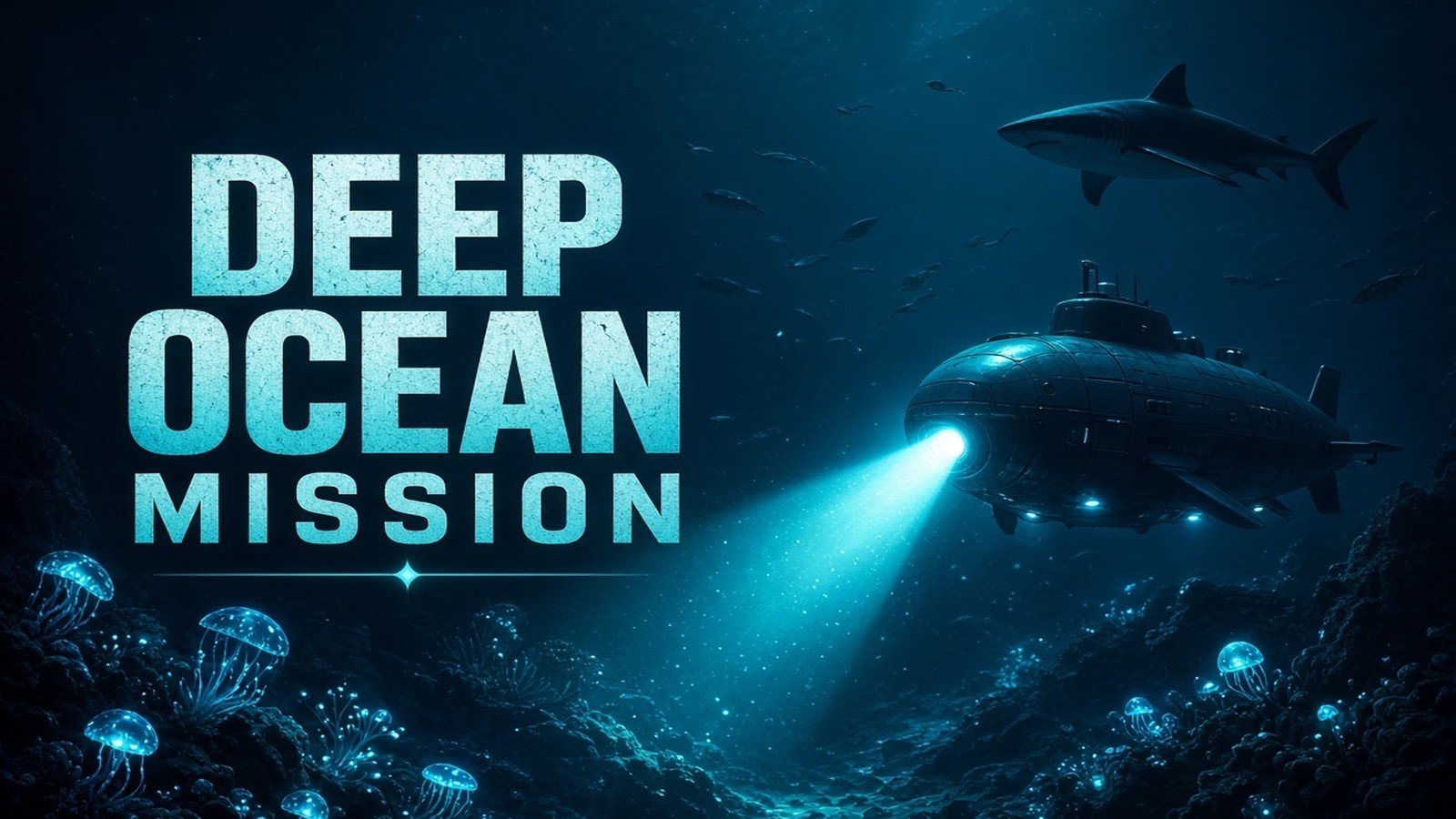
India Deep Ocean Mission discoveries in 2026: new marine-species research, deep-sea surveys and progress on the MATSYA-6000 human submersible are real, but the mission’s biggest goals should not be confused with completed dives. On 11 November 2026, government reporting described the new Indian Bramble Shark, Echinorhinus roinee, with research funded through the Deep Ocean Mission. Other documented 2026 findings include the skate Dipturus dhritiae and electric ray Tetronarce ramanamurthyi. Separately, a recent government statement has placed India’s proposed 6,000-metre human deep-sea mission target in 2028, not as a completed 2026 event.
This guide explains the discovery evidence, six parts of the programme, exactly what MATSYA-6000 has tested, why new species matter, and what readers should watch next. It deliberately separates a new scientific species description from a submersible physically discovering an animal underwater. Checked against PIB releases up to 22 November 2026.
Deep Ocean Mission India 2026: what has actually happened?
India launched the Deep Ocean Mission (DOM) in 2021 as a research and technology programme within the Ministry of Earth Sciences. It is broader than a submarine project: the work spans ocean robotics, marine life, ocean climate modelling, deep-sea geology, renewable resources and biological research infrastructure. Many achievements have been reported since launch, ranging from robotic equipment tests to species cataloguing and the imaging of deep-ocean environments.
The strongest recent distinction is between completed scientific work and planned deep-water human descent. MATSYA-6000 is designed to transport three aquanauts to roughly 6,000 metres, but the government’s August 2026 progress statement described completed wet/harbour trials at approximately eight metres of water depth in January–February 2025. That is an engineering validation under controlled conditions, not a 6,000-metre ocean dive. In November 2026, a ministerial statement described the proposed human deep-sea journey to 6,000 metres as a goal by 2028. An older 2026/2027 date appearing in a search result should not overwrite that newer public target.
| Activity | Confirmed status / evidence |
|---|---|
| Deep Ocean Mission established | 2021 programme |
| MATSYA-6000 | Design and systems developed; 8-m harbour/wet trials completed |
| Indian aquanaut experience | 4,025-m and 5,002-m dives in French Nautile in 2025 |
| 6,000-m Indian human dive | Goal by 2028 as stated in November 2026 |
| Seamounts surveyed | 31 reported in August 2026 government update |
| Species documented | 201, of which 43 were listed as potentially new taxa |
| New shark description | Echinorhinus roinee, announced 11 Nov 2026 |
Six pillars: why Deep Ocean Mission is more than Samudrayaan
Official parliamentary information groups DOM into six verticals. The first develops deep-sea mining equipment, manned submersibles and underwater robotics. This includes engineering for MATSYA-6000 and machines that can move across the seabed. The second focuses on ocean-climate advisory services—modelling changes in sea level, waves, storm surges and related long-term risks. This is relevant to coastal planning and scientific preparedness, not merely industrial exploration.
The third vertical studies deep-sea biodiversity, including animals and microbes, with molecular identification, conservation research and the possibility of useful biological compounds. The fourth explores the deep ocean through mapping, geological surveys, hydrothermal vent investigations and research-vessel capability. The fifth examines ocean-derived energy and freshwater, including ocean thermal energy conversion and desalination. The sixth involves an advanced marine biology station and collaborations with institutions around India.
This structure is important because headlines sometimes reduce the entire mission to “India to mine metals from the ocean.” Mining research is one strand; biodiversity documentation, conservation and scientific services are equally documented parts of the work. Developing a mining machine also does not mean commercial extraction has been authorised everywhere. International seabed governance, environmental assessment and the still-developing rulebook for exploitation matter in determining what may happen next.
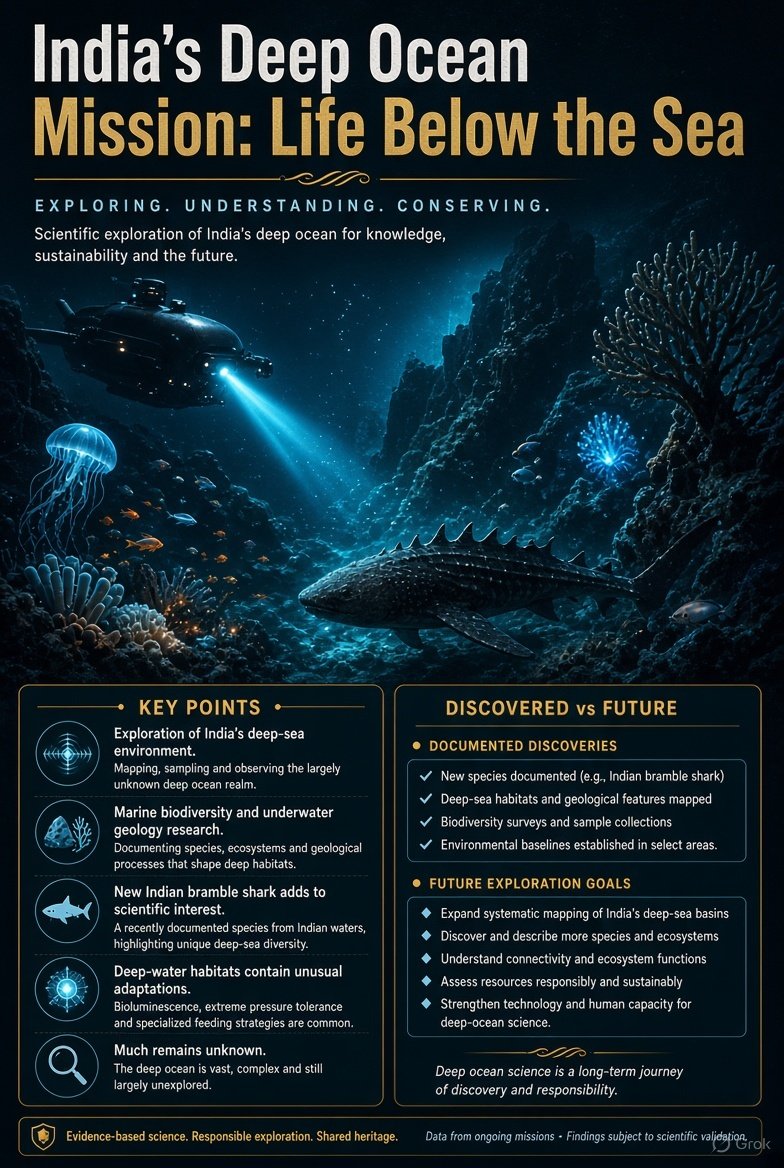
Indian Bramble Shark 2026: what was discovered in Kerala?
The 11 November PIB release records scientists from the Zoological Survey of India (ZSI) and ICAR-CMFRI identifying a distinct bramble shark species, Echinorhinus roinee. The specimens were obtained from Sakthikulangara Fishing Harbour, Kollam, Kerala, where they had been landed as bycatch from deep-sea shrimp trawlers. This matters greatly: the fish were not reported as having been filmed or physically collected by MATSYA-6000 during a completed 6,000-metre mission. Research support came from the Ministry of Earth Sciences’ Deep Ocean Mission.
The species occurs in deep continental-slope water, reported around 350–450 metres. Scientists examined the animal’s body features and DNA, finding distinctions from the Atlantic bramble shark with which it had long been confused. An unfamiliar-looking shark does not automatically represent a species never seen by any person. Taxonomists often uncover hidden diversity by studying older or routinely landed specimens with modern methods and comparing them with formally described species.
For fishermen and marine researchers, better identification is more than a naming achievement. If different shark species are mistakenly combined in fisheries records, their local abundance and vulnerability can be misunderstood. Correct names enable better data, conservation assessment and further study of their biology. The shark discovery is an example of mission-supported biodiversity research; it is not the same thing as the first Indian human dive to the seabed.
More 2026 marine discoveries: electric ray and new skate
The Indian Bramble Shark was not the only 2026 species-level finding. On 1 September 2026, PIB reported Dipturus dhritiae, a new deep-water skate from the southeastern Arabian Sea off southwestern India. The report described specimens from around 400–600 metres and DNA evidence that separated the skate from close relatives. A skate is a flattened cartilaginous fish related to rays and sharks, not a piece of skateboarding equipment. Distinguishing species within this group can help researchers recognise sensitive habitats and monitor incidental catches.
On 27 October 2026, the Zoological Survey of India described another new species, the electric ray Tetronarce ramanamurthyi, from the southeastern Arabian Sea. The study used specimen morphology and mitochondrial DNA to support the description; the result appeared in the taxonomy journal Zootaxa. This was also reported under Deep Ocean Mission-funded research. Electric rays can produce electrical discharges through specialised organs, but that ability is a normal biological characteristic, not evidence of a newly evolved superpower caused by modern pollution.
Together, these examples show a research pattern: scientists examine landings and survey specimens, compare anatomy, verify molecular differences and preserve type specimens or formal species records. Discovering a new taxon does not mean an entire unknown underwater kingdom has suddenly been found. It means the evidence supports a scientific classification that earlier records did not adequately capture.
MATSYA-6000: three-person submersible, tested milestones and 2028 target
MATSYA-6000 is the proposed Indian-built human submersible for the Samudrayaan part of DOM. Its design target is to transport three aquanauts to extreme depths, around 6,000 metres. At that pressure, safe operation demands a strong personnel chamber, reliable life-support arrangements, propulsion, navigation, communication, emergency safeguards and a verified recovery plan. There is a large engineering gap between placing a submersible in a sheltered harbour and proving safe performance kilometres below the surface.
The August 2026 ministerial progress report says subsystems were developed and that crewed and uncrewed wet harbour trials around eight metres deep were held at Kattupalli near Chennai from January to February 2025. An earlier Indian achievement involved two Indian aquanaut dives to 4,025 metres and 5,002 metres in 2025 using the French Nautile submersible through collaboration. These valuable experiences do not constitute a 5,002-metre voyage by India’s MATSYA-6000. The vehicle and operators must be named correctly to avoid inflating India’s indigenous testing status.
The latest ministerial remarks in November 2026 place a first Indian human mission reaching up to 6,000 metres by 2028. This is still a target, and a successful final mission cannot be assumed in advance. Future progress markers include sea trials, qualification at increasing depths, documented crew-safety systems, mission-clearance announcements and reporting after each test. None should be described as completed unless the named agency publishes a result.
Deep Ocean surveys: hydrothermal vents, microbes and seamount maps
Government data released in August 2026 gives wider examples of the programme’s outputs. Surveys in the Arabian Sea and Bay of Bengal had covered 31 seamounts, documenting 201 deep-sea species, of which 43 were described as potentially new to science. “Potentially new” is a provisional research category; it does not mean that all 43 had been formally published and accepted as named new species by that date. That distinction avoids converting an initial survey finding into a false taxonomy headline.
Scientists also reported isolating about 2,038 deep-sea microbes from Indian exclusive-economic-zone water and sediment samples. Microbes are extraordinarily diverse; isolation in a laboratory is not the same as discovering 2,038 wholly new species. Deep-water microbes can inform ecology, environmental processes and possible biotechnological research, but an isolated microbe is not automatically a medicine or industrial product.
Deep-ocean expeditions in the Central and Southwest Indian Ridges have reported four hydrothermal vent fields and two inactive vent sites, with Indian imaging of an active vent. Hydrothermal systems are scientifically interesting because mineral-rich hot fluids interact with much colder seawater, creating chemical gradients that can support unusual communities. Mapping such sites helps ocean geology and ecological baseline studies; the presence of mineral deposits should not be interpreted as a commercial mining licence.
Seabed minerals, climate and marine conservation: what are the trade-offs?
The deep ocean contains resources such as polymetallic nodules and sulphide deposits, which interest scientists and industry for their metal content. India’s researchers have experimented with collection equipment, including a 2024 demonstration of extracting over 100 kilograms of cobalt-rich nodules from approximately 1,173 metres in the Andaman Sea. That does not mean a national commercial deep-ocean mining industry is operating today. Pilot sampling, equipment qualification and full-scale exploitation have very different regulatory and environmental implications.
Disturbance of sediments, noise, habitat destruction and plumes could affect organisms that grow slowly or remain poorly studied. That is why environmental baselines, protected biodiversity data, monitoring and international governance all matter. A responsible reader should ask not only “how much metal is there?” but also “what lives there, what damage can be caused, and what evidence is needed before exploitation?” Long-term ocean climate projections, ocean thermal-energy experiments and desalination work belong in this broader sustainability conversation.
Coastal communities can also benefit from improved data. Ocean current, wave, storm-surge and sea-level services contribute to planning for marine activities and risks. But a mission to explore deep water is not a substitute for official cyclone or tsunami warnings. Use authorised public warning services for immediate hazards rather than inferring safety conditions from a general Deep Ocean Mission article.
Fact check: claims to avoid when sharing Deep Ocean Mission images
- Claim: MATSYA-6000 reached 6,000 m in 2026. Fact: published completed harbour trials were at around 8 m; the human 6,000-m goal was targeted for 2028 in the latest statement.
- Claim: The new Kerala shark was found by a three-person MATSYA crew. Fact: the 2026 shark specimens came via fishing-harbour bycatch and were studied through mission-funded research.
- Claim: 43 wholly new species were named. Fact: the official survey count included 43 potentially new taxa, not 43 confirmed names.
- Claim: The 5,002-m Indian aquanaut dive used MATSYA-6000. Fact: it used French Nautile during Indo-French training work.
- Claim: Pilot nodule collection proves commercial mining approvals. Fact: engineering demonstrations and exploitation permissions are different.
FAQs: Deep Ocean Mission India 2026
What is India’s Deep Ocean Mission?
A 2021 Ministry of Earth Sciences programme covering deep-sea technology, climate services, biodiversity, surveys, energy/freshwater and advanced marine biology.
Which new deep-sea species made news in November 2026?
The Indian Bramble Shark Echinorhinus roinee, with specimens from Kerala and research supported by the Deep Ocean Mission.
When will MATSYA-6000 take humans to 6,000 metres?
The latest November 2026 public statement targets a first human mission to that depth by 2028. No completed 6,000-metre voyage should be assumed.
Did Indian scientists already dive beyond 5,000 metres?
Indian aquanauts completed 4,025-m and 5,002-m dives in 2025 aboard the French Nautile, a different vehicle from MATSYA-6000.
What do 201 species and 43 new taxa mean?
Government data says 201 deep-sea species were documented in surveys, with 43 considered potentially new to science. The latter requires further formal validation.
Will this mission affect fishermen and coastal residents?
Research on species, marine services and ocean climate may improve understanding and planning, but fishermen should rely on official operational marine advisories for real-time decisions.
Conclusion: confirmed discoveries today, deeper mission goals ahead
By November 2026 India’s Deep Ocean Mission has produced verifiable work: new shark and ray taxonomy, seamount surveys, microbial research, hydrothermal mapping and progress toward a human submersible. The strongest reader value is keeping the timeline straight. The Indian Bramble Shark is a real 2026 species description; MATSYA-6000’s full human 6,000-metre dive is a future objective, publicly targeted for 2028. For a complementary visual on underwater hazards and earth systems, see our plate tectonics and tsunami diagram guide. Ocean science rewards precise evidence, not imaginary submarine photos.
Primary sources and further reading
- PIB, 5 August 2026: Deep Ocean Mission six areas and achieved results
- PIB, November 2026: 6,000-metre human dive now targeted by 2028
- PIB, 10 November 2026: MATSYA-6000 and NIOT scientific review
- PIB, 11 November 2026: Indian Bramble Shark Echinorhinus roinee and Deep Ocean Mission funding
- PIB, September 2026: Dipturus dhritiae new deep-sea skate
- PIB, October 2026: Tetronarce ramanamurthyi electric ray
Editorial and image note: this infographic is illustrative. A research-supported discovery is not necessarily a specimen collected by MATSYA-6000, and exploratory mining trials are not commercial exploitation.

















Share Your Opinion
Comments are closed on this post.