 Vista

AI Decision Intelligence is a way of improving important decisions by combining relevant data, predictive models, business rules, optimization and human judgment into a traceable workflow. Instead of simply answering “What happened last month?”, a decision-intelligence system asks “What should we do next, why, and what may happen if we choose another option?” Unlike an ordinary chatbot, it is designed around a recurring business decision and its measurable outcomes. Unlike agentic AI, it need not independently execute tasks: it can recommend an action for a manager to approve, run a decision through agreed rules or automate low-risk cases under supervision.
Updated 22 November 2026. Decision intelligence did not suddenly appear at the end of 2026. It is an established discipline whose platforms gained greater enterprise visibility with AI and agent-based workflows. For example, Gartner published a Magic Quadrant for Decision Intelligence Platforms on 26 January 2026, describing the combination of decision modeling, analytics and AI. This guide covers the definition, differences from BI, predictive analytics, generative chatbots and autonomous agents, an implementation workflow, practical examples, risks, ROI metrics and frequently asked questions.
What is Decision Intelligence in AI? Definition without the hype
Think of a supermarket deciding how much fresh food to order tomorrow. A standard report may show what sold yesterday. A predictive model may forecast tomorrow’s demand. A chatbot may explain what “inventory turnover” means. A decision-intelligence process brings these together with stock availability, delivery time, storage capacity, waste risk and margin targets to recommend an order quantity. It can also compare “order more” with “order less,” show the assumptions and record whether the actual outcome justified the choice.
The approach can use mathematics, rules engines, conventional machine learning, large language models, scenario simulations and optimization. It is not synonymous with a single AI model or paid subscription. Gartner’s 2026 description emphasizes augmenting and automating decisions by combining decision modeling, analytics and AI. IBM’s decision-intelligence offering similarly emphasizes governed decision logic, automation, optimization and connections across operational systems. The common thread is clear: the unit of work is a decision with inputs, alternatives, constraints, approval rules and outcomes.
“AI Decision Intelligence” is therefore a practical description of AI-enhanced decision design, not the name of a universally standardized new algorithm. Some organizations use the phrase loosely in marketing; the strongest implementations define exactly which decision improves, where data comes from and how performance will be checked. Without those details, a dashboard wrapped in a chatbot may provide useful answers but still not amount to a managed decision system.
Decision Intelligence vs Agentic AI vs Generative AI vs Business Intelligence
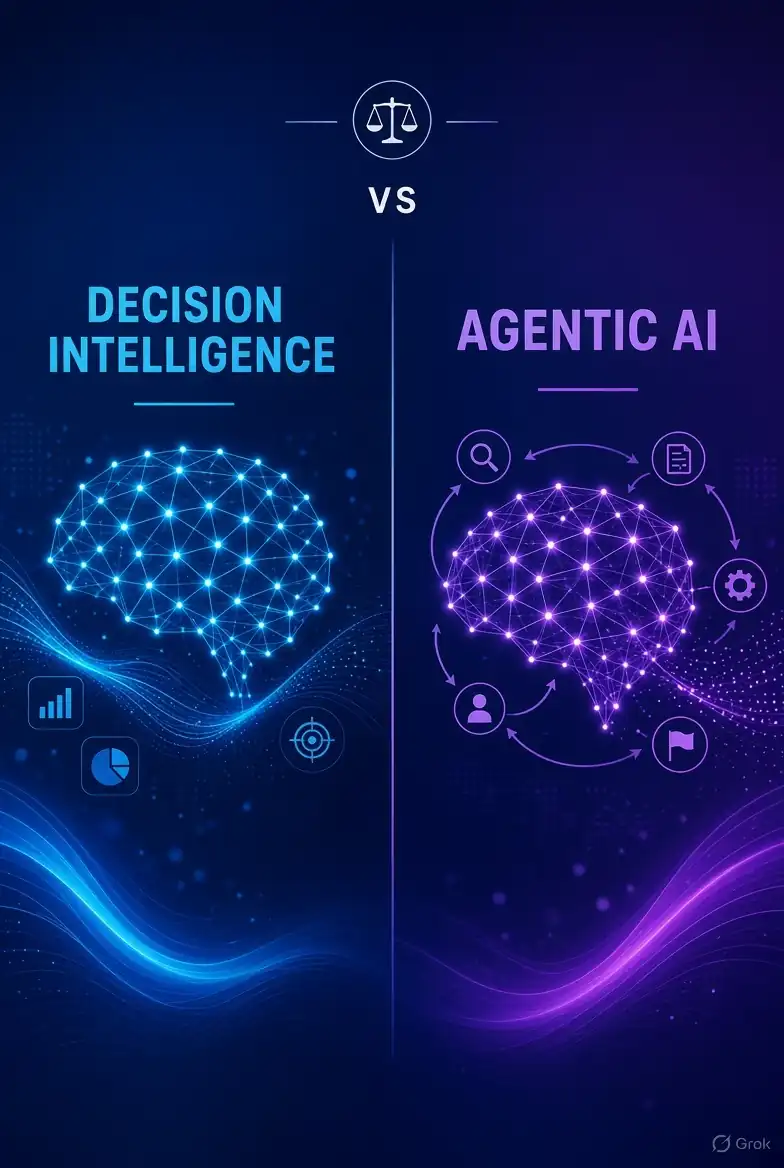
These terms overlap but describe different centers of gravity. Business Intelligence (BI) organizes metrics, charts and reporting. Predictive analytics estimates a likely future value or outcome. Generative AI creates language, code, images or other content and can summarize or explain data. Agentic AI uses goal-directed agents that may plan and take actions through software tools with limited supervision. Decision Intelligence engineers the process of selecting, governing and improving decisions. A production solution may use all five.
| Approach | Main question | Typical output | Human or system role |
|---|---|---|---|
| BI dashboard | What happened? | Sales and operations metrics | Human interprets trends |
| Predictive AI | What might happen? | Demand or risk score | Supports forecasting |
| Generative chatbot | How can you explain or draft this? | Conversation or document | Human checks answers |
| Decision Intelligence | Which option should be chosen under these constraints? | Ranked options, decision, reasoning and audit record | Human approval or governed automation |
| Agentic AI | What steps and tools will accomplish the goal? | Multi-step execution and tool actions | Autonomy with permissions and oversight |
For example, a decision-intelligence layer may determine that a supplier deserves expedited attention because stock risk is high and contract terms permit action. An AI agent may then open an approved procurement system, request a quotation and draft a purchase order. The decision system decides why and whether to take a governed action; the agent helps carry out how. However, this is an architecture pattern, not a rigid technical boundary: many modern agents contain decision logic and some decision platforms automate actions directly.
Microsoft describes agentic AI as systems pursuing goals with limited supervision, tools, enterprise data and workflows overseen by people. That definition helps explain why adding an agent alone does not guarantee good decisions: the agent still needs reliable data, authorization, business rules and clear success criteria.
How AI Decision Intelligence works: seven steps from data to measurable outcome
A reliable workflow begins with the business problem rather than a model vendor. Consider a lender deciding when an account needs additional manual review, or a hospital optimizing staffing. In both cases, accurate data and policy constraints matter at least as much as the predictive model.
- Define the decision. Write a specific question such as “Should this order be expedited today?” rather than “Use AI to improve supply chain.” Name the accountable decision owner.
- Collect permitted inputs. Connect inventory, purchase orders, transaction records, demand patterns and relevant policies. Track timestamps, missing values and provenance; restrict access to data that teams are authorized to use.
- Model alternatives. Describe feasible choices and their constraints—e.g., reorder now, wait one day or move stock from another warehouse.
- Estimate outcomes. Use statistical models, forecasts, simulation or causal reasoning to evaluate probability, cost, reliability and business impact. Distinguish prediction from causal proof.
- Apply rules and optimization. Exclude options that violate budgets, contracts, regulatory policies or safety limits; rank the remaining options against defined objectives.
- Recommend, approve or execute. For low-risk cases, a policy may permit automatic action. Sensitive or irreversible decisions should receive meaningful human review before execution.
- Measure results and learn. Log the model version, policy used, recommendation, human override, actual decision and eventual outcome. Compare performance with the previous process and investigate failure patterns.
Data quality is an operational issue, not a minor technical detail. A model fed inventory counts that are six hours old may recommend an unnecessary purchase. A cost optimizer that ignores supplier contracts may rank an unavailable option first. An eloquent explanation does not fix either problem. Strong decision governance puts validation, monitoring and override controls around the models.
Realistic 2026 business use cases: retail, finance, logistics, healthcare and customer service
Retail inventory and pricing decisions
A retailer can join sales history, expiry dates, lead times, weather and promotions to select reorder quantities. An optimization layer trades off lost sales against waste and working capital. A dashboard alone might show shortages; decision intelligence compares feasible replenishment scenarios. Prices and forecasts should still respect local laws, contracts and customer fairness. The impact must be measured against a baseline, not assumed from the presence of AI.
Bank fraud alerts and financial eligibility
A bank can use statistical risk signals and explicit policy rules to decide whether to escalate a suspicious transaction for review. For credit or other high-stakes eligibility decisions, the design should consider fairness, explainability, recordkeeping, appeal rights and applicable regulation. This is a technology example, not financial advice, and no AI score by itself should be treated as a legal justification for denying someone’s rights.
Logistics and transport operations
A delivery operator could optimize between alternate routes, vehicle availability, traffic, service-level obligations and fuel costs. The system can recommend rerouting where justified and trigger an approved workflow through an agent. Real-world performance depends on fresh traffic information, local operating constraints and driver safety, so implementation still requires human escalation paths.
Healthcare resource allocation
Hospitals can explore shift scheduling and equipment allocation using demand forecasts and documented service priorities. This does not mean an algorithm should autonomously diagnose patients, deny clinical care or override medical judgment. Decisions with patient safety implications need clinical governance, validated tools, privacy protections and professional accountability.
Marketing and customer support
A company can combine response times, segment preferences, channel costs and customer permissions to decide which approved service workflow to offer first. A conversational assistant might draft the reply while the decision layer selects the eligible policy response. Teams should evaluate whether this improves resolution and satisfaction—not merely how many automated conversations the system produces.
Decision Intelligence architecture: models, rules, optimization and agent execution
One useful way to think of the technical design is as a pipeline. Sources supply records from a CRM, ERP, operations database or approved event feeds. A data quality layer validates schemas, missing fields and freshness. Models produce forecasts or risk estimates. A decision engine applies business policies and optimization to choose feasible options. A governance layer explains key inputs, checks permitted actions, logs versions and routes sensitive cases to human reviewers. Finally, a conventional API or agent carries out approved steps and records the outcome.
Not every enterprise needs an elaborate “agent swarm”. A small company may achieve value from a well-defined reorder rule combined with a sensible forecast and a manager’s approval. More components increase integration, evaluation, security and operational costs. A conversational front end can help nontechnical users ask why a recommendation was generated, but natural-language answers should remain grounded in actual decision logs rather than invented rationales.
Large language models are particularly useful for understanding unstructured text, summarizing documents and interacting with business users. They are less reliable as the sole source of deterministic financial calculations or compliance checks. When feasible, explicit rules, calculators and optimization solvers should perform those computations; the AI assistant can explain the result and surface uncertainty. This separation reduces the risk of confident but unsupported output.
Decision Intelligence vs automated decision making: human oversight and risk
A recommendation system, a semi-automated approval flow and a fully automated action are not equivalent. The level of permitted autonomy should match the consequences of being wrong. Automatically reordering a small quantity of office supplies may be relatively reversible; denying a loan, changing a medicine dose or approving a high-value payment involves much higher stakes and requires stronger controls.
Responsible implementation should address several categories of risk. Bias can be inherited from historical data; data leakage can expose financial or personal information; model drift can make an old forecast unreliable; prompt injection can manipulate LLM-based agents using malicious source text; and automation bias can lead people to accept suggestions without proper review. Legal requirements depend on jurisdiction and industry; don’t assume a vendor’s general “AI compliant” label satisfies your specific obligations.
Useful protections include role-based permissions, documented data provenance, human approval thresholds, model and policy versioning, testing with edge cases, accessible appeals or overrides, and logs showing what actually happened. Set up alerts for abnormal patterns and a kill switch for unintended automation. An audit-friendly decision record should identify the applicable rule and model version rather than pretending a chatbot’s fluent narrative is conclusive evidence of how the system reasoned.
How to choose an AI Decision Intelligence platform in 2026
Start by listing the recurring decisions that consume time or result in costly errors. Estimate how often each occurs, who owns it, what data is available and how success will be measured. Then run a small trial with realistic cases. Compare a rules-only baseline with a more complex AI approach instead of assuming AI must always win. Vendors in the decision-intelligence market vary substantially in their integration, optimization, policy and workflow capabilities.
Gartner describes decision-intelligence platforms as software supporting or automating decisions using data, analytics, knowledge and AI. Its 2026 vendor market coverage is useful evidence that this is an established enterprise category, not a term invented by a viral post. IBM’s Decision Intelligence product illustrates a governed decisioning approach; vendor materials describe product capabilities, not independent proof of universal cost savings.
| Vendor evaluation question | What to test |
|---|---|
| Data connections | Can it ingest your real systems securely and preserve provenance? |
| Rules and policies | Can nontechnical reviewers understand and approve decisions? |
| Models and simulation | Can you compare forecasts, uncertainty and alternative actions? |
| Human oversight | Are approvals, override, rollback and audit logs supported? |
| Integration and deployment | Does it work with current APIs, cloud, security and agents? |
| Costs and reliability | How do licensing, infrastructure, human review and support affect value? |
Do not choose a platform solely because a promotional page says “high CPC,” “zero competition,” “autonomous enterprise” or “guaranteed ROI.” Search traffic, ad pricing and business returns require measured evidence. A product pilot should have written success criteria: accuracy against a known benchmark, override rate, operating cost, latency, customer harm incidents and measurable business outcomes.
How to calculate Decision Intelligence ROI without invented statistics
Decision intelligence projects can be evaluated using a transparent cost-benefit equation: net value = attributable annual benefits − total annual costs. Benefits may include reduction in avoidable waste, fewer manual hours, faster decisions, lower error losses or increased revenue, but estimate them conservatively and confirm through experiments. Total costs should include data pipelines, software licences, model inference, security reviews, ongoing monitoring, support staff, governance and integrations.
For instance, imagine a company currently loses ₹10 lakh annually to preventable inventory waste and a carefully measured pilot lowers that loss by ₹2 lakh. If the pilot and ongoing system cost ₹1.5 lakh, its illustrative annual net value is ₹50,000 before other considerations. Those numbers are hypothetical, not an industry average or a promise that any decision-intelligence tool produces that saving. The correct comparison should account for seasonality and changes in business conditions unrelated to the system.
Testing should start with historical cases and continue with a controlled live pilot. Measure outcome quality rather than only model accuracy. A highly accurate demand forecast can still produce poor decisions if the application ignores supplier constraints. Likewise, an agent that completes tasks quickly can worsen the business result if its underlying recommendation was wrong. For a broader guide to adoption considerations, read our AI agents for business overview.
AI Decision Intelligence FAQs
Is Decision Intelligence a brand-new AI technology from November 2026?
No. Decision intelligence predates 2026. AI-enabled platforms and discussions of how it works alongside agentic AI gained visibility in enterprise research, including Gartner’s January 2026 market coverage.
Can Decision Intelligence work without generative AI or a chatbot?
Yes. Statistical forecasts, explicit business rules and optimization can form a decision-intelligence workflow without an LLM. Generative AI can help users interpret information but is not mandatory.
What is the main difference between Decision Intelligence and Agentic AI?
Decision intelligence emphasizes modelling, governing and improving choices. Agentic AI emphasizes pursuing goals and executing multi-step actions using tools. Well-designed systems can combine them.
Does Decision Intelligence automatically make every business decision?
No. Organizations can use it for recommendations only, or automate selected low-risk decisions under rules. Sensitive decisions should have appropriate human supervision and escalation.
Is Decision Intelligence better than Power BI or a normal analytics dashboard?
It solves a different problem. BI makes information visible; decision intelligence structures feasible options, constraints, recommendations and outcome feedback. A dashboard may be one input into the broader process.
Does Decision Intelligence guarantee higher profit or lower costs?
No. Performance depends on data quality, implementation, operational fit, safeguards and ongoing evaluation. Validate benefits in a real pilot rather than relying on promotional figures.
Sources, conclusion and next steps
For definitions and current enterprise context, review Gartner’s 2026 Decision Intelligence Platforms report, Gartner’s category description, IBM’s decision-intelligence offering, Microsoft’s explanation of agentic AI and Microsoft’s business intelligence guidance. They support the distinctions between analytics, decisioning and agents, although vendors may describe the market differently.
Bottom line: Decision intelligence turns data and business constraints into traceable choices. Agentic AI can then help execute approved actions, while chatbots and dashboards help people interact with information. The sensible path in late 2026 is to start with a measurable business decision, integrate trustworthy data, retain human accountability and evaluate actual outcomes. This is a technology explainer, not a promise of particular financial results or an endorsement of any specific product.
























Share Your Opinion
Comments are closed on this post.