
> Quick note: When people say “ITR 2026”, they often mix up the filing year, financial year, and assessment year. The purpose of this guide is to explain the process, not to assume any single year’s tax rate, exemption, due date, or eligibility as final. Always verify the form, AY, deadlines, and rules from the current instructions on incometax.gov.in.
Filing an Income Tax Return is not just about submitting a form. It is the process of matching your entire year’s income records, tax already paid, deductions/claims, and bank details in one official statement. Just looking at a salary slip or Form 16 and filing a return directly seems easy, but small things like interest, dividends, share sales, house property, previous employers, TDS mismatches, or selecting the wrong assessment year can later result in intimations, notices, or refund delays. Therefore, before filing your ITR in 2026, answer these two questions: “From which sources did my income come?” and “What evidence do I have for them?”
This comprehensive guide first explains the practical differences between ITR-1 and ITR-2, then provides a documents checklist, step-by-step portal workflow, common mistakes causing refund delays, and five FAQs. This advice is informational; in cases involving complex capital gains, foreign income, tax residency, business income, or tax notices, it is sensible to seek advice from a qualified tax professional.
First of all: Which return year are we talking about in 2026?
In tax language, the financial year (the year income was earned) and the assessment year (the year that income return is assessed) can have different labels. News, employer emails, and apps sometimes say “2026 return”, whereas on the portal you need to select the AY. Do not pick a year based on guesswork. After logging in, cross-check the AY displayed by the portal for the current filing season against your Form 16/AIS and official instructions. If you are looking at a belated, revised, or updated return for an older year, its route and eligibility may be different.
Similarly, do not copy the due date, late fees, interest, new vs old tax regime selection, deduction fields, and ITR form eligibility from your memory of previous years. Verify current forms and instructions only on incometax.gov.in. In this article, fixed dates, income thresholds, or tax rates have intentionally been omitted because they are subject to change, and relying on incorrect numbers can ruin filing decisions.
What is ITR-1 and who is it for?
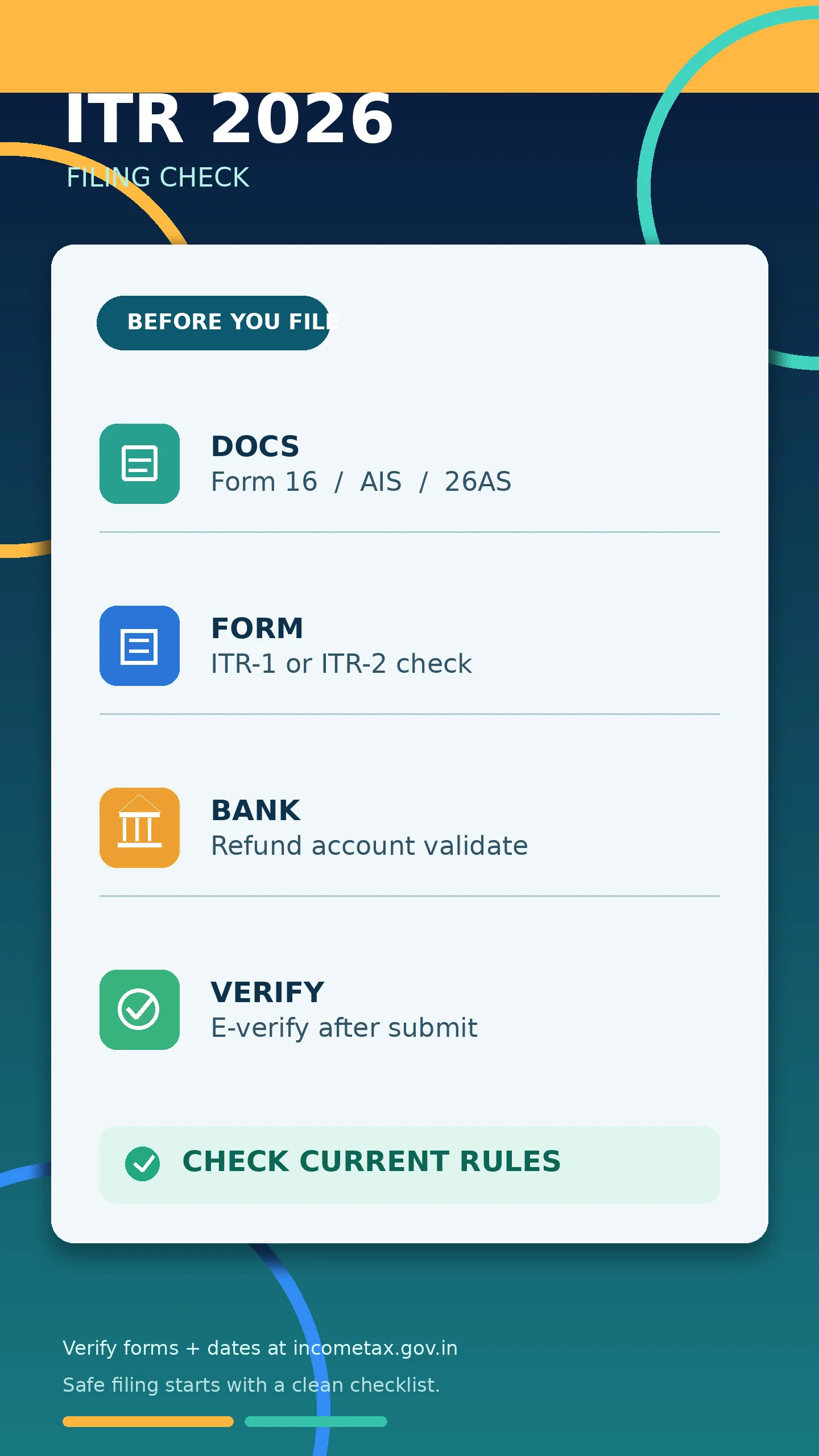
ITR-1 (commonly recognized as Sahaj) is generally designed for relatively straightforward individual returns. The exact eligibility is determined by the notified form and instructions for the current year, so consider the list below as a screening checklist rather than a final legal test. Generally, ITR-1 may be applicable for resident individual taxpayers whose income comes from salary/pension, one house property, and other sources like bank interest, provided their case fits the permitted conditions of the form.
Practical indicators include:
- Your income profile is simple and does not include income from business or profession.
- The house property portion falls under the permitted conditions of the form; multiple properties or special property situations may need to be checked separately.
- In addition to salary, interest, dividend, or other “other sources” income has not been omitted.
- There are no triggers requiring special disclosure such as capital gains, foreign assets/income, directorship, unlisted equity—or current ITR-1 instructions explicitly allow them.
- Your residential status and total income-related conditions match the current form requirements.
The most common mistake is when a taxpayer thinks, “I have a salary, so ITR-1 is automatic.” That is not the case. Along with a salary, sales of listed shares, multiple properties, foreign assets, a previous employer, special income, or any restriction of the form might require using ITR-2 instead. Map your data first, and choose the form later.
What is ITR-2 and how does it differ from ITR-1?
ITR-2 is meant for individual/HUF taxpayers who are not permitted to use ITR-1, but whose income does not arise from profits of a business or profession. Current form instructions are the final authority. Practical examples requiring ITR-2 can include salary/pension combined with capital gains, more than one house property, foreign assets/income, certain director or unlisted-share disclosures, or the need for other detailed schedules. It is essential to check the form for the current AY in every case.
Schedules in ITR-2 can be much more detailed. Share, mutual fund, or property sales may require transaction-wise statements, holding periods, and cost details. Disclosing foreign salary, interest, dividends, accounts, or assets may depend on residency and current rules. Therefore, shortcuts like “profits are visible on the broker statement, so I’ll just enter that total amount” are risky. Reconcile the statement with AIS/TIS, contract notes, broker capital-gains reports, and your bank records.
ITR-1 vs ITR-2: A quick comparison
| Question | ITR-1 Direction | ITR-2 Direction |
|---|---|---|
| Simple salary/pension + permitted sources case? | Possible, check current eligibility | Not required, unless a special trigger exists |
| Business/profession income? | Generally no | Not ITR-2; check applicable business form |
| Capital gains? | Only if current ITR-1 instructions allow it | ITR-2 route is frequently required |
| Multiple house properties? | Eligibility restrictions may apply | Check ITR-2 due to detailed schedules |
| Foreign asset/income or special disclosure? | Often restricted / extra checks required | See ITR-2 eligibility instructions |
| Final decision | Official current form | Official current form |
Do not treat this table as a substitute for a final decision. Prefilled data on the portal does not guarantee that the form selected is automatically correct.
Documents checklist: What to prepare before filing?
1. Identity and access
Keep your PAN details, Aadhaar details, and portal login access ready. If there is an issue with PAN-Aadhaar linking or status, consult current portal guidance. If there is a mismatch in your name, date of birth, or contact details, understand the correction process before filing. Ensure registered mobile numbers and emails are accessible, as verification codes and notices will be sent there.
2. Salary and pension
Keep Form 16 from every employer, salary slips, and year-end payroll summaries ready. If you changed employers during the year, you need records from both employers. Map any bonuses, arrears, perquisites, retirement benefits, or special components visible in your salary. If you are a pensioner, keep your pension statement/Form 16 and bank credit records handy. Even if data looks correct on Form 16, compare it with AIS/26AS and actual credits.
3. Tax already paid: Form 26AS, AIS, and TIS
Do not treat the TDS/TCS reported in Form 26AS, the information reported in AIS, and the summary processed in TIS as the exact same thing. Download them and match them against entries from your employer, bank, tenant, buyer, or other deductors. If an entry seems wrong or duplicated, check correction request procedures with the source reporter and view response options on the portal. Information appearing in the AIS is not always a replacement for the final taxable figure; preserve context and supporting evidence.
4. Bank and interest income
Collect interest certificates, bank statements, and dividend credits for all relevant savings/current/FD/RD accounts. Check the account number, IFSC, and account holder name for the account where you wish to receive your refund. Closed, dormant, frozen, or incorrect-name accounts can create problems with refunds. Follow the portal’s current pre-validation/nomination process. If you have multiple accounts, do not forget to declare interest income from the others when selecting a primary account for your refund.
5. House property
Keep records of rent received, municipal tax records where relevant, home loan interest certificates, co-owner details, and property ownership documents. Correctly map self-occupied, let-out, joint ownership, and loan details in the appropriate form schedule. Do not estimate rent or interest based solely on bank statements. Verify the fields and limits required in the current form using official instructions.
6. Investments and capital gains
For transactions involving shares, mutual funds, ETFs, bonds, property, or other transfers, keep broker statements, capital gains reports, contract notes, purchase confirmations, sale confirmations, and bank entries ready. Corporate actions, bonuses, splits, demat transfers, and inherited assets may have different costs or histories. While SIP data for every purchase lot comes consolidated in reports, verify any unusual entries. Do not guess claims like capital losses, carry-forwards, or set-offs—verify them against current year rules and records.
7. Deductions and claims
Keep proof of any deduction or claim you intend to take: eligible investment receipts, insurance premiums, tuition fee receipts, donation receipts, rent evidence, or medical documents as applicable. Before claiming in the form, check whether your chosen tax regime and current rules allow that claim. The fact that you “claimed it last year” is not proof of eligibility for this year.
8. Foreign or special income
Items like NRE/NRO interest, foreign salary, foreign dividends, overseas brokerage, RSUs/ESOPs, foreign bank accounts, properties, or directorships require extra caution. Residency status, reporting schedules, and treaty treatment depend on facts. Read official instructions for such cases and seek professional help if required. Do not share sensitive documents over random emails or chats.
Step-by-step overview of filing an ITR
Step 1: Create your income map
In a simple spreadsheet, list salary/pension, interest, dividends, rent, capital gains, other receipts, and taxes paid. Against each row, note the status of matching source documents with AIS/26AS. This reduces the need to recall details while looking at fields on the portal.
Step 2: Identify the correct AY and form
Log in to incometax.gov.in and check current filing options, the AY, and available forms. Read current eligibility instructions for ITR-1, ITR-2, and applicable alternatives. If you have business/profession income, choosing ITR-2 is not the solution—check the applicable form on the portal.
Step 3: Review prefilled data
Name, PAN, address, bank accounts, salary, TDS, and other reported data may be prefilled. Prefilled does not mean “final and complete”. Reconcile missing bank interest, incorrect employer amounts, duplicate TDS, or sales transactions with actual documents and AIS/26AS. Save your evidence and calculations when making corrections.
Step 4: Complete income details and schedules
Fill in salary, house property, other sources, capital gains, and deductions in relevant schedules. Completeness of information is necessary even if you have zero income, nil tax, or an expected refund. Take values from statements/certificates rather than rounded guesses. If a field is confusing, read official help/instructions; placing an amount in the wrong schedule can alter the computation.
Step 5: Review tax calculation and payable/refund amounts
Compare the portal computation with your worksheet. If TDS credit is missing, do not pay extra tax blindly, nor should you claim unverified credit. Understand the source of the mismatch. If a refund is shown, check bank account details and refund status preferences. If tax is payable, follow current portal permitted payment modes and challan instructions.
Step 6: Preview, validate, and submit
Resolve validation errors, mandatory schedule issues, and red warnings first. Save the draft/preview PDF or acknowledgement details. Before submitting, do a final review of the AY, PAN, form type, bank details, email, and refund figure. This is the stage where a two-minute checklist can save future corrections.
Step 7: Do not leave E-verification pending
Submitting a return and completing verification are distinct steps. Choose an option suited to your case from current e-verification options available on the portal—such as Aadhaar OTP, bank/demat EVC, or DSC where applicable. Save the acknowledgement and timestamp of successful verification. If verification fails, read the error message and check official retry routes.
Step 8: Post-filing tracking
Keep the acknowledgement, JSON/receipt, and important documents safe. Periodically check return status, intimations, refund status, and notices on the portal. If you receive AIS feedback alerts, defective return communications, or demand notices, respond before the deadline. Do not rely solely on email/SMS links for refunds; log into the official portal to check status.
Which mistakes cause refund delays?
1. Selecting the wrong AY: This is the most basic yet costly error. Do not guess the AY based on the filing year.
2. Choosing ITR-1 out of convenience: Selecting the wrong form despite having capital gains, foreign reporting, multiple properties, or special disclosures can halt processing.
3. Forgetting bank interest/dividends: Even small interest amounts may appear in AIS/26AS or bank data. Make a list of all accounts and investments.
4. Blind trust in Form 16: Reconcile details if you had a previous employer, multiple Form 16s, arrears, or TDS mismatches.
5. TDS credit mismatch: If a deductor reported your PAN or amount incorrectly, credit is not automatically created. Understand source corrections and official response routes.
6. Inactive or unvalidated refund bank account: Simply entering a correct account number may not be enough; fulfill the portal’s current validation requirements.
7. Unverified return: Leaving e-verification pending after submission prevents processing from moving forward. Ensure completion shows in your status.
8. Both extremes of AIS: treating as absolute truth or ignoring it completely: Match the AIS report against actual books/statements and explain or correct mismatches.
9. Wrong deductions or regime choice: Copying previous-year claims can alter tax computation and refunds. Read current form and regime instructions.
10. Ignoring notices: Treating intimations or defective return communications as “spam” can lead to missing time-bound response deadlines.
11. Rough estimates for capital gains: Manually entering totals without reconciling broker summaries with purchase history and contract notes can lead to errors.
12. Outdated contact details: Inaccessible mobile numbers or emails mean you might miss OTPs, official communications, and status alerts.
Refund delays are not always the taxpayer’s fault—departmental processing, reporting corrections, or verification queues can also be factors. Therefore, check portal status, acknowledgements, and intimations first; do not re-file repeatedly or submit duplicate returns without cause.
FACT BOX
- **Official verification point:** Visit **incometax.gov.in** for current forms, instructions, eligibility criteria, AY, dates, utilities, and e-verification options.
- **ITR-1:** Generally for simpler eligible individual cases; exact eligibility depends on the current notified form.
- **ITR-2:** For individual/HUF cases outside ITR-1 that do not have business/profession income, such as applicable capital-gains, multiple-property, foreign, or special-disclosure situations. Verify exact rules from current instructions.
- **Business/profession income:** Do not assume ITR-2 by default; check the applicable current form.
- **Core records:** Form 16, AIS, TIS, Form 26AS, bank statements, interest certificates, and relevant investment/property proofs.
- **Refund basics:** Correct bank details, current validation requirements, and completed e-verification are crucial.
- **No invented dates/rates:** Fixed due dates, thresholds, or tax rates have intentionally been excluded from this guide.
FAQ: 5 common questions
1) I only have a salary—should I file ITR-1?
Looking at salary alone is not always enough to decide. Along with salary, you might have interest, dividends, capital gains, foreign assets/income, multiple properties, or special disclosure requirements. Check eligibility using current AY ITR-1 instructions; if it doesn’t fit, look at ITR-2 or other applicable forms.
2) An incorrect entry is showing in my AIS. Should I hold off on my return?
Do not ignore the entry, nor should you change figures without supporting evidence. Compare it against bank/broker/employer statements, attempt to get corrections from the source reporter, and utilize current AIS feedback/response options on the portal. Maintain the tax treatment in your return that your records and current instructions support.
3) Tax was correctly deducted in Form 16, so why is my refund showing less?
Interest, dividends, salary from another employer, capital gains, regime/claim treatment, or TDS mismatches can change tax calculations. Reconcile AIS, TIS, 26AS, bank statements, and all Form 16s to understand the computation. Do not try to increase a refund through doubtful claims.
4) I submitted my return, but haven’t received a refund—should I file again?
First, check acknowledgement, e-verification status, processing/intimation status, and refund status on the official portal. Filing duplicate returns is generally not the solution. Take action according to instructions only if a correction or revised route is applicable under current rules; if there is a notice, follow its deadline.
5) I am unsure between ITR-1 and ITR-2—what is the safest approach?
Prepare a one-page list of income sources and special triggers, read current form instructions, and answer portal eligibility questions carefully. If you have capital gains, foreign income, complex property issues, residency nuances, or business facts, paying a review fee to a qualified tax professional is often cheaper than dealing with future delays.
Final practical checklist
Before pressing the submit button, pause for five minutes and verify: Correct PAN and AY? Correct ITR form? All income sources included? AIS/26AS/Form 16 matched? Refund bank account validated? Deductions backed by proof? E-verify plan ready? Acknowledgement saved? If your answers are “yes”, your filing process should be much smoother.
The most important habit is to double-check everything against official sources. Tax rules, forms, utilities, dates, and portal screens update regularly. Use this article as a preparation map rather than a final legal or tax authority. Just before filing, verify current ITR forms, instructions, AY, dates, and help content on incometax.gov.in—this is the most reliable step for safe filing in 2026.
Disclaimer: Tax rules change over time. Always verify forms, deadlines, and eligibility at https://www.incometax.gov.in/. This guide is educational and does not constitute personalized tax advice.