Can humans eat grass? The practical answer
Watching a cow graze makes the question seem reasonable: if grass is abundant, why cannot people use it as a meal? Being able to swallow a leaf is different from obtaining enough safe nutrition from it. Ordinary lawn or meadow grass should not be treated as a substitute for human food. Digestion, plant identity and the growing environment all matter.
The familiar explanation that humans cannot digest any cellulose is incomplete. Our own digestive enzymes do not break cellulose down, but some microbes in the human gut can. That finding does not show that a person can safely live on lawn grass or obtain the same benefit as a grazing animal.
Why is grass difficult for humans to digest?
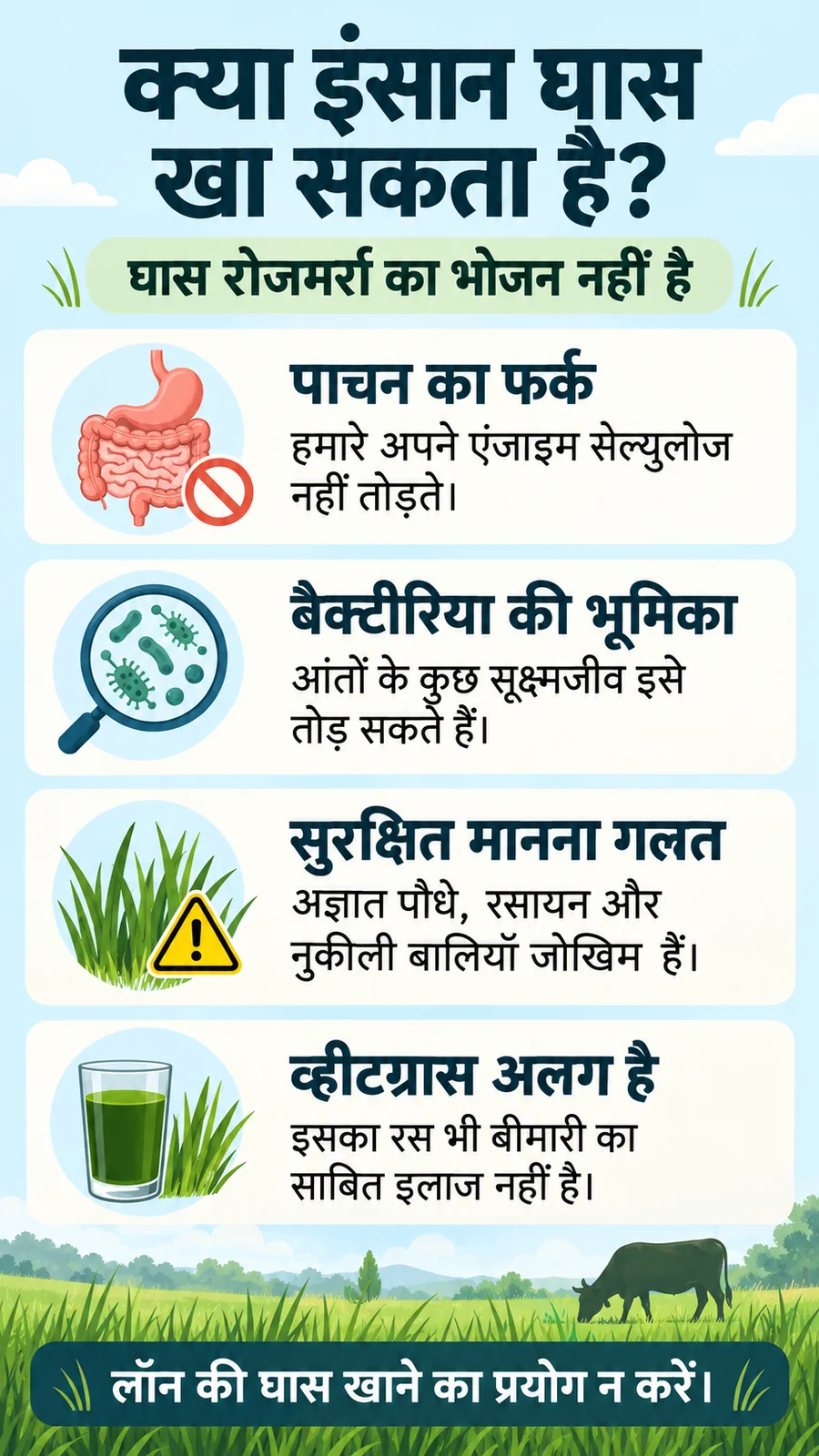
Cellulose is an important structural component of plant cell walls. Breaking it down requires specialised enzymes. Human digestive enzymes are not equipped to handle it in the way they handle readily digestible carbohydrates. It is therefore misleading to treat grass cellulose as an easy source of energy like the starch in familiar foods.
The words grass, greens and leaves also hide important differences. A recognised food plant, its edible part and its established preparation are specific pieces of information. Eating spinach does not demonstrate that another green leaf is edible. Conversely, the presence of fibre does not make every food nutritionally useless.
Ask a more useful question than whether a plant looks green: which part is normally used as food, and what evidence supports that use? A plant growing nearby or being eaten by an animal does not answer those questions. This article explains the science; it is not a field guide for choosing wild plants.
How cow digestion differs from human digestion
Ruminants such as cows have a stomach with four compartments. Microbes act on fibrous plant material early in their digestive process. This arrangement, together with rumination, helps the animal make use of grass and other forage.
Cows also depend on microbial enzymes rather than producing every cellulose-digesting enzyme themselves. The comparison is therefore not simply “cows have the enzyme and humans have nothing.” Both have microbes, but the location and organisation of digestion differ.
Human large-intestinal microbes can work on material that escapes earlier digestion. This does not give people the same grass-based feeding system as a cow. Similarity at the level of a microbial function cannot erase differences in anatomy and in how an animal meets its nutritional needs.
What new cellulose research actually shows
An original study published in 2024 identified human gut microbial species with enzyme systems capable of degrading plant cell-wall material. Their occurrence differed across human populations. This is useful evidence about the range of functions present in the gut microbiome.
The study was not a feeding trial demonstrating that lawn grass is a safe, sufficient human diet. Finding a microbial capability is different from establishing an individual nutritional benefit or the safety of an unknown plant. Do not turn a microbiome finding into a survival recipe or assume that every person has the same microbial community.
FACT: Human digestive enzymes and enzymes supplied by gut microbes are different. Acknowledging microbial cellulose breakdown does not justify recommending ordinary grass as food. Some digestion is not equivalent to a complete, reliable meal.
Real risks from grass and its surroundings
A lawn is maintained as a lawn, not necessarily produced as food. Fertilisers, weed killers and insecticides may be used. A clean-looking green surface cannot tell you what was applied. Washing is not a reliable way to declare an unknown chemical exposure safe.
Some wild grasses have seed heads with sharp, barbed awns. Putting them in the mouth can create a separate hazard. Poison Control describes human aspiration of grass awns, which can cause lung problems. This concern applies to the relevant seed structures; it should not be exaggerated into a claim that every blade behaves identically.
Plant identity, potential contamination and unfamiliar food use are different issues. Calling them all a consequence of high fibre gives a poor explanation. This article does not claim that one mouthful of grass inevitably wears away teeth or blocks the intestines. The reviewed sources do not establish such universal outcomes.
At the same time, absence of a dramatic guaranteed outcome is not a reason to experiment. It is more useful to avoid uncertain lawn or field material than to look for a single hazard that must happen every time. If an exposure occurs, the specific plant and circumstances matter to professional assessment.
Wheatgrass is different from ordinary lawn grass
Wheatgrass generally refers to products made from young wheat plants, including extracted juice. It is not another name for anything growing on a lawn. Memorial Sloan Kettering describes the leaves as fibrous and difficult to digest, which is why juice is commonly extracted. Product identity and preparation matter.
Large claims about detoxification, raising haemoglobin or curing cancer should not be accepted as proven treatment. MSK explains that these claims are not established. Small preliminary studies cannot justify stopping prescribed care or using an unverified supplement as a replacement.
Raw wheatgrass products can also raise concerns about microbial contamination, and nausea has been reported. “Home-grown” and “natural” do not establish the safety of every product. The distinction here explains terminology and evidence limits; it is not a recommendation to drink grass juice.
Does boiling or blending make grass into food?
Blending changes particle size, not plant identity. Boiling does not automatically make an unfamiliar plant edible. Cooking methods used for recognised vegetables should not be applied to every wild green as if they were universal detoxification steps.
The reviewed evidence does not establish a household method for converting ordinary grass into a dependable human food. No fixed boiling time or daily serving is recommended here. If you do not know that a material is an established food, processing it is not a substitute for knowing what it is.
In hunger or an emergency, do not plan on ordinary grass as the main source of nourishment. Feeling that the stomach is full is different from meeting nutritional needs. Prioritise familiar safe food, clean water and assistance. A taste test is not a reliable identification or safety procedure for an unknown plant.
If a child or adult has put uncertain grass in the mouth, stop further ingestion and retain available identification information. Breathing difficulty, persistent coughing after handling seed heads, loss of consciousness or other serious symptoms need immediate medical attention. For suspected plant or chemical ingestion in India, AIIMS lists its National Poisons Information Centre at 1800 116 117.
Frequently asked questions
1. Can humans survive by eating grass?
Ordinary lawn or meadow grass should not be relied on as a safe, sufficient main food. Microbiome research does not establish a grass-based human survival diet.
2. Can humans digest any cellulose?
Our own digestive enzymes do not break cellulose down. Some human gut microbes can. Saying that absolutely no cellulose breakdown is possible misses this distinction.
3. Why can cows eat grass while people cannot use it the same way?
Rumination and early microbial digestion in a four-compartment stomach differ from human digestion. An animal eating a plant does not establish human food safety or nutritional adequacy.
4. Does wheatgrass juice cure illness?
It is a different product from lawn grass, but large detoxification and disease-cure claims are not established. Do not replace medical treatment with it.
5. Is boiled grass safe?
Boiling cannot reliably correct wrong identity or remove every chemical or plant toxin. No general guarantee of safety is appropriate for unknown grass.
Advice
Learn the biology without turning it into an eating challenge. If you want fibre in your diet, use recognised familiar foods appropriate to your needs. Green colour, natural growth and an animal grazing nearby are not tests of edibility. For an actual exposure, describe the material and symptoms to a qualified professional rather than relying on a generic online answer.
For recognised food greens, read about sweet potato leaves and their identity. For local-name confusion, see charota bhaji and Senna species.
Sources and evidence limits
2024 original cellulose-degrading gut bacteria study • AMNH: digestion and microbiomes • MSK: wheatgrass evidence.
Poison Control: grass awns • Lawn chemicals • AIIMS poison information. These sources are not used to prescribe grass consumption or an individual dose.
Disclaimer: General educational and health information, not personal medical advice. Do not eat unidentified plants or lawn grass. Seek qualified medical help for suspected poisoning or serious symptoms.