Legal disclaimer
This article explains general Indian legal information, reviewed on 9 October 2026. A chat’s admissibility and evidentiary weight depend on the proceeding, applicable law, authenticity and judicial assessment. This is not advice for a particular dispute or permission to access another person’s account. Consult an advocate before presenting sensitive electronic material.
Can a WhatsApp chat be used as evidence?
Yes, a relevant WhatsApp conversation can potentially be used as electronic evidence through the appropriate legal process. That does not mean every screenshot is automatically accepted or that the message proves the entire claim. The court must consider the material’s connection with the dispute, its source, the participants and the applicable requirements for proving electronic records.
Separate three issues: relevance, admissibility and weight. A conversation may relate to the case but still need proper authentication. It may be admitted yet fail to establish the amount owed, who sent a particular message or whether a binding agreement exists. A message’s meaning also depends on surrounding exchanges and other genuine evidence.
For example, a message about repayment may support a chronology, but the amount, transaction, sender and surrounding context still need assessment. A chat about receiving a parcel may support delivery evidence without proving every contractual term. Do not turn a convenient sentence into a universal rule that a chat alone always creates liability or ends a dispute.
Which law applies: Section 65B or BSA Section 63?
The Bharatiya Sakshya Adhiniyam, 2023 includes electronic and digital records in its documentary framework. Sections 61–63 address relevant electronic-record proof, and Section 63 contains the certificate framework for the outputs covered by that provision. The older Indian Evidence Act, 1872 dealt with the corresponding subject through Sections 65A and 65B. [1]
BSA came into force on 1 July 2024, with Section 170 saving specified pending proceedings under the older Act. The date of a message alone does not decide every transitional question. Ask counsel to identify the relevant proceeding, stage and applicable law before choosing a certificate or filing route. A familiar online template may belong to a different legal framework.
Under BSA Section 63(4) and the Schedule, the certificate process includes the party and expert portions, production details and hash information. Check the actual statutory requirements and current court directions for your submission. A document labelled “65B certificate” is not automatically the correct form for every current case, and a notarised statement does not by itself complete every requirement.
FACT: A screenshot can show what appeared on a screen, but it does not by itself conclusively establish who sent the message, that the full conversation is intact or that every legal proof requirement has been met.
Preserve the original conversation and context
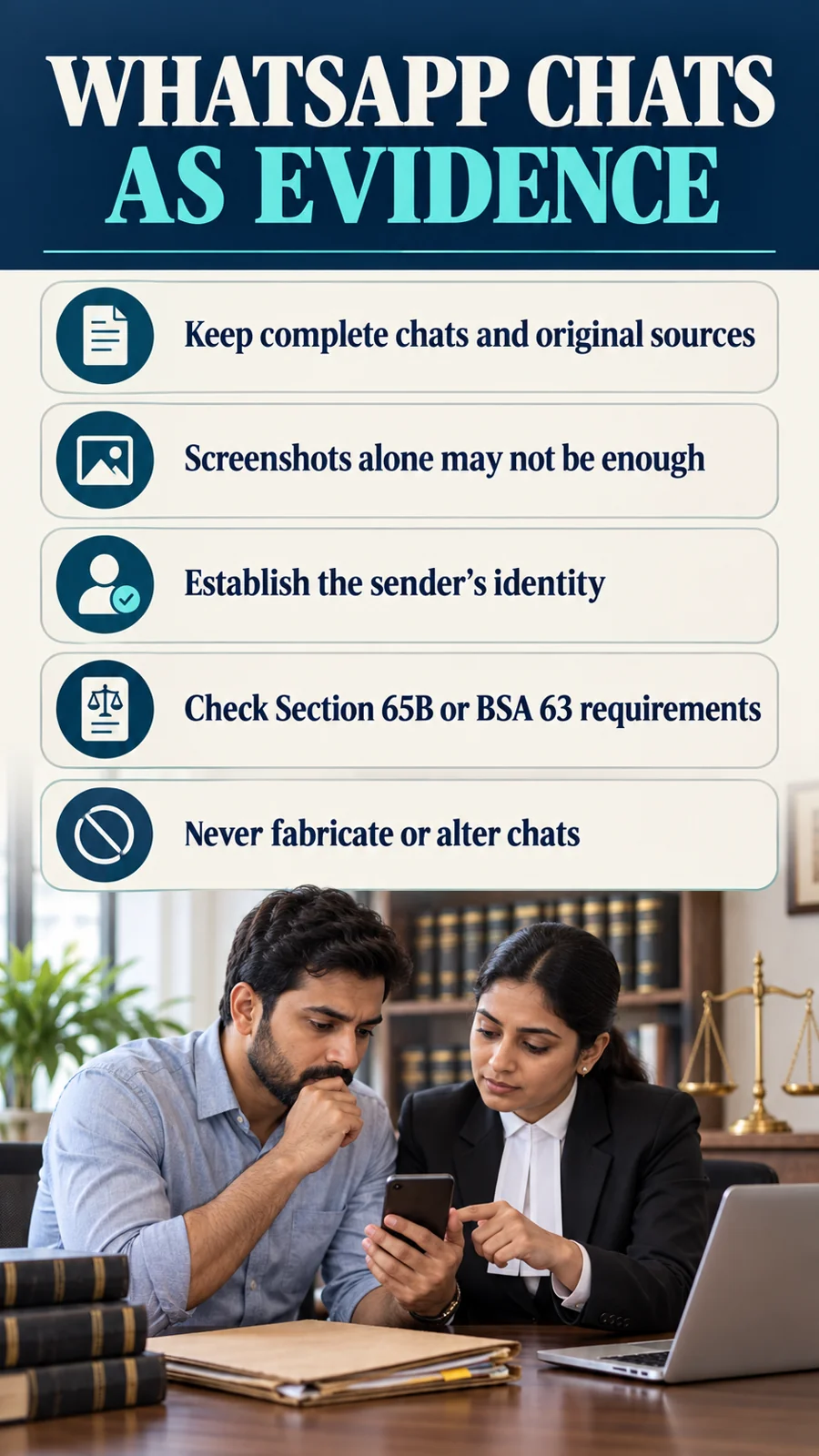
Keep the original device or lawful source and the relevant conversation available where possible. Avoid deleting inconvenient replies or editing dates and names. Preserve related attachments, voice notes and transaction records if they matter. A secure backup can help protect genuine material, but its existence should not be mistaken for automatic legal authentication.
Record an honest chronology: when the exchange occurred, how you received it, the account or number involved and who handled any exported files. Explain gaps and missing attachments rather than filling them with invented content. If a message was forwarded to you, distinguish that from receiving it directly from the alleged sender. The original source may require separate proof.
Screenshots, printouts and exported text can help an advocate review the material. They are representations of the conversation, not a guarantee that all attachments, identifiers or context have been preserved. Keep the underlying source and identify how each working copy was produced. A photograph of a screen does not automatically avoid electronic-evidence requirements simply because another camera created it.
Identify the sender instead of relying on a saved name
A contact name is usually a label stored by the phone user. Saving a number as a person’s name does not conclusively establish that person wrote every message shown. A profile picture, group display name or familiar tone may be relevant context but is not universal proof of authorship. Shared devices and account-access disputes can make identification more complicated.
Ask counsel which genuine material connects the participant with the communication. Relevant circumstances may include testimony, admitted exchanges, transaction records, number-related information obtained lawfully and consistency with other evidence. No single technical indicator should be promised to settle every dispute. A screenshot from a group also needs careful attribution to the particular participant whose message is relied on.
Message delivery or read indicators should not be treated as universal proof of identity, contractual acceptance or legal service. Those are separate legal questions. Likewise, deleting a message does not automatically prove guilt, and missing data is not necessarily proof of fabrication. The advocate and court should assess the actual record rather than a social-media rule about one app feature.
What Section 65B case law explains
In Arjun Panditrao Khotkar v Kailash Kushanrao Gorantyal, decided on 14 July 2020, the Supreme Court clarified the older Act’s certificate requirement for the relevant electronic output. It also explained the situation where the original device is produced and proved through its owner or operator and discussed obtaining material controlled by another source. [2]
The distinction is not “screenshots are always invalid” or “owning a phone means no further proof.” The actual material being tendered and how the original is proved matter. Do not automatically transplant an older-law exception into every BSA submission. Ask counsel to assess the current provision and court approach rather than asserting an exemption based only on possession of a handset.
A certificate should reflect genuine knowledge of production, the source and the required conditions. Do not ask someone to sign a fabricated account of how a chat was obtained. A hash report can support integrity assessment, but a hash does not establish the author or prove that the starting file was genuine. Qualified expert assistance may be necessary for the relevant current process.
A WhatsApp-specific Supreme Court example
In Pankaj Singh v State of Haryana, 2024 INSC 254, decided on 21 March 2024, the Supreme Court examined reliance on WhatsApp material within a criminal proceeding governed by the older framework. Paragraph 21 addressed the admission-or-denial procedure relied on under CrPC Section 294 and noted the absence of a Section 65B certificate. [3]
The lesson is that merely placing a chat in the record or claiming that the other side did not object does not automatically resolve every evidentiary issue. This was a fact-specific criminal appeal; it should not be presented as a new ban on all WhatsApp evidence. Other evidence and the particular procedural history were also part of the court’s decision.
Similarly, one favourable decision does not mean all chats are accepted in civil, criminal and family proceedings on identical terms. Forum-specific provisions may affect how material is received, while relevance and reliability remain important. Use the judgment’s actual reasoning with the appropriate statutory framework instead of attaching a case name to a guaranteed outcome.
Present the material through the appropriate court process
Give counsel the source, complete relevant exchange, genuine attachments, an accurate timeline and any available supporting records. Identify what you want each message to establish. Discuss the applicable certificate, necessary expert material, witness foundation, filing format and timing. A lawyer cannot assess the full conversation reliably if only a selectively favourable cropped image is supplied.
If translation is needed, preserve the original text and arrange an accurate translation through the proper process. Mark unclear words and distinguish your explanation from the message itself. Slang, sarcasm, emojis and references to an earlier conversation can be misunderstood. An automated translation is a useful working aid, not unquestionable proof of the speaker’s intended meaning.
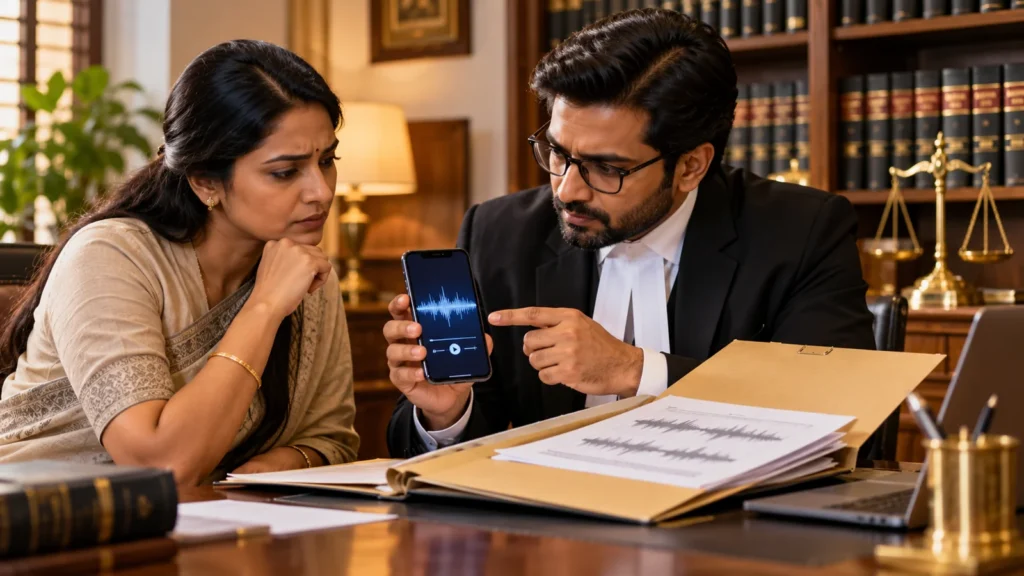
Ask about the court’s requirements for electronic files, readable copies, playback of voice notes and disclosure to the other side. A random cloud link or a large bundle of screenshots is not universally a complete evidentiary submission. Keep confidential files secure and use the authorised route. If the record is controlled by someone else, ask about lawful preservation or production assistance.
Missing messages, privacy and disputed screenshots
If messages are missing, tell counsel what remains and why there is a gap. Do not recreate a conversation in a chat generator or claim that recovered material is genuine without verification. Recovery from a device or backup can be technically and legally fact-dependent. No universal promise exists that every deleted message can be restored or obtained from the platform.
Do not access another person’s WhatsApp, linked device or backup without lawful authority. A useful potential exhibit does not itself authorise unauthorised access. Never threaten publication of private chats to force a settlement. Where intimate material, minors or unrelated third parties appear, ask about appropriate limited disclosure and confidential handling under court directions.
For disputed screenshots supplied by the other party, preserve the exact version received and raise specific objections through counsel. Source examination, surrounding context, relevant witnesses or expert assessment may be appropriate. Do not edit their material to create your own demonstration. A lawful objection should address actual defects rather than assuming every adverse message must be fake.
Frequently asked questions
1. Are WhatsApp screenshots automatically rejected?
No universal rule says that. Their relevance, authenticity, applicable certificate requirements and other proof need assessment. A screenshot alone is not a guarantee of admissibility or success.
2. Does the saved contact name prove the sender?
Not conclusively. Genuine evidence must connect the communication with the alleged person. Account access and other circumstances may require examination.
3. Which certificate should I use?
Ask counsel whether the older Evidence Act or BSA governs and what material is being tendered. BSA Section 63 and its Schedule must not be replaced blindly with an old online template.
4. Can I submit only favourable messages?
Do not conceal relevant context or alter the original. Counsel can identify a relevant portion while preserving and properly explaining the supporting conversation.
5. Can deleted chats always be recovered?
No guarantee exists. What is available depends on the device, lawful source, backup and technical circumstances. Do not manufacture missing messages or use unauthorised access.
Advice
Preserve genuine chats promptly and keep their context, source and related documents. Identify the legal point you want to establish, then consult an advocate about the correct proof and certificate process. Use qualified assistance where necessary. Protect private information, avoid fabricated or edited conversations and remember that an admitted chat does not automatically prove the entire claim.
Related reading: Is call recording admissible in Indian court? Privacy issues and Section 65B certificate mandate · How to remove name from false FIR: Section 482 CrPC quashing petition in High Court explained
Official sources and judgments
[1] Ministry of Home Affairs — BSA, Sections 61–63, 170 and certificate Schedule: https://www.mha.gov.in/sites/default/files/2024-04/250882_english_01042024_0.pdf
[2] Supreme Court — Arjun Panditrao Khotkar v Kailash Kushanrao Gorantyal, 14 July 2020: https://api.sci.gov.in/supremecourt/2017/39058/39058_2017_34_1501_22897_Judgement_14-Jul-2020.pdf
[3] Supreme Court — Pankaj Singh v State of Haryana, 2024 INSC 254, particularly paragraph 21: https://api.sci.gov.in/supremecourt/2023/6130/6130_2023_8_101_51613_Judgement_21-Mar-2024.pdf
Detailed legal disclaimer
This educational article does not endorse unauthorised access, fabricated chats, false certificates, evidence deletion, witness pressure or public exposure of private material. No admissibility, recovery of deleted data, evidentiary weight or legal outcome is guaranteed. Current law, statutory savings, court directions and individual facts require professional assessment. This disclaimer does not remove legal obligations or protect unlawful conduct.