Cyber cell bank account freeze: start with a written record
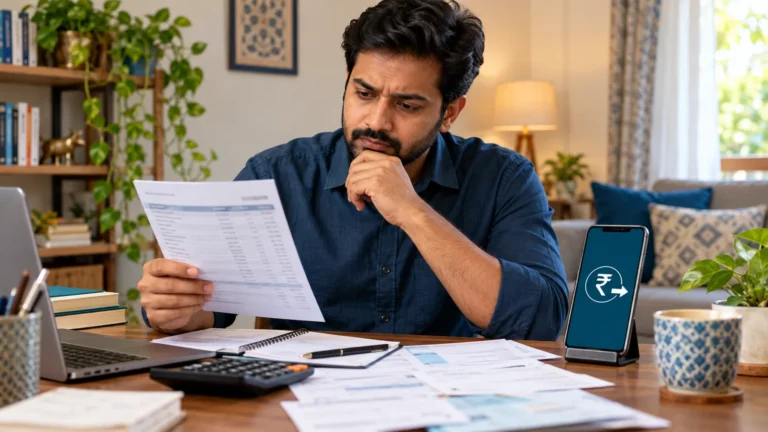
You receive a customer payment, your salary arrives, or a friend transfers money. Suddenly UPI payments fail. Your bank says a cybercrime unit in another state has restricted the account and asks you to obtain an NOC. When calls go unanswered, the useful first step is to identify the restriction, the disputed transaction and the authority behind it in writing.
A frozen bank account does not by itself prove that you committed an offence. Your account may have appeared in a chain of transfers under investigation. Equally, saying that you are innocent is not a substitute for explaining the payment with genuine documents. This guide gives a practical sequence for gathering information, making representations and considering court relief without promising instant unfreezing.
What to do today
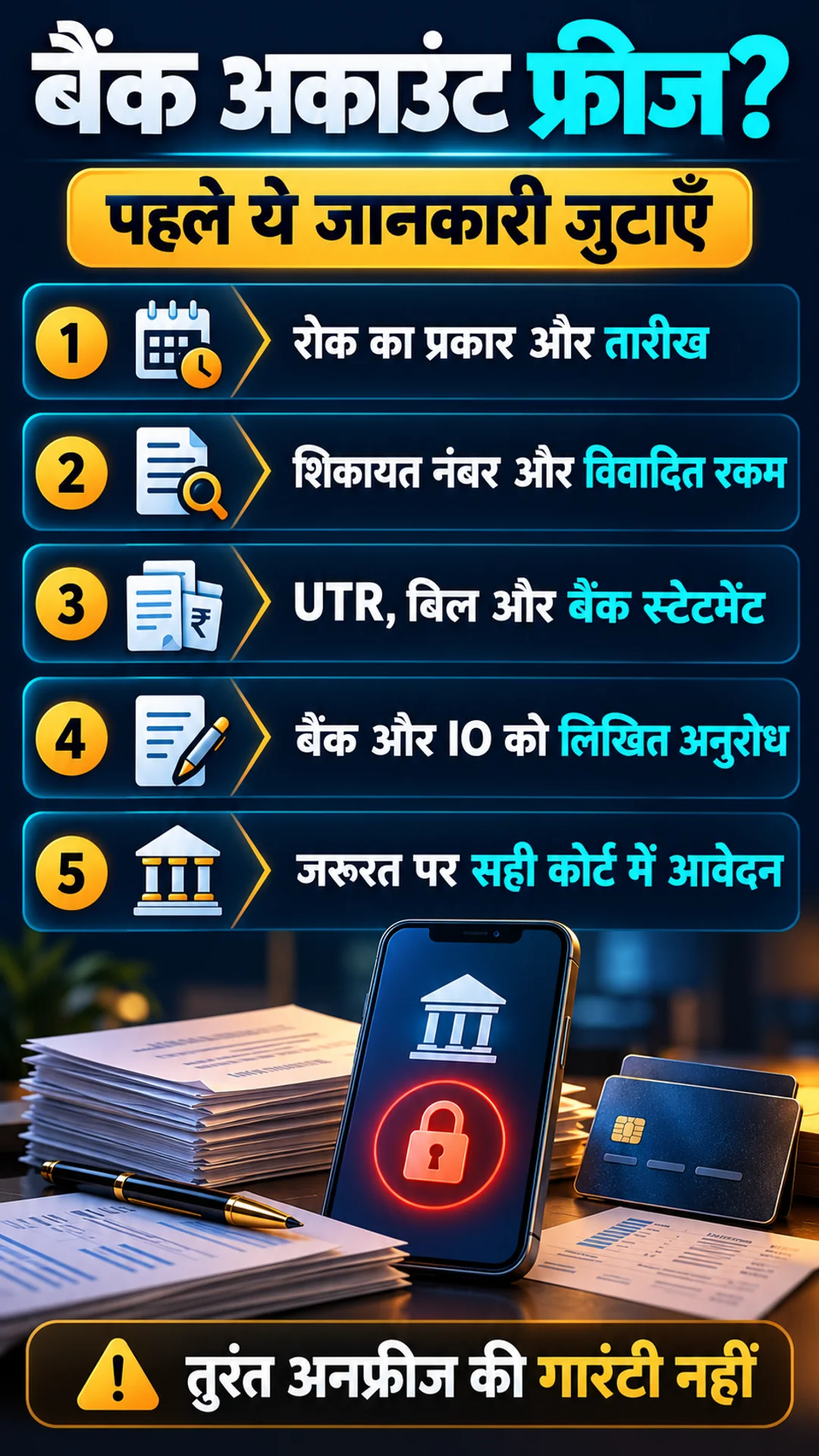
- Save the bank notification, failed-payment message and available account statement.
- Submit a written request to the branch and the bank’s official grievance channel. Keep the acknowledgment.
- Ask for the restriction type, disputed amount, transaction reference and available complaint/FIR details.
- Gather invoices, delivery records, contracts and original payment-related messages.
- Do not pay an unfreeze agent or privately refund an unknown claimant in a hurry.
Debit freeze, lien and KYC restrictions are different
A debit freeze may stop withdrawals and outgoing transfers while allowing incoming credits. An amount-specific lien or hold may reserve a stated sum while allowing use of the remaining balance. A KYC restriction is a different issue. The label in an app is not enough to establish the legal basis: ask the bank what is actually restricted and why.
Suppose the balance is ₹80,000 and one payment of ₹5,000 is disputed. You can request that the disputed sum remain secured while the rest is made available. That example does not establish an automatic right to withdraw ₹75,000. The actual instruction, additional complaints, other holds and the facts of the investigation matter.
If more than one complaint is involved, request a separate reference, amount and originating police unit for each restriction. Clearance from one investigating officer may leave another restriction in place. Ask for a complaint-wise explanation rather than guessing from the total hold shown in the account.
Ask the bank for these details and keep acknowledgment
Take two copies of a branch representation and request a receipt on yours. Use an email address published on the bank’s website or its secure complaint portal. Identify the account initially with its last four digits and provide full records through a verified secure channel when required. A representation never needs your OTP, PIN, CVV or login password.
- Date and nature of the restriction: debit freeze, lien or another hold.
- Disputed amount, transaction date and available UTR/reference.
- Available NCRP acknowledgment, FIR or crime number.
- Official identity and contact details of the requesting police unit.
- A copy of the instruction, or the information that can lawfully be disclosed.
- Other active restrictions and the documents/process needed for review.
If the bank cannot disclose something, ask it to explain that limitation in writing. The branch is not the investigating agency. Your immediate aim is to establish a record, identify the right authority and get your request routed to the competent team. Ask for a complaint number so that later follow-ups refer to the same matter.
Email template to the bank
Subject: Details and review of cyber restriction on account XXXX

Dear Sir/Madam,
My account ending XXXX has been restricted since [date]. Please provide the restriction type/date, disputed amount and UTR, available complaint/FIR reference, and the official contact of the requesting police unit. Kindly supply the instruction or information that may lawfully be shared.

[If known: The payment of ₹___ dated ___ was received for ___. Supporting records are attached.]
Please seek clarification from the competent investigating authority and review whether the restriction can lawfully be limited to the disputed amount, permitting operation of the remaining legitimate balance. I will cooperate with the investigation and comply with applicable restrictions.

Please provide a complaint reference and written response.
Name/contact: ___ | Attachments: ___
When the investigating officer is in another state
Verify the unit and contact details through the relevant state police’s official website. Do not rely on a sponsored search listing, a stranger’s WhatsApp number or an agent demanding an NOC fee. Send a short factual representation to the verified official channel, attach relevant evidence and retain the sent email and delivery record.
If there is no response, follow the unit’s available official grievance process and send a reminder to its officer-in-charge or appropriate supervisory authority with your earlier representation. Separately escalate your bank complaint through its grievance or nodal channel. Explain urgent rent, medical or business expenses with documents and request interim consideration. This is a request for relief, not a guarantee of priority or a fixed deadline.
Interstate travel is not automatically the first step. Ask whether records can be submitted by email, post or another permitted method. If you receive a formal notice, do not ignore it: clarify attendance requirements and lawful alternatives. Your local police may guide you, but they do not automatically have power to cancel another state’s instruction.
Email template to the investigating officer
Subject: Complaint/FIR [___] — representation regarding account XXXX

Dear Sir/Madam,
My bank informed me on [date] that account XXXX is restricted following your office’s instruction. Relevant payment: ₹___, date ___, UTR ___. It was received for [actual purpose]. Available invoice/order/statement/messages are enclosed.

I am willing to cooperate. Please specify any further documents, whether attendance is required and the permitted submission process. Where legally appropriate, please consider issuing a clear instruction to the bank allowing operation of the remaining balance while securing the disputed amount.

Hardship, if any: [facts and supporting documents].
Please acknowledge receipt and explain the next procedural step.
Name/address/contact: ___
Layer-2 or Layer-3: explain the transaction with evidence
A layer usually describes a position in a chain of transfers. Being further along that chain does not automatically prove innocence. A genuine seller might receive payment from an account later linked to a complaint, while a different recipient may have knowingly forwarded suspicious funds. Ask how your transaction is being examined rather than declaring yourself a certified layer-3 victim.
For a sale, preserve the invoice, order, delivery record and customer messages. For freelance work, preserve the agreement, work-delivery record and payment trail. For a personal transfer, explain its actual purpose and provide what records exist. Keep originals unchanged and prepare a one-page dated chronology. Clearly distinguish what you know from what you cannot establish.
A factual written representation is a useful starting point. If an officer or court requests an affidavit, have it prepared and verified under the applicable requirements. It should state your identity, actual transaction details, supporting records and willingness to cooperate. Do not invent a bill, backdate a document or make an untrue declaration. There is no universal affidavit that guarantees unfreezing.
Court relief: BNSS section 503 and older CrPC section 457
BNSS section 106 concerns police seizure powers. Section 503 provides for a Magistrate’s orders concerning property where police seizure is reported and the property is not produced before a criminal court during an inquiry or trial. The corresponding older CrPC provisions include sections 102 and 457. Pending older proceedings and statutory savings must be checked before choosing the applicable law.
The legal basis of a particular account restriction may differ. A standard section 503 application addressed to any convenient court is therefore not a reliable solution. The case reference, instruction, jurisdiction and investigation stage determine the appropriate approach. Useful records include the bank’s written response, statements, genuine transaction evidence, previous representations and documented hardship.
Depending on the case, a request may seek removal of the restriction, limitation to a specified disputed amount, or permission for necessary expenses. The court may obtain the investigating agency’s response and consider the connection between the funds and the alleged offence, together with appropriate conditions. A High Court challenge also depends on jurisdiction and the available remedy. No template can promise an order within a fixed number of days.
In Shento Varghese v. Julfikar Husen, 2024 INSC 407, the Supreme Court examined delay in reporting seizure to the Magistrate. Delay alone does not automatically invalidate the seizure. Avoid advice claiming that a reporting delay necessarily forces the bank to reopen the account. If representation costs are difficult, ask the District Legal Services Authority about assistance for eligible applicants.
RBI complaints, refunds and other common mistakes
The RBI Ombudsman is not the ordinary route for cancelling a police freeze instruction. Current RBI guidance excludes grievances arising from a regulated entity’s compliance with orders of competent judicial, statutory or law-enforcement authorities. If there is a separate bank service failure, first complain to the bank and check the current scheme’s eligibility. Do not treat that process as an appeal against the investigating agency’s order.
If you were yourself a victim of online financial fraud, use the official National Cyber Crime Reporting Portal. A new complaint does not automatically remove a restriction imposed in another matter. KYC problems, loan recovery and a cyber-police freeze need different responses; identifying the category helps avoid wasted correspondence.
Do not assume that paying an alleged claimant privately will close the case. You may face a second scam or pay the same disputed sum twice. Verify any proposed refund or settlement through the investigating authority or court process and obtain written directions and a payment record. Stop allowing strangers to use your account or forwarding funds for commission.
Advice
Keep three organised tracks: bank information, evidence for the investigating officer, and appropriate court relief if needed. Record dates and summaries after conversations. Keep representations consistent and correct mistakes in writing. Explain essential expenses to your family and arrange lawful support. Do not attempt to bypass a restriction by moving disputed money through another account.
Related reading: UPI fraud and payment safety and personal loan default and legal rights. These are different situations from a cybercrime account freeze.
FAQ: cyber cell account freeze
Can the bank unfreeze the account itself?
Where a police or court instruction applies, the bank generally acts within that instruction. Ask about correcting an error, obtaining clarification and implementing permission from the competent authority.
Must I travel to another state?
Not in every case. First ask about permitted document submission. Do not ignore a formal notice or a legally required appearance.
Can only the disputed amount be held?
That can be requested or sought as court relief in suitable cases. The actual instruction, evidence and other active restrictions determine the outcome.
How long will unfreezing take?
There is no single timeline for every case. Multiple complaints, investigation requirements, document review, orders and bank implementation can affect the time needed.
Will one NOC remove every restriction?
Not necessarily. Ask the bank to check all active instructions and confirm what has actually been removed.
Disclaimer: General legal information for India, not an opinion on an individual case. Applicable law and procedure vary with the facts and jurisdiction. Fact-check date: 13 October 2026. No email or application guarantees a particular result.
Sources and official links
- BNSS 2023, धारा 106 और 503 / sections 106 and 503
- Shento Varghese v. Julfikar Husen, 2024 INSC 407
- RBI Integrated Ombudsman Scheme — current FAQs
- National Cyber Crime Reporting Portal