 Vista
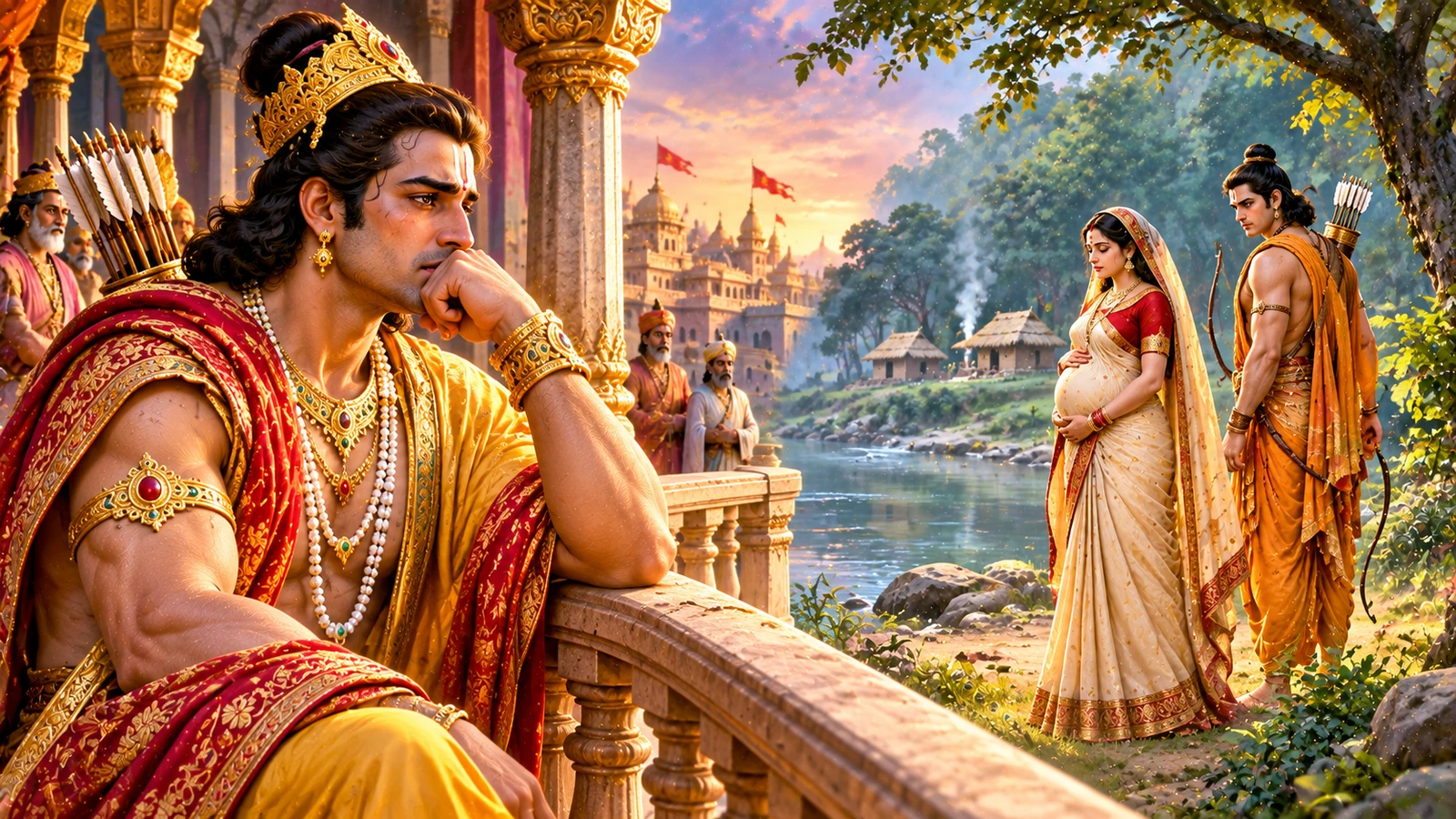
Short answer: In the Uttara Kanda of the Valmiki Ramayana, Rama orders Sita to be left near the forest hermitages after hearing that some people in Ayodhya are questioning the queen because she had been held captive in Ravana’s Lanka. The narrative presents an agonizing conflict between Rama’s understanding of a king’s public duty and his responsibility to Sita, whose purity he has already acknowledged. Sita is pregnant at the time. Lakshmana carries out the order, and the sage Valmiki later shelters her. This is Sita’s second separation, not the earlier fourteen-year exile. Different Ramayana traditions tell, shorten, reshape or leave out this episode, so a single simplified answer cannot speak for every version. The account is a religious and literary tradition, not an independently verified historical record.
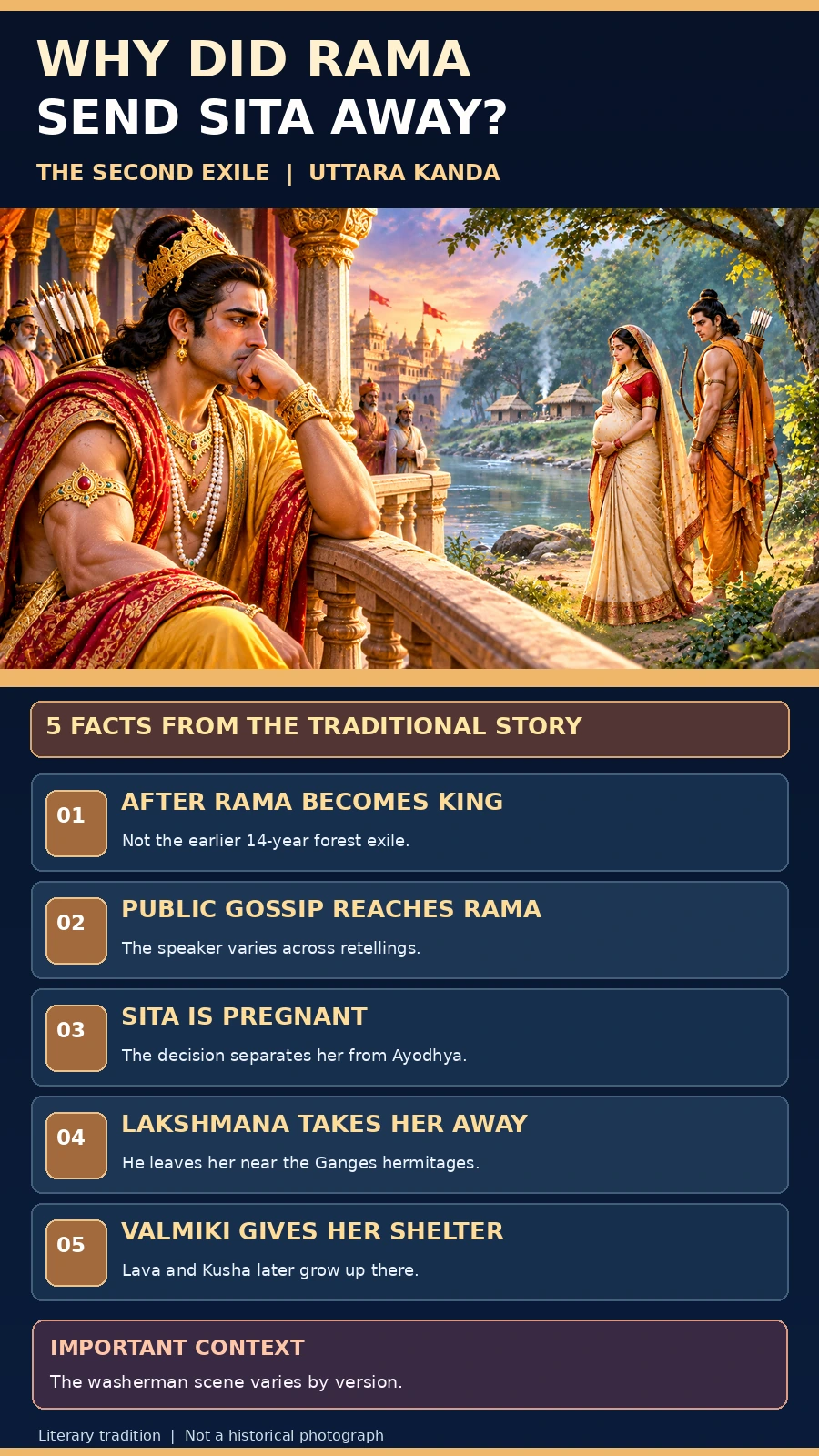
What actually happened: the first exile and Sita’s second exile
The most common confusion begins with the word vanvas, or forest exile. There are two distinct events in the Ramayana story. In the earlier Ayodhya Kanda, Rama is deprived of the throne for fourteen years because of the promises made by Dasharatha to Kaikeyi. Sita chooses to accompany Rama, and Lakshmana accompanies them as well. This is the period that eventually leads to Sita’s abduction by Ravana, Hanuman’s search, the war in Lanka and Rama’s return to Ayodhya.
The controversial second episode comes after Rama has returned and become king. In the narrative of the Uttara Kanda, Sita is not leaving as part of the original fourteen-year banishment. She is already living in Ayodhya and is expecting children. Rama’s later order separates her from the court and sends her toward the hermitages by the Ganges. Mixing the two events makes it look as if Sita was banished simply because she chose to join Rama in the forest, which is not what this later narrative says.
The difference matters emotionally as well. In the first exile, Sita insists on accompanying her husband and has a voice in the decision to go. In the later account she is left without being consulted beforehand. A reader who wants to understand the moral controversy must notice that distinction instead of collapsing both journeys into one dramatic scene.
What does the Uttara Kanda say about Rama’s decision?
The Uttara Kanda is the seventh book in the traditional seven-book Valmiki Ramayana. In its account of Rama’s reign, talk about Sita’s period of captivity in Lanka reaches the royal household. Rama hears reports that members of the public are questioning his decision to receive Sita back after the war. The gossip challenges how the king should act as a model for his subjects. Rama is deeply distressed. Crucially, he does not simply announce that he has discovered wrongdoing by Sita: the narrative also recalls her earlier vindication.
Rama nevertheless decides that his reputation and the standards expected of the king require an unbearable personal sacrifice. He orders Lakshmana to take Sita toward the forest hermitages and leave her there. He does not openly tell Sita about the decision in advance. Her wish to visit holy retreats becomes part of the circumstances of the journey. Across the Ganges, Lakshmana must explain what has happened. Sita’s grief, Lakshmana’s distress and Rama’s sorrow are integral to the narrative; they should not be edited away to make the episode a cheerful lesson about obedience.
The wording, chapter numbering and emphasis differ across translations and manuscript traditions. For a serious article, the safe source label is Valmiki Ramayana, Uttara Kanda, followed by a specific translation. The widely used critical-edition translation by Robert P. Goldman and Sally J. Sutherland Goldman is an important scholarly resource. The scene does not belong to the original exile order in Ayodhya Kanda.
Was a washerman responsible, or was it public gossip?
Many people remember a washerman, often called a dhobi, whose insulting remark allegedly prompts Rama to send Sita away. That vivid scene is prominent in popular storytelling, television adaptations and some later retellings. It is not safe to present the single washerman anecdote as a universal detail of every Ramayana. In the Uttara Kanda account, the operative issue is public gossip reported to Rama; an adviser or informant, often named Bhadra, conveys what people are saying. Different tellings attach the criticism to different speakers or dramatize it with a memorable encounter.
Why does this difference matter? If an article says, “One washerman ordered the king to abandon Sita,” it turns a complex scene about social reputation, kingship and gendered suspicion into a false chain of command. Rama makes the decision in the narrative. Ordinary people do not issue him a royal order. The rumor is the precipitating pressure, but it does not remove the ruler’s agency or the ethical responsibility for the choice.
It also helps to remember that public speech is not evidence of guilt. Sita’s time in captivity was forced upon her; the accusations concern how society judges a woman after an experience she did not choose. The reader should not repeat those accusations as established facts. They are part of the story’s painful social conflict, not the article’s own verdict about Sita.
Why did Rama choose royal duty over his marriage?
A traditional defense of Rama’s action argues that a king must protect the credibility of the throne, even at the cost of his private happiness. The Sanskrit idea of raja-dharma—a ruler’s duty—can be invoked to explain why public opinion weighs so heavily on Rama. In this interpretation, he believes the king cannot claim a personal exemption from the standard expected of everyone else. His sorrow and the narrative’s emphasis on sacrifice are central to this reading.
That explanation is not the same as saying everyone must consider the choice morally right. Other readers ask why royal duty should require abandoning an innocent and pregnant woman. They point out that the court had already seen Sita vindicated after the Lanka war. They ask whether a ruler fulfills his duty by yielding to unfair gossip or by resisting it. Many devotional, literary and feminist discussions center this objection rather than treating Sita’s suffering as a minor cost.
The episode therefore represents a genuine ethical tension, not a mathematical proof that one spouse was right and the other was wrong. It places public trust, compassion, family responsibility and the destructive power of rumor in conflict. Good writing allows readers to consider both the internal logic of Rama’s kingship and the harm that Sita suffers. Explaining the story respectfully does not require defending abandonment in real life.
How did Lakshmana leave Sita near Valmiki’s hermitage?
In the Uttara Kanda narrative, Lakshmana receives the painful order from Rama. He accompanies Sita on a journey toward the Ganges and the hermitages she had wished to visit. At or near the far bank, he reveals that she will not be returning to the palace with him. Several translations describe Lakshmana as openly distressed, weeping or unable to reconcile obedience to Rama with the suffering he has been asked to inflict.
Sita’s response is equally important. She grieves, speaks of her circumstances and asks Lakshmana to carry a message back. She is already pregnant. The scene must not be retold as if she had volunteered to settle permanently in the forest, nor as if she were comfortably escorted to a royal guesthouse. The path to the hermitage follows a harsh separation, and readers are meant to recognize the human cost.
The sage Valmiki receives her into the shelter of his hermitage in the continuing story. That location matters because Valmiki is associated with the epic’s composition and with the later teaching of the story to Sita’s sons. The narrative connects the pain of one family’s separation to the transmission of the very epic in which it appears. It is a literary structure as well as a devotional account.
What happened to Sita afterward? Lava, Kusha and the final reunion
Sita lives under Valmiki’s protection in the forest. She becomes the mother of Lava and Kusha, the twins traditionally identified as Rama’s sons. They grow up in an environment shaped by the hermitage, study and the teaching of the Ramayana. The Uttara Kanda later brings the boys into contact with Rama, often in connection with the recitation of the epic and a royal sacrifice. Details of exactly how recognition unfolds differ among tellings.
In the famous concluding scene, Sita calls upon Mother Earth—Bhumi, with whom she is closely associated—to witness her integrity. In a major version of the story, Earth receives her, and she does not return to ordinary palace life. This is often called Sita’s return to the Earth. It is better described as an event within the narrative than as a physically documented event. Its emotional force lies in Sita’s decision and the recognition that repeated public demands to demonstrate her purity have become intolerable.
Some later retellings frame the ending differently or leave a gentler impression. The idea that every version gives Sita exactly the same fate is mistaken. A reader should always ask which text, performance or regional tradition is being described before assigning a single ending to the entire Ramayana tradition.
Wasn’t Sita already proved innocent in the Agni Pariksha?
Yes: in the widely known sequence after the Lanka war, Sita’s innocence or purity is established through the Agni Pariksha episode. The later separation is especially disturbing precisely because that earlier vindication has not prevented renewed suspicion. Here, too, traditions differ over the theological meaning of the fire scene, and the image of a “test” is deeply sensitive. Some devotional readings emphasize divine revelation; others criticize the demand placed on Sita.
It is crucial not to confuse three separate moments: Sita’s abduction and captivity in Lanka, the fire episode following the war, and the Uttara Kanda decision to leave her near the hermitage. They belong to different points in the narrative. Sita’s captivity is not evidence of consent. The fire episode is not the same event as the second exile. And the later public gossip is not independent proof that Sita did anything wrong.
Several modern adaptations intensify these moments with extra conversations or scenes. Some add visual drama or simplified motivations. That is legitimate as storytelling but misleading if those invented details are attributed word for word to the oldest available text. A responsible article explains what a specific version narrates, then identifies interpretations as interpretations.
Do all versions of the Ramayana include Sita’s banishment?
No. The Ramayana has a long, multilingual history. The Sanskrit Valmiki Ramayana and its Uttara Kanda are foundational for this question, but other versions change their narrative emphasis. The popular Ramcharitmanas of Tulsidas, for example, is not simply an exact line-by-line retelling of the entire Uttara Kanda Sita-abandonment sequence. Regional songs, performances and literary works can give Sita a more prominent critical voice, soften an episode, or present a different arrangement of events.
Scholars also discuss the textual history of the Uttara Kanda. The date and layers of parts of the epic are complex, and academic arguments about composition should not be mistaken for a definitive claim that every verse was written at the same time by one identifiable author. Conversely, popular internet statements that the entire seventh book is “fake” oversimplify its long reception and significance. The responsible way to write about the issue is to identify the book in the received tradition and acknowledge scholarly debates over textual layers.
The range of retellings matters because this story has been used to reflect on kingship, marriage, women’s autonomy, public rumor and justice for centuries. Reading a version that questions Rama does not automatically imply contempt for the Ramayana. Debate is part of its literary life.
Sita exile timeline: eight events in order
| Stage | What the narrative describes | Important distinction |
|---|---|---|
| 1 | Rama, Sita and Lakshmana complete the first fourteen-year forest period | This is the first exile, not Sita’s later abandonment. |
| 2 | The war in Lanka ends; Sita is vindicated in the fire episode | The earlier ordeal precedes Rama’s kingship. |
| 3 | Rama and Sita return to Ayodhya, where Rama rules | The second separation occurs during the reign. |
| 4 | Reports of public criticism about Sita reach Rama | Popular washerman details vary across versions. |
| 5 | Rama orders Lakshmana to take Sita toward the hermitages | Sita is pregnant in the Uttara Kanda account. |
| 6 | Lakshmana explains the decision near the Ganges and leaves | The text makes their distress visible. |
| 7 | Valmiki shelters Sita; Lava and Kusha are raised in the hermitage | The boys later learn and recite the Ramayana. |
| 8 | Rama’s sons are recognized and Sita returns to Mother Earth in a major ending | Not all retellings narrate the finale identically. |
This sequence is an educational summary of the Uttara Kanda storyline, not a datable chronology of verified historical events. Different editions use varying chapter numbers, so anyone quoting a verse should specify the translator and edition used.
Myth vs fact: five things people often get wrong
Claim: “Rama sent Sita away during the same fourteen-year exile.” That confuses the first forest journey with the second separation under the Uttara Kanda. Claim: “The Valmiki text proves Sita was unfaithful.” The gossip does not establish her guilt; the epic also recalls her earlier vindication. Claim: “Every original Ramayana has a washerman.” The popular dhobi scene is not a safe universal description across different tellings. Claim: “Lakshmana happily abandoned Sita.” The narrative emphasizes his grief and ethical discomfort. Claim: “Historians have verified this as a dated royal event.” Religious and literary importance is not the same as independently verified historical documentation.
The strongest approach is not to dismiss the story or to present every detail as beyond discussion. It is to give the version, the source, the interpretation and the limits of what can be demonstrated. That method helps English-language readers who want to understand the Ramayana respectfully without confusing mythic narrative with a modern court record.
Questions readers should ask about duty, justice and Sita’s voice
Is protecting a ruler’s reputation the same thing as protecting the vulnerable people he governs? Who bears the cost when a public figure tries to satisfy gossip? What happens when a woman is asked to prove innocence repeatedly despite never having chosen the circumstances that created suspicion? What does Lakshmana’s distress tell us about obedience and personal conscience? These questions have no quick answer that every community accepts, but they are why Sita’s second exile remains relevant to ethical discussion.
A considerate modern reading can respect Rama’s devotional significance while honestly examining the injury to Sita. It can recognize the old framework of raja-dharma without making it advice for modern marriage or family decisions. Sita should be treated as a central moral voice, not merely a passive symbol around whom powerful men make decisions. Her grief, endurance and final appeal to Earth are essential to the tradition’s emotional power.
Frequently asked questions
Why did Lord Rama banish Sita even after Agni Pariksha?
In the Uttara Kanda account, Rama hears public criticism about Sita’s time in Lanka and chooses what he understands as his duty as king, despite the earlier vindication. Readers and traditions debate that decision intensely.
Was Sita pregnant when Rama sent her to the forest?
Yes. The well-known Uttara Kanda narrative explicitly presents Sita as pregnant when Lakshmana is ordered to take her to the hermitage region.
Who actually took Sita to the forest?
Lakshmana carries out Rama’s order and leaves Sita near the Ganges, in the vicinity of Valmiki’s hermitage. He is deeply distressed in major tellings.
Did a washerman cause Sita’s exile?
The washerman is familiar from popular retellings, but the broader issue in the Uttara Kanda is damaging public gossip. The speaker and wording vary; Rama, not a washerman, makes the decision.
Who cared for Sita after she was abandoned?
Sage Valmiki gives Sita shelter in his hermitage. Her sons Lava and Kusha are later raised there in the traditional narrative.
Did Sita ever return to Rama’s palace?
In a major Uttara Kanda ending, she invokes Mother Earth and is received by Earth instead of resuming ordinary palace life. Other retellings vary.
Is Uttara Kanda part of the Valmiki Ramayana?
It is the seventh book of the received seven-book tradition and is included in scholarly critical editions. Its composition and textual history are also subjects of academic discussion.
Is the story historically proven?
No independent modern historical proof establishes the events as dated occurrences. It should be presented as a significant religious and literary narrative.
Conclusion: the question is bigger than a single rumor
The direct answer is that the Uttara Kanda links Sita’s second forest exile to public criticism and Rama’s interpretation of royal duty. But the meaningful story does not end with that explanation. Sita’s innocence, pregnancy, Lakshmana’s pain, Valmiki’s shelter and the twins Lava and Kusha turn the episode into one of the Ramayana’s most difficult moral questions. Different traditions have kept the debate alive rather than closing it with a single slogan. Read the narrative in a named edition, distinguish the first exile from the second, and give Sita’s voice as much attention as the king’s dilemma.
Sources and editorial note
- Valmiki Ramayana, Uttara Kanda, Shastri translation, chapter 48: Lakshmana leaves Sita by the Ganges
- Princeton University Press: Goldman and Sutherland Goldman, The Ramayana of Valmiki, Volume VII, Uttarakanda
- Academic discussion in the introduction to Uttarakanda (Princeton University Press sample)
Reviewed: 12 November 2026. This article explains traditions and textual interpretations, not proven historical events. Illustrations are imaginative artworks rather than representations of documented scenes.
Related reading
- Ramayana and Mahabharata compared
- The ten avatars of Vishnu
- Life lessons from the Ramayana for modern readers
- Why people read the Ramayana and what they learn













Share Your Opinion
Comments are closed on this post.